
Australian No-Deposit Free Spins: What 2026’s Offshore Casinos Actually Hand You
Australian players type “no-deposit free spins” into a search bar and expect a list of licensed casinos ready to hand out a few rounds on the pokies. The list they find instead is a mirror of a market the Australian government does not allow. No online casino licence exists in this country, federally or in any state or territory. Every free-spin offer an Australian player can claim today sits on an offshore site, run under a Curaçao or equivalent foreign licence, and reachable only because the ACMA has not yet blocked its domain.

This page reads those offers carefully. It maps the ten offshore brands Australian traffic actually reaches, names the terms that turn a free spin into a real cost (wagering multiples, cashout caps, expiry windows), and lays out the legal position the player steps into. The arithmetic in the middle is the part the marketing does not say. A “free” spin at a 50x wagering multiple and a A$50 cashout cap is closer to a paid lottery ticket than a gift — and the differences between operators are the differences between a bad deal and a worse one.
Data current as of 18 October 2026, checked against the ACMA register, Curaçao licence disclosures and the Australian-licensed wagering framework. Where research has no confirmed figure, this page says so rather than papering over the gap.
Table of Contents
- Why Australian Players Hunt No-Deposit Free Spins — and What They Actually Get
- The No-Deposit Free Spins Casinos Australian Players Actually Use in 2026
- SkyCrown: 100 No-Deposit Free Spins and a Curaçao Licence
- Rocket Play: 50 Free Spins on Book of Cats, 50x Wagering
- Royal Reels: Australia’s 9th-Largest Offshore Casino by Market Share
- WinSpirit: 200% Welcome Bonus but No Confirmed No-Deposit Offer
- Stake: The Crypto Giant Without an Australian Licence
- Rainbet: Offshore Casino With No Confirmed Free-Spin Offer
- Scream Casino: Limited Publicly Available Bonus Data
- FairGO: RTG Pokies and an Australian-Facing Brand
- Bizzo Casino: TechSolutions Group N.V., Curaçao Licence
- Rocket Casino: Distinct From Rocket Play, Same Offshore Status
- Why Your ‘Free’ Spins Cost More Than You Think
- The Pokies Behind the Free Spins: Which Titles Actually Pay
- Crypto Free Spins and No-KYC Casinos: What You Give Up for Anonymity
- Mobile Free Spins: Same Bonus, Smaller Screen
- Online Casinos Are Prohibited in Australia — What That Means for Your Free Spins
- Staying in Control: Responsible Gambling Tools and Where to Get Help
- How We Selected and Ranked These No-Deposit Free Spins Casinos
- What No-Deposit Free Spins Are Worth — and Your Next Move
- Frequently Asked Questions
Why Australian Players Hunt No-Deposit Free Spins — and What They Actually Get
The phrase “no-deposit free spins” does a lot of work in one breath. A no-deposit offer is one where the casino credits the bonus without taking a deposit first. Free spins are a specific form: the casino sets a fixed stake per spin, hands over a number of rounds on a nominated pokie, and any win is the player’s to keep, subject to conditions. Combined, the term names a small, risk-free way to sample a real-money pokie before committing a cent.
The appeal is structural. A punter who has never played an online pokie, or who wants to test a new casino before funding an account, gets a few rounds on the reels without any cash at risk. The casino gets a registered account, a verified phone number or email, and a chance the player will return with a deposit later. Both sides call it a win, and on the surface it is one.
The catch sits in the terms, and the terms are uniform enough across the industry to draw a band. Wagering requirements on no-deposit free-spin winnings in 2026 run from 30x to 60x. Anything between 30x and 35x reads as reasonable; 40x is the standard offer; above 50x is the territory most players will not clear. The wagering multiple applies to the winnings, not to the spin value itself, so a small win turns into a much larger turnover obligation. Maximum cashout caps on no-deposit bonuses sit in a A$50 to A$200 range, with the operator voiding any balance above the cap. Expiry windows run from 3 to 14 days, occasionally as short as 24 hours. The free spin itself, almost without exception, is fixed at A$0.10 per spin.
Those four numbers — wagering multiple, cashout cap, expiry window, spin value — are the whole bonus. Anyone reading only the spin count is reading the offer the casino wants them to read.
What a No-Deposit Free Spin Actually Is
A no-deposit free spin is a credit the casino puts on a new account, redeemable only on a pokie the casino nominates and only at a stake the casino sets. The trigger is registration: sign up, confirm a phone number or email, and the spins appear in the account without a payment being made. The mechanic is identical to a paid spin — the reels spin, the symbols land, the result pays the same — except the stake comes from the bonus balance rather than the player’s cash.
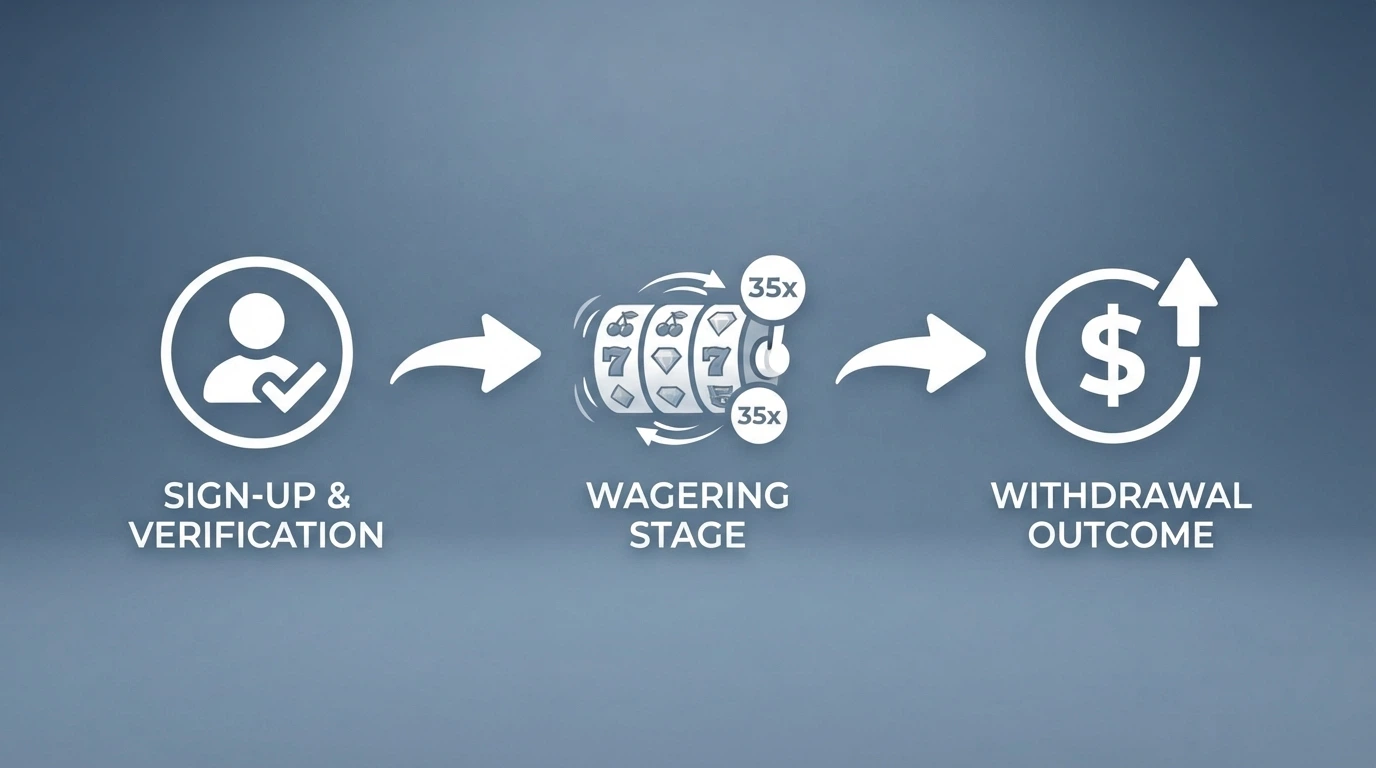
Why do casinos give these away? Because the cost of a free spin is tiny and the upside is large. At A$0.10 per spin and a 96% return-to-player pokie, the casino’s expected cost per spin is around four cents. A hundred spins costs the casino roughly A$4 in expected value. In return, the casino gets an account holder, a verified contact, and a small but non-zero chance the player will deposit later. The mathematics of player acquisition have made the no-deposit free spin a permanent fixture of offshore casino marketing.
The distinction that matters is between the spin value and the winnings. The spin value — A$0.10 — never has to be wagered. The winnings from those spins do, at a multiple the casino sets. A player who wins A$8 from a 40-spin bundle at 35x wagering owes A$280 in turnover before a cent can be withdrawn. That is the wagering requirement in plain arithmetic, and it is the same arithmetic the casino uses to price the offer.
Free Spins vs Deposit-Matched Bonuses: the Trade-Off
A no-deposit free spin costs nothing to claim but caps what can be won. A deposit-matched bonus — the 450% up to A$8,000 + 400 free spins package at SkyCrown, the up to €6,000 + 300 free spins package at Rocket Play — is larger in headline value but costs real money to trigger. The trade-off is simple: no-deposit offers are the safer first step, deposit bonuses are the higher-ceiling second move.
The no-deposit path suits a player who wants to test a casino or sample a pokie without any commitment. The downside is the cap. A A$200 maximum cashout, even on a lucky run, means most of a big win disappears. The deposit bonus path, by contrast, lets the player start with a much larger balance and clear wagering on a bigger bankroll, but every cent of the matched amount is now subject to the casino’s terms.
The typical Australian player order is to claim the no-deposit offer first — if one exists — to test the platform and the pokie, then decide whether the welcome package is worth a real deposit. The no-deposit offer functions as a try-before-you-buy. The welcome package is the actual purchase. Conflating the two is the most common error in the free-spin space: a player reads “100 free spins” in a welcome bundle and assumes no deposit is required, when the spins are in fact unlocked by a qualifying deposit.
Pokies, Slots and the Australian Player’s Vocabulary
Australian English uses one word for what the rest of the English-speaking gambling world calls slots, slot machines or online slots: pokies. The term is local — short for “poker machines”, the original name of the standalone cabinets that spread through Australian clubs and pubs from the 1990s onward — and it is the word every AU-facing casino uses in its marketing. “Free spins on pokies” is the phrase a player will see; “free spins on slots” is the same offer rendered in international English.
Operators localise to the AU vocabulary deliberately. A casino that calls them “slots” flags itself as a global brand; a casino that calls them “pokies” signals an Australian-facing product. The underlying game catalogue is the same: video slots, classic slots, jackpot slots, all built on the same random-number-generator mathematics. A pokie from Pragmatic Play or NetEnt is the same title with the same RTP in any market; only the marketing wrapper changes.
This page uses “pokies” throughout, the way an Australian player would, and uses “slots” or “slot machines” only where the international term is the established one (as in the return-to-player literature, where “slot” is the standard).
The No-Deposit Free Spins Casinos Australian Players Actually Use in 2026
The comparison below is the ten offshore casino brands Australian traffic reaches in 2026. Every one is unlicensed in Australia. The columns are licence status and the best confirmed no-deposit free-spin offer on the public record at the time of writing. Where the public record has no confirmed NDB, the cell is the no-data marker — and the operator’s H3 below is where any further detail sits, if research carries it.

| Casino | Offshore licence | Best confirmed no-deposit free spins |
|---|---|---|
| SkyCrown | Curaçao (OGL/2023/176/0095) | 100 free spins via phone verification |
| Rocket Play | Offshore (Curaçao) | 50 free spins on Book of Cats |
| Royal Reels | Offshore | — |
| WinSpirit | Offshore | — |
| Stake | Offshore (Curaçao) | — |
| Rainbet | Offshore | — |
| Scream Casino | Offshore | — |
| FairGO | Offshore | — |
| Bizzo Casino | Offshore (Curaçao) | — |
| Rocket Casino | Offshore | — |
The fill rate on the third column is the honest number: two of ten have a confirmed NDB, eight do not. That ratio is itself the page’s first finding. A player searching for no-deposit free spins at Australian online casinos will find ten names repeated across affiliate lists, but the no-deposit offer is confirmed on only two of them. The other eight are on the list because Australian traffic reaches them, not because they have a free-spin offer on the table right now.
How These Ten Casinos Were Identified
The selection starts from the Australian market table of an operator-comparison dataset: the brands Australian players actually load in their browsers, ranked by traffic share and revenue. That table mixes two kinds of operator — licensed Australian wagering brands (SportsBet, Tab, Bet365, Ladbrokes and others) and offshore casino brands. This is a free-spins page, so the licensed wagering operators are excluded. They offer no casino games, no pokies, and no free-spin bundles; they sit on a different product.
What remains is the offshore casino slice. Ten brands appear with enough confirmed presence in the Australian traffic data to clear the threshold for inclusion. They are ranked below by a combination of confirmed NDB terms and market presence, with the two operators holding a public NDB taking the top two slots and the remaining eight ordered by traffic and brand recognition.
No claim is made that this is an exhaustive list. The Australian-facing offshore market is large, fluid, and partly hidden from public measurement, because ACMA blocking makes operator domains a moving target. The ten names here are the ones the available data identifies most clearly. The page is honest about what research did not confirm: for most of the ten, the operator, the licence number and the specific bonus terms are not verified, and the H3 below says so rather than filling the gap with a guess.
SkyCrown: 100 No-Deposit Free Spins and a Curaçao Licence
SkyCrown is the standout offer on the page. The 100 free spins no-deposit bundle is activated by phone verification, no deposit required, and the wagering terms are the lightest in the featured set: 25x on winnings, with a maximum win cap of €100 (around A$165). Spins must be activated within 7 days and used within 5 days, which is a workable window rather than the 24-hour squeeze some offers impose.
The welcome package, distinct from the NDB, is a 450% deposit match up to A$8,000 plus 400 free spins spread across four deposits, with 40x wagering on both bonus money and free-spin winnings. Minimum deposits range from A$30 on the first deposit to A$100 on the fourth. A second free-spin hook sits beyond the NDB: 20 free spins on Aztec Clusters (BGaming) unlocked by profile completion, also at 25x wagering with a €100 max-win cap.
Behind the offers, the platform runs more than 10,400 games from over 50 providers: Pragmatic Play, NetEnt, Microgaming, Play’n GO, BGaming, Hacksaw Gaming, Nolimit City among them. The operator is Hollycorn N.V., holding Curaçao iGaming licence OGL/2023/176/0095 — one of the few licence numbers in the featured set that research has confirmed against the Curaçao register. Bonus-to-real conversion is capped at A$5,000 per welcome segment and A$750 on regular casino bonuses.
On the payment side, an A$180 PayID withdrawal to a nominated Australian bank account has been recorded at 2 hours and 29 minutes. PayID is unusual for an offshore casino, and the speed is a genuine data point in SkyCrown’s favour. The conversion caps, on the other hand, are the most common point at which a SkyCrown bonus returns less than it appears to: a run that pushes a bonus balance well above A$5,000 will see everything above that figure voided on conversion to real money.
For a player whose goal is to test an offshore casino without funding an account, SkyCrown’s 100-spin NDB is the strongest offer in the set. The 25x wagering is half the Rocket Play multiple, and the €100 cap is twice the size. The trade-off is the same as every offshore brand: no Australian consumer protection, no BetStop coverage, and the standing risk that the domain gets blocked with a balance on it.
Rocket Play: 50 Free Spins on Book of Cats, 50x Wagering
Rocket Play’s no-deposit offer is half the spin count of SkyCrown and double the wagering: 50 free spins at A$0.10 per spin on Book of Cats, 50x wagering on winnings, and a maximum cashout of €50 (around A$80). The 50x multiple sits at the upper edge of the industry range, where most players will not clear the requirement in practice.
The welcome package is up to €6,000 + 300 free spins across four deposits, with 40x wagering. Withdrawal ceilings are A$2,500 daily, A$7,500 weekly and A$15,000 monthly — a tiered structure that means a large win will not arrive in a single transfer. The operator is Dama N.V., an established Curaçao-licensed casino network, and the licence is offshore (most likely Curaçao, though research did not confirm the number this run).
The arithmetic on the NDB is tight. Fifty spins at A$0.10 on a pokie with a 96% RTP produces an expected win in the A$0.40 to A$0.50 range per spin cycle, totalling A$20 to A$25 in expected winnings across the bundle. That A$20 at 50x wagering means A$1,000 of required turnover to clear the bonus — and the cap at €50 means even a lucky run that returns more will be voided above A$80. The combination of high wagering and low cap makes the Rocket Play NDB a poor value compared to SkyCrown’s, and the welcome package, while larger in headline size, carries the same 40x multiple as every other offshore welcome offer in this band.
Rocket Play suits a player who specifically wants to play Book of Cats without funding an account and accepts that the cashout ceiling and the wagering multiple are unfavourable. For a player evaluating offers on the terms that matter, SkyCrown’s NDB dominates this one on every dimension except the specific pokie nominated.
Royal Reels: Australia’s 9th-Largest Offshore Casino by Market Share
Royal Reels is on this page because of its Australian traffic volume, not because of a confirmed bonus offer. The brand sits at number 9 in the operator-comparison AU market table with a 2.51% share and US$243.99M in tracked revenue, which puts it in front of most of the offshore field in raw audience size.
What the public record does not confirm is the bonus structure. No-deposit free-spin terms, the welcome package, the wagering multiple, the game count, the provider mix and the operator identity are not verified in research for Royal Reels. The brand’s prominence in the Australian traffic set makes it worth listing, but the absence of confirmed NDB terms means a free-spin seeker reading this page should treat the brand as a known quantity only for the offshore market-share line. The offers on the operator’s own site at the time of sign-up are the only authoritative source.
Royal Reels illustrates the broader pattern of the page: Australian traffic does not discriminate by bonus quality. The brands players reach are the brands that have bought, lobbied or simply outlasted the ACMA blocking programme, and the free-spin terms at those brands are not always public. A player who chooses Royal Reels is choosing on the basis of the brand’s presence, not on the basis of a no-deposit offer research can confirm.
WinSpirit: 200% Welcome Bonus but No Confirmed No-Deposit Offer
WinSpirit’s confirmed offer is a 200% deposit-match welcome bonus up to AUD1,000 plus 100 free spins. The provider mix behind the platform includes Yggdrasil, Pragmatic Play and Push Gaming — a strong line-up for a player interested in pokie variety. The operator is offshore; the licence is not an Australian one, because no Australian online casino licence exists.
What is not confirmed is a no-deposit free-spin offer. The 100 free spins in the welcome package are tied to a qualifying deposit, not a registration-only trigger. A free-spin hunter arriving at WinSpirit expecting the same NDB model as SkyCrown’s will find a different proposition: a deposit-gated welcome bonus with a generous percentage match and a meaningful free-spin bundle, but no free route to either.
The honest reading is that WinSpirit suits a player who has decided to deposit and wants the largest percentage match available. For a player specifically hunting no-deposit spins, the brand does not currently offer what the search is looking for, and the absence is a confirmed gap, not a data-failure.
Stake: The Crypto Giant Without an Australian Licence
Stake is the largest crypto-native casino in the offshore market and one of the highest-traffic brands in the Australian player base. The operator is Medium Rare N.V., the licence is Curaçao-based, and the platform runs entirely on cryptocurrency deposits and withdrawals.
What research does not confirm is a no-deposit free-spin offer. Stake’s promotional model is built around deposit-based bonuses, race competitions and rakeback rather than sign-up NDBs. The absence is structural, not a data-failure: a crypto casino that does no KYC verification has limited use for the registration-and-verify funnel a no-deposit offer requires. The brand’s presence on this page is justified by its Australian traffic volume, not by a confirmed free-spin offer.
A player considering Stake should understand what “crypto-only” means in the Australian context. The 2023 credit and crypto ban outlawed credit cards and cryptocurrency as payment for licensed Australian wagering from 11 June 2024. A casino that accepts crypto is, by definition, not operating under an Australian licence. The same regulation that makes Stake’s deposit model possible in Australia is the regulation that keeps the operator outside Australian consumer protection.
Rainbet: Offshore Casino With No Confirmed Free-Spin Offer
Rainbet appears in the Australian traffic set at a level worth listing but does not surface a confirmed no-deposit free-spin offer in the public record at the time of writing. The operator identity, the licence number, the welcome bonus terms and the wagering structure are not verified.
For a player who reaches Rainbet through search or affiliate link, the practical move is to check the operator’s own site for current promotions before signing up. Free-spin offers in the offshore market change frequently, and the absence of a confirmed NDB this run is not necessarily the absence of an NDB next week. The standing caveat is the same as for every brand on this list: the site is offshore, unlicensed in Australia, and not connected to BetStop, so any balance on the account is exposed to the ACMA blocking programme and to the operator’s own withdrawal discretion.
Scream Casino: Limited Publicly Available Bonus Data
Scream Casino is on the list on the same basis as Rainbet: it appears in the Australian traffic data at a level worth recording, but no confirmed NDB or welcome terms surface in the available research. The operator identity is not verified; the licence is offshore; the Australian market position is the only confirmed fact.
A free-spin seeker arriving at Scream Casino should treat the brand as a placeholder for “offshore casino with no public bonus terms available” rather than a confirmed offer. The verification step is the same: check the operator’s site directly, read the bonus terms in full before claiming, and weigh the absence of an Australian licence against any offer value on the table.
FairGO: RTG Pokies and an Australian-Facing Brand
FairGO is the most Australian-positioned brand in the offshore set. The domain signals AU intent, the provider association is RealTime Gaming (RTG) — a studio whose pokie catalogue has a long history with Australian-facing offshore casinos — and the brand is a familiar name to players who have spent time on the offshore market.
What research does not confirm is a current no-deposit free-spin offer. The RTG pokies catalogue is the relevant fact for a free-spin seeker: the studio’s games (Achilles, Bubble Bubble, Cash Bandits, the RTG jackpot series) are the titles most often tied to free-spin bundles, and the standard RTG wagering and cashout mechanics apply if an offer is live. The specific NDB terms at FairGO are not in the public record at the time of writing.
A player who has played RTG pokies at FairGO before and is looking for a no-deposit re-entry should check the operator’s promotions page directly. The brand’s longevity in the AU-facing market and its RTG provider tie make it a plausible place to find a free-spin bundle, but “plausible” is not “confirmed”, and this page is written on the latter.
Bizzo Casino: TechSolutions Group N.V., Curaçao Licence
Bizzo Casino’s operator is confirmed: TechSolutions Group N.V., one of the larger Curaçao-licensed casino networks. The licence is offshore; the operator runs multiple casino brands; and the platform is a well-known name in the offshore market.
What is not confirmed is a no-deposit free-spin offer. The brand’s welcome package and NDB terms at the time of writing are not in the verified research. A player who reaches Bizzo through search should expect a deposit-gated welcome offer of the type TechSolutions Group runs across its brands — and should verify the current promotion directly on the operator’s site before committing.
The confirmed fact on Bizzo is operator identity and Curaçao licence status. The unconfirmed fact is the bonus. The page records both rather than substituting one for the other.
Rocket Casino: Distinct From Rocket Play, Same Offshore Status
Rocket Casino and Rocket Play share a name. They are not the same operator. Rocket Play runs under Dama N.V.; Rocket Casino’s operator is not confirmed in research. The two brands should not be conflated by a player who arrives at one through a link intended for the other, and the no-deposit offers are entirely separate.
Rocket Casino’s NDB, welcome terms and operator identity are not in the verified record. The brand appears in the Australian traffic data at a level worth listing, and the offshore status is the same as every other brand on this page: no Australian licence, no BetStop coverage, no Australian consumer protection.
A free-spin seeker who searches “Rocket Casino no-deposit free spins” should confirm which of the two brands the result refers to before signing up. The names overlap; the operators do not.
Why Your ‘Free’ Spins Cost More Than You Think
A “free” spin is a marketing word. The arithmetic the casino runs on the offer is not free, and the player who reads only the spin count is reading the wrong number. The four cost levers — wagering multiple, cashout cap, expiry window, hidden fine print — compound on each other, and the headline figure is the least informative of the lot.

A worked example on SkyCrown’s 100-spin NDB: the bundle returns, on a 96% RTP pokie, an expected win in the A$8 to A$10 range after a full cycle. The 25x wagering on those winnings means a turnover obligation of A$200 to A$250. The max-win cap at €100 (~A$165) means anything above that figure is voided on withdrawal. The 7-day activation and 5-day use window means the player has a fixed schedule to meet. The offer is genuinely lower-risk than a deposit bonus, but the risk is not zero, and the marketing language of “free” obscures the cost structure that the terms disclose.
A comparison on Rocket Play: 50 spins at 50x wagering and a €50 (~A$80) cap. The same A$4 to A$5 in expected winnings per spin cycle produces A$200 to A$250 in total expected winnings, and at 50x wagering that becomes A$10,000 to A$12,500 in turnover — a 40x jump in required play for a similar expected return. The 50x multiple is the difference between a workable offer and one most players will not clear.
The rest of this section works through the four levers in detail. Each one is the difference between an offer that costs the player a small amount of time and an offer that costs the player a small amount of money — and the four together are the difference between a bonus the casino loses money on and a bonus the player cannot win.
Wagering Requirements: the Multiplier That Eats Your Winnings
The wagering requirement is the multiplier applied to free-spin winnings that determines how much must be turned over before a withdrawal is permitted. A 35x multiplier on A$8 of winnings means A$280 of required play. The number on the offer is the number the player ignores at their own cost.
The industry band in 2026 runs from 30x to 60x. Anything in the 30x to 35x range reads as reasonable — the player can clear the requirement with an hour or two of pokie play on a 96% RTP game. 40x is the standard offer and the median figure on the page. Anything above 50x is the territory where the maths starts to work against the player. A 50x requirement on a small win requires enough turnover that the expected loss to the house edge over the clearing period approaches or exceeds the win itself. The bonus becomes a paid lottery ticket, with the ticket price equal to the expected loss during clearing.
SkyCrown’s 25x wagering is the low-end benchmark in the featured set — below the industry floor, and one of the reasons the 100-spin NDB stands out. Rocket Play’s 50x is the high-end benchmark, and the contrast between the two is the contrast between an offer a player can clear and one most players will not.
The qualifier on wagering is the same across the industry: the multiple applies to winnings, not to the spin value. The A$0.10 per spin is never at risk. The winnings from those spins are. The distinction matters because it sets the size of the obligation relative to the size of the win, and a small win at a high multiple is the worst-case combination.
Cashout Caps: the Ceiling on What You Keep
The cashout cap is the maximum amount the casino will pay out from a no-deposit bonus, regardless of how much the player wins. A A$200 win at a A$50 cap means A$150 is voided. The cap is not a tax or a fee; it is a hard ceiling, and the casino’s terms will state it as plainly as “max cashout: A$50” or “max win: €100”.
The industry range in 2026 is A$50 to A$200. Some operators cap at A$50, others at A$100, and the more generous end of the band reaches A$200. The cap interacts badly with high spin counts: a player who receives 200 free spins has more chances to win, but the cap does not rise with the spin count. A 200-spin bundle with a A$50 cap and a 200-spin bundle with a A$200 cap are offering materially different propositions at the same spin count, and the player reading only the headline number is reading past the most important line in the terms.
SkyCrown’s €100 (~A$165) cap and Rocket Play’s €50 (~A$80) cap are the two confirmed figures in the featured set. The SkyCrown cap is double the Rocket Play cap, and on the same expected win it returns twice as much to the player. The 25x wagering difference compounds the gap further. The cap is the second of the three numbers — after the wagering multiple — that determines whether a free-spin offer is worth claiming.
The Expiry Clock: How Fast Your Spins Vanish
The expiry window is the time between claiming the offer and losing it. Three ranges are common: 3 to 7 days for the standard offer, 7 to 14 days for a more generous one, and as short as 24 hours for the tightest terms. The window is split in two parts on the better offers: an activation period (the time to trigger the spins) and a usage period (the time to use them once activated). SkyCrown’s 7-day activation and 5-day use is a reasonable example; a 24-hour total window is the worst case.
The real-world scheduling problem is the one the marketing does not flag. A player who claims a free-spin offer on a Wednesday evening and has a 3-day window must find the time to clear the wagering before Saturday. If the wagering requires A$280 of turnover and the player has a job, a family and a weekend, the clearing may not happen. The spins expire, the winnings are voided, and the player is back at zero.
The expiry is the third of the three numbers a player must check before claiming. The wagering multiple determines how much must be turned over; the cashout cap determines how much can be kept; the expiry window determines how much time the player has to do the turning over. A 30x wagering on a generous A$200 cap with a 3-day expiry is a worse offer than a 40x wagering on a A$100 cap with a 14-day expiry, because the schedule is the binding constraint, not the multiple.
Deposit-to-Withdraw and Other Fine-Print Traps
The terms beyond wagering are the terms that catch the unwary. The deposit-to-withdraw condition is the largest: some no-deposit offers require the player to make a deposit before any withdrawal is permitted, even after the wagering is cleared. The deposit may carry its own wagering requirement (0x to 5x is typical), and the player who has cleared the bonus and is ready to withdraw discovers that another step sits in the way.
Max-bet limits during wagering are the second trap. The standard ceiling is A$5 to A$7.50 per spin; exceeding the ceiling may void the bonus and all associated winnings. A player used to betting A$10 or A$20 per spin must drop the stake during the clearing period or risk losing the entire bonus. The terms state the ceiling explicitly, and the consequence of exceeding it is a hard void.
Game contribution is the third. Standard video pokies contribute 100% towards wagering; progressive jackpots contribute 0% to 10%; table games (blackjack, roulette) contribute 10% or are excluded; live dealer games are almost always excluded. A player who tries to clear a free-spin wagering requirement on a progressive jackpot pokie will find that 100 spins count as 0 toward the requirement, and the bonus will never clear. The eligible games are listed in the bonus terms, and a free-spin bundle is, by construction, tied to a specific pokie — but the player who moves off the nominated pokie during clearing will see the contribution drop.
The four cost levers together are the bonus. A player who reads wagering, cap, expiry and fine print before claiming has the information to value the offer. A player who reads only the spin count has the casino’s preferred information, and the casino’s preferred information is selected to make the offer look better than it is.
The Pokies Behind the Free Spins: Which Titles Actually Pay
The pokie tied to a free-spin bundle matters as much as the bonus terms. Return-to-player (RTP) determines the house edge on every spin; volatility determines the shape of the payout distribution; game contribution determines whether the wagering actually clears. Two pokies with a 96% RTP and a 96.71% RTP look similar on the surface and cost the player meaningfully different amounts across a typical wagering obligation.

The table below carries the two titles with confirmed RTP data. Book of Cats (Rocket Play) and Aztec Clusters (SkyCrown) are not in the table because no per-title RTP or volatility data surfaced in research; they are addressed in the prose below the table as titles tied to specific NDB offers whose specs were not confirmed.
| Pokie | RTP | Provider | Volatility |
|---|---|---|---|
| Big Bass Bonanza | 96.71% | Pragmatic Play | Moderate |
| Starburst | 96.08% | NetEnt | — |
The two RTPs are close. A 0.63 percentage-point difference is small in a single session but compounds across a wagering obligation. On a A$280 turnover at 35x wagering, the difference between 96.71% and 96.08% RTP is A$1.76 in expected loss — a small absolute number that represents a meaningful share of a small win. On a larger turnover, the gap widens.
RTP Explained: What Return-to-Player Means for Free-Spin Winnings
RTP is the percentage of all wagered money a pokie returns to players over a large number of spins. A 96% RTP pokie returns A$96 of every A$100 wagered, on average, across millions of spins. The remaining A$4 is the house edge. For any single spin, the result is random; for any session, the result can swing wildly above or below the long-run average. Over the volume of a wagering requirement, the long-run figure is a useful estimate.
The house edge is the inverse of RTP. A 96.71% RTP pokie has a 3.29% house edge; a 96.08% RTP pokie has a 3.92% house edge. Across a A$280 turnover at 35x wagering on a A$8 win, the expected loss is A$9.21 on Big Bass Bonanza and A$10.98 on Starburst. The difference is A$1.77 — small, but real, and it comes out of a win that started at A$8 before wagering.
The compounding effect matters more on larger obligations. A A$500 turnover at 50x wagering on a A$10 win costs A$16.45 in expected loss on Big Bass Bonanza and A$19.60 on Starburst. The 0.63 percentage-point gap is now A$3.15, and the higher multiple has magnified the cost of the lower RTP. For a player clearing high wagering requirements, the house edge becomes a dominant factor in the bonus’s real-money potential.
The Pokies That Dominate Australian Free-Spin Offers
Big Bass Bonanza is the dominant free-spin pokie of the past five years. The Pragmatic Play fishing-themed series has been tied to more Australian-facing NDB and welcome free-spin bundles than any other title, and the 96.71% RTP is the reason: it is high enough to make the wagering clearance achievable, the volatility is moderate enough that a player can expect to see the bonus balance move during clearing, and the theme has the broad appeal of a casual game.
Starburst is the perennial. NetEnt’s gem-themed pokie has been a free-spin fixture since the early 2010s, and the 96.08% RTP — lower than Big Bass Bonanza but still above the industry median — keeps it on the offer list. The low-to-medium volatility means smaller, more frequent wins, which suits a player clearing a wagering requirement on a tight schedule.
Book of Cats is the Rocket Play NDB pokie — a Playson title tied to the 50-spin no-deposit bundle. No per-title RTP or volatility data surfaced in research. The title’s absence from the RTP table is a data gap, not a quality judgement, and a player considering the Rocket Play NDB should treat the pokie’s contribution to the bonus as unverified in this article.
Aztec Clusters is the BGaming title tied to SkyCrown’s 20 free spins on profile completion. Like Book of Cats, the per-title specs are not in the verified record, and the same caveat applies. Both titles are addressed here because the free-spin bundles name them, and a player who reaches for one of those offers should know the RTP and volatility were not confirmed at the time of writing.
Game Contribution: Why Not All Reels Count the Same
Game contribution is the percentage of a wager that counts toward the wagering requirement. Standard video pokies contribute 100%; every A$1 wagered on a pokie counts as A$1 toward clearing the bonus. Progressive jackpot pokies contribute 0% to 10%; a A$1 wager on a progressive counts as A$0 to A$0.10 toward clearing. Table games contribute 10% or are excluded; live dealer games are almost always excluded entirely.
The implication for the free-spin player is straightforward. A free-spin bundle is tied to a specific pokie, and that pokie almost always contributes 100% — the casino wants the player to clear the bonus, and a low-contribution game would defeat the offer. The risk is in the clearing period. If the player moves off the nominated pokie and starts playing a progressive or a live dealer game, the contribution drops, and the wagering requirement will not clear at the expected rate. A player who tries to clear a 35x bonus on a progressive jackpot pokie will find that 100 spins count as 0 toward the requirement.
The eligible games list is in the bonus terms. A player who has read the terms before claiming knows which titles to play during clearing; a player who has not risks an extended clearing period or, in the worst case, a voided bonus for playing an excluded game.
Crypto Free Spins and No-KYC Casinos: What You Give Up for Anonymity
The crypto-casino free-spin offer is a different product. Bitcoin, Ethereum and stablecoin deposits are processed without a bank intermediary, identity verification is often skipped or delayed, and the player can move funds in and out without a bank statement showing a gambling merchant. The marketing positions this as privacy; the regulatory position is that it is the marker of an unlicensed operator.
The Interactive Gambling Amendment (Credit and Other Measures) Act 2023 banned credit cards and cryptocurrency as payment methods for licensed Australian wagering from 11 June 2024. A site that accepts either is, by definition, not operating under an Australian licence. Every crypto casino on this page is offshore; the crypto acceptance is the clearest signal of that fact, more reliable than the licence disclosure in the footer.
The no-KYC promise — sign up with an email, deposit, play, withdraw without sending a passport scan — is marketed as convenience and privacy. It functions as a one-way door. If the casino withholds a withdrawal, voids a bonus, or disappears entirely, the player has no identity trail to present to a regulator. The ACMA’s blocking programme does not return funds. The Curaçao Gaming Control Board does not pursue individual player complaints. The player is on their own.
Bitcoin and Crypto Free-Spin Casinos
Crypto casinos structure their free-spin offers around deposit-gated welcome bundles rather than true NDBs. The reason is structural: a no-deposit offer requires a registered account with a verified contact, and the crypto casino’s preferred model is a fast sign-up and a fast deposit. A pure NDB is rarer in the crypto space than in the fiat casino space, and the offers that do exist tend to carry higher wagering or lower caps.
The exchange-rate complication is the practical issue. A €50 cashout cap is denominated in euros; a Bitcoin or USDT withdrawal is converted at the spot rate at the time of withdrawal. A player who wins a €50 cap-equivalent on a Tuesday and withdraws on a Friday may receive a different AUD value than the cap implied at the time of the offer. The volatility is small for a cap this size, but it is non-zero, and the offshore casino will not adjust the cap for currency movement.
No-KYC Casinos: What Skipping Verification Costs You
No-KYC means no identity verification at sign-up. The casino does not collect a passport scan, a driver’s licence or a utility bill. The player can deposit, play and (in theory) withdraw without ever sharing a document.
The cost of that convenience shows up the first time the casino decides not to pay. A KYC-verified player has an identity trail: a passport number, a residential address, a phone number on file. If the casino voids a withdrawal, the player can file a complaint with the Curaçao Gaming Control Board, escalate to a payment processor, or pursue the matter in a jurisdiction where the operator holds a licence. A no-KYC player has none of those options. The casino can claim the withdrawal was tied to a bonus violation, a multiple-account abuse flag, or a “system error”, and the player has no documentary basis to dispute the claim.
The ACMA blocking programme is the other risk. The 1,564 sites blocked since November 2019 are blocked at the ISP level, which means the player’s access to the casino’s website is severed the next time the block takes effect. A no-KYC player has no way to verify their identity to recover a balance through any Australian channel. The balance sits with the operator, and the player’s recourse is limited to the casino’s own support team — which is the same team that declined the withdrawal in the first place.
Mobile Free Spins: Same Bonus, Smaller Screen
Mobile free-spin claiming is identical to desktop in terms. The bonus mechanics — wagering, cashout limits, and expiry dates — do not change between a laptop and a phone. The difference is the experience of playing the pokie.
Most offshore casinos are browser-based on mobile rather than App Store apps, which sidesteps Apple and Google’s policies on real-money gambling applications. The player loads the casino in Safari or Chrome, logs in, and plays the same pokie catalogue on a touch interface. The pokies themselves are built in HTML5, which is the standard for the past decade, and the performance is the same as desktop within the limits of the device and the connection.
The friction on a smaller screen is the practical difference. Touch targets are smaller, the orientation toggle is a thumb’s reach away, and the data usage on a mobile network is a small but real cost. None of this changes the bonus math. A 25x wagering requirement on a phone is still 25x on a laptop; a 5-day usage window is still 5 days. The offer is the same; the player’s environment is different.
Online Casinos Are Prohibited in Australia — What That Means for Your Free Spins
The Interactive Gambling Act 2001 makes it an offence to provide online casino games — including online pokies — to people in Australia. No licence exists for online casino, federally or in any state or territory. This is not a grey area; it is a statutory prohibition, and the ACMA enforces it.
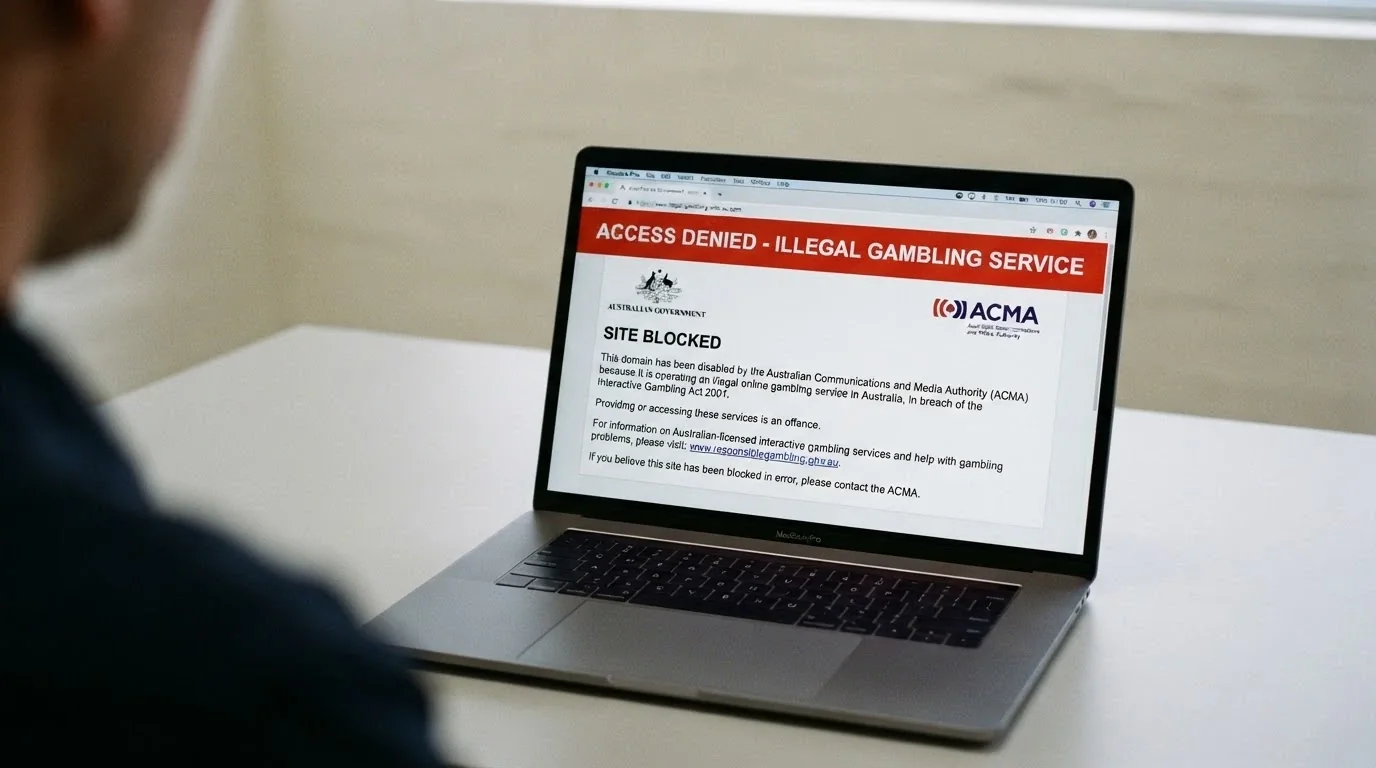
The player is not the target of the law. The IGA 2001 makes the provision of the service the offence, not the use of it. An Australian player who accesses an offshore casino is not committing a crime. The casino is. The player is, however, forfeiting every protection an Australian licence would provide: no BetStop coverage, no complaints body, no money-recovery mechanism, and the standing risk that the ACMA blocks the operator’s domain while a balance sits on the account.
The 1,564 sites blocked since November 2019 are the scale of the enforcement. Any brand on this page can be added to that list at any time. The 225-plus services that have withdrawn from the Australian market since 2017 are the brands that decided the cost of being blocked outweighed the value of the Australian traffic. The brands that remain are the ones that have stayed ahead of the blocking programme — through domain changes, mirror sites and aggressive affiliate marketing. The player’s protection is the operator’s commercial decision to keep accepting Australian customers.
The Interactive Gambling Act: the Law Australia Actually Has
The IGA 2001 was passed to regulate interactive gambling services. The Interactive Gambling Amendment Act 2017 strengthened the prohibition and gave the ACMA the power to direct ISPs to block illegal sites. The Interactive Gambling Amendment (Credit and Other Measures) Act 2023 added the credit card and cryptocurrency ban that took effect on 11 June 2024.
The IGA targets the provider. The casino is the entity committing the offence. The player is the consumer of an illegal service but is not personally liable. The distinction is real and matters for the player’s legal position; it does not, however, recover money for a player who has been stiffed by an offshore operator.
What is licensed is narrower than the marketing suggests. Wagering on races and sport placed before the event begins is permitted, through operators licensed by a state or territory (the Northern Territory Racing and Wagering Commission via Licensing NT is the de facto national licensor). Lotteries and keno are licensable in similar channels. Land-based casinos are state-licensed. None of these licences covers online casino games. A player who wants to play online pokies legally in Australia is, today, asking for a product the law does not allow.
Offshore Casinos: What Happens When You Play From Australia
The practical risks of playing at an offshore casino from Australia are itemised. There is no Australian consumer protection: no complaints body, no money-recovery mechanism, no regulator the player can file a dispute with. BetStop does not reach the offshore operator. The deposit-to-withdraw mechanic, the max-bet rule and the game-contribution terms are enforced by the casino alone, and the casino is the final arbiter when the player and the operator disagree.
The ACMA blocking programme is the standing risk. The 1,564 blocked sites are the published total; the unpublished total, including mirror sites and new domains, is higher. Any operator on this page can be added to the block list with little notice. A player with a balance on a blocked site has no Australian legal path to recover those funds.
The payment-method reality is the clearest tell. Credit cards and crypto have been banned as payment for licensed Australian wagering since 11 June 2024. An offshore casino that accepts either is operating outside Australian rules by definition. From 1 January 2027, banks and payment providers gain express authority to block transactions to illegal gambling operators, which will further constrict the deposit routes into the offshore market. A player who can no longer deposit through their normal bank has not lost access to the casino’s website, but the friction is the policy working as intended.
The 2026 Gambling Reform: What Changes in January 2027
The Interactive Gambling Amendment (Gambling Reform) Bill 2026 was introduced into Federal Parliament on 2 July 2026 and passed on 19 August 2026. Its measures commence on 1 January 2027. The Bill is the most significant update to the IGA since 2017, and it does not legalise online casino — that is not in the Bill and is not contemplated by it.
The Bill has four schedules. The first restricts wagering advertising: a ban on broadcasting sporting odds outright, a ban on wagering advertising inside sports venues and on player or official uniforms, a bar on athletes, celebrities and influencers promoting wagering products, and a cap of three wagering advertisements per hour between 6:00 am and 8:30 pm with a live-sport blackout running from 15 minutes before to 5 minutes after the event. The second schedule strengthens the framework against illegal gambling services, giving the ACMA additional enforcement tools. The third enhances the BetStop framework. The fourth prohibits online keno and foreign matched lotteries.
The inducement-marketing rules are the most direct change for the offshore market. From 1 January 2027, direct marketing of inducements is prohibited for 14 days after a customer signs up with a licensed operator, for three months after a person deregisters from BetStop, and indefinitely for customers identified as at risk of gambling-related harm. The rules apply to licensed operators; the offshore market is not bound by them, but the licensed-side cooling-off will reduce the volume of bonus marketing in adjacent channels.
The bank-blocking power is the schedule-two change with the most direct effect on offshore play. From 1 January 2027, banks and payment providers gain express authority to block transactions to illegal operators. The implementation will be gradual — not every bank will block on day one, and the block list will be developed over time — but the direction of travel is clear. A player who currently routes a deposit to an offshore casino through a standard bank transfer may find that transfer declined in 2027.
The Bill does not create an online casino licence. It does not legalise online pokies. It does not change the IGA’s prohibition on providing the service. What it does is tighten the legal and financial environment around the illegal market, and the offshore casinos this page lists are exactly the market the reform is aimed at.
Staying in Control: Responsible Gambling Tools and Where to Get Help
The responsible-gambling infrastructure in Australia is built around licensed wagering, and most of it does not reach the offshore casino market. BetStop is the national self-exclusion register; deposit limits and activity statements are tools licensed operators must provide; the National Gambling Helpline is free, confidential and staffed 24/7. None of these tools is a complete answer for a player at an offshore casino, and the page is honest about that gap.
The prevalence numbers make the urgency clear. Approximately 2.1% of Australian adults — roughly 430,000 people — experience problem gambling, and the Australian Institute of Health and Welfare put high-risk gambling at 1.8% in 2022. These are not numbers from the offshore market specifically, but they describe the population the responsible-gambling infrastructure is built to serve, and the offshore market sits outside the protection the infrastructure provides.
BetStop, Deposit Limits and the Tools That Exist
BetStop launched on 21 August 2023. To the end of Q3 FY 2025–2026, 59,830 people had registered to self-exclude from all licensed online and phone wagering providers in Australia. As of 31 March 2026, 37,247 of those registrations were active, meaning 22,583 people had completed their self-exclusion period or cancelled early. The register covers approximately 150 licensed wagering providers.
The number that matters for this page is the one the register does not reach. An offshore casino is not licensed in Australia, is not connected to BetStop, and will keep accepting a self-excluded person’s money. The 37,247 people on the active exclusion list have closed the door on licensed wagering; the offshore market is a window that the door does not cover. The only operator that can be trusted to honour a BetStop exclusion is one bound by Australian law, and the operators on this page are not.
The enforcement record is recent. In January 2026, Tabcorp Holdings paid a penalty of A$112,680 and entered into a court-enforceable undertaking after the ACMA found BetStop self-exclusion breaches. The case is the clearest demonstration that licensed operators can and do fail the register, and it is also the demonstration that the regulator responds. The offshore market has neither the register nor the regulator.
Deposit limits and activity statements are the tools that licensed operators must provide. A deposit limit caps the amount a player can fund into their account per day, week or month; an activity statement is a periodic summary of deposits, withdrawals and net position that the operator must make available on request. Both tools are part of the customer-set protections built into the licensed wagering framework. Neither is available at an offshore casino, because no regulator requires the offshore casino to provide them.
Problem Gambling in Australia: the Numbers and Where to Get Help
The 2.1% prevalence figure — roughly 430,000 Australian adults — is the headline. The 1.8% high-risk figure is the adjacent measure. These are not the numbers of people who play the pokies casually; they are the numbers of people for whom gambling has become a problem severe enough to affect their finances, their relationships or their mental health.
The National Gambling Helpline is 1800 858 858. The call is free, confidential and staffed 24/7. Online chat and counselling are available through Gambling Help Online at gamblinghelponline.org.au. Both services are funded by the Australian government and are independent of any casino operator; nothing the player says to the helpline is shared with a casino, and nothing the casino knows about the player reaches the helpline.
The practical step a reader of this page can take right now is to call the helpline. If the search for “no-deposit free spins” is the search for a free way to keep playing, the helpline is the conversation that comes before the next deposit. A player who has read to the bottom of this page and recognises their own behaviour in the description is the player the helpline was set up for. The line is staffed around the clock, and the first call is the one that does the most work.
How We Selected and Ranked These No-Deposit Free Spins Casinos
The selection frame is the Australian market table of an operator-comparison dataset: the brands Australian players actually load in their browsers, ranked by traffic share and revenue. That table mixes licensed wagering operators (which do not offer casino games) and offshore casino brands. The ten on this page are the offshore casino slice.
The ranking puts the two operators with a confirmed NDB at the top — SkyCrown and Rocket Play — and orders the remaining eight by Australian traffic presence. No claim is made that the ranking is exhaustive, that it covers the entire offshore market, or that it reflects bonus quality beyond the two operators where bonus terms are confirmed. The ranking is a starting set, not a verdict.
The licence check goes against the ACMA framework. The ACMA does not maintain a register of licensed online casino operators because no such licence exists. The benchmark is the ACMA’s list of blocked illegal gambling websites (1,564 sites as of March 2026) and the IGA’s prohibition. The licence numbers that appear in this article are the licence numbers the operators themselves disclose in their terms pages; the Curaçao register confirms one (SkyCrown’s OGL/2023/176/0095), the others are not independently verified in this run.
The honest limit of the methodology is the gap on bonus terms. For most of the ten operators, the no-deposit free-spin offer, the welcome bonus, the wagering multiple, the cashout cap and the expiry window are not in the public record at the time of writing. Where research carries no figure, this page uses the no-data marker in the comparison table and the qualitative description in the operator section. The alternative — inventing or estimating a bonus number — would make the rest of the page unreliable, and the methodology is the commitment not to do that.
What No-Deposit Free Spins Are Worth — and Your Next Move
A no-deposit free-spin offer is worth exactly the three numbers the marketing puts in small print: the wagering multiple, the cashout cap, and the expiry window. The spin count is the least informative figure on the offer. A 200-spin bundle at 50x wagering and a A$50 cap is a worse proposition than a 50-spin bundle at 25x wagering and a A$150 cap, and the headline number does not show it.

The offshore reality is the second point. Every operator on this page is unlicensed in Australia. The free spins are real, the pokies are real, the wins are paid (when the terms are met), and the player’s money is exposed to every risk that comes with a service the Australian regulator cannot reach. A balance on an offshore casino is a balance the ACMA can block the player out of at any time. A dispute with an offshore operator is a dispute the player resolves alone. The marketing is not wrong about the offer; it is silent about the framework.
The action, before claiming any offer, is to read the three numbers. The wagering multiple: anything above 50x is hard to clear, anything below 30x is generous, and 40x is the standard. The cashout cap: A$50 to A$200 is the band, and a cap below A$100 will void most of any lucky run. The expiry window: 3 days is tight, 7 to 14 days is workable, and a 24-hour window is the worst case. If the three numbers are reasonable, the offer is worth claiming. If any of them is missing from the terms, the offer is not worth the risk of signing up.
The action after claiming is to not deposit to chase a bonus. The deposit-to-withdraw mechanic on some offers requires a deposit before withdrawal; that deposit is a decision the player makes with the casino’s terms in front of them, not a step the casino should surprise the player with. A player who has cleared a no-deposit bonus and is being asked to deposit to withdraw should ask whether the deposit’s terms are worth the win. Often the answer is no.
The action if play stops feeling like a choice is to call 1800 858 858. The National Gambling Helpline is free, confidential, and staffed around the clock. The number is the one piece of information on this page that costs the reader nothing and may be worth everything.
Frequently Asked Questions
Can I win real money from no-deposit free spins?
Yes, but the winnings are subject to the casino’s terms. A no-deposit free-spin offer pays real money when the wagering requirement is cleared, the cashout cap is respected, and the offer has not expired. The wagering multiple — typically 30x to 60x on the winnings — and the cashout cap — typically A$50 to A$200 — determine the actual amount the player can withdraw. A player who wins A$200 at a A$50 cap and clears a 35x wagering requirement will receive A$50, not A$200.
Do all pokies contribute equally to wagering requirements?
No. Standard video pokies contribute 100% of each wager toward the requirement. Progressive jackpot pokies contribute 0% to 10%. Table games such as blackjack and roulette typically contribute 10% or are excluded entirely. Live dealer games are almost always excluded. A player who tries to clear a free-spin wagering requirement on a non-qualifying pokie will see the contribution drop, and the bonus will not clear at the expected rate. The eligible games list is in the bonus terms.
Is my money safe at an offshore casino that accepts Australian players?
No Australian consumer protection applies. The Interactive Gambling Act 2001 prohibits the provision of online casino services to people in Australia, and offshore casinos are outside the jurisdiction of Australian regulators. There is no complaints body, no money-recovery mechanism, and no BetStop coverage at an offshore operator. A player who has a dispute with an offshore casino resolves it with the casino alone, and the ACMA can block the casino’s website at any time.
Can I use credit cards or crypto to deposit at an Australian online casino?
Credit cards and cryptocurrency have been banned as payment methods for licensed Australian wagering since 11 June 2024. A casino that accepts either is, by definition, not operating under an Australian licence. The Interactive Gambling Amendment (Credit and Other Measures) Act 2023 introduced the ban, and penalties for non-compliance reach A$247,500. From 1 January 2027, banks and payment providers will gain express authority to block transactions to illegal gambling operators.
What happens if an offshore casino blocks my withdrawal?
The player has limited recourse. The offshore casino’s terms are the binding contract, and the casino is the final arbiter when the player and the operator disagree. There is no Australian regulator to file a complaint with, no BetStop exclusion that binds the operator, and no money-recovery mechanism. A player who has completed the wagering and is being refused a withdrawal can attempt to escalate through the casino’s support team, but the outcome is at the operator’s discretion. The practical protection is to read the terms before claiming and to withdraw a confirmed win promptly.
Does BetStop cover offshore online casinos?
No. BetStop — the National Self-Exclusion Register — covers approximately 150 Australian-licensed wagering providers. An offshore casino is not licensed in Australia, is not connected to BetStop, and is not bound by an exclusion registered on the platform. A self-excluded person who signs up at an offshore casino will not be blocked by BetStop, and the operator will continue to accept deposits. The only tools that bind the offshore market are the player’s own — and the support line at 1800 858 858.