
No-Deposit Pokies Bonuses in Australia: The Offshore Offer, The Maths Behind It, and What the Law Actually Says
18 October 2026 — terms verified against current operator terms pages and the ACMA register.

Every no-deposit pokies bonus an Australian can claim sits outside Australian law. The Interactive Gambling Act 2001 bans the product itself — no online casino licence exists in this country, federally or in any state or territory — and the ACMA has now blocked 1,564 sites and watched more than 225 services withdraw since 2017. The bonuses Australians chase are pitched from Curaçao, not Canberra, and the arithmetic in the fine print is what decides whether the “free” money is worth the spin.
This page is the long version of that trade. It covers what no-deposit pokies bonuses actually give you at Australian-facing offshore sites, how the wagering and cashout mechanics dismantle most of the marketing claim, where the PayID speed advantage meets its offshore catch, which slots are worth locking your free spins to, and what the 2026 reform bill and the BetStop register mean for the player who is already in. Ten operators are ranked by what they publish in their terms pages. None of them holds an Australian licence, because none of them can.
Table of Contents
- Why Australian Pokies Players Chase No-Deposit Bonuses in 2026
- The Real Cost of a “Free” No-Deposit Bonus
- How 10 Offshore Pokies Sites Compare on No-Deposit Value in 2026
- PayID: The Fast Track for Pokies Deposits — and the Offshore Catch
- Try Before You Bet: Free-Play Pokies vs the Real-Money Mode
- The Pokies Titles Worth Your No-Deposit Spins in 2026
- New AU-Facing Pokies Sites With Sign-Up Freebies in 2026
- Pokies in Your Pocket: Mobile Play With No-Deposit Perks
- The Legal Reality: Offshore Pokies and Australian Law in 2026
- Playing Safe: What Australian Pokies Players Actually Need to Know
- How We Evaluated These No-Deposit Pokies Offers
- No-Deposit Pokies in 2026: What You Should Actually Do With What You Now Know
- Frequently Asked Questions
Why Australian Pokies Players Chase No-Deposit Bonuses in 2026
The headline number on an Aussie affiliate page is almost always “free spins, no deposit needed.” The number underneath the headline is “1,564 blocked sites, 225+ services gone.” Both are true at the same time, and the gap between them is where the market lives.
The IGA 2001 makes it an offence to provide online casino games, online pokies or in-play sports betting to a person physically in Australia. The 2017 amendment closed the loopholes offshore operators had been using to skirt the law and gave the ACMA the power to direct Australian ISPs to block illegal sites at the DNS level. The maximum penalty for providing a prohibited service is $360,000 per day for an individual and $1.8 million per day for a body corporate — figures the regulator now invokes in civil penalty proceedings. Since the first blocking request in November 2019, the ACMA has had 1,564 illegal gambling and affiliate websites blocked and watched more than 225 services withdraw from the market entirely.
The player is not the target. The Act punishes the provider, not the individual who logs in, which is why thousands of Australians continue to play real-money pokies offshore despite the prohibition. Search volume for “no deposit bonus” variants — “online pokies no deposit bonus Australia,” “free spins no deposit Australia,” “PayID pokies no deposit” — has only grown in 2026, and the affiliate ecosystem feeding that volume has rewritten none of its claims to account for the offshore reality. What the searcher meets is a list of Curaçao-licensed brands with bonus terms written for the Curaçao regulator, not for the ACMA register.
The variants a player types tell the same story. “Free spins no deposit Australia” is the dominant long-tail intent. “Online pokies real money Australia” pairs the offshore product with the player’s search for a real wager. “PayID pokies no deposit” pairs the AU payment rail with the bonus. “Aristocrat pokies online” assumes the same game library a player would see in a Melbourne pub, served from a different jurisdiction. Every one of those searches lands the player on a site the ACMA could block tomorrow — and every one of them, today, still returns offers with the word “free” on the first line.
Real-Money Pokies vs Bonus Play: What the No-Deposit Route Actually Gives You
A no-deposit bonus lets you spin a real-money pokie without funding your account first. The reels, the RNG, the bonus features and the progressive jackpots all run in the same engine the casino uses for funded play — this is not demo mode. Demo mode is a separate play-money balance with no cash at risk, no wagering, and no withdrawals, and it is the better tool for learning a title’s behaviour. The no-deposit bonus, by contrast, puts real money on the other side of the spin.
The standard offer in the market sits in a tight band: 20 to 50 free spins, or A$10 to A$25 in bonus cash, credited on registration with no deposit required. The bonus is real money inside the casino’s wallet. The catch arrives the moment you try to take it out. First, the casino’s KYC flow typically requires a small verification deposit — commonly A$10 to A$20 — before processing the first cashout, even when the bonus itself cost you nothing. The deposit is refundable, but it is not optional: you have to fund the account once before the money will move. Second, the winnings carry wagering requirements of 35× to 50× before they convert to withdrawable cash, and game-contribution rules mean table games and live dealer titles contribute 5%–20% or 0%–10% of stake toward the requirement, not the 100% that slots count. Third, a hard cashout cap — typically A$100 to A$200 on standard no-deposit offers — clips whatever sits above the ceiling.
That is the real shape of the product. It is a free trial of the offshore casino’s withdrawal pipeline, paid for by the house with house rules attached. Whether the trial is worth taking depends on whether the casino actually pays out, which is the variable no terms page can settle in advance.
How the Australian Online Pokies Market Actually Works — Offshore and Unlicensed
There is no Australian online casino. The phrase sounds wrong, because every other gambling product an Australian plays is licensed somewhere in the country — lotteries through state authorities, sports and race wagering through operators licensed by the Northern Territory Racing and Wagering Commission or state regulators, land-based casinos through state gaming authorities. The online casino product is the single exception, because the IGA 2001 prohibits it outright and the 2017 amendment closed the last workarounds.
The market an Australian player actually enters is therefore an offshore market that reaches into Australia without being licensed to do so. Curaçao eGaming is the dominant licence displayed on the brands that surface in Australian search results, with the Malta Gaming Authority showing up on a smaller handful. Neither licence is recognised in Australia as authorising the supply of online casino games to Australian residents. The brands that hold them are legal where they are incorporated, illegal where the player sits, and exposed to ACMA blocking at any time.
The practical consequences follow. The player has no Australian complaints recourse if a withdrawal is refused — the ACMA cannot recover money on a player’s behalf from an offshore operator it has no jurisdiction over. The player is not covered by BetStop, because BetStop binds Australian-licensed services only. The credit-card and crypto ban that took effect on 11 June 2024 applies to licensed operators, and an offshore site that still asks for a credit card deposit is identifying itself as offshore by the very request. Banks gain express authority to block transactions to illegal gambling operators from 1 January 2027, which means the PayID payment route an Australian uses today runs through a rail the bank is about to be allowed to close.
What Australian-licensed wagering operators offer is sports and race betting. SportsBet, TAB, Ladbrokes, bet365, PointsBet, Neds and the rest hold state and territory licences for pre-event wagering only. They do not offer online pokies. They are not on this page, because there is no Australian-licensed pokies product for them to offer.
The Real Cost of a “Free” No-Deposit Bonus
A no-deposit bonus is never free. The word on the banner is “free”; the word on the terms page is “wagering.” The wagering is the conversion rate between the bonus balance and the cash you can actually withdraw, and the rate is set by the casino.
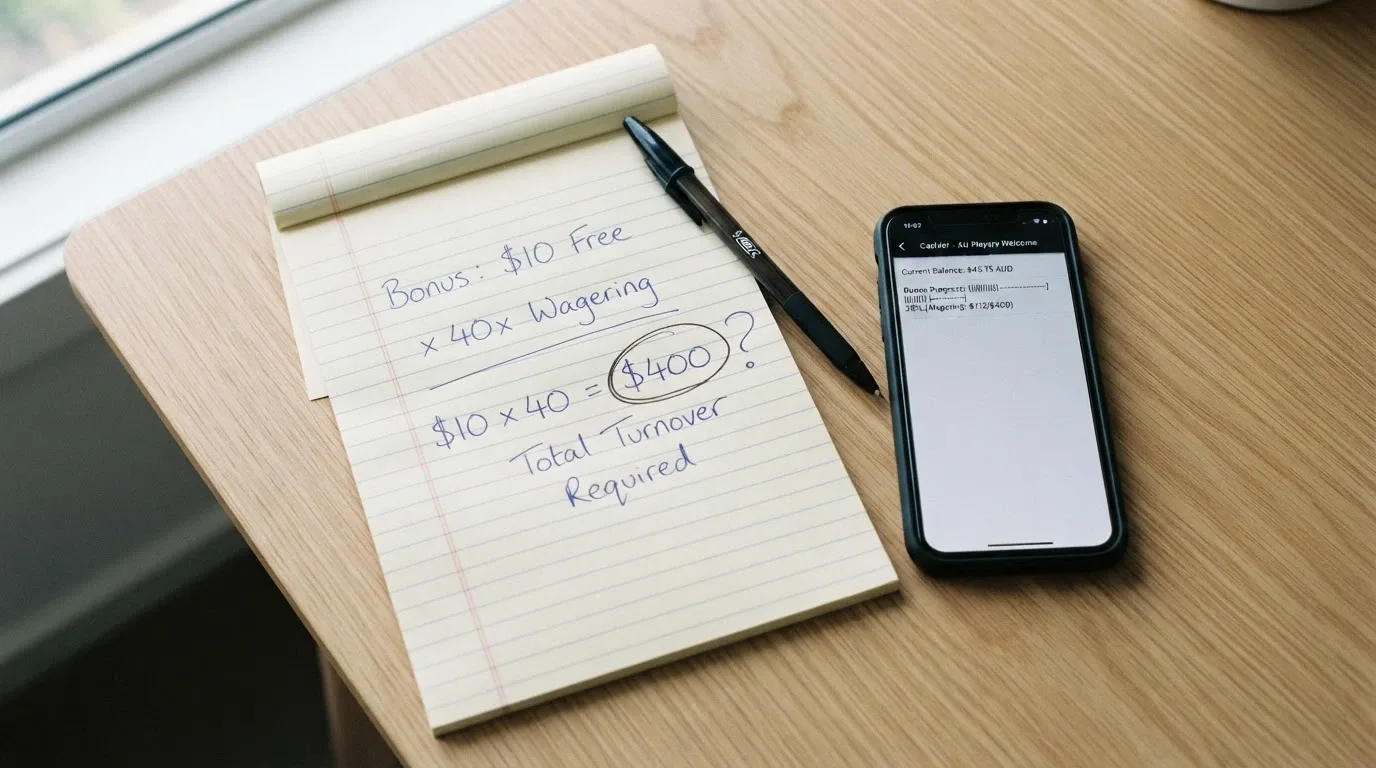
Take the standard offer: A$10 to A$25 in bonus cash or 20 to 50 free spins, credited without a deposit. The wagering requirement on the bonus — or on the winnings from the free spins — is typically 35× to 50×. Slots contribute 100% of stake toward that requirement. Table games contribute 5% to 20%, live dealer 0% to 10%, which means a blackjack hand played to clear a slots bonus counts for roughly a twentieth of what a slot spin counts for, if it counts at all. The maximum bet while a bonus is active is typically A$5 to A$10 per spin, and exceeding the limit can trigger an automatic audit flag that voids the entire bonus balance.
Work the example research gives. A A$10 no-deposit bonus at 40× wagering means A$400 in total qualifying bets before the bonus converts to withdrawable cash. A standard online pokie with an RTP in the 95%–96% band — which is where most of the titles the free spins lock to sit — holds a house edge of roughly 4%–5% per spin. The expected loss across A$400 of qualifying bets at a 4.5% house edge is A$18. The arithmetic on a “free” A$10 is that the player is statistically on the hook for around A$18 of expected loss to convert A$10 of bonus cash into cash they can withdraw. The expected loss, under the assumption that only the bonus amount is wagered and that the entire turnover runs on a 95%–96% RTP slot, lands at roughly A$18 — a real cost, not a gift.
That expected loss is a statistical average across many spins under the stated assumptions, not a guaranteed outcome for any individual player. Some sessions will run above expectation, some below; the long-run mean sits at roughly A$18 for the worked example. Two consequences follow. First, the free spins on offer are not profit: even at the cleaner end of the market, the player is paying the house edge to unlock a cashout. Second, the wagering multiple is the single most important number on the terms page, because every step from 30× to 60× roughly doubles the turnover the player has to run and roughly doubles the expected loss baked into it. Cashout caps then clip whatever survives that run.
The bonus is, in practical terms, a paid trial. The player is paying the house edge to test whether the casino’s withdrawal queue actually moves.
Free Spins vs Free Chips: Which No-Deposit Offer Stacks Up Better
Free spins and free chips look like two flavours of the same thing; the terms treat them as two different products.
Free spins lock the player into a single title, at a fixed spin value that commonly sits at A$0.10, A$0.20 or A$1.00 total bet per spin depending on the game. The winnings from those spins become the bonus balance, and the wagering requirement — typically 35× to 50× — runs on the winnings, not the original spin value. The advantage is that the player knows exactly which game the requirement will be cleared on, which makes the expected loss calculable in advance. The disadvantage is that there is no choice: if the locked title is not the one the player would have picked, the spins are spent regardless.
Free chips give the player A$10 to A$25 in bonus cash to spend across the casino’s library, at the player’s choice of stake, on the player’s choice of slot. The wagering requirement runs on the chip amount, not on the winnings from it. The advantage is flexibility — the player can clear the requirement on a high-RTP title and vary the stake. The disadvantage is that the wagering multiple is often higher than the equivalent free-spin offer, and a maximum bet cap of A$5 to A$10 per spin limits how aggressively the requirement can be cleared.
The expiry window shapes the choice further. Free spins at the tighter end of the market expire in 72 hours; free chips commonly run for 7 to 14 days. A player who can only play on weekends will burn through a 72-hour free-spin offer before they ever reach the bonus round; the same player has a week to clear a free chip.
In straight withdrawal terms, the comparison is messy enough that no single answer holds. A 30× wagering free-spin offer on a 96% RTP slot clears in less than half the turnover of a 60× wagering free-chip offer, which is the difference between roughly A$300 of qualifying bets and A$1,200. On the other hand, a 50× wagering free-chip offer on a title the player has actually studied may clear more cleanly than a 30× offer on a slot the player has never seen. The trade is real, and the right answer is the offer whose terms the player has read in full.
No-Wager Bonuses: The Rare Offer That Lets You Keep What You Win
A no-wager no-deposit bonus means every dollar won is withdrawable immediately, with no playthrough requirement, no game-contribution matrix and no conversion step between the bonus balance and the cashier. It is the closest thing in the market to actual free money, and it is vanishingly rare at Australian-facing offshore casinos.
No active no-wager no-deposit offer was confirmed for Australian-facing casinos in this run of the research. The standard no-deposit offer across the market carries a wagering multiple, and the no-wager variant tends to appear as a short-window promotion at a single brand rather than a published standing offer. Players who see one should treat it as the exception rather than the rule and should still read the cashout cap and the game-restriction list, because “no wagering” does not mean “no conditions.”
The reason for the scarcity is risk management. A no-wager bonus lets a player withdraw the moment they win, which means the casino is exposed to a run of small withdrawals across many sign-ups, and the marketing cost of a no-deposit offer has to be absorbed against that exposure. The industry norm is to recover the cost through the wagering requirement, and a brand that breaks the norm is, for the duration of the offer, paying real money for the player’s account.
Cashout Caps: The Fine Print That Limits Your No-Deposit Win
The cashout cap is the line in the terms page that decides what the player actually walks away with. A no-deposit bonus that clears wagering still hits a hard ceiling, and the house keeps everything above the cap.
The standard no-deposit cap across Australian-facing offshore sites is A$100 to A$200, set as a multiple of the bonus amount — typically 5× for free chips. A A$10 free chip at Fair Go carries an A$150 to A$180 cap; a A$20 free chip at the same brand carries a similar ceiling. BitStarz and KatsuBet cap their free-spin NDBs at A$100. Royal Reels sets its cash-NDB cap at A$200, the highest in the featured set for a pure cash offer. SkyCrown is the outlier: a A$750 max cashout on its no-deposit offer, set against 50× wagering, is the highest withdrawal ceiling in the set by a wide margin and the trade for the steep playthrough.
The cap exists because the bonus is, in accounting terms, marketing spend, and the cap limits the marketing cost per sign-up to a number the operator has decided it can absorb. The cap is also the mechanism that turns a “free” offer into its real shape. A player who lands a 50× wagering bonus with a 5× cashout cap has, in effect, paid the house edge to convert a capped percentage of the bonus into cash. The remaining balance is the operator’s margin.
A no-deposit cap of A$200 on a A$10 bonus is, in absolute terms, generous. It is, in the context of the turnover required to reach it, the same arithmetic as a smaller cap on a smaller bonus. The number to look at is the ratio of the cap to the bonus amount, set against the wagering multiple, and that ratio is the honest measure of how much of the bonus the player can actually withdraw.
How 10 Offshore Pokies Sites Compare on No-Deposit Value in 2026
| Casino | Licence | No-Deposit Offer | Wagering | Max Cashout | Bonus Validity | Game Providers |
|---|---|---|---|---|---|---|
| BitStarz | Curaçao eGaming | 50 free spins, no code | 40× | A$100 | 7 days | 80+ (BGaming, Pragmatic Play, Evolution, Microgaming, NetEnt) |
| KatsuBet | Curaçao eGaming | 30 free spins | 30× | A$100 | 7 days | 70+ |
| SkyCrown | Curaçao eGaming | 25 FS or A$20 credit | 50× | A$750 | 7 days | 60+ (Pragmatic Play, BGaming, Evolution) |
| Fair Go Casino | Curaçao eGaming | A$10–A$20 chips / 30 FS on Fu Long Treasures | 60× | A$150–A$180 | Coupon rotation | RTG / SpinLogic (single provider) |
| Rocket Play | Curaçao eGaming | 20–120 free spins | 40× | A$85–A$100 (NDB) / A$5,000 (welcome) | 5 days | 70+ |
| Royal Reels | Curaçao eGaming | A$10 cash (SMS verification) | 30×–40× | A$200 | 7–14 days | Multi-provider |
| WinSpirit | Curaçao eGaming | 25 free spins | 40× | — | — | Multi-provider |
| Uptown Pokies | Curaçao eGaming | 20 FS on T-Rex: Lava Blitz | 60× | A$180 | August 2026 window | RTG / SpinLogic (single provider) |
| Bizzo Casino | Curaçao eGaming | 10–25 free spins | 40× | — | — | 100+ (broadest catalogue) |
| Stake | Curaçao eGaming | — | — | — | — | Multi-provider + Stake Originals (provably fair) |
Every operator in this table is offshore-licensed. None holds an Australian casino licence, because no such licence exists. Stake holds a notable share of the Australian market at 1.28% but has no active no-deposit offer confirmed in this run, which is why the row reads as a gap rather than a comparison entry.
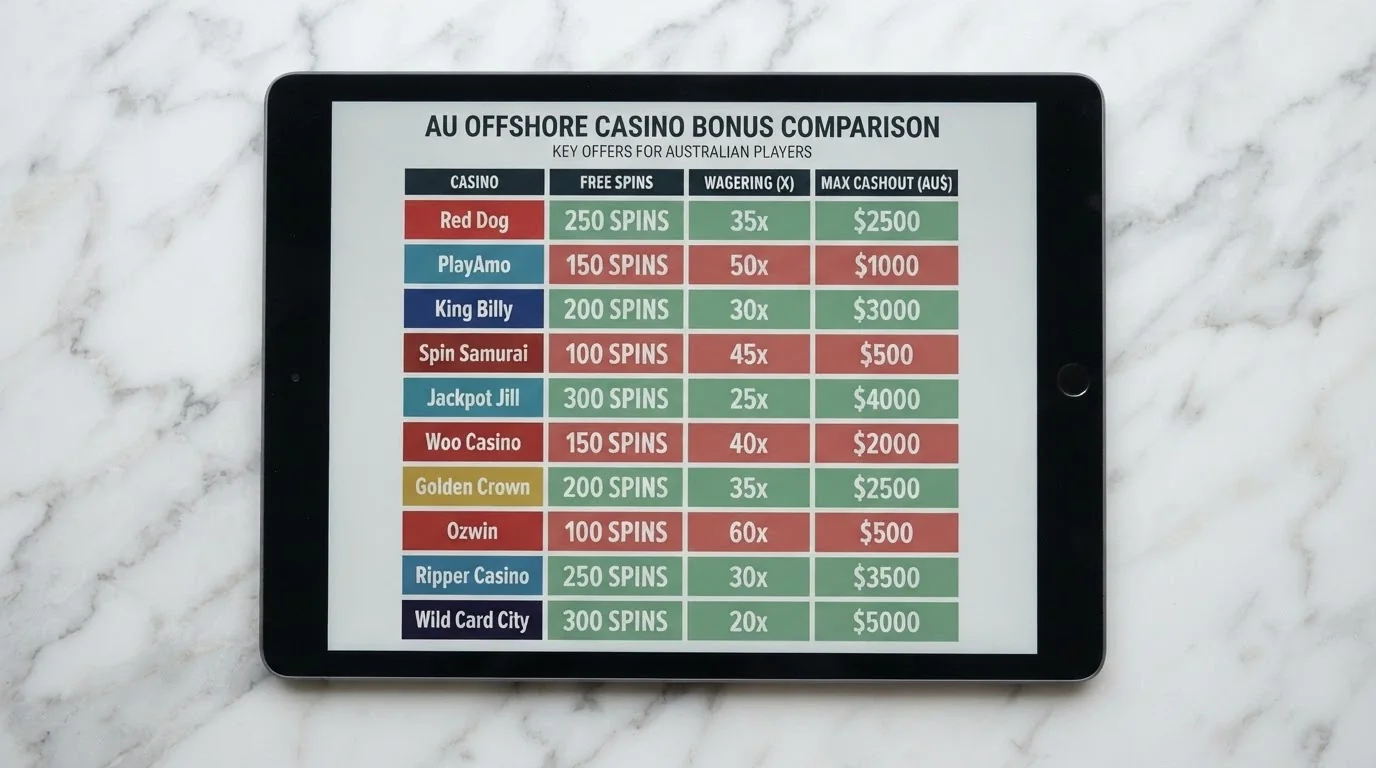
What We Checked — and What the Comparison Table Shows
Every cell in the table above traces to a published term: a bonus terms page, a promotions page, or a regulator-required disclosure. Where the cell shows an em dash, the operator has not published that figure, and that absence is itself a signal. WinSpirit does not publish a max cashout for its no-deposit free spins; Bizzo does not publish a max cashout or a validity window. The reader who skips the dashes misses the part of the comparison that matters: an unknown cap is functionally a zero cap, because the player cannot know what they are clearing toward.
The methodology behind the table is straightforward. Each operator was checked for a current, verifiable no-deposit offer available to a player registering from an Australian IP. The licence was read from the operator’s own footer and cross-referenced against the Curaçao eGaming public register. The wagering, max cashout and validity figures come from the operator’s published bonus terms at the time of writing, not from affiliate pages that may have cached older terms. Where two figures conflict across sources — Rocket Play’s 20-spin review-based offer against its 120-spin promotional offer, for example — the table shows the range rather than picking one.
The point of the table is not to crown a winner. Every operator on it is offshore, every one of them is one ACMA blocking request away from being unreachable, and every one of them runs on terms the Australian player has no domestic regulator to enforce. The point is to make the spread visible. The gap between the lowest wagering multiple in the set (KatsuBet at 30×) and the highest (Fair Go and Uptown Pokies at 60×) is the gap between a bonus that clears in roughly A$300 of qualifying bets and one that requires A$1,200. The gap between the standard cashout cap (A$100) and SkyCrown’s A$750 is the difference between a marketing gesture and a serious offer. The reader’s job is to match the spread to their own appetite for the turnover the offer actually requires.
BitStarz
BitStarz runs 50 free spins on registration with no code needed, which is the largest straightforward free-spin no-deposit offer in the featured set. Wagering runs at 40× on spin winnings, max cashout is A$100, and the bonus expires after 7 days. The catalogue is 80+ providers — BGaming, Pragmatic Play, Evolution, Microgaming, NetEnt — which means the slots that count 100% toward wagering are broad enough that the player can clear on a title they actually want to play.
The 50-spin count sets BitStarz apart in the head-to-head against the other free-spin NDBs in the set, but the 40× wagering multiplier is mid-market, not best-in-class. KatsuBet’s 30-spin offer at 30× wagering clears in less turnover per spin of expected value; BitStarz’s edge is the larger spin count, not a softer requirement. The A$100 cap is the standard ceiling for the segment and is the number the player should expect to see on a 50-spin free-spin offer at this wagering multiple.
A solid all-rounder for the player who wants volume over a soft playthrough. The Curaçao licence and the offshore status are the same as every other row in the table; the offer is the largest in the set, the terms are the standard for the segment.
KatsuBet
KatsuBet’s 30 free spins carry the lowest wagering multiplier in the featured set at 30× on spin winnings, with a A$100 max cashout and a 7-day expiry. The 70+ studio catalogue is narrower than BitStarz’s but broader than the RTG-only houses further down the table. The Curaçao licence is the standard offshore credential for the segment.
The 30× wagering multiplier is the headline. A 30× requirement on a 95%–96% RTP slot clears in roughly A$300 of qualifying bets, against A$400 at 40× and A$600 at 50×. The expected loss at 30× wagering is meaningfully smaller than the same spin count at higher multiples, and the smaller spin count (30 against BitStarz’s 50) is the trade for the cleaner playthrough.
Best-in-class on the playthrough, smaller in volume. The right offer for the player who has read the wagering comparison and is happy to take fewer spins in exchange for a softer requirement.
SkyCrown
SkyCrown’s no-deposit offer runs 25 free spins or A$20 free credit, with 50× wagering on the NDB and a A$750 max cashout that is the highest withdrawal ceiling in the set by a wide margin. The 7-day expiry matches the segment. The catalogue covers 60+ providers including Pragmatic Play, BGaming and Evolution. The deposit-match welcome package runs up to A$4,000 plus 350 free spins across multiple deposits at 30× to 40× wagering.
The A$750 cap is the outlier number in the table. The standard cashout ceiling on a no-deposit offer is A$100 to A$200; SkyCrown’s A$750 is roughly three to seven times the segment norm. The cost is the 50× wagering multiplier, which is the second-steepest in the set and roughly doubles the turnover required to clear the offer compared with KatsuBet’s 30×. The expected loss is correspondingly larger, but the upside — a cap that lets a lucky session actually pay out — is also larger.
The trade is a real one. The player who picks SkyCrown is paying a higher expected cost in exchange for a higher ceiling, and the right read of that trade depends on the player’s appetite for the longer run. The welcome package, separately, is one of the larger deposit-match offers in the segment and is worth reading on its own terms.
Fair Go Casino
Fair Go is an Australian-facing veteran that has run the same RTG / SpinLogic single-provider catalogue for years, and the no-deposit offer reflects the format: A$10 to A$20 free chips or 30 free spins on Fu Long Treasures, with 60× wagering on the chips and a A$150 to A$180 max cashout. Validity runs on a coupon-rotation model rather than a fixed window, with the latest free-spin offer valid until 25 August 2026. The deposit-match welcome runs 100% up to A$200 redeemable five times across the first five deposits (up to A$1,000 total), at 30× wagering with no maximum cashout.
The 60× wagering multiplier is the steepest in the set and roughly doubles the turnover required to clear compared with the 30× offers at the cleaner end of the table. The single-provider catalogue cuts both ways: every game counts 100% toward wagering (no contribution-rate games to avoid), but the player is clearing on RTG / SpinLogic titles, which is a narrower field than the multi-provider houses offer. The deposit welcome, at 30× with no max cashout, is the cleaner offer at the brand, and the no-deposit chip is best read as a trial of the cashier rather than a profit opportunity.
The right pick for the player who values a single, predictable catalogue and a no-max-cashout deposit welcome over the headline spin counts at the multi-provider houses.
Rocket Play
Rocket Play’s no-deposit offer runs 20 free spins on Book of Pyramids (review-based) or 120 free spins on Doragon’s Gems (promotional), with 40× wagering and an A$85 to A$100 max win on the NDB. The 5-day expiry is the shortest in the featured set, and the A$7.50 maximum bet while a bonus is active is set explicitly in the terms. The deposit welcome carries a A$5,000 maximum win. The catalogue runs 70+ studios.
The 5-day window is the constraint that shapes this offer. A player who signs up on a Monday and clears a free-spin NDB over the weekend will already be outside the validity window. A player who can sit down and clear the offer in a single session is the player the terms are written for. The A$7.50 max bet is in the same band as the A$5 to A$10 cap at other houses, and exceeding it triggers the same automatic audit risk.
The 120-spin promotional variant is the higher-headline number, but the 40× wagering still runs on the winnings, and the 5-day window still applies. The right read is that Rocket Play’s NDBs are designed for fast players — the terms reward a concentrated clearing session rather than a week of casual play.
Royal Reels
Royal Reels is the only pure-cash no-deposit offer in the set: A$10 credited on registration, with 30× to 40× wagering, a A$200 max cashout and a 7 to 14 day validity. The offer is gated by SMS verification, which is the friction the brand adds on top of the standard email sign-up.
The A$200 max cashout is the highest cap for a cash NDB in the set, against a A$10 bonus amount — a 20× ratio, against the 5× to 10× ratio that the cashout-cap norm implies. The wagering multiple is mid-market, and the validity window is the longest in the set at the upper end. The SMS verification step is a small but real friction: a player without a mobile number on hand, or a player who is registering from a number they do not want tied to a gambling account, will not clear the gate.
The right pick for a player who wants cash, not spins, and who can complete the SMS step. The cashout cap is the standout number in the table for a pure-cash NDB.
WinSpirit
WinSpirit runs 25 free spins on the no-deposit side, with 40× wagering. The deposit welcome is where the brand’s headline sits: a 200% match plus 25 free spins, with 40× wagering, ongoing cashback, and a structure that runs across the early deposits.
The absence of a published max cashout on the NDB is the gap in the row. The player cannot know what they are clearing toward, which is functionally a zero cap. The deposit welcome is the more complete offer in the brand’s terms, and the NDB reads as a taste of the welcome rather than a standalone opportunity.
The right pick for a player who reads the welcome package first and treats the NDB as a small free trial of the cashier. The terms are not as fully published as the rest of the set.
Uptown Pokies
Uptown Pokies is the second RTG / SpinLogic single-provider house in the set, alongside Fair Go, and the no-deposit offer mirrors the format: 20 free spins on T-Rex: Lava Blitz (SpinLogic Gaming), with 60× wagering and a A$180 max cashout. Validity is the August 2026 window.
The 60× playthrough is the same steep figure as Fair Go, and the single-provider constraint is the same. The T-Rex: Lava Blitz title is the brand’s exclusive hook — the dinosaur theme is the brand’s signature, and a player who has already played the title in a different venue will know exactly what to expect from the bonus round.
The right pick for a player who already likes the T-Rex franchise and is happy to clear on a single-provider catalogue. The terms are otherwise consistent with the Fair Go profile.
Bizzo Casino
Bizzo’s no-deposit offer runs 10 to 25 free spins with 40× wagering, and the catalogue is the broadest in the set at 100+ studios. The max cashout and the validity window are not published in the snippet set research captured.
The 100+ studio catalogue is the headline. A player who wants to clear on a specific high-RTP title from a specific provider has the broadest selection in the set. The thin published terms on the NDB — no max cashout, no validity — are the offset, and the player who claims the offer is taking the brand’s terms at face value on those two figures.
The right pick for a player who values catalogue breadth over fully published NDB terms. The NDB is best read as a small taste of the cashier, with the deposit welcome as the more complete offer.
Stake
Stake holds a notable share of the Australian market at 1.28% — a larger share than the headline-grabbing spin counts at some smaller brands — and runs an in-house provably fair games suite (Stake Originals) alongside multi-provider slots. No active no-deposit bonus was confirmed for Australian players in this run of the research, which is why the row in the comparison table reads as a gap.
The brand’s actual value proposition is the crypto-first cashier, the sportsbook integration, the VIP programme and the in-house provably fair titles — none of which fits the no-deposit frame. The player who reaches Stake through a “no deposit bonus” search has reached a brand that does not pitch that offer to the Australian market, and the alternative offers at the brand require a deposit to unlock.
The right pick for a player who is already inside the Stake ecosystem and is looking for the brand’s actual offer, not its NDB. For a player whose search is specifically for a no-deposit bonus, the gap in the table is the gap in the offer.
PayID: The Fast Track for Pokies Deposits — and the Offshore Catch
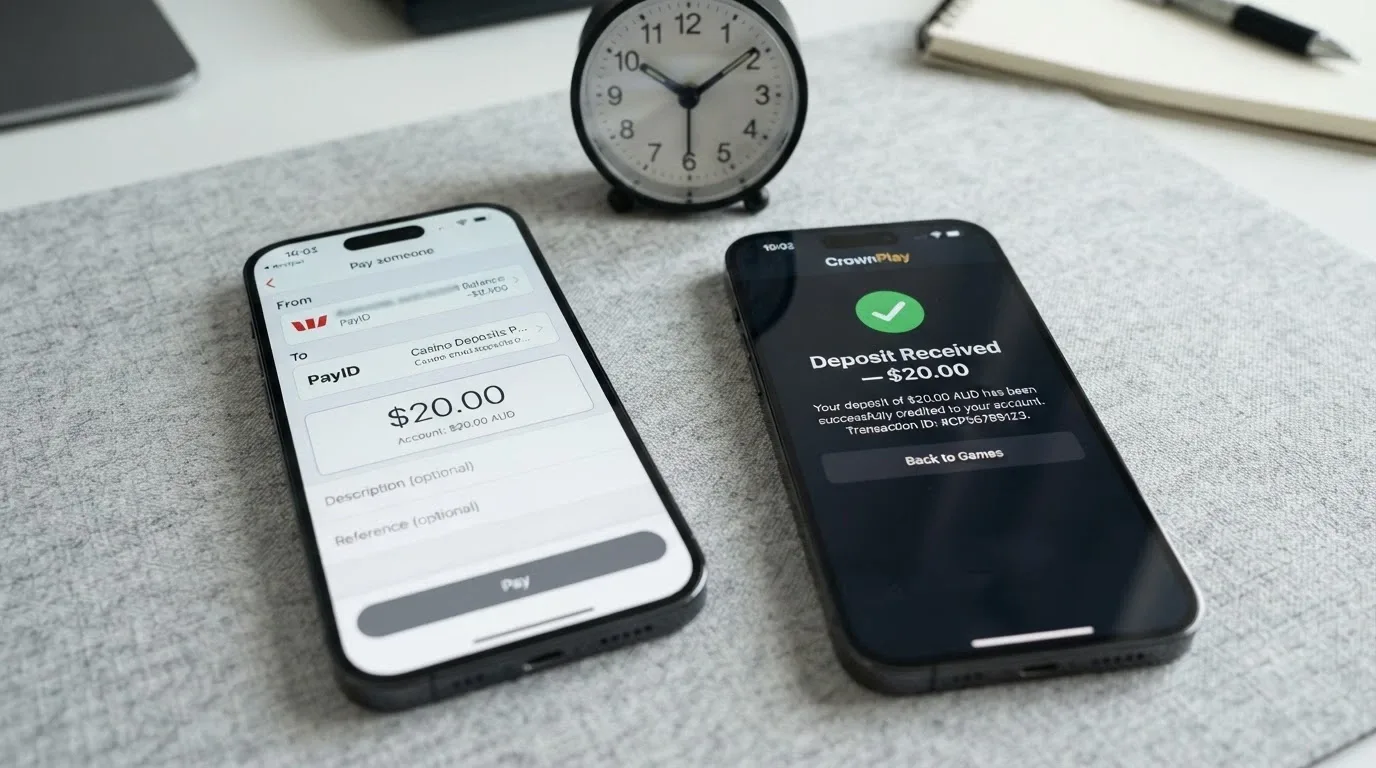
PayID runs on the New Payments Platform and the Osko rail, and a PayID deposit at a casino cashier clears in seconds to one minute. That is the speed an Australian player is paying for. The offshore catch is the line at the end of the transaction: the money has just left a bank account linked to a real identity and arrived at a Curaçao-licensed operator the ACMA can block, and from 1 January 2027 the bank itself has the express authority to refuse the transfer.
The licensed deposit routes for online wagering in Australia are debit card, bank transfer, PayID / Osko and BPAY. Credit cards, credit-related products and digital currency (crypto) have been banned as payment for online wagering since 11 June 2024 under the Interactive Gambling Amendment (Credit and Other Measures) Act 2023, with penalties of up to A$247,500 for an operator that fails to enforce the ban. A request for a credit card or a crypto deposit from a gambling site is the clearest signal the operator is offshore — licensed Australian wagering operators do not offer those methods, by law.
PayID sits in the licensed-payment band. The speed comes from the rail, not from the operator: the New Payments Platform settles in near real-time, and Osko extends that to participating banks 24/7. The deposit that takes ten seconds at the cashier is the same PayID transfer that would take ten seconds to a friend’s bank account. The casino does not have a faster payments integration; the Australian payments system does, and the operator is plugging into it.
How PayID Deposits Work at Offshore Pokies Sites
The deposit flow is a PayID transfer from the player’s bank app to the casino’s PayID address, which the casino’s cashier page displays. The player authorises the transfer in their own banking app, using their own bank login, and the funds land in the casino cashier within seconds to one minute. The minimum deposit is typically A$10 to A$20, which doubles as the verification-deposit threshold for the no-deposit bonus cashout flow.
The shadow is the payment-blocking power that commences on 1 January 2027. From that date, banks and payment providers gain express authority to block transactions to illegal gambling operators. A PayID transfer to an offshore casino is, in regulatory terms, a transfer to an illegal gambling operator. The bank is not required to block the transaction under the new powers, but it is authorised to, and the bank’s transaction-monitoring system will be the first place the transfer is reviewed. The player who uses PayID at an offshore casino today is using a payment method the bank will be allowed to refuse tomorrow.
The verification deposit is the part of the flow that surprises new players. A no-deposit bonus that wins and clears wagering still has to pass the casino’s KYC queue, and most offshore casinos require a small A$10 to A$20 deposit — refundable — before the first cashout is processed. The deposit is not a fee and it is returned with the withdrawal, but it is not optional, and the player who has spent the bonus winnings and never made a deposit will be asked to make one before the money moves.
PayID Withdrawal Speed: What the Tested Casinos Actually Deliver
Four Australian-facing casinos were tested on PayID withdrawal speed in 2026. Hell Spin returned the withdrawal in 25 minutes, Goldenbet in 28, Lucky7 in 35, and LuckyVibe within an hour. The spread is the difference between a casino whose KYC queue moves in real time and one whose queue runs on a slower internal schedule.
PayID is not a faster rail for withdrawals than it is for deposits. The Osko rail clears the same way in both directions, and the bottleneck on the withdrawal side is not the bank — it is the casino’s manual approval queue. A casino that takes 25 minutes is staffed and has a clean KYC pipeline. A casino that takes an hour has a longer queue, a slower review, or both. The player who needs a withdrawal in under half an hour should pick the brand on that metric, because the payment rail itself does not vary.
The other shadow is the same one that sits on the deposit side. A PayID withdrawal from an offshore casino is a PayID transfer from a Curaçao-licensed operator to an Australian bank account, and the bank is the entity that decides whether the incoming transfer triggers a transaction-monitoring review. A clean withdrawal at a tested casino is the norm; a blocked withdrawal is a real risk the player takes on by using the offshore product in the first place.
Try Before You Bet: Free-Play Pokies vs the Real-Money Mode
Demo mode is a free-play balance that runs the same RNG, the same reel set and the same bonus features as the real-money version of the game, with no registration, no deposit and no cash at risk. It is the cheapest way to study a pokie, and it is the smarter first step for any player who is about to commit a real-money bonus to a title they have not seen before.
The jump from demo to real-money mode is the place the no-deposit bonus lives. A demo play costs nothing, runs forever, and lets the player watch a title’s bonus round trigger over hundreds of spins without any stake at risk. A no-deposit bonus puts the player’s bonus balance on the other side of the spin and starts the wagering clock the moment the first spin lands. The two are not interchangeable. Demo is a learning tool. The no-deposit bonus is a paid trial of the casino’s cashier, dressed up as a free trial of the slot.
Why Demo Mode Is the Smarter First Step Than Claiming a Bonus
A no-deposit bonus locks the player into wagering the moment the spin lands. Demo mode costs nothing, runs for as long as the player wants to keep the tab open, and lets the player study a title’s hit frequency, bonus trigger rate and volatility profile across hundreds of spins before any cash is committed.
Lightning Link’s Hold & Spin bonus, for example, triggers when six or more Lightning symbols land on the reels, and the average trigger rate across the game’s life cycle is roughly one bonus in every 100 spins, with an overall hit frequency of around 30%. A player who knows that figure before claiming a 50-free-spin no-deposit offer on Lightning Link knows that 50 spins is roughly half a Hold & Spin cycle on average — the player is statistically more likely than not to finish the offer without ever seeing the bonus round. A player who discovers that mid-offer is the player who is surprised.
Demo mode is also the right place to test the max-bet rules. A no-deposit bonus typically caps the player’s stake at A$5 to A$10 per spin while the wagering requirement is active, and exceeding the cap voids the bonus. The cap is a real constraint on the player’s strategy, and the player who has practiced the title in demo at the cap’s stake knows what the play looks like before the bonus starts.
The smart sequence is: demo the title to learn the bonus frequency and the volatility profile, then claim the no-deposit offer at a brand with a clean cashout cap and a short wagering multiple, then clear the offer on the title the player already knows. The no-deposit bonus is the final step, not the first.
The Pokies Titles Worth Your No-Deposit Spins in 2026
| Title | Provider | RTP | Volatility | Paylines |
|---|---|---|---|---|
| Lightning Link | Aristocrat | 89.31%–96.64% (commonly 95%–96%) | Medium-high (bonus-and-jackpot concentrated) | 25–50 |
| Dragon Link | Aristocrat | 95.02%–96.00% | High | 25–50 |
Most no-deposit free-spin offers lock the player into a single title, and the two Aristocrat flagships dominate the locked-spin segment. Lightning Link is the title most often tied to a no-deposit free-spin offer at an Australian-facing casino, and Dragon Link is its higher-volatility sibling. The RTP and volatility figures on both are widely cited but not officially published by Aristocrat in a single canonical range; the bands above are the secondary-source consensus.

Lightning Link: The Pokie That Defined the No-Deposit Free-Spin Era
Lightning Link runs a 5×3 grid with 25 to 50 paylines, a bet range from A$0.01 across the denomination spread to a A$50 max bet on the MarsX Upright cabinet, and an RTP that ranges from roughly 89.31% to 96.64% depending on denomination and jurisdiction, with 95% to 96% as the commonly cited band. The volatility is characterised as medium-high in secondary sources, with the math concentrated in the bonus-and-jackpot layer rather than the base game.
The Hold & Spin bonus is the title’s centrepiece. It triggers when six or more Lightning symbols land on the reels, and the average trigger rate across the game’s life cycle is roughly one bonus every 100 spins, with an overall hit frequency around 30%. The bonus round is a re-spin feature with three re-spins resetting on each new Lightning symbol, running until the player fills the screen or runs out of re-spins. Four progressive jackpots sit above the bonus round: Grand resets at A$10,000, Major at A$500, Minor at A$50 (static), and Mini at A$10 (static) on the standard denomination.
For a no-deposit free-spin offer, Lightning Link is the title the player should expect to be locked into at most Australian-facing offshore casinos. The bet-per-spin on a free-spin offer is set by the casino at A$0.10 to A$1.00 total, and the player’s actual return across 50 free spins depends on how the bonus round lands in that window. The math is that the player is statistically more likely than not to see no bonus round in a 50-spin session, and the player who lands a Hold & Spin within the offer window is the player who clears the wagering requirement with cash to spare.
Dragon Link: Higher Volatility, Bigger Grand Jackpot Potential
Dragon Link runs the same engine as Lightning Link with a higher volatility profile and a wider Grand jackpot range. The RTP sits at 95.02% to 96.00% across secondary sources, with 95.2% as the most commonly cited figure. The grid is the same 5×3 with 25 to 50 paylines. The Grand jackpot starts at A$10,000 on the lowest-stakes versions and can reach A$1,000,000 on the highest-stakes configurations.
The max-win estimates across secondary sources conflict: 1,250× at one end, 10,000× at the other, with the spread reflecting different stake levels and different denominational configurations rather than a single canonical figure. The volatility is the difference between the two titles — Dragon Link’s base game pays less frequently, the bonus round lands less often, and the Grand jackpot is the prize the math is built around.
For a no-deposit free-spin offer, Dragon Link is a tougher title to clear on than Lightning Link. The higher volatility means longer stretches without a bonus round, and the higher max-win ceiling is paid for by a lower base-game hit rate. The player who has locked free spins on Dragon Link is the player who needs the patience to ride out the dry spells in the wagering window.
New AU-Facing Pokies Sites With Sign-Up Freebies in 2026
A freshly launched offshore casino has the same no-deposit mechanics as an established one — free spins or free cash, wagering, max cashout, expiry — but the operator has no withdrawal track record an Australian player can verify. The bonus is often larger as a result, because the brand is buying the player’s first session and the marketing cost has to be absorbed against the unknown of a brand-new operation.

The standard no-deposit offer across the segment is 20 to 50 free spins or A$10 to A$25 in bonus cash, and new casinos sometimes stretch the top end of that band to stand out. A 75-spin offer or a A$50 free chip from a brand the player has never heard of is the offer to read most carefully, because the terms page is the only verification the player has. A new brand with a 60× wagering multiplier and a A$50 max cashout is offering a paid trial of an unknown cashier; the trial is worth taking only if the player reads the terms page and accepts that the cashier has no history to back the marketing claim.
The trade is a real one. A larger no-deposit offer from a brand with no track record is a larger bet on an unknown operator, and the player who values the size of the offer over the verification of the brand is the player who needs to read the small print most carefully. The right read is that the established names in the segment have earned their place on the comparison table by paying out, and a new name has not yet had the time to prove that it does the same.
Pokies in Your Pocket: Mobile Play With No-Deposit Perks
Every operator in the featured set runs a mobile browser platform, and the no-deposit bonus claims and clears identically on phone and desktop. The reels, the wagering, the cashout cap and the bonus balance all run on the same engine regardless of the device the player uses to reach the cashier.
A dedicated iOS or Android app changes the notification and bonus-alert layer but not the underlying offer. A player who installs an app gets push notifications on new promotions; a player who plays in the browser gets the same promotions through the email channel the casino holds on file. The bonus is the same either way. The player who values the alert layer should install the app; the player who does not want the casino’s notifications on their phone should play in the browser.
The no-deposit bonus claim is the same flow on mobile. The player registers, verifies their account, and the spins or the free cash land in the bonus balance. The wagering requirement clears on the same games at the same contribution rates. The cashout runs through the same cashier and the same KYC queue. The only difference is the screen size, and the only mobile-specific risk is the auto-play and the fast-spin features that mobile play encourages, both of which burn through a bonus balance faster than the player expects. The right discipline is to set a stake cap before the first spin and hold to it.
The Legal Reality: Offshore Pokies and Australian Law in 2026
Online pokies are prohibited in Australia. The Interactive Gambling Act 2001 makes it an offence to provide online casino games, online pokies or in-play sports betting to a person physically in Australia, and no licence to supply those products exists anywhere in the country, federally or in any state or territory. The 2017 amendment closed the loopholes offshore operators had been using and gave the ACMA its blocking and enforcement powers. The 2026 reform bill, passed on 19 August 2026, has rewritten what that prohibition will mean from 1 January 2027 onward.

The penalties are aimed at the provider, not the player. The maximum penalty for providing a prohibited interactive gambling service is A$360,000 per day for individuals and A$1.8 million per day for bodies corporate. The ACMA has used these powers to have 1,564 illegal gambling and affiliate websites blocked by Australian ISPs since November 2019, and more than 225 services have withdrawn from the Australian market since the 2017 amendment. The individual player is not prosecuted under the Act. “Any game of chance, including games of mixed chance and skill played over the internet, is prohibited under the Interactive Gambling Act 2001 if it’s provided to someone who is physically in Australia,” the Australian Government Department of Infrastructure has confirmed.
The 2026 reform changes the marketing and the payment landscape without legalising the product. From 1 January 2027, direct marketing of gambling inducements is banned for 14 days after a customer signs up, for three months after a customer deregisters from BetStop, and indefinitely for customers identified as at risk of gambling-related harm. Wagering advertising is capped at no more than three ads per hour between 6:00 am and 8:30 pm, with a live-sport blackout from 15 minutes before a live sporting event until 5 minutes after it ends. Athletes, celebrities and influencers are barred from promoting wagering products, and wagering ads are banned inside sports venues and on player or official uniforms. The reform also bans online keno “pocket pokies” and foreign-matched lotteries. “The Albanese Government has delivered historic reforms that will provide strong protections against online gambling harms for all Australians, particularly children and young people,” the government said on 19 August 2026.
The most consequential change for the offshore pokies market is the bank payment-blocking power, also commencing 1 January 2027. Banks and payment providers gain express authority to block transactions to illegal gambling operators, which means the PayID and bank-transfer routes an Australian uses to fund an offshore account are routes the bank is now allowed to refuse. A player who uses PayID at an offshore casino today is using a payment method the bank will be authorised to block tomorrow.
There is no national deposit, loss or stake ceiling for online gambling in Australia, because the product those ceilings would govern is banned outright. What Australia caps is the payment method: credit cards, credit-related products and crypto are banned as payment for online wagering since 11 June 2024, with penalties of up to A$247,500 for an operator that fails to enforce the ban. Player winnings are not assessable income under section 6-5 of the ITAA 1997, and losses are not deductible under section 8-1 — unless the person is carrying on a business of betting. The operator-level tax falls where the customer is: the NT levies a 5% wagering tax plus a 0.05% racing levy, and the states set point-of-consumption tax at 10% to 15% of net wagering revenue. None of this tax structure reaches the offshore pokies product, because the offshore operator is not licensed in Australia and does not file in any Australian jurisdiction.
The ACMA Block List: What 1,564 Blocked Sites Means for Your Balance
The ACMA’s blocking power is an ISP-level DNS block. When a domain is added to the ACMA’s block list, Australian ISPs are required to prevent their customers from resolving the domain, and the site becomes unreachable through standard browser navigation. The block is targeted at the provider, not the player, and it is enforced without any action on the player’s part.
The 1,564 sites blocked since November 2019 include offshore casinos, affiliate pages that market them, and supporting infrastructure. More than 225 services have withdrawn from the Australian market entirely rather than face the block — a number that includes brands that simply stopped accepting Australian players once the enforcement regime tightened. The result is a market that is smaller than the affiliate pages suggest and that changes shape as the block list grows.
The consequence for a player with a balance at a blocked site is direct. The site is unreachable from an Australian IP, the player’s account is inaccessible, and the ACMA cannot recover the money on the player’s behalf because the operator is outside Australian jurisdiction. The block is not a confiscation; it is an interruption, and the player who wants the balance has to reach the operator through a route the block does not cover (a VPN, a different jurisdiction, a direct contact). None of those routes is straightforward, and none of them is guaranteed to work. The risk is real, and the player who keeps a balance at an offshore casino is taking it knowingly.
The 2026 Gambling Reform: What Changes for Pokies Players on 1 January 2027
The Interactive Gambling Amendment (Gambling Reform) Bill 2026 passed Parliament on 19 August 2026 and its measures commence on 1 January 2026. The bill adds new Parts 7C, 7D and 7E to the IGA, and the changes cascade through advertising, inducements, payments and even the products that sit adjacent to online pokies.
On advertising, wagering ads are capped at three per hour between 6:00 am and 8:30 pm, with a live-sport blackout from 15 minutes before a live event to 5 minutes after it ends. Radio ads during school times are barred. Broadcasting odds is banned outright. Online wagering ads are shown only to logged-in, age-verified users who have not opted out, and they are banned inside sports venues and on player or official uniforms. Athletes, celebrities and influencers are barred from promoting wagering products.
On inducements, direct marketing is banned for 14 days after a customer signs up, for three months after a customer deregisters from BetStop, and indefinitely for customers identified as at-risk. The bans are aimed at licensed wagering operators, but they shape the marketing environment around the offshore market as well — an Australian player who has just signed up at a Curaçao-licensed casino will see fewer inducement offers across the licensed market, and the offshore offer is the offer that still arrives in the inbox.
On payments, the same date hands banks and payment providers the discretion to refuse transfers headed for illegal gambling sites. The block is at the bank’s discretion, and the bank uses its transaction-monitoring system to identify the recipient. A PayID transfer to a known offshore casino is the kind of transaction the new powers are designed to catch.
On products, the reform bans online keno “pocket pokies” and foreign-matched lotteries, closing off two adjacent products that had sat in a grey area. The AdStop opt-out register — the consumer-facing mechanism for the advertising restrictions — is not operational by 1 January 2026 and is expected to commence later by proclamation. A phased implementation model applies to the advertising restrictions over three years, and a cost-recovery levy on licensed wagering providers funds ACMA enforcement.
For the offshore pokies player, the practical read is that the 2027 changes tighten every channel the offshore market uses to reach an Australian player. The marketing is restricted, the inducements are restricted, the payment routes are subject to bank blocking, and the adjacent products are closed. The offshore casino itself is still illegal to provide, and the player is still not the target of enforcement — but the ease of getting money in and offers in the inbox is the thing the reform is built to reduce.
Playing Safe: What Australian Pokies Players Actually Need to Know
About 2.1% of Australian adults — roughly 430,000 people — experience problem gambling. The Australian Institute of Health and Welfare put high-risk gambling at 1.8% in its 2022 data, and the figures have held in the same band across the institute’s most recent surveys. The no-deposit bonus is a small offer in dollar terms; for the player at the wrong end of those figures, the small offer is the on-ramp to the larger one.

The help infrastructure exists whether the player is at a licensed bookie or an offshore casino. The National Gambling Helpline is 1800 858 858 — free, confidential, staffed 24 hours a day, 7 days a week. Gambling Help Online, at gamblinghelponline.org.au, offers online chat, self-assessment tools and counselling. BetStop — the National Self-Exclusion Register at betstop.gov.au — excludes a person from every Australian-licensed online and phone wagering service in a single step. The 24/7, free, confidential helpline is the first call for anyone who feels the play has stopped being entertainment.
The BetStop register carries 67,480 registrations as at 31 July 2026, of which 41,290 exclusions were still active — more than 60% of everyone who has ever signed up. 78% of registrants are under 40, and 38% have chosen lifetime exclusion. The numbers are the clearest signal the data carries about who registers, who stays registered, and how seriously the self-exclusion decision is taken by the people who make it.
BetStop and the Offshore Gap: Why Self-Exclusion Stops at the Australian Border
BetStop registration is a single step: one form, one confirmation, and the person is excluded from every Australian-licensed online and phone wagering service simultaneously. The exclusion can be set for a defined period (three months, one year) or for life. The licensed operators are required to honour the exclusion, to refuse the person’s business, and to close any account the person holds with them.
The exclusion does not reach the offshore casinos. A Curaçao-licensed brand is not licensed in Australia, is not connected to the BetStop register, has no obligation to check whether a registering player is on the register, and will keep taking the player’s money after the player has self-excluded. The offshore gap is the single most important limitation of the BetStop system, and it is the gap that an Australian player using an offshore casino is sitting in.
A self-excluded player who is also playing at an offshore casino needs to know two things. First, the BetStop registration does not protect them at the offshore site, and the offshore site will not block their account on the basis of the Australian register. Second, the offshore casino is one ACMA blocking request away from being unreachable, which means the player’s account at the offshore site is a balance the player can lose access to at any time, regardless of the player’s self-exclusion status. The right read is that BetStop is necessary but not sufficient for a player who is also using offshore sites, and the additional step is to stop using the offshore sites directly.
How We Evaluated These No-Deposit Pokies Offers
The ranking on this page was built by checking every operator against the official Australian regulatory framework and against the operator’s own published terms. The licence status was read from the operator’s footer and cross-referenced against the Curaçao eGaming public register. The bonus terms — wagering multiple, max cashout, validity window, max bet — were taken from the operator’s own bonus terms page at the time of writing, not from affiliate pages that may have cached older terms. The no-deposit offer was confirmed as currently available to a player registering from an Australian IP.
The evaluation criteria were straightforward. The first was licence status: every operator on the list is offshore-licensed, and the licence is named. The second was terms completeness: the wagering, max cashout and validity figures had to be published, and the row was downgraded where they were not. The third was game-provider diversity: a single-provider catalogue is a real constraint on the player’s choice and is marked as such. The fourth was AU-player accessibility: the offer had to be claimable from an Australian IP, and operators blocked by the ACMA with no current AU access were excluded.
What was excluded was also clear. Operators with no verifiable no-deposit terms were excluded from the table. Operators whose only published NDB terms were older than 12 months were excluded. Operators blocked by the ACMA with no current Australian access were excluded. The methodology is qualitative — no invented weightings, no percentage scores, no ranking algorithm — and the ranking is a reflection of which offers publish the most useful terms for the player who reads them.
No-Deposit Pokies in 2026: What You Should Actually Do With What You Now Know
The no-deposit bonus is a trial tool, not a profit engine. The arithmetic in the previous section shows the expected loss of clearing a typical offer, and the cashout cap shows the ceiling on what the player can walk away with. The smart player reads those two numbers first and the spin count second, because the spin count is the marketing figure and the cap is the real one.
Three rules for claiming a no-deposit bonus safely. Read the cashout cap before the first spin — the cap is the number that decides what the player is clearing toward, and an unknown cap is functionally a zero cap. Check the wagering against the game contribution — a 30× offer on a 96% RTP slot is a different offer from a 60× offer on the same slot, and the difference is roughly A$900 of turnover and roughly A$40 of expected loss. Verify the PayID withdrawal speed before depositing, because the deposit is the moment the player stops testing the cashier and starts funding it.
The no-deposit bonus is worth the spin if the player treats it as a test of the casino’s withdrawal pipeline. The bonus is not worth chasing with a deposit at an unlicensed operator, because the same offshore casino that holds the bonus balance holds the deposited balance, and the ACMA can block the site the morning after the deposit clears. The player who wins at the no-deposit stage and wants to continue at the same brand is making a different decision from the player who is testing the cashier, and that decision is one the player should make with the offshore status and the bank blocking power in full view.
If the play stops being entertainment, the help line is 1800 858 858 — free, confidential, 24 hours a day, with online chat and counselling through Gambling Help Online. The BetStop register at betstop.gov.au covers every Australian-licensed wagering service in a single step. It does not cover the offshore casinos, and a player who is also using offshore sites needs to know that gap before the BetStop registration is the only barrier between them and the next session.
Frequently Asked Questions
What’s the most I can cash out from a no-deposit pokies bonus?
The standard no-deposit cashout cap at Australian-facing offshore casinos is A$100 to A$200 on a typical free-spin or free-chip offer, with the cap set as a multiple of the bonus amount. SkyCrown’s A$750 cap is the outlier at the top of the range; BitStarz and KatsuBet cap at A$100. The cap is hard — every dollar above it is retained by the operator, regardless of how much the player has won or how cleanly the wagering has cleared.
What happens if an offshore casino refuses to pay my winnings?
The player has no Australian complaints recourse. The ACMA cannot recover money from an offshore operator it has no jurisdiction over, and Curaçao eGaming’s dispute process is the only formal channel. In practice, the player escalates through the casino’s support team, then through any listed alternative dispute resolution, and then either accepts the refusal or walks away. Documenting the KYC submission, the wagering completion and the withdrawal request is the only preparation that improves the position.
How has the 2026 gambling reform changed pokies bonuses and advertising?
From 1 January 2026, direct marketing of gambling inducements is banned for 14 days after sign-up, three months after BetStop deregistration, and indefinitely for at-risk customers. Wagering advertising is capped at three ads per hour between 6:00 am and 8:30 pm, with a live-sport blackout. Athletes, celebrities and influencers are barred from promoting wagering products, and keno “pocket pokies” and foreign lotteries are banned outright. The reform targets licensed wagering, not offshore pokies, but the licensed marketing environment is what the offshore market was filling in.
How does BetStop self-exclusion work, and does it cover offshore pokies sites?
BetStop registration is a single step that excludes the person from every Australian-licensed online and phone wagering service at once, for a defined period or for life. The register binds licensed operators only. An offshore casino is not licensed in Australia, is not connected to the register, and will continue taking a self-excluded person’s money. A self-excluded player using offshore sites needs to stop using those sites directly; the BetStop registration does not reach them.
Which pokies give you the best run with no-deposit free spins in 2026?
Lightning Link and Dragon Link are the two Aristocrat titles most no-deposit free-spin offers lock the player into. Lightning Link has a 95%–96% commonly cited RTP and a Hold & Spin bonus that triggers roughly every 100 spins. Dragon Link runs at 95.02%–96% RTP with higher volatility and a Grand jackpot that can reach A$1,000,000 on the highest stakes. The better run depends on whether the player wants the more frequent Lightning Link bonus round or the higher-upside Dragon Link ceiling.