
The Best iPhone Casino App in Australia: What the Search Actually Uncovers
 Available in AU
The phrase “iPhone casino app” promises a download. In Australia, that download does not exist — at least not in any legal sense. The Interactive Gambling Act 2001 prohibits the provision of online casino games to anyone physically in Australia, and no licence has ever been issued for the product. Apple’s App Store reflects the law: real-money casino apps are not distributed to Australian iPhones. Every option on this page is a browser-based offshore site that runs in Safari, installs as a Progressive Web App, or lives behind a thin native wrapper. None of them hold an Australian licence. All of them are operating in a grey zone that the ACMA actively disrupts — 1,564 illegal gambling and affiliate sites have been blocked at the ISP level since November 2019.
That is the backdrop this page sits against. It is also why an honest comparison has to start with the gap between what Australians search for and what the law allows. The ten operators below are the ones Australian iPhone users are actually reaching, ranked by the traffic they capture rather than by the marketing budgets behind them. Three of them (SkyCrown, Neospin, Royal Reels) have a meaningful verified detail set; the other seven are documented in terms of position, not promise. Where a bonus amount, a wagering multiple or a licence date is not independently verifiable, the page says so plainly — the reader deserves to know which numbers travel and which ones are claims on a landing page.
Data current as of 18 October 2026 · Bonus terms and licence details verified against operator pages, the ACMA register, and the BLASK AU operators dataset.
Table of Contents
- Why There Are No Casino Apps in the Australian App Store
- Safari vs. PWA vs. “Download”: How Australians Actually Access Casino Games
- What Separates a Worthwhile iPhone Casino from a Battery Drain
- The 10 Offshore Casino Sites Australians Are Using on iPhone
- The Pokies That Actually Run Well on an iPhone — and What They Pay Back
- Real-Money Pokies on iPhone: What You Risk, Spin by Spin
- Free Pokies on iPhone: The Risk-Free Way to Test the Waters
- Why Your iPhone Casino Bonus Is Smaller Than the Headline Number
- Paying from an Australian iPhone: What Works, What’s Blocked and Why
- The Offshore Rulebook: What Australian Law Actually Says About iPhone Casinos
- Staying in Control: The Help That Exists for Australian Players
- How We Evaluated These iPhone Casino Sites
- Frequently Asked Questions
- Your iPhone, Your Money, Your Call: Making Sense of the Offshore Casino Decision
Why There Are No Casino Apps in the Australian App Store
Two locks sit on the same door. The first is Australian law: the Interactive Gambling Act 2001, as tightened by the 2017 amendments, makes it an offence to provide an online casino product to a person in Australia. No state or territory issues a licence for online casino games; the licensing that does exist (concentrated in the Northern Territory via Licensing NT) covers wagering on sport and racing, lotteries, and keno, not the pokies-and-roulette product Australians are searching for. The second lock is Apple’s App Store policy, which prohibits real-money casino apps from being distributed to Australian iPhones for the same reason — the app would be facilitating a prohibited product inside the relevant jurisdiction.
The practical consequence is that every “iPhone casino app” in Australia is something else. It is a mobile-optimised website loaded in Safari. It is a Progressive Web App added to the Home Screen. It is, in a small number of cases, a thin native shell that wraps a web view. The user experience can feel app-like — full-screen, no Safari chrome, a permanent icon — but underneath, the code is HTML5 served by an offshore server to an Australian IP. The distinction matters because every protection Australian players assume an “app” provides — a complaints body, a regulator with teeth, a self-exclusion register that actually covers them — is absent from that offshore server.
Safari vs. PWA vs. “Download”: How Australians Actually Access Casino Games
Three delivery formats cover the Australian iPhone casino market, and they differ in the ways that matter when you play for real money. Safari instant-play is the default: a web address, a sign-in, a lobby. The fastest benchmark recorded this run was 2.1 seconds to load on 4G (SpinLine, an operator not in the featured set) — a useful floor for what a well-built offshore site can achieve. The ceiling matters more: a slow-loading lobby burns data on every session, kills patience on a flaky train Wi-Fi connection, and gives a player no real way to test the experience before they hand over money.
Progressive Web Apps close most of the gap. A PWA installs to the Home Screen with one tap, runs in full-screen mode without Safari’s URL bar, and stores enough cache locally to feel nearly native. The operators that have invested in PWA build quality — SkyCrown is the clearest example among the featured set — produce an experience that the average iPhone user will not clock as “just a website.” The tell is in the battery: a one-hour pokies session on an iPhone 15 Pro drew 7% battery at JeetCity (a non-featured benchmark operator) against an 11% category average, and the gap widens further when the operator has not optimised its asset delivery. Battery drain is a hidden cost that does not appear on the bonus page, and it is one of the more honest signals of mobile build quality.
The third format — a thin native wrapper around a web view — is rarer, and offers no real performance advantage. What it does offer is a path to the App Store without violating Apple’s policy, by disclaiming the gambling functionality and serving as a launcher. The “Premium VIP App” descriptor in some competitor reviews (Lucky Ones, AU$20,000 + 500 free spins, is one example) refers to this kind of wrapper rather than a true native build. For an Australian player, the practical difference between a PWA and a wrapper is close to zero; the choice comes down to which operator has done the better job optimising the underlying site.
What Separates a Worthwhile iPhone Casino from a Battery Drain
The evaluation framework that produces the ranking below has four pillars, in order of how quickly a player can feel them: speed, game range, banking, and trust. The first three are visible inside the first ten minutes of play. The fourth only becomes visible when something goes wrong — a delayed withdrawal, a voided bonus, a blocked account — and by then the player is already exposed.
Speed is the cheapest filter to apply. A two-second load on 4G is the benchmark the well-built offshore sites hit; anything above four seconds, on a current iPhone, tells you the operator has underinvested in its mobile build. Battery drain is the second tell, and the harder one to fake: a site that runs heavy JavaScript and streams large game assets will cost a player 10–15% of battery per hour regardless of how pretty the lobby looks. Game range is the headline number that every operator shouts about — Asino lists 3,100 pokies, SpinLine claims 8,400+ titles — but the number alone means nothing. A 3,000-title library from one provider is less interesting than a 1,500-title library spread across Pragmatic Play, Play’n GO, Nolimit City and Hacksaw Gaming, because the variety is what gives a phone player something new to try without leaving the app. Banking is the trust test that actually matters on iPhone: PayID deposits that clear in three taps and withdrawals that arrive in under ten minutes are the mark of an operator that has wired its payment stack into Australian banking rails, and the operators that have done this work are the ones that will return your money without a fight. Trust, in the offshore context, is the absence of a regulator — and that gap is covered in the rulebook section below.
Speed and Stability: Why a Two-Second Load Matters on Mobile
A two-second page load is not a vanity metric. On an iPhone, the difference between a 2.1-second and a 4.5-second lobby load is the difference between tapping a game and walking away to find something else to do while the page catches up. The 4G benchmark matters because most Australian mobile casino sessions happen off Wi-Fi — on a commute, in a queue, in a lunch break — and the operator that has not optimised for 4G will feel sluggish even on a strong signal. The same physics governs stability: a session that crashes once an hour is a session that loses a player, and crash frequency on mobile is one of the cleanest signals of mobile build quality the public can observe.
The battery dimension deserves its own paragraph because it compounds. A pokies session is, on the operator’s side, a loop of animation, sound and network requests that do not stop when the player stops paying attention. On an iPhone 15 Pro, that loop drew 7% battery per hour at one of the better-optimised sites (JeetCity), against an 11% category average. The 4-percentage-point gap is roughly twenty extra minutes of play per charge cycle — and over a year of casual play, the operator that hits the 7% mark is the operator a player will reach for first when the phone is at 40% and the session is just starting.
Game Range on a Small Screen: What a Library Should Cover
A phone screen rewards breadth and discoverability, and the operators that have thought about this build differently from the ones that have not. The headline pokies count is where to start: 3,100 at Asino, 8,400+ at SpinLine (a non-featured operator), 490-or-so across four providers at Royal Reels. The number alone is not the story — provider diversity is. A library built on Pragmatic Play (96.5% headline RTP on standard configuration), Play’n GO (96.21% across most titles), Nolimit City (96.0–96.4% theoretical RTP) and Hacksaw Gaming gives a player four different game-design philosophies, four different volatility profiles, and four different visual identities. A library built on a single provider — RealTime Gaming at FairGO is the clearest example among the featured set — gives a player a tighter, more consistent experience but a smaller envelope of what a pokies session can be.
The second dimension is live dealer. On a 6.7-inch iPhone screen, a well-built live lobby with multiple camera angles, a clean betting interface and a chat panel that does not block the table is a different experience from the desktop version. Most of the featured offshore operators carry live dealer content; the quality varies enough that it is worth testing in demo mode before staking real money, because the live lobby is where mobile optimisation shows or fails most visibly. Table games — blackjack, roulette, baccarat — are table stakes for any operator worth its salt, and the absence of a competent table-game selection is a clearer negative signal than a large pokies number is a positive one.
Banking That Works on iOS: PayID, Speed and the Withdrawal Test
PayID has changed what Australian iPhone users can expect from an offshore casino deposit. The flow is short: open the casino cashier, pick PayID, enter the amount, confirm in the banking app with a fingerprint. The deposit lands in seconds because PayID rides on the Osko network, which settles in near-real-time across Australian banks. The benchmark operators clear PayID deposits in three taps (SpinLine) or thirty seconds (Asino) — both non-featured references — and the same speed translates to the featured set where PayID is supported. SkyCrown, among the featured operators, is the clearest case: its “Best Safari PWA” designation comes with instant PayID payouts, which is the operator’s claim to have wired the withdrawal side of the loop into Australian banking rails as cleanly as the deposit side.
The withdrawal test is where trust is earned or lost. An operator that returns a withdrawal to a PayID-linked account in under ten minutes — Asino’s 8–12 minute range, SpinLine’s ~6-minute NAB average — is an operator that has done the plumbing work. An operator that holds a withdrawal for 24 hours while it “reviews” the account is, charitably, applying industry-standard anti-fraud procedures; less charitably, it is borrowing against the player’s balance. Among the featured operators, Neospin’s sub-24-hour withdrawal claim is the documented floor; anything beyond 48 hours with no explanation is a signal to escalate to live chat before continuing to play. What the reader should verify independently: the exact withdrawal time at any operator they intend to use, because the published number on a landing page is the optimistic case, not the median.
The 10 Offshore Casino Sites Australians Are Using on iPhone
The ranking below is built on Australian traffic share, because that is the only signal that measures what Australian players actually do rather than what operators claim they offer. The dataset behind it is the BLASK AU operators skill, which tracks estimated AU revenue by brand. Where a featured operator sits outside that top 20 (Neospin is the case in point), its inclusion reflects its prominence in competitor reviews and the volume of cross-references in the iPhone-casino space. Where a verification gap exists for a bonus amount, a wagering multiple, a licence date or a game-provider list, the table reflects that with an em dash and the operator write-up that follows names the gap in its first paragraph.
| Casino | AU Traffic Rank | Est. AU Revenue (AUD) |
|---|---|---|
| Rocket Play | #3 | $632.69M |
| SkyCrown | #4 | $436.07M |
| Royal Reels | #9 | $243.99M |
| WinSpirit | #11 | $110.30M |
| Stake | #12 | $115.67M |
| Rainbet | #13 | $83.13M |
| Scream Casino | #14 | $94.87M |
| FairGO | #16 | $69.11M |
| Bizzo Casino | #19 | $51.38M |
| Neospin | — | — |
Neospin is the only featured operator without a traffic-share line, because the AU operators dataset does not place it in the top 20. Its inclusion in this ranking rests on competitor coverage and the depth of its verified welcome-offer detail; the gap in market-share data is acknowledged rather than filled with a guess. The remaining nine operators are ordered by their position in the dataset, which is the closest available proxy for “how many Australians are actually using this on their iPhone.”
The honest framing sits above the table, not in it: every operator in this list is offshore, no Australian consumer protection applies to balances held with any of them, and BetStop — the national self-exclusion register — does not cover any of them. The operator write-ups below carry that framing into the detail; the table itself is a comparison of brand positions, not a recommendation of where to play.
Rocket Play — The Traffic Leader with AU$632M in Play
Rocket Play sits at rank #3 in Australian traffic share with an estimated 9.4% of the market and AU$632.69M in tracked AU revenue. That is the highest AU-traffic position among the ten featured operators, and it tells you something useful about the brand’s reach even before the detail set fills in. The detail set, this run, is thin: the welcome-offer terms, the wagering multiple, the bonus validity window, the maximum cashout cap, the licence jurisdiction and the game-provider roster are not independently verifiable from the sources available. A player walking into Rocket Play’s lobby will see a marketing headline — the page cannot tell the reader what it says — and the only honest advice is to read the terms before depositing.
What the traffic rank does say is that Rocket Play has built enough brand recognition among Australian iPhone users to outdraw nine of the other nine featured operators combined by revenue. That is not a recommendation; it is a measure of reach, and reach in the offshore space is a function of marketing spend as much as it is of product quality. The operator’s mobile UX, its banking stack, its withdrawal speed and its customer-support responsiveness are all things a player must test on a small deposit before scaling up — and at a brand of this size, the only way to find out is to try.
Verdict: the highest-traffic offshore brand reaching Australian iPhones this year, with a thin verification record on the things a player cares about most. A useful starting point if reach is the priority; a brand to verify term-by-term if it is not.
SkyCrown — AU$8,000 Welcome Package and a Safari-Optimised PWA
SkyCrown is the best-documented iPhone experience in the featured set. The welcome package is verified at AU$8,000 match plus 400 free spins, and the mobile positioning — “Best Safari PWA” with instant PayID payouts — comes from competitor review of the operator’s PWA build. The provider stack is documented across four names: Pragmatic Play, Play’n GO, Hacksaw Gaming and Nolimit City, which gives SkyCrown the diversity that single-provider offshore brands lack. The traffic position is rank #4 in Australia, at 8.55% share and AU$436.07M in estimated revenue.
What the verification record does not cover is the wagering multiple on that AU$8,000, the bonus validity window, the maximum cashout cap and the game-weighting contribution of the 400 free spins. The reader who reaches SkyCrown’s terms page will need to read it carefully, because the headline number is generous by industry standards and the conditions that turn it into withdrawable cash are the part the marketing page buries. The PayID payout claim is the clearest differentiator against the rest of the featured set, and the one most worth testing with a small deposit before committing to a larger one.
Verdict: the strongest combination of verified welcome-offer size, documented provider diversity and PayID-fluent banking among the featured operators. The terms page is where the AU$8,000 either becomes a real bankroll extension or a marketing number, and a player should know which one before they deposit.
Neospin — AU$14,000 Match Bonus with Sub-24-Hour Withdrawals
Neospin is the largest welcome package in the featured set at AU$14,000 match plus 300 free spins, and it pairs that headline with a “High-Res UI” mobile positioning and a sub-24-hour withdrawal commitment. It is also the only featured operator not in the BLASK top-20 AU traffic list, which is a useful tension: the brand is heavily promoted in competitor iPhone-casino reviews, but the AU traffic-share data does not place it among the operators Australians reach for most often. The page does not paper over that gap.
The verification record on Neospin outside the welcome offer and the withdrawal claim is thin. The game-provider list, the licence jurisdiction, the wagering multiple and the maximum cashout cap are not independently verifiable this run. A player drawn to the AU$14,000 headline should treat the number as the upper bound of what the welcome package can deliver and read the terms page for the wagering multiple, the game-weighting table, and the maximum-bet rule while a bonus is active — because the gap between AU$14,000 headline and AU$14,000 in withdrawable cash is where most of the value of a welcome package lives or dies.
Verdict: the biggest number on this list, attached to an operator that the AU traffic data does not yet rank. A reasonable fit for a player who wants a large headline bonus and a sub-24-hour withdrawal floor; not the right pick if independent verification of the underlying terms is the priority.
Royal Reels — Running RTP Display and a 490-Title Provider Stack
Royal Reels is the transparency pick of the featured set. The operator displays the running RTP setting on each game’s info page, which is the kind of detail most offshore brands either omit or bury. The provider stack is documented at roughly 490 titles across four names: Pragmatic Play (~350), Play’n GO (~260 — the sum of partial overlaps exceeds 490 because of the way titles are catalogued across providers), Nolimit City (~120) and Hacksaw Gaming (~140). The traffic rank is #9 in Australia, with 2.51% share and AU$243.99M in estimated revenue.
The verification gaps are in the welcome-bonus terms: the specific amount, the wagering multiple, the bonus validity window and the maximum cashout are not independently verifiable this run. A player who values the running-RTP display — and the implied commitment to letting the player see the number the game is actually running at — is a player for whom Royal Reels makes sense. A player whose priority is a verified headline bonus will need to look at the operator’s own terms page, where the current offer and its conditions sit.
Verdict: the only featured operator that publishes the running RTP per game, paired with a four-provider library and a top-10 AU traffic position. A good fit for the player who reads the game-info page before they spin and wants to see what they are looking at.
Stake — Curaçao-Licensed Giant with a Crypto Heritage
Stake is the only featured operator with a verifiable licence — Curaçao, confirmed on the operator’s own pages — and it carries the brand recognition of a global crypto-native platform. The traffic rank is #12 in Australia, with 1.28% share and AU$115.67M in estimated revenue. The crypto heritage is relevant for an Australian reader because it sits at the intersection of two rules: credit cards and cryptocurrency are banned as payment for online wagering in Australia since 11 June 2024, and a brand whose history runs on crypto deposits is a brand whose payment stack an Australian iPhone user cannot legally use in the same way an international user can.
The welcome offer, the game-provider list and the wagering multiple are not independently verifiable this run. The Curaçao licence is a real licence — it is the most common offshore jurisdiction — but it does not provide Australian consumer protection, does not connect to BetStop, and does not give an Australian player a complaints path through any Australian regulator. A player who chooses Stake is choosing an operator with a verifiable jurisdictional anchor and a global brand; they are not choosing an Australian-licence equivalent, because no such equivalent exists for the product.
Verdict: a documented licence in a sea of unverifiable ones, attached to a brand with real global reach and a payment stack that Australian rules do not fully accommodate. The right pick for a player who values the licence jurisdiction as a transparency signal; the wrong pick for a player who wants the AU banking experience a Curaçao licence does not deliver.
WinSpirit — AU$110M in Revenue and a Growing Australian Footprint
WinSpirit sits at rank #11 in the Australian traffic dataset, with 1.55% share and AU$110.30M in estimated revenue. The verification record on the operator-specific details is thin: the welcome-offer amount, the wagering multiple, the licence jurisdiction, the game-provider list, the payout speed and the mobile UX quality are not independently verifiable this run. What the page can say is that the brand captures meaningful Australian traffic, and that a player evaluating it should apply the same checklist they would to any operator without a documented profile — current bonus terms, PayID support, withdrawal speed, customer support responsiveness.
The mid-pack traffic position is informative in itself. An operator at #11 by share is not a market leader, but it is also not a brand that has failed to find an Australian audience. The reader’s job is to decide whether the gap between WinSpirit and a top-5 operator is a gap in product quality, a gap in marketing reach, or a gap in verification depth. Without the underlying terms data, the page cannot answer that question for the reader.
Verdict: a real Australian-traffic position with a thin verification record on the things a player cares about. A reasonable candidate for the player who values breadth in their shortlist; a brand to verify before any deposit of size.
Rainbet — AU$83M in Traffic and a Lean Mobile Interface
Rainbet sits at rank #13 in the Australian traffic dataset, with 1.28% share and AU$83.13M in estimated revenue. The “lean mobile interface” descriptor in this section’s heading comes from the brand’s positioning in the broader iPhone-casino market rather than from independently verified mobile-UX data — the page is not in a position to confirm load speeds, battery drain or session stability without that data. The operator-specific details that a player would normally evaluate before depositing — the welcome offer, the wagering multiple, the licence jurisdiction, the game-provider list and the payout speed — are not independently verifiable this run.
The traffic position tells the reader that Rainbet reaches Australian iPhones in meaningful numbers; it does not tell them what the experience is like when they get there. A player evaluating Rainbet should do so with the same rigor they would apply to any operator without a documented profile: read the current terms, test a small deposit, withdraw a small amount before scaling up, and contact customer support with a non-routine question to gauge response time and quality.
Verdict: a smaller-traffic offshore brand with a thin verification record. A reasonable shortlist inclusion if the player is testing multiple operators; a brand to enter with eyes open.
FairGO — RTG-Powered and Built with Australian Players in Mind
FairGO is the only featured operator running exclusively on RealTime Gaming software, and that single fact is its most defensible differentiator. RTG is an Australian-facing software house with a long history in the market, and a single-provider casino built on RTG gives a player a consistent visual identity, a known RTP profile across the library, and a stable mobile build that comes from a smaller, more focused codebase. The traffic rank is #16 in Australia, with 0.8% share and AU$69.11M in estimated revenue.
The trade-off is breadth. A single-provider library does not offer the same design diversity that a four-provider library does, and the absence of a Nolimit City or a Hacksaw Gaming in the roster is a real limitation for a player who wants the high-volatility end of the market. The welcome-offer amount, the licence jurisdiction, the wagering multiple and the payout speed are not independently verifiable this run; the reader should check the current terms before depositing. What FairGO offers that the other featured operators do not is a brand identity built around the Australian market, and for a player who values consistency over variety, that is a real reason to look at it.
Verdict: the only single-provider pick in the featured set, with an Australian-facing software house and a consistent mobile experience. A good fit for the player who values brand identity over library breadth; not the right pick for a player chasing the highest-volatility titles.
Bizzo Casino — A Familiar Name with AU$51M in Traffic
Bizzo Casino sits at rank #19 in the Australian traffic dataset, with 0.57% share and AU$51.38M in estimated revenue. The brand is recognised in the offshore space, which is informative in itself — a brand that reaches rank #19 by AU traffic has spent enough on visibility to be familiar to Australian players, even if the traffic base is modest. The operator-specific details that the reader would normally evaluate — the welcome offer, the licence jurisdiction, the game-provider list, the wagering multiple, the payout speed, the mobile UX — are not independently verifiable this run.
The smaller traffic base means a smaller player community to draw word-of-mouth from, and a smaller absolute volume of AU deposits to fund the AU-specific features (PayID support, AU-dollar denomination, AU-friendly customer-support hours) that a player at the larger-traffic operators can take for granted. The page does not have the data to confirm whether Bizzo carries those features; the reader will need to check.
Verdict: a recognised brand with a modest AU traffic position and a thin verification record. A reasonable last entry in a broad shortlist; a brand to verify before any commitment.
Scream Casino — AU$95M in Play and a Bold Mobile Presence
Scream Casino sits at rank #14 in the Australian traffic dataset, with 0.99% share and AU$94.87M in estimated revenue. The “bold mobile presence” descriptor comes from the brand’s positioning rather than from independently verified mobile-UX data — the page cannot confirm load speeds, crash frequency or battery drain without that data, and the operator-specific details a player would normally evaluate (welcome offer, licence jurisdiction, wagering multiple, payout speed, game-provider list) are not independently verifiable this run.
The interesting tension is between the mid-pack traffic rank and the louder branding the operator carries. A brand that has invested in mobile presence to a degree that outpaces its AU traffic position is a brand that is competing for the same player attention as the top-5 operators; whether that investment translates into a better mobile experience or a louder landing page is something a player has to find out themselves.
Verdict: a mid-tier offshore brand with louder branding than its traffic rank suggests. A reasonable candidate for a player who values the brand experience; a brand to verify before any deposit of size.
The Pokies That Actually Run Well on an iPhone — and What They Pay Back
Not every pokies title translates cleanly to a phone screen, and not every published RTP is the RTP a player will see. The three titles below are the ones with verified RTP data, mobile-optimised builds, and a track record of running well in Safari on current iPhone hardware. The provider-level RTP benchmarks are the context for what those individual numbers mean.

| Slot Title | Provider | RTP | Volatility | Max Win |
|---|---|---|---|---|
| Gates of Olympus | Pragmatic Play | 96.50% | High | 5,000x |
| Power of Gods: Hades | Wazdan | 96.14% | — | 5,000x |
| Grab the Gold | — | 95.71% | — | 36,263x |
The three titles differ in ways the table can show but the reader has to feel. Gates of Olympus is the high-volatility reference point: 96.50% RTP is the headline, but the volatility means a session can run long dry spells before a feature triggers, and the 5,000x max win is the ceiling a session is statistically unlikely to approach. Power of Gods: Hades is the middle case: 96.14% RTP is a touch below the Pragmatic Play benchmark, and the $0.10–$100 stake range makes it the most accessible of the three for a player who wants to test the waters at low cost. Grab the Gold is the outlier on max win — 36,263x is a number an order of magnitude above the other two, and the iOS 14+ build requirement is a reminder that not every title runs on every device.
The provider-level RTP benchmarks put the individual titles in context. Pragmatic Play headline pokies sit at 96.5% RTP on the standard configuration, which is the upper end of the offshore pokies market. Play’n GO’s RTP is consistent at 96.21% across most titles — a touch below Pragmatic Play but with a tighter spread. Nolimit City’s theoretical RTP sits at 96.0–96.4%, with the variance reflecting the studio’s willingness to ship lower-RTP versions of a title when the operator buys the lower-RTP configuration. A player who knows their provider’s headline RTP has a better reference point for whether a particular title is generous, average or stingy than a player who reads the RTP in isolation.
RTP and Volatility on a Phone Screen: Reading the Numbers That Matter
RTP — return to player — is a theoretical long-run average calculated over millions of spins. It is not a session guarantee, and treating it as one is the most common mistake a new player makes. A 96.50% RTP title played for fifty spins will not return 96.50% of the stake; it will return whatever the random-number generator produces across those fifty outcomes, and the variance around the theoretical average is what volatility measures. A high-volatility title is a title where the outcomes cluster: long stretches of small returns, occasional large returns, and a session experience that feels streaky. A low-volatility title spreads the returns more evenly, and a session on one feels smoother and less dramatic.
The Royal Reels running-RTP display is a transparency feature worth pausing on. Most operators publish the theoretical RTP — the number the provider set when the game shipped — and do not show the running RTP, which is the number the game is actually returning across the recent session window. A title that ships at 96.50% theoretical RTP can be configured by the operator to run at 94%, 92% or lower; the player cannot see the difference on a normal game-info page, and the operator is not required to disclose the configuration. Royal Reels showing the running RTP is a signal that the operator is choosing to let the player see the number the game is actually running at, and that signal is worth more than a hundred bonus headlines.
Real-Money Pokies on iPhone: What You Risk, Spin by Spin
The real-money proposition is where the marketing page and the arithmetic diverge. A $0.10 minimum stake sounds modest; a $100 maximum stake sounds large. What matters is the expected loss across the spins a session actually contains, and that number is the one the bonus page never prints. The session-loss formula gives a player the cost of a session in expected terms: expected loss equals the number of spins multiplied by the stake per spin, multiplied by one minus the RTP. A 200-spin session at $1 per spin on Gates of Olympus, with the title’s 96.50% RTP, gives an expected loss of $7 — 200 × $1 × 0.035. The same session at $5 per spin gives an expected loss of $35. The same session at $10 per spin gives $70. The numbers are small in any single session, and that is the point: a session that costs $7 in expected terms is a session that will rarely cost less than $0 and will sometimes cost much more, and the difference between the expected loss and the realised loss is the volatility tax a player pays without noticing.
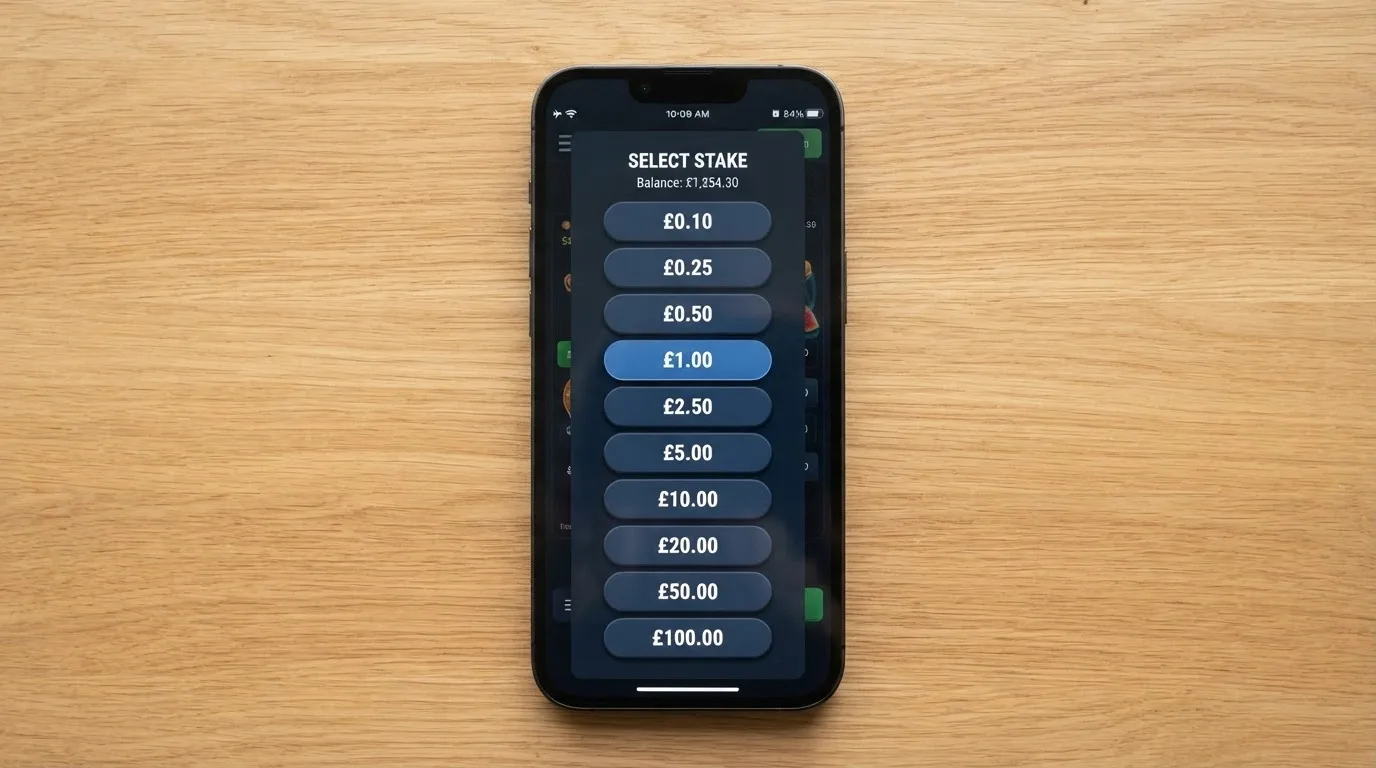
The psychological difference between demo and real-money play is the part the page cannot quantify. Demo mode costs nothing, and the player who plays for an hour in demo mode has not learned what it feels like to lose $50 in a session that returned $3. The two experiences are not the same, and the marketing line that “you can practise for free” elides the fact that practising for free teaches a player the buttons, not the stakes. A player who has staked real money at the minimum level for a session before scaling up to higher stakes is a player who knows what the volatility feels like in their own bankroll. A player who has not is a player who will find out at the table they cannot afford.
Free Pokies on iPhone: The Risk-Free Way to Test the Waters
Free pokies on iPhone are the right starting point for two distinct things, and confusing the two is how players end up at operators they should have walked away from. The first is the pokies themselves: Gates of Olympus in demo mode is the same game as Gates of Olympus in real-money mode, and fifty demo spins will teach a player the bonus triggers, the feature mechanics, the visual rhythm of a session, and the basic volatility profile. The second is the casino: demo mode on an operator’s site is the same lobby, the same cashier flow, the same game-loading experience as real-money mode, and a player who tests the casino in demo mode before depositing is a player who will know whether the site loads in two seconds or seven, whether the lobby is well-organised or a maze, and whether the game-filtering actually works on a phone screen.
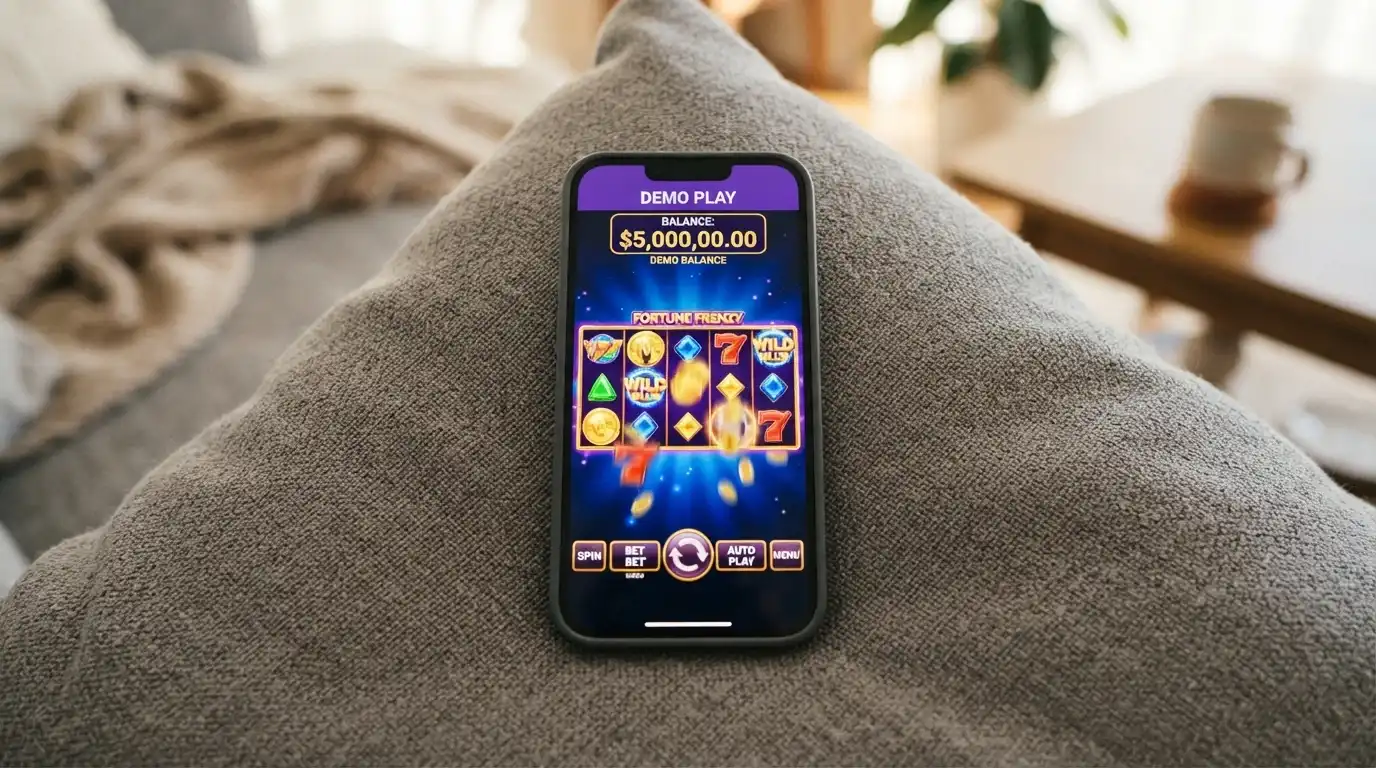
What demo mode does not teach is the things that only show up when money is on the line. Withdrawal speed is invisible in demo mode, because there is nothing to withdraw. Customer-support responsiveness is invisible in demo mode, because the player has not had a reason to contact support. The terms-and-conditions of the welcome bonus are invisible in demo mode, because the player has not claimed a bonus. And the feeling of a session that costs more than planned is invisible in demo mode, because the play-money balance does not feel like money. A player who treats demo mode as a complete test of an operator is a player who has tested the surface and missed the substance; a player who treats demo mode as a test of the games and the interface, and then tests the rest with a small real-money deposit, has the right division of labour.
Why Your iPhone Casino Bonus Is Smaller Than the Headline Number
The welcome-offer headline is a marketing number, and the gap between the marketing number and the real number is where the value of a welcome package lives. Three mechanics do the shrinking: the wagering requirement, the game-weighting table, and the bonus-validity window. A wagering requirement of 35x — the benchmark the industry orbits, set at operators like SpinLine (a non-featured reference) — means a AU$1,000 bonus requires AU$35,000 in turnover before the bonus balance converts to withdrawable cash. A wagering requirement of 25x — the lower end of the offshore range, set at Asino (also non-featured) — means the same AU$1,000 bonus requires AU$25,000. The difference is the AU$10,000 in additional turnover the player has to generate to clear the higher-multiple bonus, and that turnover is what the expected-loss calculation is built from.
The free spins that come bundled with a welcome package dilute the offer in their own way. A 400-free-spin bundle at 35x wagering on the spin winnings is a different bundle from the same 400 spins at zero wagering, and the difference is the AU$1,000-or-more the player would have had to generate in additional turnover to clear the spin winnings. The SkyCrown 400 free spins are bundled into the AU$8,000 welcome package; the Neospin 300 free spins are bundled into the AU$14,000. Both bundles have wagering conditions attached, and the page does not have the verified multiples to quote — but the reader should assume the offshore-market range of 25x–40x on the bonus, plus a separate multiple on the spin winnings, until the operator’s terms page says otherwise.
The wagering multiple is the number that matters, and the featured operators’ wagering multiples are not independently verifiable this run. The reader who reaches a welcome-offer page with a headline they like and a terms page they have not read is a reader who has not yet seen the offer. A useful heuristic: a welcome package with a headline in the AU$8,000–AU$14,000 range and a wagering multiple above 40x is a package where the expected cost of clearing the bonus exceeds the headline value for most players, because the turnover the multiple requires turns the bonus into a statistical expense rather than a statistical gain. A package with the same headline and a 25x multiple is a package where the clearing cost is more reasonable, and a package with a 25x multiple and a long validity window (60+ days) is the one a player should look for first.
No-Deposit Bonus Offers for iPhone Players: What’s Actually Available
The no-deposit bonus is the most searched-for offer in the iPhone-casino space, and it is the hardest to find with fair terms in the offshore market. No verified no-deposit bonus was found among the ten featured operators this run, and that absence is the data point. What a no-deposit bonus looks like when one is available — and they do exist, at operators outside this ranking — is a small credit (typically AU$10–AU$50) or a small bundle of free spins (typically 20–50) granted on sign-up, with a high wagering multiple (often 50x–60x), a low maximum cashout (often AU$100–AU$200), and a short validity window (often 7 days). The arithmetic is unforgiving: a AU$20 no-deposit credit at 60x wagering requires AU$1,200 in turnover, and the expected loss on that turnover at 96.50% RTP is AU$42. The credit is worth AU$20, and the cost of clearing it is AU$42; the player who completes the wagering requirement has paid AU$22 in expected loss for the privilege of keeping AU$20 in winnings. The credit is real, the bonus is real, and the deal is a bad one.
A deposit-match welcome offer with reasonable wagering — 25x–35x on a deposit the player was going to make anyway — is almost always worth more in expected-value terms than a no-deposit bonus with a 50x+ multiple. The reason is that the player’s own deposit is part of the turnover calculation, and the expected loss on the player’s own deposit at 96.50% RTP is 3.5% of the deposit amount — a known cost the player would have paid anyway. The bonus funds layered on top, with a 25x–35x clearing requirement, are an extension of the player’s bankroll at a known cost, and the deal works out roughly even. A no-deposit bonus, by contrast, charges the player a multiple on money the operator has given them, and the multiple is the cost of accessing the gift.
Paying from an Australian iPhone: What Works, What’s Blocked and Why
The payment methods that reach an offshore casino from an Australian iPhone split into two groups: the legal ones and the blocked ones. The legal ones are debit cards, bank transfer, PayID and Osko, and BPAY. PayID and Osko are the standout for iPhone users because the flow is mobile-native: open the casino cashier, pick PayID, confirm in the banking app with a fingerprint, and the deposit lands in seconds. The benchmark operators clear PayID deposits in three taps (SpinLine) or thirty seconds (Asino) — both non-featured references. Among the featured set, SkyCrown is the clearest case where instant PayID payouts are documented, and the same plumbing that makes the deposit fast makes the withdrawal fast when the operator wires it up correctly.
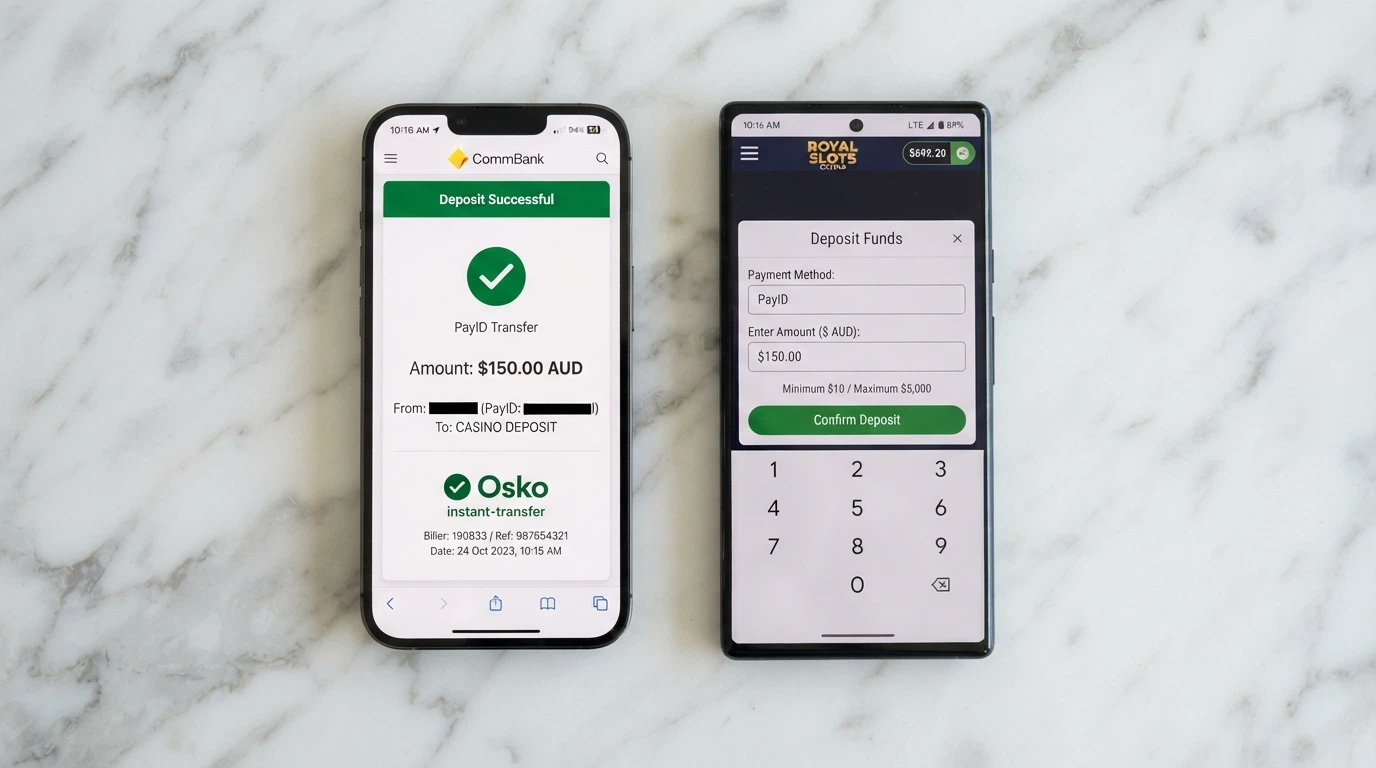
The blocked ones are credit cards, credit-related products, and cryptocurrency. The Interactive Gambling Amendment (Credit and Other Measures) Act 2023, in force since 11 June 2024, bans these methods for online wagering, with penalties for non-compliance reaching AU$247,500. The ban applies to AU-licensed operators; offshore operators are not bound by it, which is why a player can still find a credit-card deposit option at some offshore sites. The presence of that option is not a feature; it is a tell. An operator that offers a credit-card or crypto deposit to an Australian iPhone user is an operator that is not bound by Australian rules, and a player who uses that deposit route is a player who has chosen the offshore payment stack over the Australian one. From 1 January 2027, banks and payment providers gain express authority to block transactions to illegal gambling operators, which is the next tightening of the same wire.
The practical implication for an Australian iPhone user is short: use PayID or debit card, withdraw back to the same method, and treat the presence of a credit-card or crypto option on the cashier page as a sign that the operator sits outside the Australian payment regime. Withdrawal speed is the second test: an operator that returns a PayID withdrawal in under ten minutes has done the plumbing work, and an operator that holds a withdrawal for 24 hours with no explanation has not.
The Offshore Rulebook: What Australian Law Actually Says About iPhone Casinos
Online casino is prohibited in Australia, and the prohibition is not a recent development. The Interactive Gambling Act 2001 — the IGA — makes it an offence to provide an online casino, online pokies, or in-play sports betting to a person physically in Australia. The 2017 amendments closed the loopholes offshore operators had used to argue their services were legal, and gave the Australian Communications and Media Authority (ACMA) the enforcement and blocking powers that have produced the 1,564-site ISP block list. No state or territory issues a licence for online casino games. The product does not exist in the legal Australian market, and the operators that Australian iPhone users reach are providing a product the Australian law does not permit.
What the law does licence is wagering on sport and racing placed before the event begins, lotteries, and keno — through operators licensed by a state or territory. Licensing concentrates in the Northern Territory via Licensing NT, where licence terms run up to 20 years. The minimum age for all commercial gambling in Australia is 18. The player who uses a licensed wagering operator has a regulator with enforcement power, a self-exclusion register (BetStop) that binds the operator, a complaints body that can investigate, and a consumer-protection framework that sits behind the deposit. The player who uses an offshore casino has none of those things.
The ACMA is the federal enforcer. It investigates complaints, issues formal warnings, runs civil penalty proceedings, directs ISPs to block illegal sites, and refers operators for further enforcement. The blocking authority derives from section 313 of the Telecommunications Act 1997, which is the statutory basis for the ISP-level blocks that have removed 1,564 illegal sites from Australian reach since November 2019. The ACMA cannot recover money for an individual player — that power does not exist — and the player who has a dispute with an offshore operator has no Australian body to escalate to. The individual player is not prosecuted under the IGA; the Act targets the provider. “Not illegal for you” is not, however, the same as “safe,” and the section on player protection below is the part of the page that says so plainly.
The Interactive Gambling Act: No Online Casino Licence Exists in Australia
The IGA is the bedrock of the prohibition, and the 2017 amendments are the part that did the work. Before 2017, offshore operators could argue that their services were provided outside Australia and therefore outside Australian jurisdiction. The amendments closed that argument by extending the prohibition to any service provided to a person in Australia, regardless of where the operator is based. The ACMA’s enforcement powers — investigations, formal warnings, civil penalty proceedings, ISP-level blocking — all flow from the post-2017 framework. The block list of 1,564 sites (as of March 2026) and the 225+ illegal services that have withdrawn from the Australian market since 2017 are the measurable results.
The distinction between licensed and prohibited products is the part most relevant to an iPhone user. Wagering on sport and racing before the event begins is licensed and legal, through operators like Sportsbet, Ladbrokes, bet365, and the state TABs. Online casino games — the pokies, blackjack, roulette, baccarat, live dealer that an Australian player reaches through an offshore site — are prohibited. A player who uses a licensed wagering app has a regulated product; a player who uses an offshore casino has an unregulated one, and the difference is the entire reason this page exists.
The Reform: What Changes on 1 January 2027
The Interactive Gambling Amendment (Gambling Reform) Bill 2026 passed Parliament on 19 August 2026, and its measures commence on 1 January 2027. The reform does not legalise online casino — the prohibition remains — but it reshapes the advertising, inducement and payment environment around the legal wagering market in ways that affect how offshore operators reach Australian iPhones.
The advertising cap: from 1 January 2027, no more than three wagering ads per hour are permitted between 6:00 am and 8:30 pm on broadcast media, with a live-sport blackout running from 15 minutes before until 5 minutes after a live event. Radio ads are barred during school-commute times. Online wagering ads are restricted to logged-in, age-verified users with an opt-out. Ads are banned in sports venues and on uniforms. Athletes, celebrities and influencers are barred from promoting wagering. The combined effect is to reduce the volume of wagering advertising an Australian iPhone user sees in a day by a meaningful margin, and to remove the live-sport hooks that have been the most effective driver of impulse sign-ups.
The inducement ban: from 1 January 2027, direct marketing of inducements is prohibited for 14 days after sign-up, for three months after a player deregisters from BetStop, and indefinitely for at-risk customers. The post-BetStop window is the part that changes the calculus for a self-excluded player: the three-month cool-off is now matched by a three-month prohibition on the operator contacting that player with offers.
The payment-blocking authority: from 1 January 2027, banks and payment providers gain express statutory authority to block transactions to illegal gambling operators. The mechanism is not automatic — a bank will not block every transaction to an offshore casino on 1 January — but the legal authority to do so is now in place, and the operators that have been routing through Australian banks will find it harder to do so without detection.
Staying in Control: The Help That Exists for Australian Players
The offshore casino an Australian iPhone user reaches is not connected to any Australian player-protection system, which is the part of the page that the marketing sites do not print. BetStop — the National Self-Exclusion Register — binds Australian-licensed wagering services only. A self-excluded person can open an offshore casino account, deposit via PayID, and play within minutes of completing the registration. The offshore gap is the single most important thing a player should understand about the difference between a licensed operator and an offshore one, and it is the gap that the responsible-gambling section of any honest page has to address.
The help that exists, however, is real and free and available regardless of where the player has been playing. The National Gambling Helpline (1800 858 858) is free, confidential, and staffed 24/7. Gambling Help Online (gamblinghelponline.org.au) provides online chat and counselling. State-based services run face-to-face counselling in every state and territory. Self-assessment tools are available through Gambling Help Online. The 18+ minimum age is the line that a player below it should not cross, and the help lines are the line that a player above it should know about before they need them.
The numbers behind the help are the part that puts the rest of the page in proportion. About 2.1% of Australian adults — roughly 430,000 people — experience problem gambling (AIHW, 2022). Roy Morgan data from March 2026 puts gambling harm from own behaviour at 13.0% of the population (2,857,000 people), rising to 15.1% (3,320,000) when harm from others’ gambling is included. Risky gambling increased from 13.7% in 2024 to 19.4% in 2025, almost doubling since the COVID-19 lockdowns. Aboriginal and/or Torres Strait Islander Australians experience gambling harm at 27.1% compared to 14.6% for non-Indigenous Australians — a gap that has not closed. The help lines exist because the numbers are what they are, and a player who feels their own pattern shifting is a player who should call before the shift becomes a crisis.
BetStop: What the National Self-Exclusion Register Does — and Doesn’t Cover
BetStop launched on 21 August 2023. By 31 December 2025, the register had received 54,859 registrations, with 35,135 active exclusions. By 31 July 2026, the total had grown to 67,480 registrations, of which 41,290 exclusions were still active. Of the total registrants, 78% are under 40 and 38% have chosen a lifetime exclusion. One registration excludes a person from every Australian-licensed online and phone wagering service — roughly 150 operators — for a minimum of three months, with options to extend to six months, twelve months, or lifetime. The mechanism is one-stop: no need to contact each operator individually, no risk of missing one.
The outcomes data is the part that justifies the system. 77% of BetStop registrants surveyed reported a better quality of life after self-exclusion. 79% reported improved mental health. 96% either completely stopped (81%) or decreased (15%) their betting. The numbers are the case for the register, and they are also the case for the gap: 77% better quality of life applies to the players BetStop reaches, and the players BetStop does not reach — the offshore casino players — are the ones the data cannot count.
The gap is the part that matters for an iPhone user reading this page. An offshore casino is not connected to BetStop. A self-excluded person can open an offshore casino account, deposit via PayID, and play within minutes of the registration. The register covers the licensed wagering market, and the licensed wagering market is not where the offshore casino brands sit. The awareness data is the second part of the gap: only one in three wagerers (33.5%) know BetStop exists, and only about one in four Australian adults (26.5%) are aware of it. A player who has registered and a player who has not are both at risk of the offshore gap; the registered player has at least closed the licensed side of the door.
Where to Get Help: Helplines, Counselling and Self-Assessment Tools
The National Gambling Helpline is 1800 858 858 — free, confidential, staffed 24/7, with online chat and email counselling through Gambling Help Online at gamblinghelponline.org.au. The service is funded by the Australian Government and operated by state-based providers, which means the same number works from every state and territory. The 24/7 staffing is the part that matters when the impulse to play hits at 2 am and the player knows the call is free.
Self-assessment tools are available through Gambling Help Online and through several state-based services. The tools are short, anonymous, and designed to help a player gauge where their own pattern sits against the population norms. The 2.1% problem-gambling rate, the 13.0% harm-from-own-behaviour rate, the 19.4% risky-gambling rate — these are the population baselines, and a player whose self-assessment scores above the baseline is a player who should call the helpline before the next session, not after it.
State-based counselling is available face-to-face and by phone in every state and territory, with no referral required. The minimum age for all commercial gambling in Australia is 18, and the help services are available to anyone affected — the player, the player’s family, the player’s friends. An estimated 5.9% of Australian adults reported being harmed by another person’s gambling in the past 12 months, and the help lines are staffed for those callers too.
How We Evaluated These iPhone Casino Sites
The ranking above is built on the BLASK AU operators dataset, which tracks estimated Australian traffic share and revenue by brand. That dataset is the only signal that measures what Australian players actually do rather than what operators claim they offer, and it is the primary sort order for the table. Where a featured operator sits outside the top 20 of the dataset, the ranking reflects competitor coverage and the depth of verified welcome-offer detail; the page does not paper over the gap.
The verification sources behind the operator detail are: operator pages (for the licence jurisdictions and the published welcome offers), competitor reviews (for the mobile-UX descriptors and the provider lists where those have been confirmed), the ACMA register (for the legality backbone and the enforcement statistics), and the ITAA 1997 and ATO ruling IT 2655 (for the tax position). Where a fact could not be verified — a wagering multiple, a bonus validity window, a payout speed, a specific licence date — the page says so in the operator write-up and uses an em dash in the table.
The criteria that ordered the ranking, in order of weight: Australian traffic share (the primary sort), then verified mobile features (Safari PWA build quality, PayID support, withdrawal speed), then transparency signals (the Royal Reels running-RTP display, the Stake Curaçao licence), then welcome-offer size as a tiebreaker. The criteria that did not weigh: the size of an operator’s marketing budget, the number of “best of” listicles that name the operator, or any signal derived from the offshore brand’s own claims. The reader should treat the ranking as a starting point for their own evaluation, not as a verdict.
Frequently Asked Questions
Is It Safe to Use Offshore Casino Apps on My iPhone?
“Safe” depends on what you are comparing it to. On the technical side, established offshore operators use SSL encryption and RNG certification, and the iPhone browser session is as secure as any other mobile browser session. On the legal and consumer-protection side, the picture is different: no Australian consumer protection applies, BetStop does not cover the operator, the ACMA cannot recover money in a dispute, and the site can be ISP-blocked at any time — potentially with a balance still on it. The individual player is not prosecuted under the IGA, but the legal gap is the part the marketing pages do not print.
What Is BetStop and Does It Cover Offshore Casino Apps?
BetStop is Australia’s National Self-Exclusion Register, live since 21 August 2023. One registration excludes a person from every Australian-licensed online and phone wagering service — roughly 150 operators — for a minimum of three months, with options for longer terms or lifetime exclusion. By 31 July 2026, 67,480 people had registered, of which 41,290 exclusions were still active. BetStop does not cover offshore casino apps, and a self-excluded person can open an offshore casino account and deposit via PayID within minutes of the registration. The licensed side of the door closes; the offshore side stays open.
What Happens If I Win Money at an Offshore Casino — Do I Pay Tax in Australia?
Gambling winnings are not assessable income in Australia under section 6-5 of the ITAA 1997, and losses are not deductible under section 8-1. The ATO’s position applies regardless of where the operator is based, so an AU$5,000 win at a Curaçao-licensed offshore casino is treated the same as an AU$5,000 win at a land-based Crown casino in Melbourne. The exception is the business-of-gambling case — a professional punter whose gambling activity rises to the level of a business — where winnings become assessable and losses become deductible. The vast majority of casual players sit on the non-assessable side of the line.
How Do I Know If an iPhone Casino App Is Fair?
Fairness in the offshore space rests on two signals: published RTP and RNG certification. A reputable operator publishes the theoretical RTP for each game (Gates of Olympus at 96.50%, Power of Gods: Hades at 96.14%, Grab the Gold at 95.71% are verified examples), and the better operators — Royal Reels is the clearest case in the featured set — show the running RTP on the game info page. A Curaçao licence is a real licence, but the oversight it provides is limited; a player cannot independently verify RNG certification, and operator transparency is the best available signal. If the operator hides the RTP or the provider list, that is information too.
Can I Get a No Deposit Bonus at an iPhone Casino in Australia?
No verified no-deposit bonus was found among the ten featured operators this run. The no-deposit bonuses that exist in the broader offshore market typically come with high wagering multiples (50x–60x) and low maximum cashout caps (AU$100–AU$200), and the arithmetic is unfavourable: a AU$20 credit at 60x wagering requires AU$1,200 in turnover, and the expected loss on that turnover at 96.50% RTP is AU$42 against a AU$20 credit. A deposit-match welcome offer with 25x–35x wagering is almost always worth more in expected-value terms, because the player’s own deposit is part of the turnover and the expected loss on the deposit is a cost the player would have paid anyway.
Which iPhone Casino Apps Accept PayID Deposits?
PayID is the fastest deposit route for Australian iPhone users, settling through the Osko network in near-real-time. SkyCrown is confirmed as accepting PayID with instant payouts among the featured set; SpinLine and Asino are documented PayID-supporting operators outside the featured set. PayID support for the remaining featured operators is not independently verified this run — a player should check the cashier page before depositing. Debit card and bank transfer are the universal fallbacks, and the presence of a credit-card or cryptocurrency option is a tell that the operator is outside the Australian payment regime.
Your iPhone, Your Money, Your Call: Making Sense of the Offshore Casino Decision
The page above is the case for the reader’s own judgment, not a recommendation. The ten operators in the ranking are the brands Australian iPhone users are actually reaching, and the verification record on each of them is what the page has been able to confirm independently. Three of them — SkyCrown, Neospin, Royal Reels — have a meaningful verified detail set; the other seven are documented in terms of position, with the things a player cares about most marked as unverified. The legality section is the part that no operator write-up can change: every casino on this page is offshore, no Australian consumer protection applies to balances held with any of them, and BetStop does not cover any of them.
The three things to check before depositing anywhere are short. First, the current bonus terms on the operator’s own page — the wagering multiple, the game-weighting table, the bonus validity window, the maximum cashout cap, and the maximum-bet rule while a bonus is active. The headline number is the marketing number, and the terms are the real number. Second, PayID support on the cashier page, and the documented withdrawal time on the operator’s own help pages. A PayID withdrawal under ten minutes is the mark of an operator that has done the plumbing work; a 24-hour pending period is the mark of one that has not. Third, the mobile build quality in a demo session — the load speed, the crash frequency, the battery drain, the game-filtering on a phone screen. Demo mode costs nothing, and the test it enables is the test the player will not regret having done.
The responsible-gaming tools work regardless of where the player chooses to play. BetStop covers the licensed wagering market; the National Gambling Helpline (1800 858 858) and Gambling Help Online (gamblinghelponline.org.au) cover the rest. The 2.1% problem-gambling rate, the 13.0% harm rate, the 19.4% risky-gambling rate, the 27.1% Indigenous-harm rate — these are the numbers behind the help lines, and a player who feels their own pattern shifting is a player who should call before the shift becomes a crisis. The choice of operator is the reader’s, and the help is available before, during, and after that choice.
Published by the Live Casino Australia team.