
How Casino VIP Programs Actually Work for Australian Players
Current as of 18 October 2026 — operator terms cross-checked against the ACMA register and individual licence pages where applicable.

The headline figure on a casino VIP program is rarely the figure that matters. A six-tier ladder with custom bonuses at the top, a personal account manager from Gold level, and cashback multipliers climbing through one to two-and-a-half times all sound like the kind of thing the marketing department would build around. The arithmetic is less generous: at 35x wagering, a AU$2,000 welcome bonus requires AU$70,000 in turnover before any of it is withdrawable, and the house edge on most pokies quietly eats that turnover long before the player does. Every VIP programme on this page operates from outside Australia — no Australian online casino licence exists, none has ever existed, and the Interactive Gambling Act 2001 prohibition is the reason. This guide works through what offshore VIP programmes actually offer Australian players, what they cost in real turnover, and what the reader has and does not have by way of protection.
Table of Contents
- VIP Programmes at Offshore Casinos — What They Actually Look Like
- The Offshore VIP Casinos Australians Use — Every Programme Ranked
- Jackpot Jill — Wager-Free Spins and a Six-Tier VIP Ladder
- Rocket Play
- Skycrown
- JokaRoom Vip — Three-Step Welcome With a 40x Hurdle
- Casiny — Ten-Level VIP With No-Wager Cashback up to 25%
- VipLuck — Curaçao-Licensed, 35x Wagering, 300 Free Spins
- Wolf Winner — AU$5,500 Across Four Deposits at 50x
- Charmius — Seasonal VIP Bonuses, Tiered Cashback and Deposit Rebate
- Lizaro — 250% Match, 350 Free Spins and 15% No-Wager Cashback
- Black Pokies — 25 No-Deposit Midnight Spins on Registration
- The Legal Reality — Online Casino VIP Programmes Are Not Licensed in Australia
- VIP Bonuses — Why Your Welcome Package Costs More Than It Looks
- VIP Pokies and Live Casino — Where the High-Stakes Action Sits
- Crypto VIP Play — The Offshore Circuit’s Open Secret
- Responsible Gambling — The Help Australian VIP Players Actually Have
- How We Evaluated These VIP Programmes
- What an Australian VIP Player Should Actually Do With This Information
- Frequently Asked Questions
VIP Programmes at Offshore Casinos — What They Actually Look Like
What a Casino VIP Programme Is and Why Offshore Casinos Invest in Them
A casino VIP programme is a structured loyalty system that rewards high-volume play with escalating perks — higher cashback percentages, dedicated account managers, faster withdrawals, sometimes invitations to events the rest of the customer base never hears about. The basic mechanic is older than the offshore industry: a player wagers, the operator tracks, and at certain thresholds the operator opens doors that were closed at signup.
Offshore casinos invest in these programmes for the obvious reason — they retain high-deposit customers who would otherwise drift to the next brand — and for a less obvious one. The IGA prohibition means an Australian player who finds an operator they trust is hard to replace. Once a punter has verified an account, sorted a payment route, and found a few games they like, the friction of leaving for a rival brand is real. A six-tier ladder with custom bonus structures at the top is a way of converting that friction into tenure.
The comparison with Australian-licensed wagering loyalty schemes is instructive. A licensed wagering operator runs loyalty on sports and racing: points that convert to bonus bets, occasional money-back specials, the kind of reward structure a once-a-week punter actually uses. There is no AU-licensed loyalty programme for casino play, because there is no AU-licensed casino. Every VIP scheme that markets itself to Australian players sits outside the country, and every one of them does so without an Australian licence to lose.
Tier Structures — Bronze, Silver, Gold and Beyond
The standard offshore model runs four to six tiers, though the variance in the wild is wider than that. Jackpot Jill runs six tiers — Bronze through Royal — with cashback multipliers climbing from 1x at signup to a custom rate at the invitation-only top of the ladder. Charmius uses five (Bronze through Diamond) with cashback rising from 2% at Level 4 to 10% at Diamond. Casiny runs ten levels, the deepest structure in this ranking, with cashback up to 25% on losses at the upper end. The same operator family can stretch a five-tier ladder into ten by inserting sub-levels between the named tiers — the same perk landscape, sliced thinner.
What changes at each tier depends on the operator, but the typical pattern holds. Entry-level tiers offer a small cashback percentage, faster email support, and the standard withdrawal queue. Mid-tiers add a personal account manager — at Jackpot Jill from Gold, around A$5,000 lifetime wagered; at Casiny from level 5 and above. Upper tiers bring higher cashback multipliers, higher withdrawal limits, and invitations to events the casino does not advertise. The top tier — Diamond, Royal, or similar — is usually invitation-only, with terms negotiated rather than published.
What the tier structure actually delivers, in cash terms, varies enormously. A 2% cashback rate on losses at 5x wagering is worth very different money from a 25% cashback rate with no wagering. The gap between these two rates is not a matter of marketing nuance — it is a matter of whether the cashback changes the bonus’s real cost to the player or simply dresses it up.
How You Join — Comp Points, Wagering Thresholds and the Invitation-Only Ceiling
There are two paths into VIP status. The first is cumulative wagering: the operator tracks lifetime stakes, and at published thresholds the player steps up a tier. Jackpot Jill’s Silver tier opens at around A$1,000 lifetime wagered, Gold at roughly A$5,000, Platinum at roughly A$25,000. Charmius runs a similar model — entry tiers open at small multiples of the minimum deposit, with the top tiers reached after sustained volume. The exact thresholds are not always public; what is published is the principle: the more you wager, the higher you climb.
The second path is invitation. Operators keep the top tier off the published ladder because the terms are negotiated with the player — a custom bonus structure, a withdrawal ceiling matched to the player’s volume, conditions that vary case by case. This is where the highest-volume players end up, and it is also where the published rules stop applying.
Comp points — points earned per wager, redeemable for bonus money or perks — exist at some offshore brands and not others. No research in this set gives a universal formula for comp-point accumulation, and the honest framing is that the principle varies. What does hold is the lifetime-wagered milestone: a player who has put A$25,000 through the site is treated differently from one who has put A$2,500. The published tier threshold is the visible marker; the comp-point mechanic, where one exists, runs in parallel.
Status transfer between casinos is a common question in the affiliate-review space. No research in this set documents a specific transfer example, and the practice as it exists in the offshore market is opaque. A player who has held Diamond at one brand should not assume that status travels to another. The honest answer is that the practice exists in some form at some operators and that no player should plan around it without confirmation from the receiving brand.
VIP Hosts, Priority Support and the Perks That Come With the Lounge
A personal account manager is the perk that often matters more than the cashback rate. At Jackpot Jill, Gold tier and above gets a dedicated manager. At Casiny, the personal manager arrives at level 5. In practice, this means a named contact who knows the player’s history, processes withdrawals faster, and is the route for offers the published bonus page never sees.
Priority withdrawal processing is a related perk — VIP withdrawals move through the queue ahead of standard requests. Higher withdrawal ceilings are common at upper tiers, though operators differ on whether the ceiling is daily, weekly, or monthly. VIP lounges and exclusive events appear in marketing copy more often than they appear in published terms; the offer, where it exists, is by invitation rather than by tier name.
The honest summary: the perks that show up in published tier tables — the named cashback rate, the published threshold, the manager from Gold up — are the perks a player can expect. The perks that appear in marketing — VIP events, luxury gifts, holiday packages — are real for the highest-volume players and unlikely for anyone below the top tier. A reader choosing a programme on the published table is choosing well. A reader choosing on the marketing brochure is choosing on something else.
The Offshore VIP Casinos Australians Use — Every Programme Ranked
The table below ranks the ten offshore VIP casino programmes this page covers on four columns: licence status, welcome deposit bonus structure, free-spin terms where the operator runs them, and wagering requirement. Cells marked “Unconfirmed this run” indicate that this review did not confirm the value; readers should check the operator’s own terms page for current figures.

| Operator | Licence / AU Legal Status | Welcome Deposit Bonus | Free Spins (count + conditions) | Wagering Requirement |
|---|---|---|---|---|
| Jackpot Jill | Offshore — no AU casino licence (product prohibited) | A$7,500 across 5 deposits | 100 wager-free FS on Dragon Pearls (A$200 max-win cap) | Not clearly stated this run for deposit bonus; FS are wager-free |
| Rocket Play | Offshore — no AU casino licence (product prohibited) | Unconfirmed this run | Unconfirmed this run | Unconfirmed this run |
| Skycrown | Offshore — no AU casino licence (product prohibited) | Unconfirmed this run | Unconfirmed this run | Unconfirmed this run |
| JokaRoom Vip | Offshore — no AU casino licence (product prohibited) | 100% up to A$1,000 (1st) / 125% up to A$1,250 (2nd) / 150% up to A$1,500 (3rd) | Unconfirmed this run | 40x on bonus amount (A$10 max bet per spin) |
| Casiny | Offshore — no AU casino licence (product prohibited) | Up to A$1,975 + 500 FS (5-stage) | 500 FS (welcome package) | 40x within 7 days |
| VipLuck | Curaçao licence OGL/2024/129/0131 (issued 01/07/2024 to 130Group N.V.) — no AU casino licence | 100% up to AU$2,000 | 300 FS | 35x (AU$5 max bet, 30-day bonus, 7-day FS) |
| Wolf Winner | Offshore — no AU casino licence (product prohibited) | Up to AU$5,500 across 4 deposits (1st: 125% up to AU$2,000) | 125 FS on Wolf Saga (25/day over 5 days) | 50x on bonus funds + FS winnings |
| Charmius | Offshore — no AU casino licence (product prohibited) | Unconfirmed this run (VIP seasonal no-deposit: up to A$3,750) | Unconfirmed this run (welcome) | VIP cashback x5; seasonal no-deposit x15–x25 |
| Lizaro | Offshore — no AU casino licence (product prohibited) | 250% up to A$6,000 | 350 FS | 35x (spins valid 24h) |
| Black Pokies | Offshore — no AU casino licence (product prohibited) | Unconfirmed this run (deposit bonus) | 25 no-deposit Midnight Spins on registration | 50x (A$50 max cashout) |
The structure of the table matters. The licence column repeats “no AU casino licence” nine times in ten rows because that is what the law says. The Curaçao licence on VipLuck is the only verifiable licence number in the set — and a Curaçao licence, whatever it licenses, does not license the operator to take Australian players. The wagering column is where the page’s real comparison sits: 35x at VipLuck and Lizaro, 40x at JokaRoom and Casiny, 50x at Wolf Winner and Black Pokies, wager-free for the spins portion at Jackpot Jill. That spread is what changes the cost arithmetic, and it is the column the reader should read first.
Jackpot Jill — Wager-Free Spins and a Six-Tier VIP Ladder
Jackpot Jill’s standout feature is not the six-tier programme. It is the 100 free spins inside the welcome package, which carry zero wagering. Every other operator in this ranking attaches a 35x to 50x multiplier to its spin winnings; Jackpot Jill converts spin wins to cash directly.
The welcome package runs A$7,500 across five deposits, with the 100 free spins on Dragon Pearls at registration. The spin winnings carry an A$200 maximum-win cap, and the minimum deposit is A$20. Beyond the welcome, the VIP ladder runs six tiers — Bronze on signup with 1x cashback, Silver at roughly A$1,000 lifetime wagered (1.2x), Gold at roughly A$5,000 (1.5x, with a personal account manager attached), Platinum at roughly A$25,000 (2x), then Diamond and Royal as invitation-only tiers with custom bonus structures and multipliers climbing to 2.5x and beyond. The cashback multiplier is the mechanism — a 2.5x multiplier at Diamond means bonus cash is multiplied 2.5 times on conversion, which is materially different from a 1x entry-level conversion.
The wager-free spins are the headline. A player who registers, deposits the A$20 minimum, and runs the 100 Dragon Pearls spins through whatever the slot pays out walks away with cash in the withdrawal queue, not bonus money tied to a 40x or 50x turnover requirement. For a player who values the spin portion of a welcome package over the deposit-match portion, this is the strongest offer in the ranking.
Jackpot Jill is the strongest VIP programme in this ranking for an Australian player who values the spin side of a welcome package and who plans to wager in the volumes that move the tier ladder. The wager-free spins are genuinely unusual; the A$200 cap keeps the upside bounded. A reader chasing the A$7,500 ceiling should read the per-deposit terms before assuming the full total lands.
Rocket Play
Rocket Play is a fixture in AU-facing casino rankings, and its presence in this guide reflects that visibility. What its VIP programme actually looks like in terms an Australian player can plan around — the tier count, the cashback rate, the host access, the bonus conversion multiple — was not verifiable from public pages at the time of this review. The operator’s licence status is offshore; no AU casino licence exists for the product; the IGA prohibition applies.
That is the honest framing. A reader who is evaluating Rocket Play as a VIP option should go to the operator’s own terms page and read the current VIP terms directly, rather than relying on a third-party review that may have stale data or may have inferred a programme structure from a general template. The risk of depositing at a brand whose VIP terms are not publicly transparent is that the player discovers the terms when they try to withdraw — too late to do anything about them.
A reasonable baseline for a Rocket Play reader: assume standard offshore terms until shown otherwise. That means a deposit match with a wagering multiple in the 35x to 50x range, a tier ladder of four to six steps, a cashback rate climbing from low single digits at entry to maybe 10–15% at upper tiers, and a personal host somewhere in the middle of the ladder. Whether Rocket Play matches that baseline — better, worse, or otherwise — is the question the player should answer before depositing.
Skycrown
Skycrown sits in the same position as Rocket Play — a brand that surfaces in AU-facing rankings, that operates offshore, and whose VIP programme specifics this review could not confirm from public pages. The licence status is offshore; the IGA prohibition applies; every VIP programme on this page operates from outside the country.
The general VIP model at this tier of offshore casino is similar across brands: a tier ladder of four to six steps, a deposit-match welcome with a 35x to 50x wagering multiple, a cashback rate in the low single digits at entry level climbing to perhaps 10–15% at upper tiers, and a personal host from somewhere in the middle of the ladder. Whether Skycrown matches that baseline is the question the player should answer from the operator’s own current terms.
The transparency gap is worth naming plainly. An operator whose VIP programme is not publicly described in detail is harder to evaluate than one whose programme is published in full. A player who values predictability — knowing what the cashback rate will be at Silver, what the conversion multiple is at Gold — should choose an operator that publishes those numbers. A reader considering Skycrown should ask the operator’s support team for the current VIP terms before depositing, and treat the absence of a clear answer as information.
JokaRoom Vip — Three-Step Welcome With a 40x Hurdle
JokaRoom Vip’s welcome package is structured as a rising three-step ladder. First deposit: 100% match up to A$1,000. Second: 125% up to A$1,250. Third: 150% up to A$1,500. Total ceiling: A$3,750 across three deposits, with the match rate climbing rather than the deposit ceiling. The wagering requirement is 40x on the bonus amount — not deposit plus bonus — and the maximum bet during clearance is A$10 per spin.
The 40x on the bonus amount is the middle of the AU market. JokaRoom’s structure means a player claiming the full A$3,750 ceiling is working through a turnover requirement that varies by deposit. A first-deposit bonus of A$1,000 at 40x is A$40,000 in turnover; the third-deposit bonus of A$1,500 at 40x is A$60,000. The total turnover across the three deposits is meaningful — into six figures at the ceiling — and the max-bet cap of A$10 means the player cannot shortcut the requirement with a single large spin.
JokaRoom Vip rewards the player who values a rising-match welcome and is comfortable with a 40x multiplier on the bonus amount. The max-bet cap and the deposit-by-deposit structure prevent the player from racing through the requirement in a single session. The VIP programme beyond the welcome — the tier ladder, the cashback rate, the host access — is not detailed in the research available for this review.
Casiny — Ten-Level VIP With No-Wager Cashback up to 25%
Casiny’s VIP programme is the deepest in this ranking — ten levels, with cashback up to 25% on losses and no wagering requirements on the cashback. That second clause is what changes the maths: most cashback at most offshore brands comes with a 5x to 25x playthrough; at Casiny the cashback arrives as cash, withdrawable, no turnover attached.
The cash rewards run up to A$25,000 per level, and a personal manager arrives at level 5 and above. The welcome package is A$1,975 plus 500 free spins across a five-stage structure, with 40x wagering within a 7-day window — tight by AU market standards. The minimum deposit is A$20. The 7-day validity window is shorter than most competitors; a player who takes the welcome and does not clear the requirement within a week forfeits the bonus.
The 25% no-wager cashback is the structural advantage. A player at the upper levels of Casiny’s ladder receives a quarter of their net losses back as withdrawable cash, every period the cashback is paid. Combined with the personal manager from level 5 and the A$25,000 per-level reward ceiling, the upper ladder is genuinely different from a typical offshore programme — closer to a structured retention scheme than a marketing overlay.
Casiny’s edge is the 25% no-wager cashback — none of the other programmes in this ranking match that at the upper levels. The 7-day welcome validity is the sharp edge: a player who cannot clear 40x in a week should not take the welcome.
VipLuck — Curaçao-Licensed, 35x Wagering, 300 Free Spins
VipLuck is the only operator in this ranking with a verifiable licence number — Curaçao OGL/2024/129/0131, issued on 1 July 2024 to 130Group N.V. That licence is not an Australian licence, because no Australian online casino licence exists. It is, however, the only entry in the table that an Australian player can verify against a public register rather than relying on the operator’s own claim.
The welcome package is 100% up to AU$2,000 plus 300 free spins, with 35x wagering on the bonus amount, a AU$5 maximum bet during clearance, a 30-day bonus validity, and a 7-day free-spin validity. The minimum deposit is AU$20. The 35x multiplier is at the low end of the AU market — VipLuck is materially cheaper to clear than Wolf Winner’s 50x or Black Pokies’ 50x. The AU$5 max bet is the tightest cap in this ranking and the one a player is most likely to forget about when in the middle of a clearance session.
The VIP programme beyond the welcome — the tier structure, the cashback rate, the host access — is not detailed in the research available. A player choosing VipLuck on the welcome package is choosing on a verifiable licence, a moderate wagering multiplier, and a tight max-bet cap.
VipLuck fits a player who values a verifiable licence number and a moderate wagering multiplier more than the deepest tier ladder. The AU$5 max-bet cap means a player who likes A$10 or A$20 spins during a bonus should plan around it.
Wolf Winner — AU$5,500 Across Four Deposits at 50x
Wolf Winner’s welcome package is up to AU$5,500 plus 125 free spins across four deposits, with the first deposit carrying a 125% match up to AU$2,000 and 125 free spins on Wolf Saga delivered 25 per day over five days. The wagering requirement is 50x on bonus funds and on free-spin winnings — both — which is the high end of the AU market and the number that determines the package’s real cost.
The 50x multiplier is significantly higher than VipLuck’s 35x. A player who takes the full AU$5,500 ceiling is working through six-figure turnover before any withdrawal. The minimum deposit is AU$20. The free spins are gated at 25 per day, which means the player who wants to use the spins efficiently has to log in five days running.
Wolf Winner’s VIP programme beyond the welcome is not detailed in the research available. The welcome is the visible structure, and the 50x multiplier is the structural disadvantage compared to VipLuck (35x) or even JokaRoom (40x).
Wolf Winner is the right pick for a player who values the largest welcome total in this ranking and who can sustain the 50x turnover at the volumes required. A player with a smaller bankroll should look at the 35x or 40x operators first.
Charmius — Seasonal VIP Bonuses, Tiered Cashback and Deposit Rebate
Charmius is the operator with the most elaborate VIP bonus architecture in this ranking. The cashback runs from 2% at Level 4 to 10% at VIP Diamond, with 5x wagering on the cashback amount, a A$1.50 minimum qualifying cashback, and a maximum payout of 25 times the bonus amount per Thursday payout. That is a five-tier ladder with a defined payout cadence — cashback lands every Thursday, with the rate scaling with the player’s tier.
The seasonal VIP no-deposit bonuses run from A$150 at Bronze (25x wagering) to A$3,750 at Diamond (15x), with the wagering multiplier stepping down at the upper tiers as the bonus size steps up. The Daily Deposit Rebate offers up to 15% on net losses from three deposits per day, with win limits from A$300 at Bronze to A$15,000 at Diamond and wagering from 20x at Bronze down to 3x at Diamond. (No deposit insurance or payout guarantee applies.) The Live Casino cashback is a separate perk: up to 5% cashback on real-money balance from live sessions, with a A$150 minimum and A$1,500 maximum, activated by Friday 23:59 UTC.
The structure is dense, and the bonuses at the upper tiers are large. The seasonal no-deposit of A$3,750 at Diamond is the largest no-deposit bonus anywhere in this ranking. The daily deposit insurance layered on top of the tier-based cashback layered on top of the live cashback gives an upper-tier player three independent rebate streams.
Charmius is the right pick for a high-volume player who can climb the ladder and who values a structured cashback-plus-bonus architecture over a single large welcome. The seasonal no-deposit at Diamond is genuinely different from anything else in this ranking.
Lizaro — 250% Match, 350 Free Spins and 15% No-Wager Cashback
Lizaro’s welcome package is 250% up to A$6,000 plus 350 free spins at 35x wagering, with a A$20 minimum deposit and a 24-hour free-spin validity. The 250% match is the highest matched-deposit percentage in this ranking; VipLuck and Wolf Winner run 100% and 125% respectively on the first deposit. The 24-hour FS validity is the tightest in the set — a player who takes the spins and does not use them within a day forfeits them.
The cashback is 15% on net losses, credited every Monday, with no wagering. Like Casiny’s 25%, this cashback arrives as cash — no turnover attached. The cashback cadence (Monday) and rate (15%) make Lizaro competitive with Casiny at the upper levels, though the headline 25% at Casiny is higher than Lizaro’s 15%.
Lizaro’s tier ladder beyond the cashback is not detailed in the research available. A player choosing Lizaro on the welcome and the cashback cadence is choosing on the headline match rate and the no-wager cashback, both of which are visible in the operator’s published terms.
Lizaro is the choice for a player who values the highest matched-deposit percentage in this ranking and a weekly no-wager cashback. The 24-hour FS validity is the constraint — a player who cannot use 350 spins within a day is leaving value on the table.
Black Pokies — 25 No-Deposit Midnight Spins on Registration
Black Pokies is the only operator in this ranking offering a bonus with no deposit required at all — 25 Midnight Spins on registration, with 50x wagering on any winnings and a A$50 maximum cashout. That is the entire welcome offer that this review could confirm. The deposit bonus terms are unconfirmed.
The no-deposit bonus is the standout feature, and the conditions attached to it are the standard no-deposit architecture: 50x wagering is high, and the A$50 cap means even a hot run on the spins is bounded. A player who registers, runs the 25 spins, and cashes out below A$50 walks away with whatever the spins paid and nothing else. A player who wins more than A$50 keeps A$50 and forfeits the rest.
The deposit welcome package — the part of the welcome that most readers actually care about — was not confirmable from public pages at the time of this review. A player considering Black Pokies should treat the 25 no-deposit spins as a free trial and ask the operator about the deposit welcome before funding the account.
Black Pokies is the only operator on this list offering a bonus with no deposit required at all. The 25 spins are a free trial; the deposit welcome terms are the gap a player should close before funding.
The Legal Reality — Online Casino VIP Programmes Are Not Licensed in Australia
The Interactive Gambling Act — What It Actually Prohibits
The Interactive Gambling Act 2001 makes it an offence to provide online casino games, online pokies, and in-play sports betting to a person in Australia. There is no licence for online casino anywhere in the country — not federally, not in any state or territory. The prohibition was strengthened by the Interactive Gambling Amendment Act 2017, and the federal enforcer is the Australian Communications and Media Authority.

What is licensed is narrower than the marketing suggests. Wagering on races and sport placed before the event begins, lotteries, and keno — all through operators licensed by a state or territory. The Northern Territory Racing and Wagering Commission, administered through Licensing NT, is the de facto national licensor for online wagering; about fifty operators hold NT licences, running up to twenty-year terms. The loyalty programmes those operators run cover sports and racing, not casino play. There is no AU-licensed casino VIP programme because there is no AU-licensed casino.
The ACMA enforces the online prohibition directly. Since its first blocking request in November 2019, the regulator has had 1,564 illegal gambling and affiliate websites blocked by Australian ISPs, and more than 225 illegal services have withdrawn from the Australian market since enforcement strengthened in 2017. The ACMA investigates complaints, issues formal warnings, pursues civil penalty proceedings, and directs ISPs to block illegal sites. None of that enforcement reaches the individual player, which is the next point.
Offshore Casinos — Why They Accept Australians and What That Means for You
Offshore casinos take Australian players because the IGA targets the provider, not the punter. The individual player is not prosecuted. The site can be — and routinely is — blocked, fined, or pushed to withdraw, but the player who placed bets from Australia has committed no offence under the Act.
What the player has forfeited is the part the marketing tends to skip. No Australian consumer law applies to an offshore operator. No Australian dispute body can compel a payout. No BetStop registration covers the site, because BetStop binds Australian-licensed wagering providers only, and an offshore casino is not licensed in Australia. If the operator refuses a withdrawal, the player’s recourse is the licence-issuing jurisdiction’s complaint mechanism — for Curaçao, that is the Curaçao Gaming Control Board — and nothing else. The site can be blocked at any time, with a balance still sitting on it.
The credit-card and crypto ban that took effect on 11 June 2024 sharpens the offshore signal. Credit cards, credit-related products, and digital currency are banned as payment for online wagering in Australia; an operator faces penalties of up to A$247,500 for non-compliance. Legal deposit routes for licensed wagering are debit card, bank transfer, PayID and Osko, and BPAY. Any casino accepting Bitcoin from an Australian player is operating outside Australian law by definition. The crypto payment route is the cleanest signal that an operator is offshore.
Licensed Wagering vs Offshore Casino — What Each Loyalty Scheme Actually Gives You
A licensed wagering operator’s loyalty scheme covers sports and racing. Points convert to bonus bets. Money-back specials appear at major meetings. Activity statements are issued by law. Customer-set deposit limits and take-a-break periods are required under state and territory conditions. BetStop covers the operator. The operator holds an NT licence (or state equivalent), pays wagering tax — 5% on wagers minus payouts plus a 0.05% racing levy in the NT; point-of-consumption tax of 10–15% in the states — and is bound by Australian consumer law.
An offshore casino’s VIP programme covers pokies and live casino. Cashback rates are higher. Personal hosts arrive earlier in the tier ladder. Bonus structures are more elaborate. The player has none of the licensed protections above. No AU consumer law. No BetStop. No activity statement required by law. No deposit limit required by law. The site can block the player, freeze the balance, or close the account, and the player’s recourse is the operator’s licensing jurisdiction — for Curaçao, a complaint to the CGCB; for an unlicensed operator, nothing at all.
The trade-off in concrete terms: an Australian player who wants casino play has chosen offshore by default. The only AU-licensed alternative is no casino play. A player who values the AU protections should bet only with licensed wagering operators and only on sports, racing, lotteries, and keno. For the punter, choosing the offshore VIP programme means accepting the absence of Australian regulatory safeguards.
VIP Bonuses — Why Your Welcome Package Costs More Than It Looks
Welcome Packages — The High-Roller Deposit Ladders With Fine Print
| Operator | Welcome Bonus | Wagering Requirement |
|---|---|---|
| Jackpot Jill | A$7,500 (5 deposits) | FS are wager-free |
| JokaRoom Vip | A$3,750 (3 deposits) | 40x bonus amount |
| VipLuck | 100% up to AU$2,000 | 35x |
| Wolf Winner | Up to AU$5,500 | 50x |
| Lizaro | 250% up to A$6,000 | 35x |
The headline figures on offshore welcome packages — A$7,500, AU$5,500, A$6,000 — are ceilings, not balances. They are spread across multiple deposits, with escalating match rates that reward a player for staying past the first deposit. Jackpot Jill’s A$7,500 is across five deposits; Wolf Winner’s AU$5,500 is across four; Lizaro’s A$6,000 is a single 250% match.
The match-rate escalation is the pattern. Jackpot Jill’s structure climbs through its five deposits; JokaRoom runs 100%, 125%, then 150% across three steps; Wolf Winner leads with 125% on the first deposit. A player who takes only the first deposit is leaving a meaningful portion of the ceiling on the table — and, importantly, the wagering turnover attached to it.
The minimum deposit hurdle is the gate. Most of these packages open at A$20. JokaRoom’s first deposit, by contrast, requires a meaningful stake to claim the full first-deposit match — a much higher floor that filters for higher-volume players. A reader should match the minimum deposit to their actual budget, not to the ceiling they would claim if they hit the package perfectly.
The total figure is what it looks like: a ceiling. A player who claims every deposit of the Jackpot Jill package at the A$20 minimum and runs every bonus through the wagering requirement is working through significant turnover before any of it is withdrawable. The ceiling is not the figure that reaches the wallet.
No-Deposit VIP Bonuses — What Is Actually on Offer
Genuine no-deposit bonuses exist in the offshore VIP space, but they are rarer than the search results suggest. Black Pokies offers 25 no-deposit Midnight Spins on registration with 50x wagering and a A$50 maximum cashout. Charmius runs seasonal VIP no-deposit bonuses ranging from A$150 at Bronze (25x wagering) to A$3,750 at Diamond (15x) — the largest no-deposit bonus in this ranking, gated by tier. Other brands in the broader market offer similar mechanics — 20 free spins split between phone and email verification, with 50x wagering in 24 hours — but the principle is the same.
The conditions are the substance. A 50x wagering requirement on free-spin winnings, with a A$50 cashout cap, means the player who runs the spins, wins A$60, and tries to withdraw A$60 walks away with A$50 and a multiplier still attached. A player who wins A$50 or below walks away with everything. The ceiling is tight by design.
Most featured operators do not offer a no-deposit bonus. Jackpot Jill’s welcome requires a A$20 minimum deposit. JokaRoom’s first-deposit match starts well above the floor to claim the full ceiling. VipLuck, Wolf Winner, Casiny, and Lizaro all require a deposit. A reader who is filtering for no-deposit offers is filtering for a narrow set, and should expect the wagering and cashout caps that come with that model.
Cashback and Loyalty Rewards — Real Rates and Real Conditions
Cashback is the VIP perk that changes the arithmetic, because cashback returns a percentage of net losses — and the wagering requirement attached to it determines whether the player is getting a rebate or a recycled bonus.
Charmius runs cashback from 2% at Level 4 to 10% at VIP Diamond, with 5x wagering on the cashback amount. Casiny runs up to 25% with no wagering. Lizaro runs 15% with no wagering, credited Mondays. Jackpot Jill’s cashback comes through a multiplier system rather than a flat percentage — the 1x to 2.5x multipliers convert bonus funds at a rate that scales with tier.
The wagering question is the difference. Charmius’s 10% at 5x means a A$100 cashback arrives as bonus money tied to A$500 of turnover; Casiny’s 25% at zero wagering means a A$250 cashback on the same net loss arrives as withdrawable cash. The 15-percentage-point gap in headline rate understates the actual value gap once the wagering is factored in.
Payout cadence matters too. Charmius pays cashback every Thursday. Lizaro pays every Monday. Casiny’s cadence varies by level. A player who plans cash flow around the rebate should check the cadence — a programme that pays weekly is materially different from one that pays monthly.
The maximum cap is the ceiling on the rebate. Charmius caps at 25 times the bonus amount per Thursday payout. Live cashback at Charmius caps at A$1,500 per period. Lizaro’s 15% is uncapped in the available research but the rate is the rate — a player who wants larger absolute cashback needs a higher rate or a higher net-loss base, not just a higher tier.
Wagering Requirements — The Multiplier That Eats Your Bonus
A wagering requirement is the turnover the player must generate before a bonus becomes withdrawable. The standard AU range is 30x to 50x; pokies usually contribute 100% while table games contribute 10–20%. The multiple applies to the bonus amount, not the deposit — except where an operator specifies deposit plus bonus, which most do not.
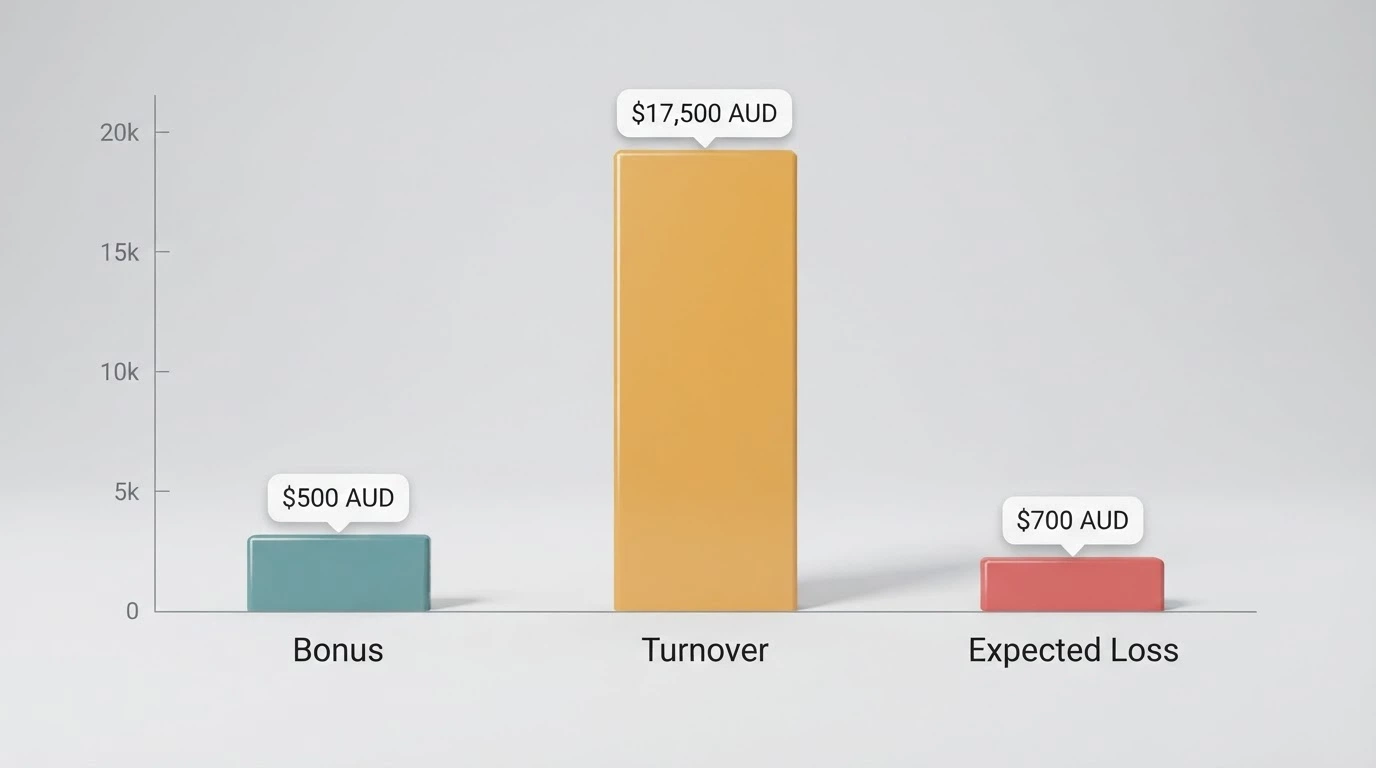
The arithmetic is the substance. A AU$2,000 bonus at 35x is AU$70,000 in turnover. At 50x, it is A$100,000. The expected loss on that turnover, at a 96% pokie RTP, is 4% of turnover — A$2,800 at the 35x scenario, A$4,000 at the 50x scenario. The bonus is positive in expected value only if the bonus itself exceeds the expected loss; the headline figure on the offer rarely does.
Take VipLuck’s welcome as the worked example: 100% up to AU$2,000 at 35x wagering. The bonus is AU$2,000; the required turnover is A$2,000 multiplied by 35, which is A$70,000. At a 96% pokie RTP, the expected loss on A$70,000 of wagering is A$70,000 multiplied by 0.04, which is A$2,800 — meaning the bonus costs the player more than the bonus pays on average. At Blood Suckers’ 98.00% RTP, the expected loss drops to A$70,000 multiplied by 0.02, which is A$1,400; the bonus becomes positive expected value at that title. At Bonanza Billion’s 95.97% RTP, the expected loss is A$70,000 multiplied by 0.0403, which is A$2,821 — almost identical to the 96% benchmark, with the high volatility changing the distribution of outcomes more than the expected value. This is a statistical estimate over many spins, not a guaranteed outcome for any single player; the title the player chooses moves the figure by nearly A$1,400 either way.
Max-bet caps are the secondary condition. JokaRoom caps at A$10 per spin during clearance; VipLuck caps at AU$5; Black Pokies’ 50x no-deposit spins carry their own cap. The cap is the speed limit on clearance: a player who would naturally wager A$20 per spin cannot, on a bonus, and the clearance time stretches accordingly. Validity windows are the other speed limit. VipLuck’s bonus expires in 30 days; the free spins in 7. Lizaro’s free spins expire in 24 hours. Falling short of the turnover requirement within that window means the bonus amount and any winnings are forfeited.
VIP Pokies and Live Casino — Where the High-Stakes Action Sits
High-Stakes Pokies — RTP, Volatility and What a VIP Player Should Actually Look For
Pokies dominate Australian online gambling. Every casino in one reviewer’s top eight reported pokies as 70% or more of their AU revenue. The metric a high-volume player should look at is not the theme — it is the RTP and the volatility.

RTP, or return to player, is the percentage of wagered money a pokie returns over a very large number of spins. A 96% RTP means a pokie returns A$96 of every A$100 wagered, on average, with the house keeping A$4. A 98% RTP pokie keeps A$2. The gap compounds fast at VIP staking levels. A player running A$100,000 of turnover through a 96% pokie loses an expected A$4,000; through a 98% pokie, an expected A$2,000. That A$2,000 is the difference between a bonus clearing comfortably and a bonus eating the bankroll.
Blood Suckers is the cleanest data point in the available research: 98.00% RTP, low volatility. Bonanza Billion sits at the other end: 95.97% RTP, sky-high volatility, random multipliers from 2x to 100x, and a maximum win of 15,000x stake. The 2.03-percentage-point RTP gap compounds across the turnover a VIP player runs; the volatility gap changes the shape of the session.
Volatility is the variance, not the house edge. A low-volatility pokie pays small amounts frequently; a high-volatility pokie pays rarely and in large amounts when it does. A high-volume player with a long session horizon is closer to the RTP number regardless of volatility. A player on a short session is more exposed — a high-volatility session can produce a string of dead spins that the RTP does not protect against. For a VIP player, volatility is the secondary metric after RTP, and it matters most for bankroll management during the session rather than for the long-term expected value.
Most pokie RTPs are not published per-title at the operator level. The two research points above are the data this review carries. A player who wants to choose on RTP should look for titles with publicly disclosed RTPs and should treat unverified RTPs as marketing copy. The difference between a 96% pokie and a 98% pokie, run across the turnover a VIP player generates, is a four-figure number that no theme screen tells the reader about.
VIP Live Dealer Tables — Private Tables, Higher Limits and the Magic-Host Experience
Live casino VIP is about table access. Higher betting limits than the standard floor. Private tables reserved for upper-tier players. Dedicated live hosts who know the player’s preferred game and stake. The architecture is the same across most major live-dealer providers, but the operator’s terms determine whether the player reaches it.
Charmius is the one operator in this ranking with a researched live-specific VIP perk: the Live Cashback, up to 5% cashback on real-money balance from live casino sessions, with a A$150 minimum and A$1,500 maximum, activated by Friday 23:59 UTC. That is a rebate on net losses at the live tables, paid weekly. It is the only live-cashback figure in the available research; the rest of the live VIP model — table limits, private-table availability, host access — varies by operator and is not detailed in the available data.
The games that typically carry VIP treatment are blackjack, roulette, and baccarat — the table games where high rollers concentrate. Pokies are a separate ecosystem; the “VIP live dealer” experience is a blackjack-and-roulette experience, with baccarat reserved for the highest-volume players in some programmes. A reader who is choosing a programme on the live-casino experience should ask the operator directly about table limits and private-table availability at the relevant tier, since the published bonus page rarely tells the whole story.
Crypto VIP Play — The Offshore Circuit’s Open Secret
Bitcoin, Ethereum and Crypto Deposits — How They Work for VIP Accounts
Crypto and VIP casino play are linked because they both operate outside Australian regulatory reach. The credit-card and crypto ban that took effect on 11 June 2024 — credit cards, credit-related products, and digital currency banned as payment for online wagering, with penalties of up to A$247,500 — means any Australian-licensed operator cannot accept these routes. Any casino taking Bitcoin from an Australian player is, by definition, offshore.

Crypto deposits work the same way at any operator that accepts them. The player sends Bitcoin or Ethereum from a personal wallet to a casino-controlled wallet address; the casino credits the account once the transaction confirms on-chain. Settlement is faster than bank transfer for most coins; the typical confirmation window is minutes for Bitcoin, faster for Ethereum or stablecoins. Limits are typically higher than fiat routes — the operator’s risk model is different for crypto, and the per-transaction ceiling is often generous. For a VIP player moving meaningful sums, the per-transaction ceiling matters.
The anonymity dimension is the appeal and the cost. Crypto deposits do not flow through the Australian banking system, and the player’s name does not appear on the deposit side of the casino’s ledger. The casino still knows the player has an account; what it does not have is the bank trace that an Australian debit card produces. For a player who values that separation, the route is the cleanest available. For a player who values recourse, the route removes it: the chargeback mechanism that exists for card payments does not exist for crypto, and a casino that refuses a crypto withdrawal has effectively won.
No AU-licensed operator can touch this market. The product — online casino — is prohibited; the payment route — crypto — is prohibited. The only operator that takes Australian players with crypto is the offshore operator, and the protections that apply to AU wagering do not apply.
Anonymous Play — What Privacy Costs at an Offshore VIP Casino
Crypto-enabled anonymous play removes the Australian identity trail. It also removes every safeguard that depends on identity. Know-your-customer verification is the mechanism through which licensed operators verify a player is who they claim to be; it is also the mechanism through which disputes are resolved, withdrawals are processed, and self-exclusion is enforced. An operator that does not verify identity has no basis to enforce a self-exclusion request, and no way for the player to prove a disputed withdrawal belongs to them.
BetStop does not cover offshore casinos. A player who has registered for BetStop self-exclusion is excluded from every licensed Australian wagering provider — about 150 to 190 of them. An offshore casino is not connected to the register and will keep accepting that player’s deposits. The BetStop registration is a strong, single-registration barrier against licensed wagering; it is no barrier at all against offshore casino play. The offshore blind spot is the most concrete harm of the offshore route, and it is worth stating plainly.
The VPN dimension is the second-order issue. A player who uses a VPN to make their location look offshore to the casino, or to make their location look onshore to a geo-blocked service, is operating outside the operator’s published terms. The operator’s recourse is to freeze the account; the player’s recourse is the operator’s licensing jurisdiction. Anonymous play is anonymous to the player, not to the operator — and the operator’s record of the player’s activity, identity documents where collected, and transaction history is the operator’s to keep.
A player who values privacy and accepts the loss of recourse has made an informed choice. A player who values privacy without knowing the cost has not.
Responsible Gambling — The Help Australian VIP Players Actually Have
BetStop — 67,480 Registrations and the Offshore Blind Spot
BetStop — the National Self-Exclusion Register — is the strongest player-protection tool Australia has. One registration excludes the person from every licensed online and phone wagering provider in the country. As of 31 July 2026, 67,480 Australians had registered; 41,290 of those exclusions were still active. Seventy-eight per cent of registrants were under 40, and 38% chose lifetime exclusion. The minimum exclusion period is three months; the maximum is lifetime.

The outcomes data is strong. ACMA-commissioned research found that 77% of people who registered for self-exclusion experienced a better quality of life; 79% experienced improved mental health; 96% said they either completely stopped betting (81%) or decreased their betting (15%). One registration produces a measurable change in gambling behaviour for nearly everyone who uses it.
The offshore blind spot is the gap that matters. ACMA has confirmed that when a person self-excludes via BetStop, they are excluded from all licensed wagering providers — but an offshore casino is not licensed in Australia, is not connected to the register, and will keep taking a self-excluded person’s money. BetStop binds around 150 to 190 licensed providers; it does not bind the ten operators in this ranking. A player who has registered for BetStop and then opens an account at an offshore casino has not protected themselves from that casino.
This is the most dangerous fact on this page. The Australian player who decides to take a break from gambling, registers with BetStop, and considers the matter closed has protected themselves only against licensed wagering. The offshore casino, which is the only place an Australian can play pokies or live casino online, is still open to them. The protection is real and meaningful for the licensed market; it is incomplete for the market that exists.
Deposit Limits, Cooling-Off and Activity Statements — Tools AU-Licensed Operators Must Offer
Australian-licensed wagering operators are required to offer customer-set deposit limits, activity statements, and cooling-off (take-a-break) periods under state and territory conditions. The exact requirements differ between jurisdictions — what is required in the Northern Territory differs from what is required in Victoria — but the broad obligations are consistent across the country.
Customer-set deposit limits let the player choose a daily, weekly, or monthly ceiling. The operator must honour the limit. Activity statements provide a record of play — deposits, withdrawals, time on site — that the player can review. Take-a-break is a temporary self-exclusion, distinct from BetStop, that blocks the player from a single operator for a defined period. Each of these tools is a licensed-wagering requirement, and none of them is a guaranteed feature at an offshore casino.
The 2026 reform tightens the inducement side of the equation. From 1 January 2027, direct marketing of inducements is prohibited for 14 days after a customer signs up, for three months after a person deregisters from BetStop, and indefinitely for customers identified as at risk of gambling-related harm. The reform also gives banks and payment providers express authority to block transactions to illegal gambling operators from that date — a tool that does not exist today, and that when it arrives will apply to offshore operators only.
Offshore casinos are not bound by any of the above. A player at an offshore casino has the protections the operator chooses to offer, which is to say the protections the operator markets. Some offshore operators offer deposit limits and self-exclusion at their discretion. None is required to. A player who values these tools should choose a licensed operator; a player at an offshore casino should set personal limits independently, because the operator’s tools are unreliable.
Help Services — 1800 858 858, Gambling Help Online and Where to Go
The National Gambling Helpline is 1800 858 858 — free, confidential, and staffed 24 hours a day, seven days a week, nationwide. Online chat and counselling are available through Gambling Help Online. BetStop registration is the official government route to self-exclusion. State-based services include Gambler’s Help Victoria. The prevalence data is the context: approximately 2.1% of Australian adults — roughly 430,000 people — experience problem gambling, and the Australian Institute of Health and Welfare put high-risk gambling at 1.8% in 2022. A model-based estimate published in the Journal of Gambling Studies put the number of Australians affected annually by their own or another person’s gambling at approximately 3.29 million, including roughly 1.38 million adult affected others. The annual health loss associated with gambling-related harm in Australian adults is estimated at over 400,000 Years Lived with Disability.

The infrastructure exists because the harm is real. The BetStop registration, the helpline, the online counselling, the state services — each is staffed and funded for a reason. A player reading this page because they are choosing where to play is in a different position from a player reading it because they need help. Both are real readers of this page.
How We Evaluated These VIP Programmes
The operators and programmes in this ranking were drawn from the AU operators landscape surfaced through current affiliate-review and comparison coverage, cross-checked against operator sites where programme terms are publicly disclosed. Each operator was checked against the ACMA prohibition status — and every operator in the ranking is offshore, because no online casino licence exists in Australia. Licence claims were checked against the issuing regulator’s register where one exists; VipLuck’s Curaçao licence OGL/2024/129/0131 is verifiable from the Curaçao Gaming Control Board’s public listings. The other operators in this ranking either hold licences from jurisdictions whose registers were not checked this run or are unlicensed in any verifiable sense.
The evaluation criteria were programme depth (tier count, cashback structure, host access), bonus terms transparency (whether the welcome package and VIP terms are published in detail), cashback structure (rate, wagering, cadence, caps), wagering burden (the multiple on the welcome and the per-spin cap during clearance), and licence verifiability (whether a licence number is on the public register). What the evaluation does not do is verify operator solvency, audit payout rates, or guarantee that any specific bonus term will be honoured at withdrawal. Those are outcomes only the player can test.
The legal framework is the same throughout: every operator in this ranking operates from outside Australia, none holds an AU casino licence, and the IGA 2001 prohibition applies to the product. The legal section above describes what that means for the player; the responsible-gambling section describes what protections exist and where the gaps are. This ranking is a comparison of programmes, not a recommendation of operators.
What an Australian VIP Player Should Actually Do With This Information
The page has established that every VIP programme open to Australians is offshore, that BetStop does not cover them, and that the bonuses carry real costs. The concrete steps that follow from those facts are short.
Verify the licence before depositing. The operator’s own claim is not verification — the issuing regulator’s register is. Curaçao, the Malta Gaming Authority, the Isle of Man, the UK Gambling Commission — each maintains a public list of licensees. An operator whose licence number cannot be found on the relevant register is an operator whose licence claim should be treated as unverified. The licence number on the footer of a casino’s homepage is not the register; the register is the register.
Calculate the wagering turnover before claiming any bonus. A AU$2,000 bonus at 35x is AU$70,000 of turnover. A A$1,000 bonus at 50x is A$50,000. The expected loss on that turnover at a 96% pokie RTP is 4%; at a 98% RTP, 2%. A player who claims a bonus without doing the arithmetic has not priced the offer. The headline figure is the marketing; the turnover figure is the cost.
Set a personal deposit and loss limit before playing, and treat it as the hard ceiling. The offshore operator’s deposit-limit tool, where it exists, is voluntary. The player’s own limit is not. A bankroll that is allocated to entertainment, separate from bills and savings, and that stops when spent, is the only deposit limit that protects the player regardless of what the casino offers.
Register with BetStop if gambling is causing harm. The 67,480 registrations and the 77% quality-of-life improvement figure are the strongest evidence on this page. BetStop does not cover the offshore casino, but it covers the licensed wagering market where most Australian gambling harm occurs, and the exclusion is a meaningful intervention. The 96% statistic — that nearly every BetStop registrant stopped or decreased their betting — is the kind of outcome a player in trouble should weight heavily.
Use payment methods that leave a trace. A debit card or bank transfer produces a record the player can review; crypto removes it. The privacy that crypto offers is real; the recourse it removes is also real.
Know that AU consumer law does not reach offshore. The Australian Consumer Law, the ePayments Code, the Australian Financial Complaints Authority — none of these reach an offshore casino. The player’s recourse is the operator’s licensing jurisdiction, and that jurisdiction’s complaint mechanism is the only path to a disputed withdrawal.
Frequently Asked Questions
What welcome bonuses and cashback rewards are available at VIP casinos accepting Australian players?
The featured operators run welcome packages ranging from Black Pokies’ 25 no-deposit Midnight Spins (50x wagering, A$50 max cashout) to Wolf Winner’s AU$5,500 across four deposits at 50x, with JokaRoom’s three-step ladder (100%/125%/150% up to A$3,750) and Lizaro’s 250% match up to A$6,000 sitting in between. Cashback runs from Charmius’s 2% to 10% at 5x wagering to Casiny’s 25% with no wagering and Lizaro’s 15% weekly with no wagering. The headline figure is rarely the figure that reaches the wallet.
Does BetStop cover VIP programs at offshore casinos, and what protections do Australian players have?
BetStop covers around 150 to 190 Australian-licensed wagering providers — not any of the offshore casinos on this page. A player who self-excludes via BetStop is excluded from licensed wagering only; an offshore casino will keep accepting their deposits. The ACMA has confirmed this gap explicitly. The National Gambling Helpline (1800 858 858) and Gambling Help Online are the protection that applies to the player regardless of which operator they use.
What is the difference between a licensed Australian wagering operator’s loyalty program and an offshore casino’s VIP scheme?
A licensed wagering operator’s loyalty programme covers sports and racing, includes activity statements and customer-set deposit limits by law, and binds the operator to Australian consumer law and BetStop. An offshore casino’s VIP scheme covers pokies and live casino, has no AU consumer law obligation, no BetStop coverage, and no statutory deposit-limit requirement. The licensed scheme is more conservative; the offshore scheme offers casino play that the licensed market does not.
Can I use crypto or credit cards to fund a VIP casino account in Australia?
Credit cards, credit-related products, and digital currency (crypto) are banned as payment for online wagering in Australia since 11 June 2024, with penalties of up to A$247,500 for non-compliance. Any casino accepting Bitcoin or a credit card from an Australian player is operating outside Australian law by definition. Legal deposit routes for licensed wagering are debit card, bank transfer, PayID and Osko, and BPAY.
How does the 2026 Interactive Gambling Amendment reform affect online casino VIP programs?
The Interactive Gambling Amendment (Gambling Reform) Bill 2026 passed Parliament on 19 August 2026, with measures commencing 1 January 2027. The reform introduces advertising caps (no more than three wagering ads per hour between 6 am and 8:30 pm), a live-sport blackout, a ban on athlete, celebrity and influencer wagering promotion, and express authority for banks and payment providers to block transactions to illegal gambling operators. It does not legalise online casino in Australia — the IGA 2001 prohibition continues to apply to the product itself.