
Casino Bonus Codes in Australia: What the Codes Unlock, What They Cost
Verified against the ACMA’s enforcement record and operator terms pages as of 18 October 2026.
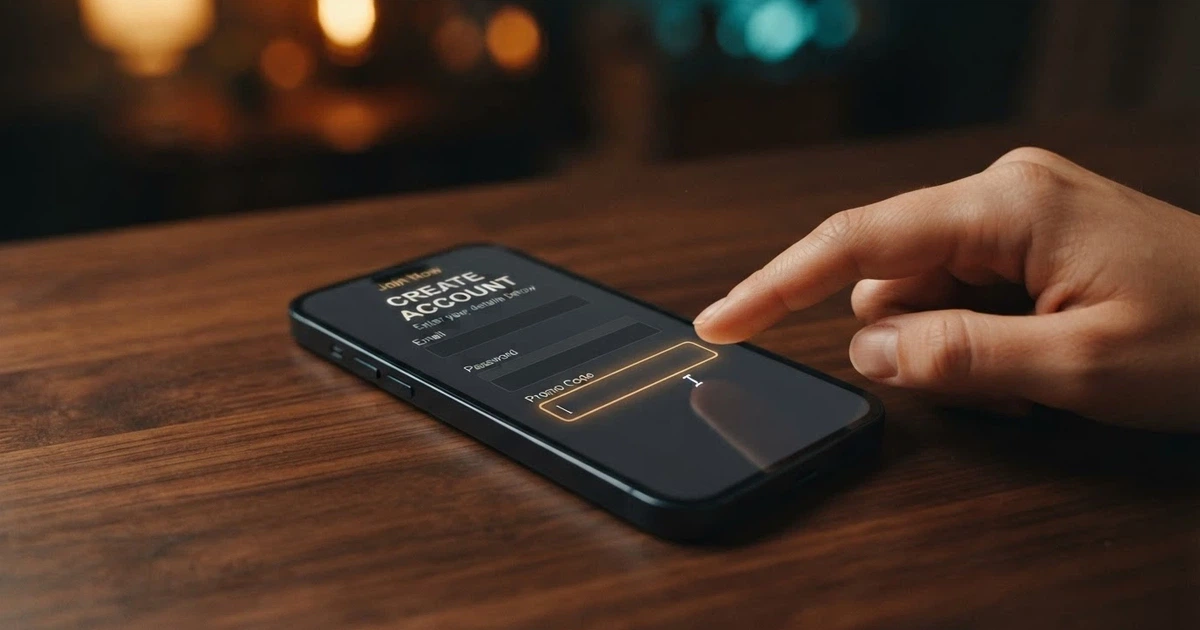
A casino bonus code is a short text string that an Australian player enters at sign-up or in the cashier to claim a specific promotional offer. None of those codes unlock anything inside Australia. There is no licensed online casino in the country — the Interactive Gambling Act 2001 makes providing one a criminal offence, and the Australian Communications and Media Authority actively blocks the offshore sites that target Australian players. Every bonus code on this page routes to a brand operating under a Curaçao, Anjouan or Kahnawake licence. That single fact shapes the arithmetic, the risk and the protection (or absence of it) on every offer below.
The codes themselves are not exotic. They are short alphanumeric strings typed into a field — sometimes labelled “promo code”, sometimes “coupon”, sometimes “bonus code” — during registration or when making a deposit. What sits behind the string is the actual product: a no-deposit free chip, a batch of free spins on a named pokie, a percentage match on a first deposit, or a tiered welcome package spread across several deposits. The code is the door key. The room it opens is what costs the punter time and, often, money.
Table of Contents
- Why Every Casino Bonus Code in Australia Comes From Offshore
- The Bonus Codes Australian Players Actually Get — and What They Cost
- Claiming Bonus Codes on Mobile — What Changes and What Doesn’t
- The Law Australia’s Casino Bonus Pages Won’t Tell You About
- When a Bonus Code Becomes a Problem — Safer Play for Australian Punters
- Offshore Casinos with Bonus Codes for Australians — How Their Offers Stack Up
- How We Evaluated These Casino Bonus Codes
- What an Australian Punter Should Actually Do With a Bonus Code
- Frequently Asked Questions — Casino Bonus Codes in Australia
Why Every Casino Bonus Code in Australia Comes From Offshore
The reason every bonus code in this market points offshore is structural. Australia has never licensed an online casino. The Interactive Gambling Act 2001 prohibits the provision of online casino games and online pokies to persons physically in Australia, and the 2017 amendments gave the ACMA the power to direct ISPs to block offending sites, issue formal warnings and pursue civil penalty proceedings. The licensed Australian wagering market covers racing, sports and lotteries — not casino lobbies in the offshore sense. That is why the high-street wagering brands focus on racing and sports, not full casino products. None of those licensed brands publishes a casino bonus code for Australian players, because there is no casino product to promote under an Australian licence.
What a casino bonus code actually is
A casino bonus code is a marketing flag. It tells the operator’s system that this player arrived via a specific promotional track and should be assigned the offer attached to that track. Codes let operators run several welcome tiers at once, segment campaigns by traffic source and measure which affiliate sent the player. From the player’s side, the code changes which bonus appears in the account after sign-up or deposit — entering nothing usually triggers a default offer, but operators also use codes to lock in a higher-value tier or a no-deposit chip that is not advertised on the homepage.
Codes are not a magic extra. They do not create value that the operator does not fund. They route a player to one of the offers already loaded into the platform’s bonus engine. The actual cost is in the terms attached to the offer: the wagering multiplier, the game weighting, the cashout cap, the validity window and the maximum bet during clear-down. None of those is optional, and none is negotiable after the code goes in.
How bonus codes work vs plain no-code offers
No-code offers are applied automatically. The moment a new account makes a qualifying deposit, the default welcome bonus appears in the account balance, no string required. This is the dominant pattern for first-deposit matches at offshore casinos: the operator does not need a code because it only runs one welcome tier at a time.
Codes come into play when an operator runs multiple concurrent welcome tiers, or when an affiliate has negotiated a private offer. A code also shows up when the operator wants to put a special — a no-deposit free chip, an extra batch of free spins, a reload — behind a string rather than letting every account grab it. In short, codes are how an offer gets segmented. They are the marketer’s tracking and targeting tool, and the player’s way of unlocking a specific promotional tier that may be larger, smaller or differently structured than the default.
Where to enter a bonus code — registration, cashier or promo section
There are three common entry points. The first is during registration, where a “promo code” or “bonus code” field sits below the email and password boxes. Entering a code there ties the offer to the new account from the moment it is created. The second is in the cashier, where a code field appears when making a deposit; this is where a code-gated reload or a no-deposit activation usually goes. The third is a dedicated promo or bonus section inside the account, where a player pastes a code to claim something already on offer.
What happens when a code is entered in the wrong place depends on the operator. Some systems silently accept it at deposit and apply the offer. Others reject it with a generic error message. A small number of operators treat the code as having been redeemed the first time it is read, regardless of where. The safe sequence is to enter the code exactly where the operator’s promotional instructions tell you to enter it — usually one of those three places — and not to assume a string entered at sign-up will still be valid at the cashier.
The terms every bonus code carries — and why reading them matters
A code unlocks an offer, not a payout. The terms printed underneath decide what the offer actually pays. The five numbers to read before claiming any bonus code in Australia are: the wagering multiplier (commonly 30x to 50x on the bonus, sometimes on the deposit plus the bonus), the game contribution weighting (pokies usually contribute 100%, table games typically 10% to 20% of every dollar wagered), the maximum cashout (especially on no-deposit offers, where A$100 is a common ceiling), the validity window (most no-deposit offers expire within 3 to 7 days of activation) and the maximum bet during the clear-down (often A$5 to A$7.50 per spin, with anything above voiding the bonus and any winnings tied to it).
Skipping those numbers is how a player ends up surprised. A A$50 no-deposit free chip at 40x wagering means A$2,000 of turnover before any withdrawal — at A$0.10 a spin, that is 20,000 spins. Even assuming five seconds per spin and only the bonus amount is wagered, that is roughly 28 hours of continuous play before the bonus clears. Most players never read the math in those terms before entering the code. The marketing works precisely because few do.
The Bonus Codes Australian Players Actually Get — and What They Cost
Bonus codes for Australian players come in three broad shapes: no-deposit offers (free chips and free spins credited before a deposit), first-deposit matches (a percentage of the deposit added as bonus money), and tiered welcome packages (a match spread across several deposits, usually with a free-spin component on at least one tier). The arithmetic on each is different. The cost in time is almost always the same: many thousands of spins, often compressed into a few days by the validity window.
No-deposit bonus codes — the offer that asks for nothing upfront
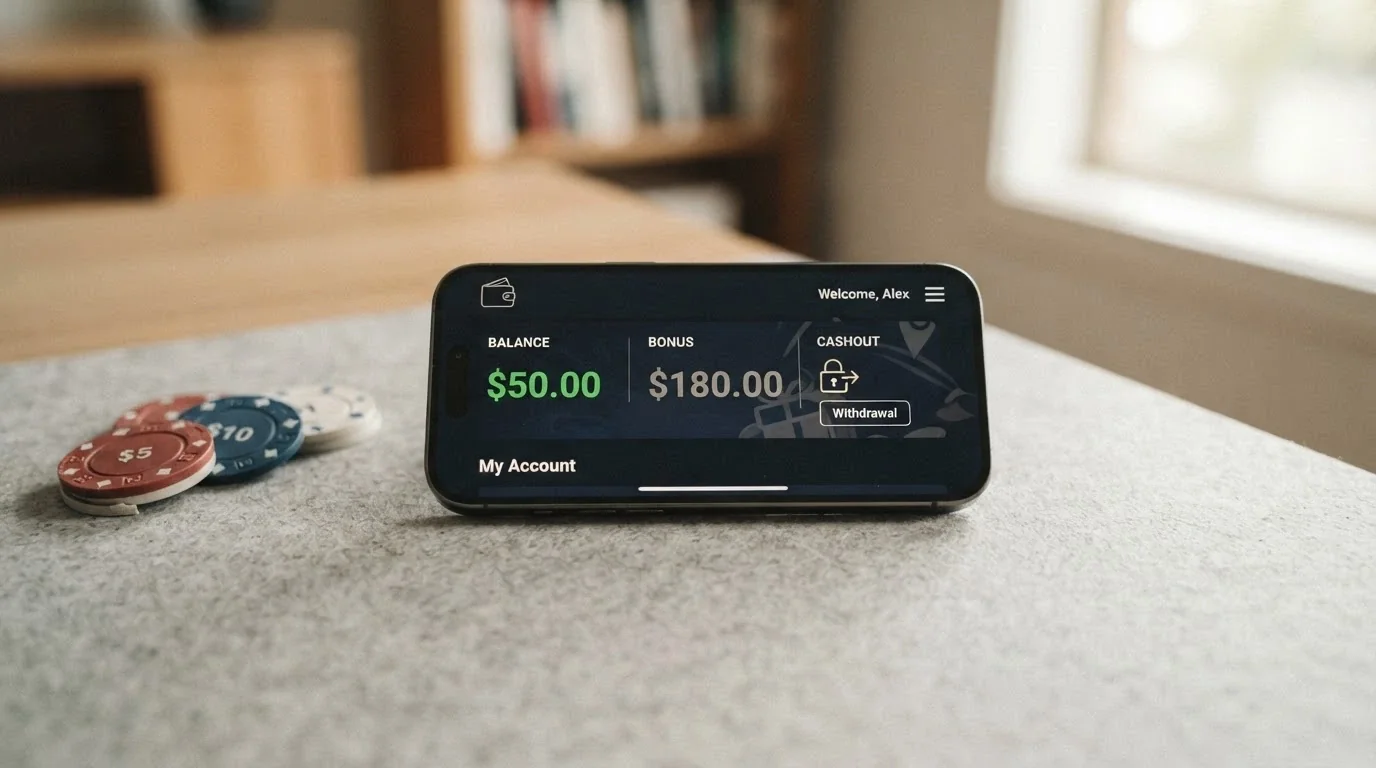
A no-deposit bonus code is the most common reason an Australian player searches for “bonus code” in the first place. The offer is credited without the player depositing: typically a free chip of A$10 to A$50, or a batch of 10 to 100 free spins on a named pokie, sometimes after a phone-verification step. The offer looks generous because the player has risked nothing. The terms underneath tell a different story.
The cashout cap is the first number that deflates the headline. A A$50 no-deposit free chip on one Curaçao-licensed brand is capped at A$180 cashout, which means anything the player wins above that figure during wagering simply disappears from the balance at conversion. The minimum cashout threshold itself sits around A$100 — below that level, the effort of meeting wagering rarely justifies the reward. The standard minimum spin value is A$0.10, and reputable aggregators exclude offers with lower spin values because the clear-down arithmetic breaks down at sub-A$0.10 stakes.
The wagering is the second number. Even on a small no-deposit, a 40x bonus wagering requirement on A$50 means A$2,000 of required turnover before any withdrawal. At A$0.10 a spin, that works out to 20,000 spins. Assuming only the bonus amount is wagered and an average of five seconds per spin, the play time to clear runs close to 28 hours of continuous play. Most no-deposit codes carry a 3 to 7 day expiry window. A punter who treats the offer as a 28-hour grind compressed into a week finds out quickly why the marketing language around no-deposit bonuses uses words like “free” and “instant” without quoting the wagering figure.
The arithmetic on a smaller no-deposit tells the same story at lower scale. A A$10 no-deposit at 35x wagering means A$350 of required turnover, or 3,500 spins at the A$0.10 minimum stake. That works out to roughly five hours of continuous play for a bonus that pays out at most the cashout cap. At the upper end of the typical wagering range — 50x on the same A$50 free chip — the required turnover rises to A$2,500, or 25,000 spins, or close to 35 hours of play. The spread between 30x and 50x on a single no-deposit chip is the difference between 21 hours and 35 hours of grind for the same headline offer. No-deposit codes are not a payday. They are a low-cost trial of a platform the player has no other cheap way to evaluate, and the trial costs roughly a working week of continuous play to clear.
Free spins and free chip codes — what each spin is actually worth
Free spins and free chips are both no-deposit offers, but their mechanics differ. Free spins land on a single named pokie at a fixed stake — commonly A$0.10 to A$0.20 per spin — with any winnings treated as bonus money subject to wagering. Free chips land as a balance the player can usually spread across multiple games, subject to the operator’s game weighting rules.
Take a batch of 50 free spins at A$0.20 each. The headline number — “50 free spins” — sounds like a meaningful gift. The stake value tells a more honest story: 50 × A$0.20 = A$10 of total turnover from the spins themselves, before any win multiplier applies. If the pokie returns its published long-term RTP and the player clears the wagering, the bonus converts to a small cash balance subject to the cashout cap. The marketing figure is the count of spins, not the expected return.
Game weighting tightens the picture. Pokies almost always contribute 100% of every dollar wagered toward clearing the bonus. Table games — blackjack, roulette, baccarat — typically contribute only 10% to 20%. A punter who tries to clear a no-deposit bonus by betting A$10 a hand on blackjack finds out, often too late, that only A$1 to A$2 of every A$10 counts toward the A$2,000 wagering requirement. The bonus becomes effectively un-clearable in the validity window at any reasonable stake. The 100% contribution on pokies is not generosity; it is the only path through the wagering requirement inside the validity window.
The distinction between “free spins” and “free chip” matters less than it sounds. Both end up the same way: bonus money, wagering requirement, capped cashout. The player who reads both types of code as identical marketing wrappers for a low-stakes trial is reading them correctly.
Deposit-match welcome codes vs claiming without a code
Most deposit-match welcome bonuses do not need a code. The default offer applies automatically once a new account makes a qualifying deposit. The code exists where an operator runs multiple concurrent welcome tiers, or where an affiliate has negotiated a private structure. The default offer is rarely the highest tier.
Tiered welcome structures are common at the larger offshore brands. A four-tier package might offer 120% on the first deposit (up to A$1,200 with 125 free spins), 100% on the second (up to A$1,000 with 75 free spins), 75% on the third and 100% on the fourth — totalling up to A$8,000 in bonus money plus 400 free spins across all four deposits. The first-deposit tier often scales by deposit size: 50% match for deposits of A$20 to A$50, up to 125% for deposits of A$250 or more. Reading the tier table before depositing matters; the difference between a A$20 deposit and a A$250 deposit can be 75 percentage points of bonus match on the same day.
Where a code does gate a welcome package, the value tends to be higher than the default no-code offer — that is why the operator hides it behind a string. The trade-off is the same: a larger bonus carries a larger wagering obligation. A first-deposit match of A$1,200 at 40x wagering means A$48,000 of required turnover before any withdrawal is permitted. At A$0.10 a spin, that is 480,000 spins, or close to 667 hours of continuous play. The figure explains why no serious player clears a full welcome package on its own — they either clear it partially, switch to lower-house-edge play during clear-down, or move on after the first tier.
Wagering and cashout — the conditions that decide whether a code pays
The wagering multiplier and the cashout cap are the two numbers that turn a bonus code from a gift into a maths problem. Most Australian-facing offshore offers use bonus-only wagering as the base (the wagering applies to the bonus, not to the deposit plus the bonus), but a meaningful share of deposit bonuses use deposit-plus-bonus as the base, which roughly doubles the required turnover. Reading the wagering base in the terms matters as much as reading the multiplier itself.
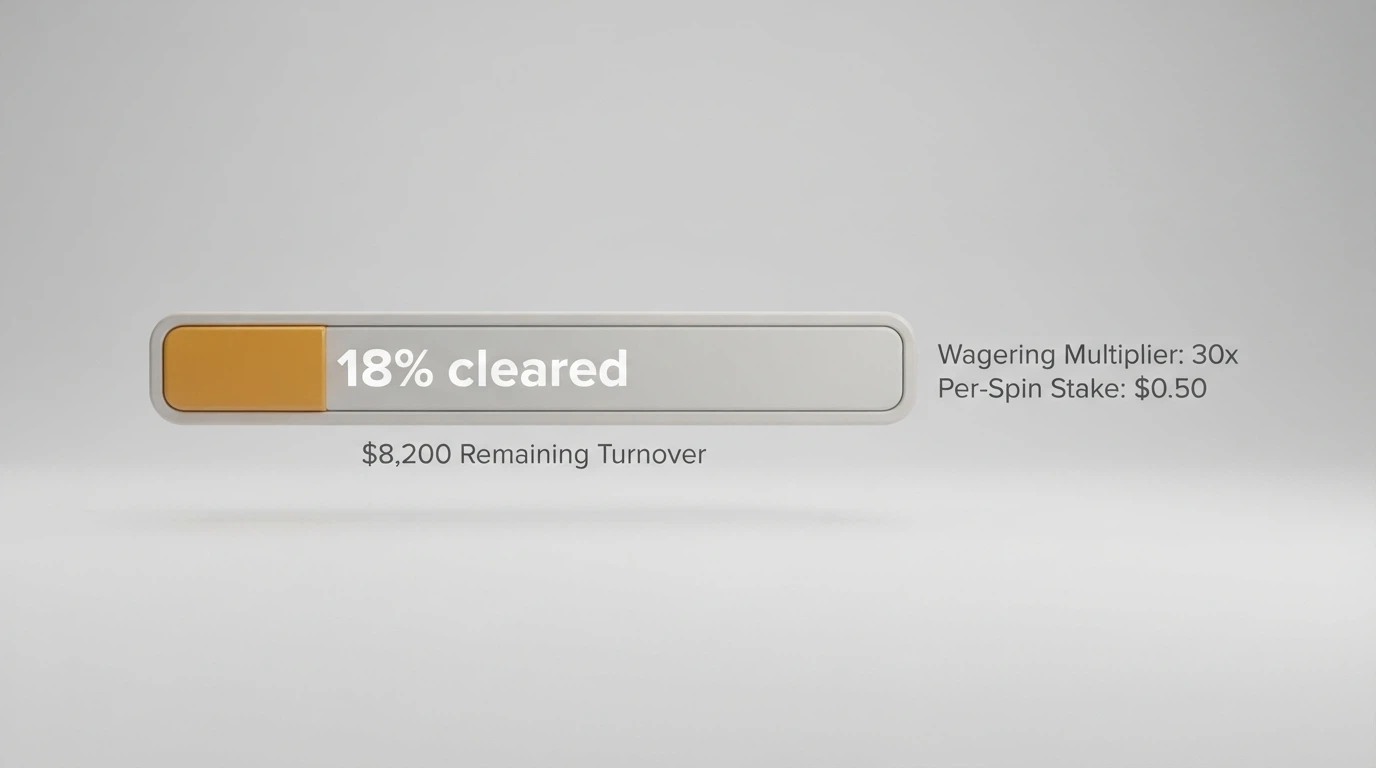
Game contribution weighting is the third variable. Pokies 100%, table games 10% to 20% is the standard split. A player who clears a bonus on blackjack at A$10 a hand effectively needs ten times the number of hands they would have played on pokies at the same stake. The validity window closes that gap; at 3 to 7 days on most no-deposit offers, the player does not have time to grind through table games at the reduced contribution.
The max-bet rule is the silent killer. Most offshore offers cap the bet during clear-down — typically A$5 to A$7.50 per spin on pokies. Exceeding the cap, even once, voids the bonus and the winnings tied to it. The cap exists partly to stop players from racing through wagering in a few giant bets and partly to protect the bonus balance against high-variance runs. Either way, the cap is enforced, and “I didn’t realise” is not an accepted defence when the player tries to withdraw.
The cashout cap on no-deposit offers is the final wall. A$100 is the typical minimum threshold below which operators decline withdrawals. A$180 is a common cap on A$50 no-deposit chips. Anything above the cap is removed from the balance at the moment of conversion. The cap is the reason no-deposit bonuses feel stingy to players who actually win during wagering: the offer pays the same maximum regardless of how well the player ran during the clear-down.
The table below compares the four common bonus-code types by the three numbers that decide whether a code pays. The figures are typical bands drawn from the offers surveyed for this page, not the maximum or minimum across the entire offshore market.
| Bonus Code Type | Typical Wagering | Validity Window | Max Cashout |
|---|---|---|---|
| No-deposit free chip | 30x–50x | 3–7 days | A$100–A$180 |
| No-deposit free spins | 30x–50x on winnings | 3–7 days | A$100–A$180 |
| First-deposit match | 30x–40x | 7–14 days | Varies; sometimes uncapped |
| Tiered welcome package | 30x–40x | 7–14 days per tier | Varies per tier |
The table shows the structural truth. Headline amounts vary widely across operators, but the wagering band stays narrow, the cashout caps cluster on no-deposit offers, and the validity windows compress no-deposit play into a working week. The code type is the lever; the terms are the constraint.
Claiming Bonus Codes on Mobile — What Changes and What Doesn’t
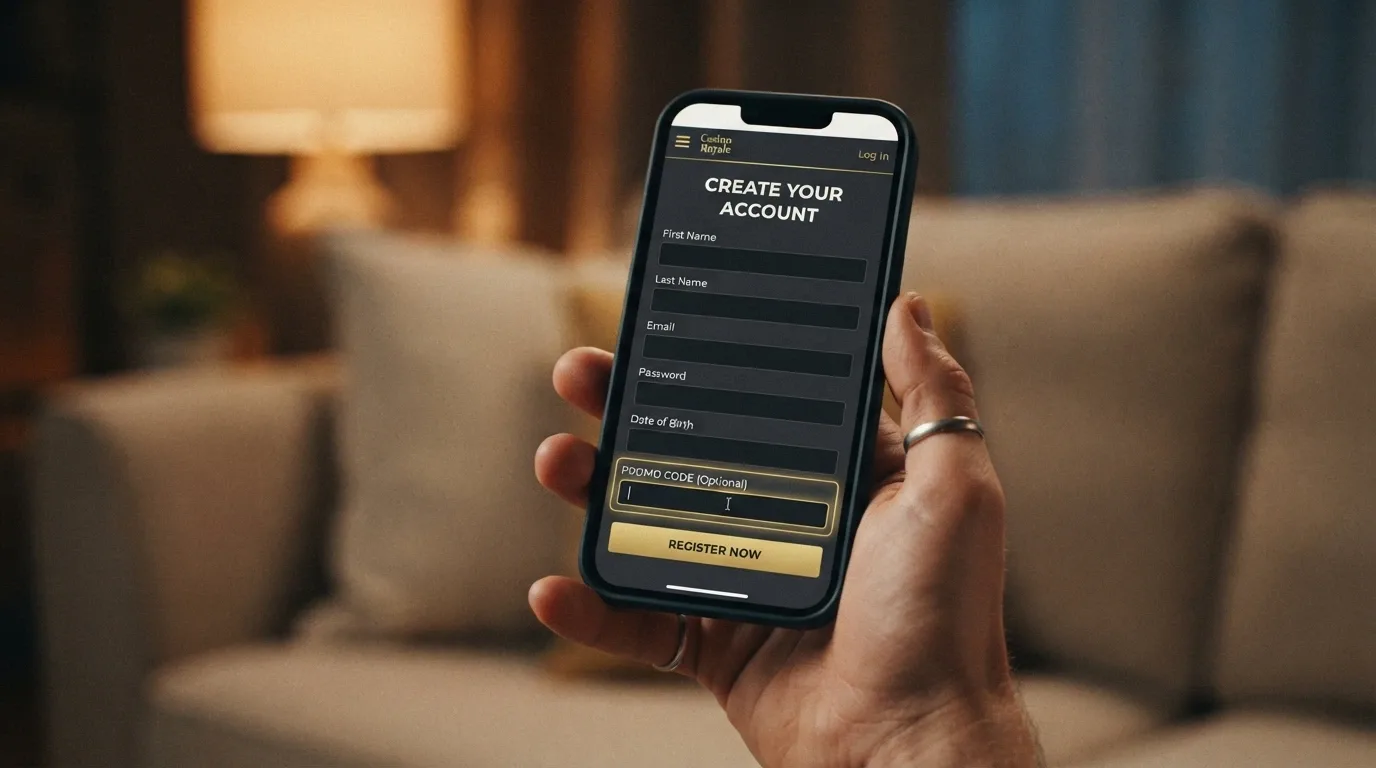
The codes themselves do not change between desktop and mobile. The entry field shifts. Most offshore casinos accepting Australian players run a responsive website rather than a downloadable app, so the same registration form, the same cashier, the same promo field render in a narrower layout on a phone screen. The string is identical; the player types it into a smaller box.
No-deposit bonus codes redeemable on mobile
Responsive sites make code redemption identical to desktop. The player opens the casino in the mobile browser, registers or signs in, enters the code in the cashier or the promo section, and the offer appears in the account balance. There is no functional difference in how the code is read or applied by the operator’s bonus engine.
A small number of offers are mobile-native by trigger. The clearest example is the no-deposit bonus some operators credit when the player enables browser push notifications — that is a mechanic built around the mobile experience, even though it also works on desktop. Push notifications are how the operator reminds the player to come back; the no-deposit is the carrot for opting in. The code itself may not exist on these offers at all — they may activate automatically the moment the player toggles notifications in the browser settings, with no string to enter.
Bonus codes inside a casino app vs the mobile browser
Few offshore casinos targeting Australia maintain a native iOS or Android app distributed through the official stores. Distribution through the App Store or Google Play is restricted in Australia for real-money gambling apps, so the offshore brands tend to rely on either a progressive web app (a website that behaves like an app when installed to the home screen) or a downloadable APK distributed through the operator’s own site. In either case, the code entry field is the same string in a slightly different wrapper, and the bonus engine reads it the same way.
The tell for whether the player is dealing with an offshore operator is in the payment method, not in the app wrapper. Australian-licensed wagering operators cannot accept credit cards or cryptocurrency for online gambling — that ban has been in force since 11 June 2024. An Australian punter who is asked for a credit card or a crypto deposit by a gambling site is being served by someone outside the Australian rules. The payment method is itself a tell. This is true on desktop and on mobile, and it is true regardless of whether the site is wrapped as an app, a progressive web app or a plain browser tab.
The Law Australia’s Casino Bonus Pages Won’t Tell You About
The omission is consistent. Almost every comparison page ranking bonus codes for Australian players skips the legal frame entirely. That is the gap this section fills, because the frame changes everything else on the page: who holds the licence, who enforces the rules, what protection the player has and what recourse exists if the operator refuses to pay.
The Interactive Gambling Act and the ACMA — the prohibition most bonus pages skip
The Interactive Gambling Act 2001 prohibits the provision of online casino games, online pokies and in-play sports betting to persons physically in Australia. The 2017 amendments closed the loopholes offshore operators had been using and gave the Australian Communications and Media Authority the enforcement and blocking powers that have defined the market since. There is no licence for online casino anywhere in the country — not federally, not in any state or territory. The licensed Australian wagering market covers pre-event racing and sports betting, lotteries and keno, through operators licensed by state and territory regulators. In practice, the Northern Territory Racing and Wagering Commission, administered through Licensing NT, is the de facto national licensor for online wagering.
The ACMA enforces the prohibition in several ways. It investigates complaints, issues formal warnings, runs civil penalty proceedings and refers operators for enforcement. Most visibly, it directs Australian ISPs to block illegal sites — since the first blocking request in November 2019, the ACMA has had 1,564 illegal gambling and affiliate websites blocked at the ISP level. More than 225 illegal services have withdrawn from the Australian market since 2017. The numbers move every quarter, and they have moved consistently in one direction.
The individual player is not prosecuted. The Interactive Gambling Act targets the provider, not the customer. No Australian punter has been charged for using an offshore casino. That fact is real, but it is only half the picture. The other half is what the player loses by being outside Australian jurisdiction: no consumer protection, no ACMA complaint resolution, no recourse if the operator refuses a withdrawal, and the constant risk that the site is blocked at the ISP level with a balance still on deposit.
The reform package passed Parliament on 19 August 2026 and commences on 1 January 2027. The Interactive Gambling Amendment (Gambling Reform) Bill 2026 tightens wagering advertising on broadcast media — three ads per hour between 6:00 am and 8:30 pm on television, with a live-sport blackout from 15 minutes before to 5 minutes after an event, no radio ads during school drop-off and pick-up, no broadcasting of sporting odds and no wagering advertising to anyone who is not logged in, verified over 18 and opted in. Athletes, celebrities and influencers are barred from promoting wagering products. From 1 January 2027, direct marketing of inducements is prohibited for 14 days after a customer signs up, for three months after a person deregisters from BetStop, and indefinitely for customers identified as at risk of gambling-related harm. None of these restrictions bind an offshore casino that advertises a welcome bonus to Australians today, but they sharpen the picture of where the licensed Australian market is heading and how clearly the offshore operators sit outside it.
What playing via an offshore bonus code means for your protection
An offshore casino holding a Curaçao or Anjouan licence is regulated by the body that issued that licence, not by the ACMA. The Australian player is the customer of a foreign-licensed operator with no Australian complaint pathway. If the operator refuses a withdrawal, delays a payout beyond its stated timeframe or simply disappears, the Australian punter has no agency to escalate to. The dispute resolution process is whatever the operator’s own terms page describes — and the operator writes the terms.
BetStop, the National Self-Exclusion Register, binds Australian-licensed wagering providers. Approximately 150 licensed brands honour a BetStop registration, and the registration covers every one of them in a single step. It does not cover offshore casinos. A punter who registers with BetStop and then deposits at an offshore casino has not excluded themselves from that casino. The offshore brand will keep taking the punter’s money. Self-exclusion only works inside the system that enforces it.
Payment methods are the second tell. Credit cards, credit-related products and cryptocurrency have been banned as payment for online wagering in Australia since 11 June 2024, with penalties of up to A$247,500 for non-compliance. The licensed wagering market operates on debit cards, bank transfers, PayID, Osko and BPAY. An offshore casino that accepts credit cards and crypto is operating outside the Australian regime. From 1 January 2027, banks and payment providers will gain express authority to block transactions to illegal gambling operators, which means the payment-method tell becomes harder to ignore as transaction screening sharpens across the banking system.
The structural summary: an Australian punter playing with a bonus code at an offshore casino is gambling at a business that is illegal to operate in this country, under a foreign licence that does not bind the operator to Australian consumer law, with no ACMA complaint path and no BetStop coverage, on a domain that can be ISP-blocked at any time. The marketing still calls it a welcome bonus. The legal frame around it is something quite different.
When a Bonus Code Becomes a Problem — Safer Play for Australian Punters
Bonus codes are designed to drive play. That is the marketing point. For most players, the codes work as intended — a small nudge to try a new platform, a low-cost way to test a game library, a bit of extra turnover to clear a welcome tier. For a meaningful minority of players, the chase for the next code, the next reload and the next wagering clear-down becomes the problem rather than the entertainment. This section is about the help that exists for those players, and the limits of that help at offshore casinos.

BetStop and the National Gambling Helpline — the help that exists
BetStop launched on 21 August 2023. It is the National Self-Exclusion Register, run by the ACMA, and lets a person self-exclude from all approximately 150 Australian-licensed wagering providers in a single step. Self-exclusion periods range from three months to lifetime. As of 31 March 2026, 59,830 people had registered with BetStop, of whom 37,247 had active exclusions at that date. The demographic pattern is striking: 78% of registrants are under 40, and 38% have chosen lifetime exclusion — the strongest possible commitment the register offers.
The outcomes for those who register are real. ACMA research found that 77% of BetStop registrants reported better overall quality of life after self-exclusion, 79% reported improved mental health, and 96% had either completely stopped betting (81%) or decreased their betting (15%). The register is not a soft opt-out. It works because the licensed wagering brands are required to honour it. The same research is the source of the published outcomes.
The helpline sits alongside BetStop. The National Gambling Helpline — 1800 858 858 — is free, confidential and staffed 24 hours a day, 7 days a week. Online chat, email support and self-help resources are available through Gambling Help Online at gamblinghelponline.org.au. Both services are free and both operate under the Department of Social Services gambling support framework. BetStop’s statutory review, published on 25 February 2026, made 10 recommendations focused on community awareness, reducing circumvention and improving user experience — the structural sign that the register is treated as a continuing public-health instrument rather than a one-off launch.
The critical caveat, repeated in the section on offshore casinos and worth repeating once here: BetStop binds Australian-licensed wagering services only. An offshore casino is not connected to the register. A punter who has registered with BetStop and then opens an account at an offshore casino has not excluded themselves from that offshore casino. The offshore brand will accept the deposit, run the bonus code and process the wagering. The protection that BetStop offers stops at the Australian licensing perimeter.
Setting deposit and time limits around bonus play
Licensed Australian wagering operators are required to offer customer-set deposit limits and activity statements, and most extend those tools across their product suite. The reason those tools exist is structural — the licensed operator has a continuing duty of care to its customer over time. The deposit-limit tool is the single most useful safeguard a punter can set before claiming a bonus code, because it caps the loss in a way the bonus terms do not.
Offshore casinos sit outside the Australian duty-of-care framework. Some offer deposit-limit tools; many do not. The terms page is the only honest source on what the operator has chosen to implement. The more reliable safeguard is one the player sets unilaterally: a fixed deposit budget for the bonus period, a fixed time budget and a rule that the bonus is forfeited if either is exceeded. The arithmetic in the section on no-deposit codes is the reference for what those numbers should be — a A$50 no-deposit bonus at 40x wagering runs to roughly 28 hours of continuous play. A punter who commits to a 5-hour evening session and walks away when it ends has constrained the cost to a fraction of the clear-down time.
The validity window on most no-deposit offers is 3 to 7 days. That window is the operator’s bet that the punter will compress many hours of play into a short period, raising the chance of impulsive decisions. Time-budgeting against the window is the way to invert the bet. There is no federal deposit, loss or stake ceiling for online gambling in Australia — because the product those ceilings would govern is banned outright — so the only ceiling in play is the one the player draws for themselves.
Spotting the signs — when a promo offer is driving harmful play
Problem gambling in Australia is not a marginal phenomenon. About 2.1% of Australian adults — roughly 430,000 people — experience problem gambling; the Australian Institute of Health and Welfare put high-risk gambling at 1.8% in its 2022 figures. The 430,000 figure is a population estimate. Behind it sit real people, and the most common pattern in the harm literature is promotional offer chasing — moving from one bonus code to the next, depositing to clear a wagering requirement, playing past the validity window, escalating stake size to chase a near-miss on the wagering progress bar.
The behavioural signs are well-documented and worth naming plainly. Depositing more than the pre-set budget to clear a wagering requirement. Opening a new offshore casino account to claim a fresh no-deposit bonus while still clearing the previous one. Playing past a self-imposed time limit. Borrowing to fund a deposit. Hiding the play from family or partner. Returning to play immediately after a session that ended in a loss. None of these is a diagnostic test. All of them are signals that the bonus code has stopped being entertainment and started being the structure of the day.
The help line at 1800 858 858 is free and confidential, available 24 hours a day. The same service is reachable online at gamblinghelponline.org.au. The BetStop register — at betstop.gov.au — is the single most effective structural step for someone whose gambling has moved beyond what they want it to be, with the limitation noted above that offshore casinos sit outside it. Financial counselling through the DSS gambling support services is also available. The services exist. The first call is the hard one.
Offshore Casinos with Bonus Codes for Australians — How Their Offers Stack Up
The table below compares the ten offshore operators profiled in this section. The columns cover what a player can verify before depositing: licence status, welcome bonus and wagering requirement. Where research did not surface a confirmed figure, the cell carries an em dash — not because the offer does not exist, but because the figure was not available at review time. The page describes; it does not advertise. Every operator named below is an offshore brand. None holds an Australian licence, because no such licence exists.
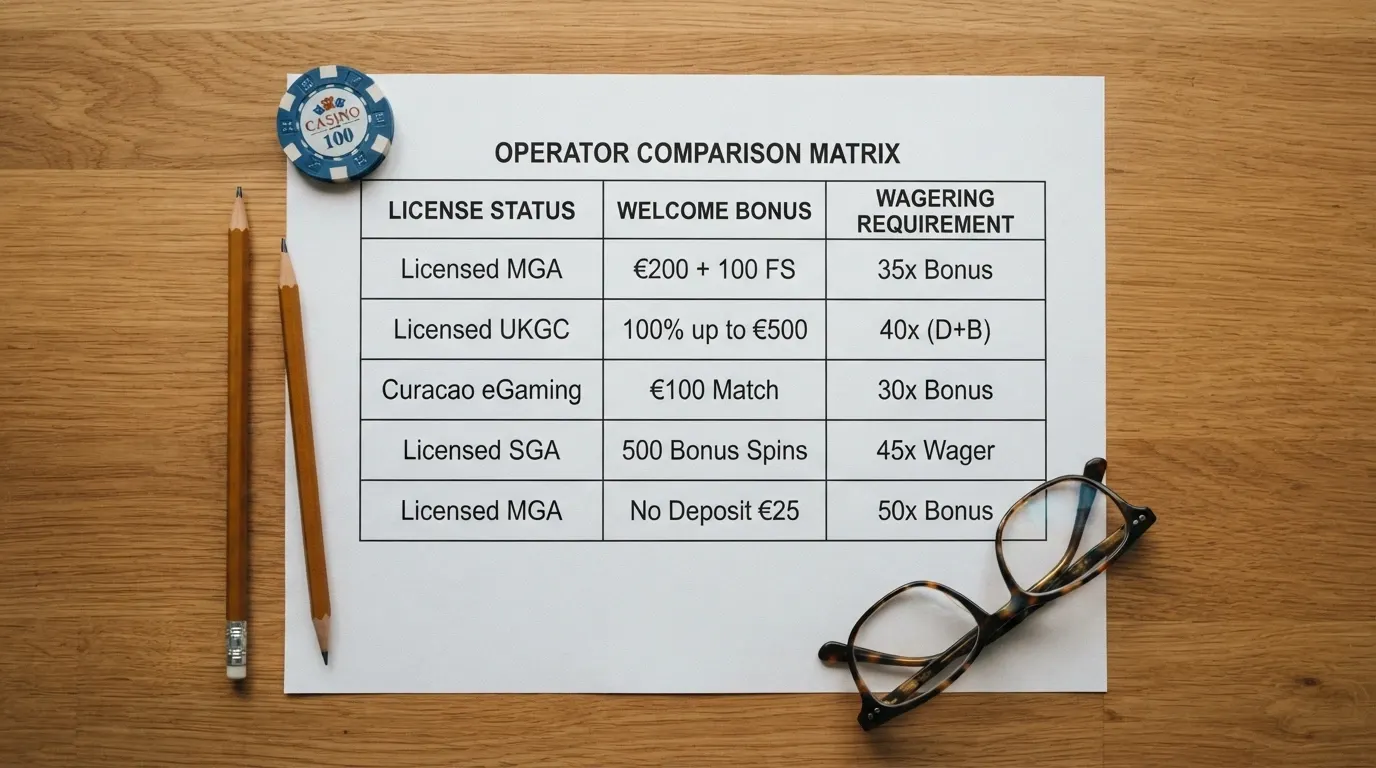
| Casino | Licence | Welcome Bonus (2026) | Wagering |
|---|---|---|---|
| Skycrown | Offshore (Curaçao) | A$8,000 + 400 FS across 4 deposits | 40x |
| Rocket Play | Offshore (Curaçao) | AU$6,000 + 300 FS across multiple deposits | 30x–40x |
| Fair Go | Offshore (Curaçao) | 300% up to A$3,000 + 50 FS on Cash Bandits 2 | 30x (deposit) |
| Royal Reels | Offshore | A$2,500 + 50 FS across 3 deposits | 35x |
| Bizzo Casino | Offshore (Curaçao) | A$7,250 + 175 FS across 4 deposits | 40x |
| Rainbet | Offshore (Anjouan) | 250% up to $1,750 + 60 FS across 3 deposits | 40x or no-wager |
| WinSpirit | Offshore (Curaçao) | AU$4,500 + 425 FS | — |
| Stake | Offshore (Curaçao) | — | — |
| Scream Casino | Offshore | — | — |
| Rocket Casino | Offshore | — | — |
The spread down the welcome-bonus column looks dramatic, but the wagering column clusters in a tight 30x to 50x band. A larger headline bonus does not mean a better offer; it means a larger turnover obligation. The three operators with em dashes in both columns — Stake, Scream Casino and Rocket Casino — are included because their Australian market-share data is verifiable; their bonus structures were not surfaced at review time and are best read on the operator’s own promotions page.
Skycrown
Skycrown runs the largest welcome package in this set: up to A$8,000 in bonus money plus 400 free spins, spread across four deposits. The first deposit earns 120% up to A$1,200 with 125 free spins, then 100% up to A$1,000 with 75 free spins on the second, 75% up to A$1,250 with 50 free spins on the third, and 100% up to A$2,000 with 150 free spins on the fourth. Minimum deposits rise from A$30 on the first tier to A$100 on the fourth. The wagering requirement sits at 40x on both bonus money and free-spin winnings. Standard bonus validity is 14 days; high-roller tiers compress to 5 days. The free-spin cap per deposit tier is A$300.
Two qualifications matter. First, Skycrown’s welcome bonus is not available to players who deposit with cryptocurrency — the bonus engine excludes crypto-funded accounts from the welcome tier, though those accounts remain eligible for other promotions. Second, the 40x wagering applies to the bonus and the free-spin winnings as two separate playthrough obligations, which roughly doubles the apparent multiple on the deposit-match portion. A player clearing A$1,200 in bonus money and 125 free spins at A$0.20 each is working through A$48,000 of bonus turnover and a separate A$1,000 of free-spin turnover at 40x each. The arithmetic puts the clear-down well past the 14-day validity on the standard tier.
Skycrown suits a punter who plans to deposit across all four tiers and treats the package as a four-month campaign rather than a four-week sprint — the A$8,000 headline is real money, but only across the full tier walk. It does not suit a player looking to clear a single no-deposit bonus and walk away.
Rocket Play
Rocket Play’s welcome package totals 300% up to AU$6,000 plus 300 free spins across multiple deposits, with the first deposit offering 100% up to AU$1,000 plus 100 free spins. Wagering sits in the 30x to 40x range. The bonus validity is 5 days — tight even by the standards of this market. The maximum win from the bonus is capped at A$5,000, and the maximum bet while the bonus is active is A$7.50 per spin.
The 5-day validity window is the most consequential number on this offer. A A$1,000 first-deposit bonus at 40x wagering means A$40,000 of required turnover in 5 days. At A$0.10 a spin, that is 400,000 spins, or close to 556 hours of continuous play compressed into 120 hours. The clear-down is mathematically possible only for a player who treats the bonus as a full-time job for the validity window. The A$5,000 max-win cap means that even if a punter hits a hot streak during the clear-down, anything above A$5,000 is removed from the balance. The A$7.50 max bet is the guardrail that prevents the player from racing through the wagering in a few oversized spins.
Rocket Play suits a player who plans to deposit small, treat the bonus as a structured short-term campaign, and accepts that the 5-day validity is the constraint that defines the play. The package is aggressive on the numbers; the terms push back hard against anyone trying to extract outsized value.
Fair Go
Fair Go is the only RTG-powered brand in this set, which means its game library draws on RealTime Gaming’s catalogue rather than the multi-provider libraries common at the larger offshore brands. The headline welcome bonus is a 300% match up to A$3,000 plus 50 free spins on Cash Bandits 2, with no maximum cashout on the deposit bonus — a structural differentiator from every other brand profiled here. The alternative welcome structure is a 100% match up to A$200 on each of the first five deposits (totalling A$1,000), with 30x wagering on the combined deposit and bonus.
The no-deposit free chip is the most distinctive Fair Go offer. A$50 is credited to a new account, subject to wagering and capped at A$180 cashout. The cap is the same band as other no-deposit offers in this market; the entry threshold is the same. What differs is the absence of a maximum cashout on the deposit bonus, which means a player who runs hot during the wagering on the 300% match takes the full balance to withdrawal rather than hitting a ceiling.
Fair Go suits a punter who values the no-max-cashout structure on the deposit bonus over the larger headline amounts offered by multi-provider brands. The RTG-only library is narrower than Bizzo’s 8,000+ titles or Royal Reels’s 5,400+, but the RTG catalogue is consistent and the games are familiar to players who have spent time on RTG-powered platforms before.
Royal Reels
Royal Reels runs a three-tier welcome package totalling A$2,500 in bonus money plus 50 free spins, with the tiers structured as 100% up to A$500, 75% up to A$750 and 100% up to A$1,250. Wagering is 35x on the bonus only — a meaningfully friendlier base than the deposit-plus-bonus wagering some operators apply. The maximum bet during clear-down is A$5 per spin. The 50 free spins land on a featured pokie at a fixed A$0.20 stake, with winnings subject to 35x wagering.
Royal Reels also offers a A$10 no-deposit bonus after phone verification — one of the lower entry thresholds in this set, paired with one of the smaller no-deposit amounts. The game library runs to 5,400+ pokies from 40+ providers, which is narrower than Bizzo but wider than Fair Go’s RTG-only catalogue. The bonus-only wagering base is the structural advantage. A player clearing a A$500 first-deposit bonus at 35x is working through A$17,500 of turnover, not the A$35,000 that a deposit-plus-bonus base would impose. Royal Reels fits a player who wants the friendliest wagering base in the set and is comfortable with a smaller headline.
Bizzo Casino
Bizzo runs the largest game library in this set: 8,000+ titles from 70+ providers, which is roughly a thousand more games than the next-largest operator. The welcome package is up to A$7,250 plus 175 free spins across four deposits, with 40x wagering across all tiers. The first-deposit match scales by deposit size: 50% for deposits of A$20 to A$50, 75% for A$50 to A$100, 100% for A$100 to A$250 and 125% for deposits of A$250 or more, with the largest first-deposit tier offering up to A$2,500 plus 125 free spins.
The mobile-native mechanic on Bizzo is the no-deposit bonus for enabling browser push notifications. The offer activates when the player opts in to notifications in the browser settings; it does not require a code. The mechanic is how Bizzo captures mobile users into its retention funnel without a code-based acquisition offer, and it sits on top of the standard welcome structure rather than replacing it.
The minimum deposit of A$20 puts Bizzo within reach of a player with a smaller bankroll, and the tiered first-deposit match means the bonus scales with what the player can afford to commit. The 8,000-game library is the largest single differentiator from every other operator profiled here, and the A$20 entry point is the lowest in the set.
Rainbet
Rainbet is the Anjouan-licensed operator in this set, with a 250% match up to $1,750 plus 60 free spins across three deposits. The wagering structure is unusual: the player chooses between 40x wagering (the standard path) or a no-wager gradual-release path that pays bonus money back in tranches as the player wagers, with no playthrough requirement on the released portions. Minimum deposit is $30, maximum per-deposit is $700, and bonus validity is 7 days.
The reward model is where Rainbet differs structurally from every other brand in this set. Approximately $1.7 million in monthly race prize pools, a $20,000 weekly raffle and rakeback form an ongoing value proposition that dwarfs the welcome bonus. The game library runs to 7,000+ games plus 14 provably fair Originals — the Originals are the crypto-style games designed in-house with verifiable randomness.
The no-wager gradual-release path is the structural answer to the 40x wagering question. A player who chooses it accepts a smaller headline bonus in exchange for bonus money paid out as it is earned, without a playthrough obligation on the released portions. The choice between paths is one the player should make before claiming — switching mid-clear-down is not how the structure works. Rainbet suits a player who values ongoing race and raffle structure over a single welcome spike, and who is comfortable with Anjouan licensing.
WinSpirit
WinSpirit is the Curaçao-licensed brand with AUD support and crypto withdrawals processed in under 2 hours — the fastest payout speed of any operator in this set where the figure is confirmed. The welcome bonus is up to AU$4,500 plus 425 free spins, with 6,000+ pokies in the game library. The wagering requirement on WinSpirit’s welcome bonus was not confirmed in this review. The terms page is the only honest source. A player considering WinSpirit should check the wagering multiplier, the validity window and the max-bet rule on the terms page before claiming the welcome bonus — these are the three numbers that decide whether the offer pays in practice.
WinSpirit suits a player whose priority is fast crypto withdrawals rather than the largest headline bonus, and who is willing to verify the bonus terms directly with the operator. The AUD support removes the FX conversion cost that a punter using a non-AUD-denominated brand absorbs, and the sub-2-hour crypto payout is the standout feature in a market where 24 to 72 hours is the typical offshore withdrawal window.
Stake
Stake is a cryptocurrency-focused offshore casino operating under a Curaçao-class offshore licence. It does not hold an Australian licence. Stake’s Australian market share sits at 1.28% with revenue of A$115.67M, placing it among the larger offshore brands serving Australian players by revenue. Bonus-code specifics for Australian players were not surfaced in this review.
The structural reason Stake sits separately in this comparison is its crypto-first model. The operator runs on the same rails as the major cryptocurrency sportsbooks and exchanges, with deposits and withdrawals denominated in Bitcoin, Ethereum, Litecoin and other digital assets. The bonus structure — where it exists — is built around that model rather than around the traditional fiat-deposit welcome package. A player who already holds cryptocurrency and is comfortable with on-chain deposits finds Stake’s mechanics familiar. A player who has never used a crypto wallet before faces a learning curve that has nothing to do with the bonus code itself. Stake suits a crypto-native player who already has a wallet, understands the deposit flow and is comfortable verifying the current bonus terms directly with the operator.
Scream Casino
Scream Casino operates offshore with no Australian licence. Its Australian market share sits at 0.99% with revenue of A$94.87M. Specific welcome-bonus terms and bonus-code structures were not confirmed in this review — the operator’s current promotions page is the only honest source for what is on offer at any given time.
The market-share position is the only verifiable figure on Scream Casino from this review. A player considering Scream should approach the welcome offer with the same term-reading discipline applied to any other brand in this set — wagering multiplier, game weighting, cashout cap, validity window, max bet during clear-down — and should treat the absence of a confirmed figure here as a reason to read the terms page more carefully, not less. Scream is included for completeness; the comparison does not extend beyond what was confirmed at review time.
Rocket Casino
Rocket Casino is an offshore operator distinct from Rocket Play. The two share a name pattern and nothing else. Rocket Casino’s Australian market share sits at 0.57% with revenue of A$43.22M. Like Scream, specific welcome-bonus terms were not confirmed in this review.
The small market-share position relative to Rocket Play — the latter sits in the higher-tier comparison above — is the only verifiable comparative data point. A player who has encountered “Rocket” branding in search results should verify which operator is being referenced, because the two are not interchangeable. The bonus structure on Rocket Casino, where it exists, would need to be confirmed on the operator’s own terms page before any deposit decision.
Rocket Casino is included in this comparison for completeness. The market-share and revenue figures are the only confirmed data points. The bonus-code analysis does not extend to figures this review did not surface.
How We Evaluated These Casino Bonus Codes
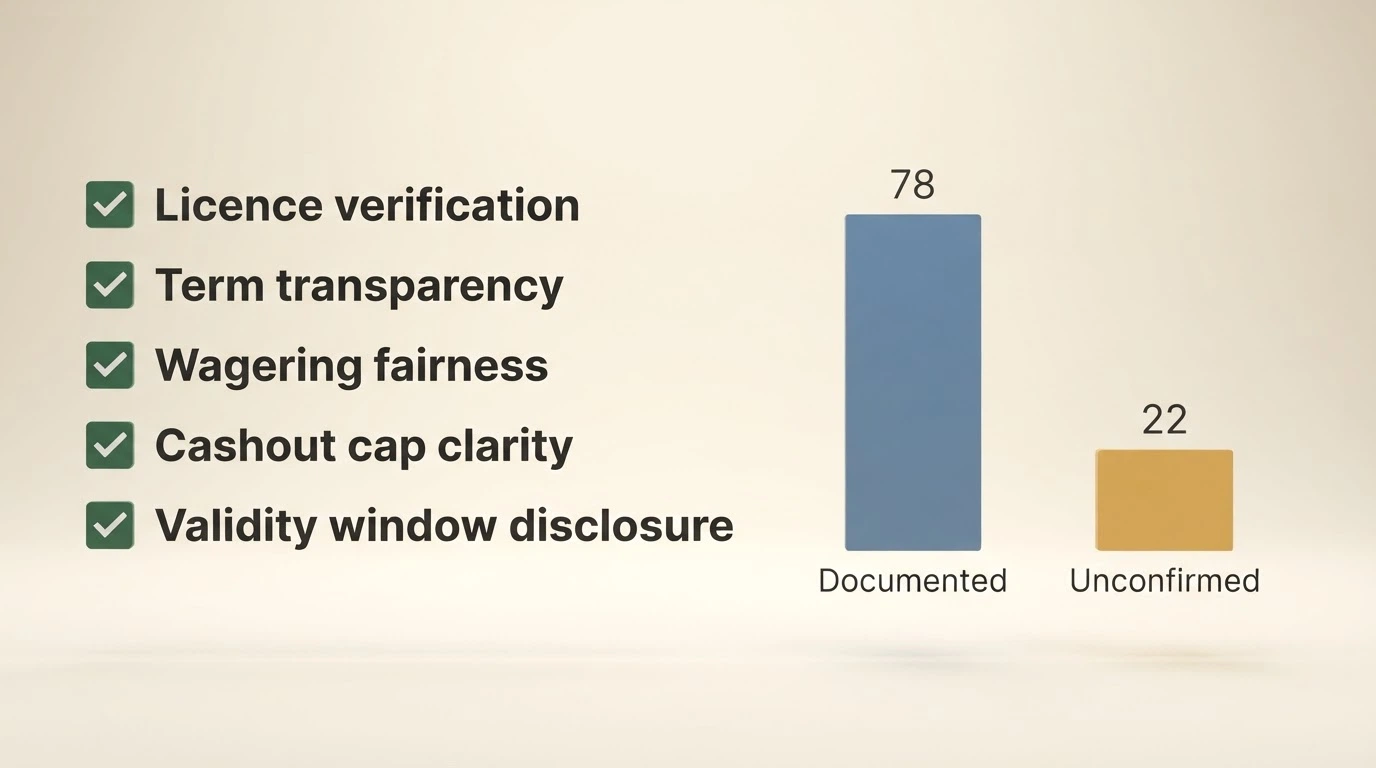
The ranking in this section is not a leaderboard. The offers differ on headline amount, on wagering structure, on game-library breadth and on the presence or absence of a no-deposit bonus, but they all sit on the same structural footing: every one is an offshore offer with no Australian licence, every one is covered by the IGA prohibition, every one leaves the player outside Australian consumer protection. The ordering here reflects offer depth and term transparency, with the most fully-documented brands listed first and the brands whose bonus structures were not confirmed placed at the end.
The data sources are the operator’s own terms pages and a small set of reputable affiliate aggregators whose figures were cross-checked against the operators’ own published terms. The licence status of each brand was verified against the absence of any Australian online casino licence register — the IGA makes such a register impossible, and no brand in this set claims an Australian licence. The wagering figures, cashout caps and validity windows are taken from the operators’ published terms as confirmed at review time; the bonus amounts and structures change, and a player should always re-check the terms before claiming.
The criteria used in ordering are qualitative rather than weighted: offer depth (the size and structure of the welcome package, the presence of a no-deposit tier), term transparency (whether the wagering, validity and cashout figures are published in the terms and verifiable in this review), and the breadth of the player-protection or payout information available. The crypto restriction on Skycrown’s welcome bonus and the no-wager alternative on Rainbet are flagged because they materially change the offer; the absence of confirmed figures on Stake, Scream Casino and Rocket Casino is flagged for the opposite reason.
The standard applied to a no-deposit offer is whether the wagering, cashout cap and validity window are published in a way a player can read before claiming. The standard applied to a deposit-match offer is the same, plus the bonus-only or deposit-plus-bonus wagering base. The standard applied to every operator is whether the licence it operates under is named and verifiable. Every operator in this set meets that bar. None meets a higher one.
What an Australian Punter Should Actually Do With a Bonus Code
The verdict the page reaches is straightforward. A bonus code in Australia is a trial tool, not a wealth strategy. The arithmetic says most no-deposit codes clear to A$100 to A$180 at best after hours of wagering, that the deposit-match codes trade a real-money deposit for a turnover obligation in the tens of thousands of dollars, and that the offshore status of every operator on this page means the player carries every risk that an Australian licence would otherwise absorb.
The practical sequence for a punter who has decided to use a bonus code at an offshore casino is: read the terms page before entering the code, confirm the wagering multiplier, the game weighting, the cashout cap, the validity window and the max bet during clear-down. Set a deposit budget that the player is prepared to lose entirely. Set a time budget that fits inside the validity window. Treat the bonus as a low-cost way to test the platform’s games, payment flow and customer support — not as a path to a payout. If any of those tests fails, walk away before the wagering begins.
The structural reality is the same for every brand profiled here. An offshore casino holding a Curaçao or Anjouan licence is not subject to Australian consumer law. The ACMA cannot compel a payout. BetStop does not exclude the player from the platform. The site can be ISP-blocked with a balance still on deposit. Those facts do not change because the bonus code reads “WELCOME200” or because the marketing page uses words like “instant” and “exclusive”. The marketing is what it is. The arithmetic is what the arithmetic is.
The smart play, on the terms the page itself lays out, is to treat a bonus code as exactly what the offshore operators intend it to be: a low-stakes way to try a platform. Never deposit more than the punter is prepared to lose to a business that operates outside Australian law. Check the terms before the code goes in — every time, even when the offer looks familiar. The terms are where the offer is.
Frequently Asked Questions — Casino Bonus Codes in Australia
What is the difference between a no-deposit bonus code and a regular welcome bonus?
A no-deposit bonus code credits the offer to a new account without requiring a deposit — typically a A$10 to A$50 free chip or 10 to 100 free spins on a named pokie, subject to a cashout cap of around A$100 to A$180. A regular welcome bonus is a percentage match on the first deposit, usually 100% to 125% up to a stated maximum, with wagering applied to the bonus (and sometimes the deposit) before any withdrawal is allowed. The no-deposit offer is a trial; the welcome bonus is a deposit-gated package. The wagering, cashout cap and game weighting rules apply to both, but the cashout cap is most punishing on no-deposit offers, and the turnover obligation is most punishing on welcome bonuses.
What happens if I use a bonus code at an offshore casino — am I protected?
No. An offshore casino holding a Curaçao, Anjouan or Kahnawake licence is not subject to Australian consumer law. The player has no ACMA complaint pathway, no BetStop coverage and no Australian regulatory recourse if the operator refuses a withdrawal, delays a payout or disappears. The Interactive Gambling Act 2001 targets the provider, not the customer, so the player is not prosecuted — but the absence of prosecution is not the same as the presence of protection. The site can also be ISP-blocked at any time, which has happened to more than 1,564 illegal gambling and affiliate websites since November 2019.
Are no-deposit bonus codes really free, or is there a catch?
The catch is the terms. A A$50 no-deposit free chip at 40x wagering requires A$2,000 of turnover before any cashout, which at a A$0.10 minimum spin means 20,000 spins, or close to 28 hours of continuous play. The cashout cap is typically A$100 to A$180, meaning anything won above that figure during the clear-down is removed from the balance at conversion. The 3 to 7 day validity window forces the play into a compressed period. The offer is genuinely free to claim, but it is not free to clear, and the player who treats it as free usually discovers the cost in time. The arithmetic is a statistical estimate over many spins, not a guaranteed outcome for any single session.
How do I know if a casino bonus code is still active and valid?
The terms page on the operator’s own site is the only authoritative source. Bonus codes rotate, expire and get replaced; a code listed on an affiliate aggregator page may have been superseded by the time the player visits the casino. The reliable sequence is to open the casino’s promotions page directly, find the offer currently advertised, and use the code or claim method shown there rather than relying on a code copied from a third-party list. If the offer has changed, the new terms apply; if the code no longer works, the casino’s support chat is the fastest way to confirm whether a replacement exists.
What is BetStop, and does it cover offshore casinos?
BetStop is the National Self-Exclusion Register, run by the ACMA since August 2023, that lets a person self-exclude from all approximately 150 Australian-licensed wagering providers in a single step. Self-exclusion periods range from three months to lifetime. BetStop does not cover offshore casinos. A player who registers with BetStop has excluded themselves from the licensed wagering market only; an offshore casino is not connected to the register and will continue to accept deposits from a self-excluded player. BetStop is the most effective structural safeguard available to a punter who wants to stop, and its limits define what it cannot do.
Online vs mobile — does the code work the same way?
The code string itself is identical across devices. What changes is the entry point. On a desktop browser, the field is a wide box in a registration form or a cashier overlay. On a mobile browser, the same field renders inside a responsive layout — narrower, often with a “Have a promo code?” toggle that expands the input. In a native casino app where one exists, the field is built into the deposit flow rather than appearing on a webpage. The string does not care which device typed it. The operator’s promotion engine reads it and assigns the offer the same way.
The mobile-specific mechanics are around the bonus itself, not the code. A small number of offshore casinos run no-deposit offers that require enabling browser push notifications — that is a mobile-first mechanic. Push notifications on a desktop browser do exist but are unusual. The point is that the code remains the same string; the trigger for unlocking the offer sometimes requires a mobile action.