
The Real Cost of a 2026 $300 No-Deposit Bonus for Australian Players
 Available in AU
The $300 figure is the hook. It is also, in practice, almost fictional. Australian players searching for a $300 no-deposit bonus find offers that range from A$5 free chips to A$100 free spins — verified chips rarely climb higher than the low triple digits, and every one of them sits behind a wagering requirement that turns the gift into a grind. The maths runs against the player at every step: the wagering turnover, the cashout cap, the offshore licence that takes the operator outside Australian consumer protection.

Data current as of 18 October 2026 and verified against the ACMA register and operator terms pages.
Table of Contents
- What a $300 No-Deposit Casino Bonus Actually Means for Australian Players
- Why Your 2026 No-Deposit Bonus Costs More Than It Gives
- The Offshore Casinos Offering No-Deposit Bonuses to Australians, Reviewed
- PayID Pokies and the Payment Routes That Actually Work from Australia
- The Legal Reality: Online Casino Is Prohibited in Australia
- Playing Safely When the Safety Net Doesn’t Reach Offshore Casinos
- How We Selected and Evaluated These Operators
- What the Numbers Actually Say About Claiming a 2026 No-Deposit Bonus
- Frequently Asked Questions
What a $300 No-Deposit Casino Bonus Actually Means for Australian Players
The “$300 no-deposit bonus” is a marketing anchor. The actual Australian-facing bonus landscape does not match it. Industry coverage of $300 chips notes wagering multipliers of 50x to 70x, which on a $300 balance requires between A$15,000 and A$21,000 in cumulative turnover before any dollar leaves the casino. That is roughly 3,000 to 4,200 spins at the A$5 maximum stake — a four-to-seven-hour grind at five seconds a spin, all to clear a “free” balance that almost never survives long enough to convert into real cash.
The headline number, in other words, is a ceiling that exists on paper. The casino-standard wagering band for no-deposit bonuses in Australia sits lower, at 40x to 60x, with maximum cashout caps between A$50 and A$200 — and that is where the genuine offers land. Most A$100 no-deposit chips cap cashout at A$50 to A$100. A rare genuine $300 chip at 35x wagering still means $10,500 of cycling bets and an A$250 cap on what can actually be withdrawn. The size of the headline figure and the size of the real payout are not the same number.
The marketing reason is straightforward: the higher the bonus figure, the better the click-through. The arithmetic reason is just as straightforward — every dollar of advertised bonus comes with a multiplier attached, and the multiplier consumes the bonus long before the player reaches any cashout screen.
The Difference Between Real-Money and Free-Play Bonus Credit
A no-deposit bonus does not move money into the player’s bank account. It moves script. The A$20 of bonus credit that lands on a new account is non-withdrawable until the wagering requirement is cleared, and even then, only up to the cashout cap. The expected value of that A$20 is not “+A$20.” It is a negative number dressed in confetti.
The mechanics are simple enough to summarise. Bonus credit sits in a separate balance from real money. Wagering applies only to that bonus balance — and only at the games that contribute toward clearing it. Pokies contribute 100%; table games, crash titles and live casino contribute 0% to 20%. Free spins are a form of bonus credit too: each spin is a fixed-stake wager on a named game, and any winnings from those spins enter the bonus balance under the same wagering conditions as a chip.
The distinction matters because a player who confuses bonus credit with real money will treat the A$20 like an A$20 deposit and try to walk away with it. They cannot. The bonus balance converts into withdrawable cash only after the wagering multiplier has been satisfied, and only up to the cap. Anything left in the bonus balance when the wagering is incomplete is forfeit when the timer runs out.
Who Actually Qualifies for These Offers in Australia
The casino invites Australian players. Australian law does not invite the casino. The Interactive Gambling Act 2001 makes it illegal for a provider to offer online casino games to a person physically in Australia — there is no licence anywhere in the country for the product these bonuses are attached to. The minimum age for any commercial gambling in Australia is 18, and offshore operators enforce that gate at the registration screen, sometimes with a passport upload, more often with a payment-method check at withdrawal.
Beyond the age check, qualification is the operator’s own rulebook. A single no-deposit bonus is usually redeemable once per household, once per IP address, and once per payment method. Two players on the same Wi-Fi will not both receive a chip. The operator also enforces a “consecutive free bonus” rule across its sister sites: redeeming an NDB at one brand and then trying to claim another at a sister network without making a real-money deposit in between will flag the account as a bonus abuser and freeze withdrawals. The rule exists because bonus abuse is the fastest-growing cost line for offshore operators; the consequence for the player is that chasing free chips across brands does not work.
Verification is the next gate. A withdrawal — even of a free-chip win — requires a small real-money deposit first, typically A$10 to A$20, to lock in a payment method and complete anti-money-laundering checks. The deposit sits as a real-money balance on the account and the player can withdraw it after the bonus has cleared. It is not optional. No verification deposit, no withdrawal.
Why Your 2026 No-Deposit Bonus Costs More Than It Gives
The gift is the headline. The cost is everything attached to it. A A$300 no-deposit bonus at 50x wagering means A$15,000 must cycle through bets before any dollar leaves the casino — at the A$5-per-spin maximum, that is 3,000 spins, or about four hours and ten minutes of continuous play assuming five seconds per spin and no bonus voiding along the way. The same A$300 balance at the 70x ceiling some offers quote requires A$21,000 in turnover, or 4,200 spins, or close to six hours of grinding.
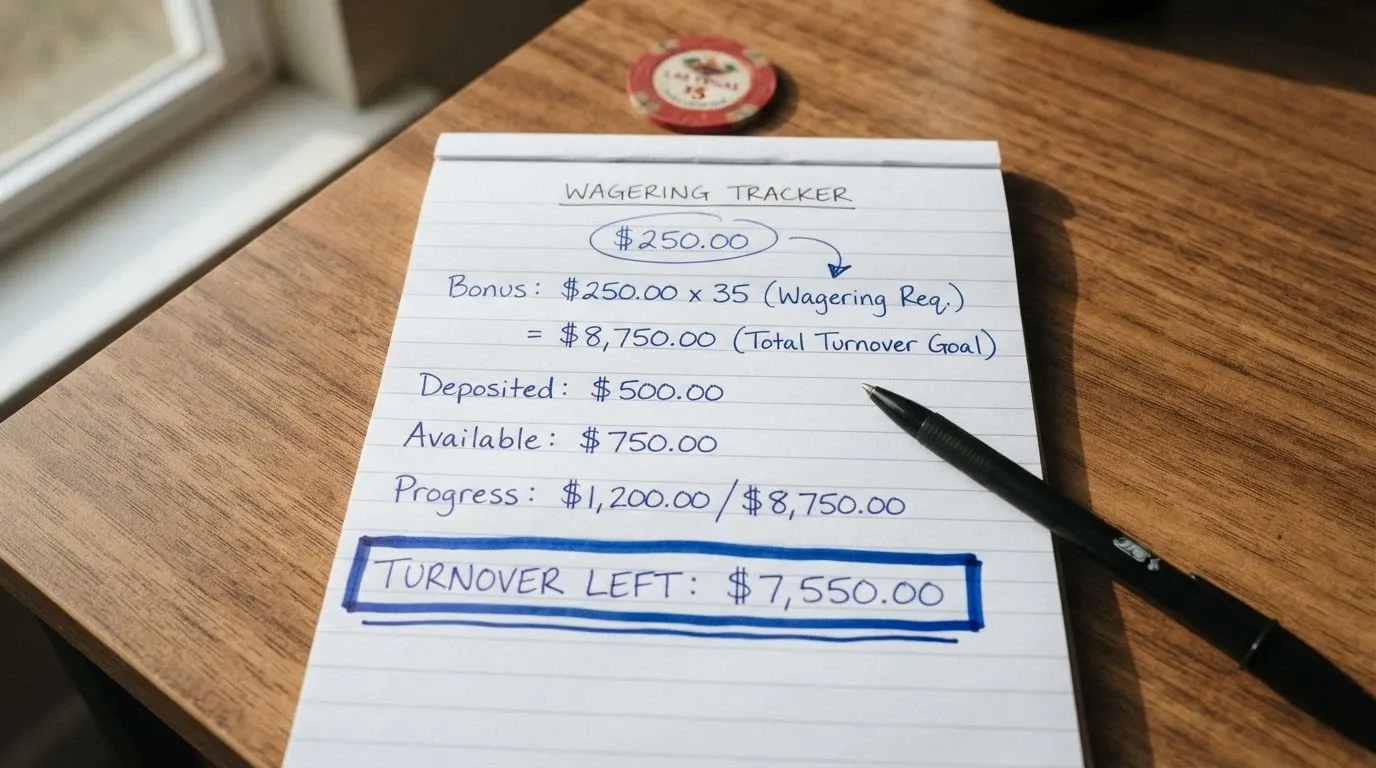
The expected loss on that grind is the part the marketing never names. A slot paying 96% keeps 4% of turnover as house edge — on A$15,000 of cycling bets, that is A$600 of expected loss over the four-hour session. The bonus started at A$300. The arithmetic left the player roughly A$300 down before any withdrawal attempt, before any cap is applied, and before any time expires. A A$20 free chip on the same maths — A$20 × 40x wagering = A$800 turnover, 4% house edge = A$32 expected loss — is the same problem in miniature. The expected value of every no-deposit offer is negative. The only variable is how much.
The Cashout Cap: Why a $300 Bonus Rarely Means a $300 Withdrawal
The cashout cap is the quiet term that makes the headline figure an illusion. Industry coverage puts the standard range at A$50 to A$200, with broader industry data showing caps as high as A$500 depending on the operator. Anything the player wins above the cap is forfeited on withdrawal — the casino pays out the cap, not the balance.
A genuine A$300 no-deposit chip with a 35x wagering requirement carries a cap that is most commonly around A$250. A more typical A$5 to A$50 free chip carries a cap that is roughly four times the bonus amount. WinSpirit caps general NDB withdrawals at A$75, and its 35-free-spins offer caps cashout at A$50. Royal Reels matches the cap exactly to the bonus: A$50 in, A$50 out. FairGO’s verified NDB caps at roughly A$180. Every one of these caps is smaller than the wagering turnover the player is expected to cycle through to reach the cap.
The cap is where the bonus becomes a fee. A bonus with a A$100 cap and a 50x wagering multiplier is a A$100 offer no matter what the headline says — and the player who clears wagering, exceeds the cap, and watches A$800 of “winnings” become a A$100 withdrawal has learned the lesson the term sheet was written to teach.
How Game Eligibility and Bet Caps Gut the Offer
Wagering clears only on eligible games. Pokies contribute 100% toward the requirement; table games, crash titles and live casino contribute 0% to 20%. A player who tries to grind the bonus on blackjack or a live-dealer table is grinding at a fraction of the rate they expected, and the wagering timer does not pause while they work out why their balance is not moving.
The bet cap is the other rule that voids everything if broken. The standard maximum stake while a bonus is active is A$5 or less; one spin above the cap and the entire bonus balance is forfeit, including any winnings accrued to that point. FairGO enforces the cap at A$5 and pairs it with A$0.10 free-spin stakes on its Sparkling Fortunes promotion — the rule is strict, and the operator monitors bet sizes across its games. A player who sizes up on a “hot streak” bet is, in the bonus terms, breaching the agreement and the winnings disappear with the balance.
These two rules together mean that clearing an NDB is not a question of running a strategy. It is a question of running a single game type at a fixed stake for the entire life of the bonus. The casino has decided what clearing looks like before the player has spun a reel.
Wager-Free Claims and What Actually Survives Testing
“No wagering” bonuses sound like the answer. They are not the common case. Of 27 advertised “no wager” no-deposit claims tested across 21 Australian-facing operators, only 5 produced an actual 0x-wagering bonus credited on signup with cashable winnings paid out cleanly. The other 22 either buried a wagering requirement in their small print, applied a high cashout cap that wiped the value, locked the bonus to a single game with poor RTP, or required a verification deposit that no real-money player would consider free.
The 5 that paid out cleanly are real exceptions, not a category. Even those carried their own traps — a verification deposit still required, a max-bet rule still in force, a game eligibility list still narrower than the casino’s full library. “No wagering” in this market is more often marketing than mechanism, and the player who takes the claim at face value without reading the terms will discover the wagering requirement on the first withdrawal attempt.
How Quickly Your Bonus Expires — and Why It Matters
The clock starts at claim, not at first bet. Typical no-deposit bonus expiry windows sit at 3 to 7 days from when the chip is credited. Free chips can expire within 24 to 72 hours if the wagering is not met within that window — a player who takes a day to read the terms has already burned a third of the validity on the A$50 chip they never got to play.
FairGO gives players 7 days from credit on its 100 free spins offer. WinSpirit’s two NDB offers also run on a 7-day clock from credit. Royal Reels’ validity window was not confirmed at the time of this review — players should treat it as short until the terms page confirms otherwise. The point is that no-deposit bonuses are short-duration products, designed to be cleared quickly or to expire trying. A player who treats the bonus as something to come back to over a week will find an empty bonus balance and a forfeit wagering progress on day eight.
The Offshore Casinos Offering No-Deposit Bonuses to Australians, Reviewed
Every operator on this page is offshore and Curaçao-licensed. The Interactive Gambling Act 2001 prohibits online casino in Australia; no Australian licence exists for any operator on this page. The comparison starts from that legal reality — every entry below is, in Australian terms, unlicensed — and shows what each brand offers on the no-deposit axis. Three operators carry a verified no-deposit offer; seven do not.
| Bonus Type | Typical Wagering Multiple | Typical Max Cashout | Typical Validity Window | Game Contribution |
|---|---|---|---|---|
| No-deposit free chip | 40x–60x | A$50–A$200 | 3–7 days | Pokies 100%; table/live 0%–20% |
| No-deposit free spins | 40x–45x | A$50–A$180 | 7 days | Single named pokie at 100% |
| Genuine A$300 no-deposit chip | 35x–50x | A$180–A$250 | 3–7 days | Pokies 100%; table/live 0%–20% |
| Deposit match welcome | 30x–40x | A$3,000 weekly win limit | 30+ days | Pokies 100%; table/live 0%–20% |
| Weekly cashback | 5x | Net losses returned | Weekly | Pokies 100%; table/live 0%–20% |
| Operator | Signature Trait |
|---|---|
| FairGO | 60x NDB wagering and a ~A$180 cashout cap — the heaviest NDB terms on the list |
| WinSpirit | Two distinct NDB offers (app install + signup) plus a 10% weekly cashback at 5x |
| Royal Reels | A$50 free chip with a matching A$50 cap — the smallest verified offer on the list |
| Rocket Play | 9.4% AU traffic share in tracked data; no verified NDB at this review |
| Skycrown | 8.55% AU traffic share in tracked data; no verified NDB at this review |
| Stake | Crypto-only platform; traditional NDBs not part of the model |
| Scream Casino | — |
| Bizzo Casino | — |
| Rocket Casino | — |
| Rainbet | — |
FairGO
FairGO is the most prominently promoted no-deposit offer for Australian players, and it pays for that visibility in wagering. The operator runs A$5 to A$50 free chips alongside a 100-free-spins package on Sparkling Fortunes at A$0.10 per spin, and both carry 60x wagering on bonus winnings — well above the 35x industry average for deposit bonuses. The cashout cap sits around A$180, and the bonus carries 7-day validity from credit. Max bet while wagering is capped at A$5.
The deposit-side welcome bonus is more forgiving: a 300% match at 30x wagering, separate from the NDB terms. Withdrawals are limited to A$2,500 per week, with crypto and eWallet payouts clearing in 2–3 business days and bank transfers taking up to 15. RTG (RealTime Gaming) powers the game library. The brand is well-known in the Australian-facing affiliate space, and the familiarity translates to more aggressive terms — FairGO’s NDB is one of the hardest-cleared offers on the list precisely because the brand does not need to compete on softness.
The verdict: FairGO remains the standard-bearer for comparative review. Its NDB is genuine and verifiable, but the 60x multiplier and A$180 cap effectively limit the value for any player expecting the headline A$300 figure. Comparing this offer against other Curaçao-licensed bonuses provides a necessary sanity check on the brand’s aggressive marketing.
WinSpirit
WinSpirit runs two distinct no-deposit offers rather than one. The first is 20 free spins credited when the player installs the mobile app — A$0.10 per spin, A$2 total stake, 40x wagering, one-time per player. The second is a 35-free-spins package on signup, A$0.10 per spin, A$3.50 total, at 45x wagering with an A$50 cashout cap and 7-day validity. The general NDB cashout cap sits at A$75; the 35-FS specific cap is tighter at A$50. A A$10 verification deposit is required before withdrawal.
The deposit-side welcome is the most generous verified offer on this page: 100% up to A$1,000 plus 100 free spins on first deposit, 200% up to A$1,000 on second deposit, both at 40x wagering with an A$3,000 win limit. The minimum deposit to trigger the welcome is A$30. A weekly cashback returns up to 10% of net losses at 5x wagering — the lowest wagering on any WinSpirit offer. Weekly withdrawal ceiling on bonus winnings is A$3,000.
The verdict: WinSpirit provides two distinct signup options, though both are modest in absolute stake. The 35-FS package is the cleaner choice on terms—higher wagering and a lower cap, but consistent with the industry range. Players interested in long-term play should focus on the deposit-match welcome bonus rather than these entry-level gestures.
Royal Reels
Royal Reels offers the smallest verified no-deposit package on the list: a single A$50 free chip, 40x wagering, A$50 max cashout, validity not confirmed at the time of this review. The cap and the bonus match exactly — what the player can withdraw is what they were given, and the offer reads as a trial of the platform rather than a value proposition.
The verdict: Royal Reels offers a straightforward A$50 chip, best viewed as an inexpensive platform trial. The terms remain sparse: no verified welcome bonus or game eligibility list exists in current data. Evaluation here relies strictly on the limited NDB specifics.
The verdict: A$50 in, A$50 out, 40x grinding in between. Royal Reels is a curiosity rather than a recommendation, useful as a comparison point for what a basic NDB looks like in the AU-facing offshore market.
Rocket Play
Rocket Play maintains a substantial AU presence, with 9.4% market share in tracked data, yet lacks a verifiable NDB program. The platform prioritises standard deposit-match promotions. Players hunting for free-play value will need to look elsewhere, as the operator publishes no equivalent terms.
The verdict: Rocket Play focuses exclusively on deposit-side value. Players prioritising a no-deposit bonus will find no utility here, as the operator does not publish such terms.
Skycrown
Skycrown sits in the same category as Rocket Play: substantial AU traffic — 8.55% market share in tracked data — Curaçao-licensed offshore, and no verified no-deposit bonus at the time of this review. The brand runs deposit-side promotions and a broad game library; the absence of an NDB in the terms surfaced here matches the pattern of higher-traffic offshore brands that compete on deposit value rather than on sign-up gestures.
The verdict: Skycrown is the same offer shape as Rocket Play. A player choosing between them is choosing on game library, deposit terms and payment speed, not on the no-deposit side — neither has anything to compare on that axis at this review.
Stake
Stake is the outlier. The operator runs a crypto-focused model — proprietary games alongside third-party titles, deposits and withdrawals settled in cryptocurrency, no traditional fiat banking interface. Traditional no-deposit bonuses are not part of the model; the promotional structure is rakeback, races and reload offers rather than sign-up chips. The absence of an NDB is structural, not an oversight.
The complication for Australian players is that cryptocurrency is a banned payment method for online wagering in Australia since 11 June 2024. An Australian player who deposits at Stake using crypto is using a payment method that Australian law bars licensed operators from accepting — and Stake is offshore and unlicensed, so the ban does not bind it, but the ban is a marker that the operator sits outside the Australian regulatory frame entirely. From 1 January 2027, banks and payment providers gain express authority to block transactions to illegal gambling operators, which extends the same logic to fiat-to-crypto on-ramps.
The verdict: Stake is not a no-deposit product, and Australian players accessing it are using a payment method that licensed operators are barred from accepting. That single fact closes the comparison to every other operator on this list.
Scream Casino
Scream Casino operates offshore without an Australian licence. It features deposit-side welcome offers rather than an NDB. For players evaluating the site, the operator’s own terms page remains the primary source for current promotional data.
The verdict: the absence of a verified NDB means there is nothing to compare on the no-deposit axis. Scream is a deposit-side brand in a no-deposit ranking — the same shape as Rocket Play and Skycrown, and the next port of call is the operator’s own welcome-package terms.
Bizzo Casino
Bizzo Casino is an offshore operator without Australian licensing. It maintains presence in local affiliate channels, but its terms exclude a verifiable NDB. Interested players should consult the operator’s site directly for its current deposit-match and game-library specifics.
The verdict: Bizzo is in the same group as Scream Casino and the rest of the no-NDB cluster. The comparison is on deposit terms and game library, not on sign-up value.
Rocket Casino
Rocket Casino operates offshore without Australian licensing. While the name shares similarities with other brands, this review treats it as a distinct entity. No NDB program is currently verified for the site.
The verdict: Rocket Casino sits with the rest of the no-NDB cluster — the absence of a verified offer here means the comparison to FairGO and WinSpirit is on deposit terms only.
Rainbet
Rainbet is an offshore brand with no Australian licence and a smaller market footprint than the leading competitors. It does not currently offer a verifiable NDB, leaving its deposit-side terms as the main area for player consideration.
The verdict: Rainbet rounds out the no-NDB cluster. A player with no verified offer here has nothing to compare on sign-up value; the operator’s deposit terms are the next port of call.
PayID Pokies and the Payment Routes That Actually Work from Australia
PayID is the instant-transfer system built on Australia’s New Payments Platform — bank-to-bank transfers that settle in seconds using a PayID identifier (a phone number, email or ABN) rather than a BSB and account number. For Australian players funding offshore casinos, PayID is one of two routes that consistently works. The minimum deposit is typically A$10 to A$20; the maximum per transaction is most commonly A$1,000 to A$10,000; and the deposit itself is instant.
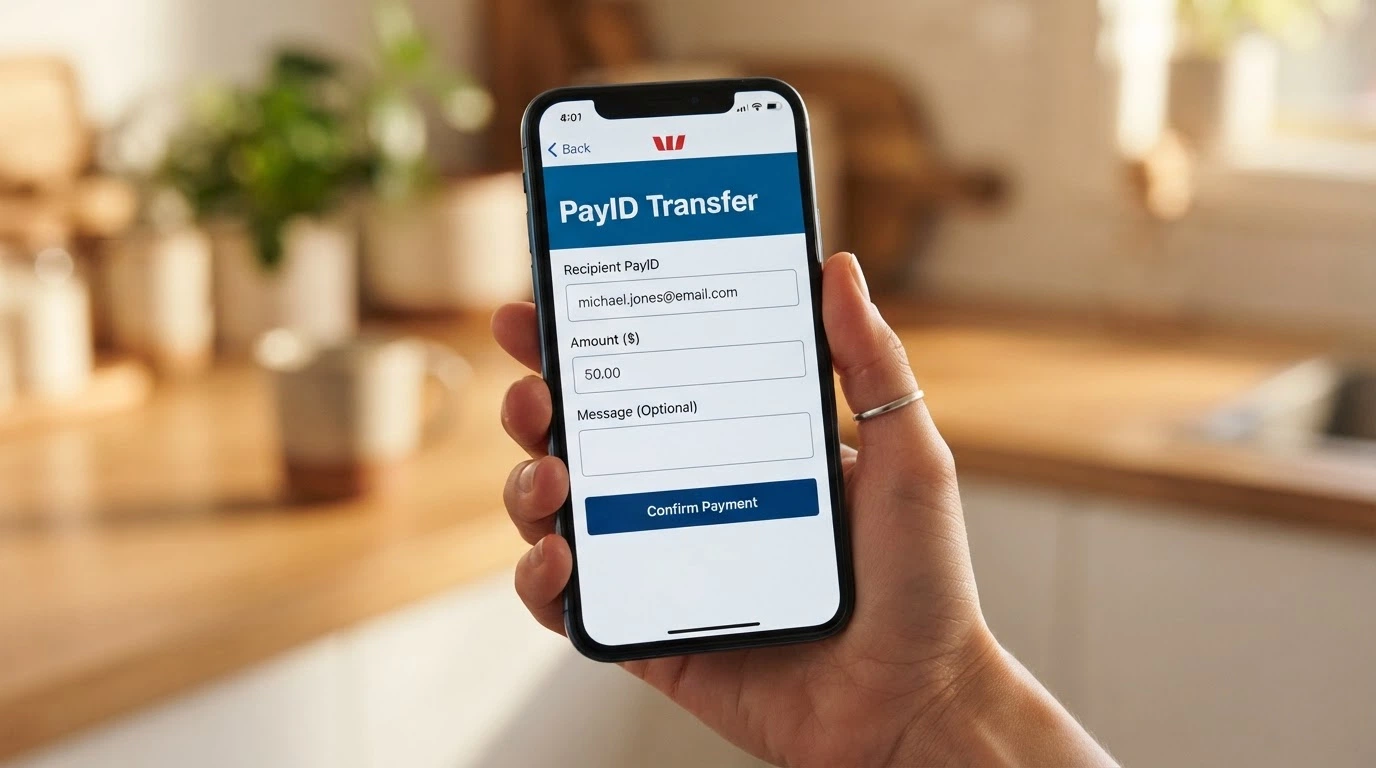
The catch is that PayID withdrawals are rarely supported. The Australian banks that sit behind the PayID system block direct transactions identified by gambling merchant codes, and offshore operators route deposits through third-party processors to bypass those blocks. The deposit works because the processor masks the merchant category; the withdrawal fails because the same routing logic rarely applies in reverse. An Australian player who deposits A$500 via PayID at an offshore casino will, in most cases, need to receive their withdrawal via bank transfer — which on the slower operators on this list can take up to 15 business days, and on every operator here is gated by a weekly withdrawal ceiling.
The payment method itself is a tell. An Australian player who is asked for a credit card or crypto deposit by a gambling site is being served by someone outside Australian rules — credit cards, credit-related products and cryptocurrency have been banned as payment for online wagering since 11 June 2024, with penalties of up to A$247,500 for operators that fail to enforce the ban. The legal deposit routes for licensed wagering are debit card, bank transfer, PayID/Osko and BPAY. An offshore operator asking for anything else is signalling its unlicensed status before the first spin.
Deposit Speed, Limits and Bonus Eligibility When You Use PayID
A PayID deposit at an offshore casino is instant. The funds land in the casino balance in seconds, and the welcome bonus — if any — is credited at the same time, gated by the bonus code or promotional link that triggered the offer. Minimum deposits at A$10 to A$20 mean the bonus-triggering threshold is lower than for bank transfers; maximum per-transaction limits of A$1,000 to A$10,000 cover most deposit-match offers without forcing the player to split the funding across multiple transactions.
Bonus eligibility is the next question. Most deposit-match bonuses — including WinSpirit’s 100% up to A$1,000 first-deposit offer and FairGO’s 300% match — are triggered automatically by any deposit above the threshold, regardless of payment method. PayID is treated as a deposit like any other. The no-deposit side is different: the bonus is credited on signup or on a code redemption, not on the deposit itself. A player who deposits via PayID to trigger a welcome bonus is also clearing the verification deposit requirement that gates NDB withdrawals — A$10 to A$20 minimum covers the threshold on most operators.
The constraint is the third-party processor. Australian banks block direct PayID transactions tagged with gambling merchant codes, and offshore operators route the deposit through a payment intermediary that re-codes the transaction. The player does not see the routing; the player sees a successful deposit. The risk is that the third-party processor is offshore, the player has no recourse through Australian consumer protection if the transaction fails, and the bank may flag the transaction on its own fraud-detection system. The work-around works — until it does not.
Why Withdrawals Are the Real Bottleneck
Depositing is the easy half. PayID withdrawals are rarely supported, and the operator routes the payout through bank transfer — which on FairGO can take up to 15 business days, on WinSpirit sits behind an A$3,000 weekly win limit, and on every operator is gated by the verification deposit that proves the player has funded the account at least once.
FairGO caps withdrawals at A$2,500 per week; Bitcoin and eWallet withdrawals clear in 2 to 3 business days, but bank transfers take up to 15. WinSpirit caps weekly bonus-winnings withdrawals at A$3,000. Royal Reels’ specific withdrawal terms were not confirmed at this review. Every operator requires a verification deposit — A$10 to A$20 — before any withdrawal is processed, regardless of whether the winnings came from a no-deposit bonus or a deposit match. The deposit is the casino’s KYC trigger: it locks in a payment method and confirms the player’s identity to a level the regulator would require if the operator were licensed.
The combination is the slow half of the offshore experience. A player who clears A$1,000 in bonus winnings on a Friday will not see the money in their bank account for two weeks on the slowest operators, will hit a weekly cap that delays any excess by another week, and may discover at withdrawal that a verification deposit they never made blocks the payout entirely. The bottleneck is not the wagering. The bottleneck is everything that happens after.
The Legal Reality: Online Casino Is Prohibited in Australia
The Interactive Gambling Act 2001 makes it illegal for a provider to offer online casino games, online pokies or in-play sports betting to a person physically in Australia. There is no licence for these products anywhere in the country — not federally, not in any state or territory. What is licensed is wagering on races and sport placed before the event begins, plus lotteries and keno, through operators licensed by a state or territory body. The Northern Territory Racing and Wagering Commission is the de facto national licensor for online wagering; the large Australian-facing bookmakers hold NT licences for their pre-event sports and racing products.

The federal regulator is the Australian Communications and Media Authority (ACMA). ACMA investigates complaints, issues formal warnings, brings civil penalty proceedings, refers operators for enforcement and — since November 2019 — directs Australian internet service providers to block illegal gambling and affiliate websites. As at March 2026, 1,564 illegal sites had been blocked. More than 225 illegal services have withdrawn from the Australian market since enforcement was strengthened in 2017.
The prohibition targets the provider, not the punter. The individual player is not prosecuted under the IGA — the Act makes it an offence to provide prohibited interactive gambling services to Australians. What the player gives up by accessing an offshore casino is recourse: ACMA cannot recover an individual’s funds, BetStop does not reach offshore operators, and the operator’s own terms govern every dispute.
What the 2026 Reform Changes for Australian Players
The Interactive Gambling Amendment (Gambling Reform) Bill 2026 passed Parliament on 19 August 2026, and its measures commence on 1 January 2027. The reform does not legalise online casino — the prohibition stays. It tightens everything around the prohibition.
The advertising restrictions bite the licensed wagering market hardest: no more than three wagering ads per hour on television between 5 am and 8:30 pm; a live-sport blackout window from 15 minutes before to 5 minutes after a live event; a bar on athletes, celebrities and influencers promoting wagering products. From 1 January 2027, direct marketing of inducements is prohibited for 14 days after a customer signs up with a licensed operator, for three months after a person deregisters from BetStop, and indefinitely for customers identified as at risk of gambling-related harm. The intent is to choke the licensed industry’s promotional spend; the offshore industry sits outside the regime entirely and is unaffected by the rules.
The more consequential change for offshore play is the authority given to banks and payment providers to block transactions to illegal gambling operators, also commencing 1 January 2027. PayID, BPAY and card transactions that fund an offshore casino account will be subject to blocking at the bank’s discretion, not just at the merchant code level. The payment channel that worked in 2026 will not necessarily work in the same way in the next calendar year.
Offshore vs Licensed: What the Player Actually Gives Up
The licensed Australian wagering market has a safety net built over decades: ACMA enforcement, state-level dispute resolution, BetStop self-exclusion, mandatory deposit limits, activity statements, take-a-break tools. None of that reaches an offshore casino. A player who has self-excluded through BetStop will still be able to deposit at an offshore site — BetStop covers approximately 150 licensed wagering providers, and an offshore casino is not on that list.
The payment method is the practical tell. An Australian asked for a credit card or a crypto deposit by a gambling site is being served by someone outside the Australian rules. The ban on credit cards and crypto for online wagering has been in force since 11 June 2024, with penalties of up to A$247,500 for operators that fail to enforce it. The ban does not bind an offshore operator — there is no Australian regulator to fine — but the ban signals that the operator has opted out of the Australian frame entirely.
The player who funds an offshore casino account accepts three specific losses that no bonus can price: no Australian consumer protection if the operator refuses a withdrawal; no complaints body with authority to recover funds; and the site can be blocked at the DNS level at any time, with any balance remaining on it. Blocking is the ACMA’s preferred enforcement tool, and 1,564 sites have already gone through it.
How Australia’s Model Compares: Prohibition, Not Regulation
Australia runs the French model — prohibit, block, enforce — not the British one of licensing and regulating online casino. The structural choice shapes every offer on this page. There is no national deposit ceiling because there is no product to cap. There is no national self-exclusion that reaches offshore operators because the licensed market is the only market the regulator can see.
The narrow licensed market runs through the Northern Territory Racing and Wagering Commission, which acts as the de facto national licensor for online bookmakers. The NT levies a 5% wagering tax on wagers minus payouts plus a 0.05% racing levy. Each state adds its own point-of-consumption tax on top, typically 10% to 15% of net wagering revenue. The licensing structure exists to tax and regulate the narrow licensed product, not to extend a regulatory umbrella over the offshore industry.
The international comparison matters for what Australian players should expect from any “regulation” claim an offshore operator makes. Curaçao licensing is real but light: the regulator audits operators, charges fees and issues licences, but the player-protection regime, dispute resolution and complaint pathways are not equivalent to those of a state-licensed Australian bookmaker. An Australian player who chooses an offshore casino over a local licensed bookmaker is trading the local safety net for higher bonus figures and a broader game library.
Gambling Winnings and Tax: What the ATO Says
Gambling winnings are not taxable income for the ordinary Australian punter. Section 6-5 of the Income Tax Assessment Act 1997 makes betting and gambling winnings non-assessable, and section 8-1 makes losses non-deductible — unless the person is carrying on a business of betting or gambling, a test set out in the ATO’s own ruling IT 2655. The ATO’s criteria for a “business of betting” include systematic, organised betting activity with the aim of profit; ordinary recreational play, even at an offshore casino, does not meet the test.
The practical effect is that a player who withdraws A$500 from a no-deposit bonus win keeps the A$500 free of Australian income tax, but cannot claim any of the losses incurred while clearing the bonus as a deduction. The bonus’s expected loss — the A$32 on an A$20 chip with 40x wagering at 96% RTP, the A$600 on an A$300 chip at 50x — is a real cost that the player absorbs personally. The tax system treats gambling as a closed transaction for ordinary punters, and the arithmetic of expected loss is the only arithmetic the player has to do.
Playing Safely When the Safety Net Doesn’t Reach Offshore Casinos
The Australian player-protection infrastructure — BetStop, mandatory deposit limits, activity statements, take-a-break tools — was built for the licensed wagering market, and the licensed wagering market is the only one it reaches. Offshore casinos sit outside every part of it.

BetStop is the National Self-Exclusion Register. One registration excludes a person from every Australian-licensed online and phone wagering service in a single step. As at 31 July 2026, 67,480 registrations had been made; 41,290 exclusions were still active — more than 60% of everyone who had ever registered. 78% of registrants were under 40; 38% chose lifetime exclusion. A self-exclusion can run from a minimum of three months to a lifetime, and a person cannot apply to be removed in the first three months.
The register covers approximately 150 licensed wagering providers. An offshore casino is not on the list. The same player who is blocked from every Sportsbet, bet365 and Ladbrokes account is still able to deposit at FairGO, WinSpirit or any other Curaçao-licensed brand on this page. BetStop’s gap — the offshore blind spot — is the single most concrete harm of the unlicensed route. Self-exclusion is a closed door in one market and an open one in the other.
The Australian Institute of Health and Welfare estimates that roughly 2.1% of Australian adults—about 430,000 people—experienced problem gambling in 2022, with 1.8% identified as high-risk. The National Gambling Helpline (1800 858 858) operates 24/7 with confidential counselling and chat services. While the helpline understands licensed-market realities, its support is open to every Australian, including those using offshore platforms. Anyone feeling the pressure of a bonus grind or finding themselves depositing beyond their means should reach out immediately.
Recognising the Warning Signs When the Casino Has No Duty of Care
An offshore casino has no Australian-mandated responsible-gambling code. There is no activity statement, no enforced deposit limit, no take-a-break tool that locks the account for 24 hours or seven days at the player’s request. The player is the only one watching for harm.
The warning signs are the same ones the licensed market is trained to flag: chasing losses, depositing more than planned, playing longer than intended, hiding play from family or partners, borrowing to fund play, neglecting work or relationships. The difference is that on a licensed Australian platform, the operator would have intervened by now — surfacing a pop-up, restricting deposits, refusing further play. On an offshore platform, the operator has no obligation to do any of that. The player who notices the signs in themselves is the only person who will act on them.
Self-monitoring is the only tool available. A player at an offshore casino can set a personal deposit limit, refuse to deposit after the NDB has been cleared, treat the bonus as a fixed-cost entertainment purchase with a known negative expected value, and walk away when the timer on the bonus expires. The consecutive-free-bonus rule across sister networks is, ironically, a brake on the same behaviour: the operator has built in a rule that prevents a player from cycling through brands in search of free chips without a real-money deposit in between. The rule is designed for the operator’s protection. It also happens to slow the player down.
How to Use a No-Deposit Bonus Without Letting It Use You
A no-deposit bonus is a trial, not an income. The maths is negative — A$32 expected loss on an A$20 chip with 40x wagering at 96% RTP, A$600 on an A$300 chip at 50x — and the cashout cap erases the upside. The bonus is worth claiming as a way to test an offshore platform’s interface, game library and payout speed before committing real money. It is not worth chasing as a profit opportunity.
The hard rules that follow from that framing: set a fixed stop-loss before claiming the bonus and stop when the stop-loss is reached. Do not deposit to chase a cashout cap — the verification deposit exists to allow a withdrawal, not to fund the next round of wagering. Treat any winnings above the cap as a windfall that was never part of the deal, not as money the casino “owes” the player. Do not let the 3-to-7-day expiry window push the player into bigger bets than the A$5 cap allows; exceeding the cap voids everything.
The consecutive-free-bonus rule across sister networks — FairGO, WinSpirit and other Curaçao operators linked to the same parent group — is a brake on cycling through brands. A player who claims an NDB at one brand and then immediately tries to claim another at a sister site without depositing in between will be flagged as a bonus abuser. The flag is not a criminal matter; it is a withdrawal block that the player can sometimes work around but usually cannot. The rule exists because bonus abuse is the fastest-growing cost line for offshore operators. It also means a player who treats the bonus as a single trial, not a continuing project, will never trigger the flag.
How We Selected and Evaluated These Operators
The featured set was built from three sources: the ACMA’s published register and enforcement record, the operators’ own published terms pages, and affiliate-channel audits of no-deposit offers available to Australian players. Each operator was checked against the Interactive Gambling Act 2001 prohibition — none of the ten on this list holds an Australian licence for online casino — and against the operator’s own published no-deposit bonus terms, where available.

The presence of a verified no-deposit bonus was the primary ordering criterion. FairGO, WinSpirit and Royal Reels each had a verifiable offer in the operator’s own published terms or in a current affiliate audit at the time of this review, and they lead the ranking for that reason. Rocket Play and Skycrown follow on traffic share — both brands appear in tracked AU data at 9.4% and 8.55% respectively — and are listed because their absence of a verified NDB at this review is itself useful information for a player searching for one. Stake, Scream Casino, Bizzo Casino, Rocket Casino and Rainbet complete the set as additional brands that appear in the AU-facing channel but for which no NDB was confirmed at this review.
The evaluation criteria were the published bonus terms themselves: wagering multiplier, maximum cashout, validity window, game eligibility, max-bet rule and verification-deposit requirement. Where the operator’s terms did not include a no-deposit offer, the operator was listed but the NDB-specific figures were left blank — the absence of a verifiable offer is the result, not a gap to be filled with an estimate. Market share figures were treated as traffic-based indicators for ranking only and are not published as audited data.
What the Numbers Actually Say About Claiming a 2026 No-Deposit Bonus
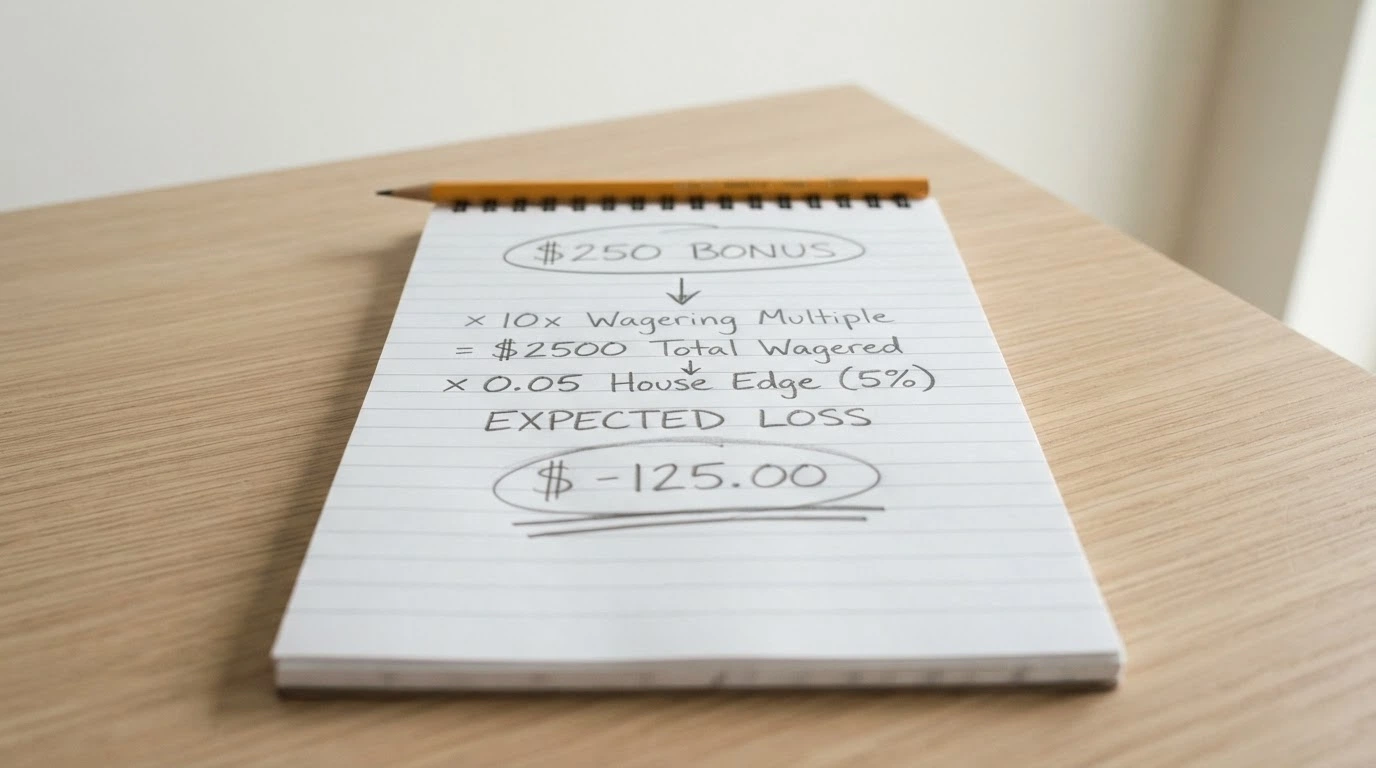
The maths is blunt. An A$300 no-deposit bonus at 50x wagering means A$15,000 in turnover before any dollar can leave the casino — at the A$5 maximum stake, that is 3,000 spins, or roughly four hours and ten minutes of continuous play. The 4% house edge on a 96% RTP slot makes the expected loss on that grind about A$600, against a bonus that started at A$300. The expected value of the offer is negative A$300 before any cashout cap is applied. The same arithmetic, scaled to an A$20 free chip with 40x wagering — A$800 turnover, A$32 expected loss — produces the same shape in miniature. The expected value of every no-deposit bonus is negative. The only variable is how much.
The cashout cap makes the shape worse. The industry-standard cap sits at A$50 to A$200, with broader data showing caps up to A$500. A genuine A$300 chip at 35x wagering carries a typical A$250 cap; an A$100 chip typically caps at A$50 to A$100. The cap is the line where bonus arithmetic meets withdrawal reality — the player who clears A$2,000 of wagering turnover, exceeds an A$100 cap and watches A$800 of “winnings” become an A$100 payout has reached the end of what the term sheet was built to deliver.
The offshore legal reality adds risk no term sheet can price. No BetStop coverage, no Australian consumer protection, no ACMA recourse for funds. The site can be blocked at the DNS level at any time, with the player’s balance still on it. The 1,564 sites ACMA has had blocked since November 2019 are not all defunct — some have re-emerged at new domains — but the original site, with the original account, is no longer reachable.
A no-deposit bonus is a low-stakes trial of an unlicensed platform. It is entertainment with a known negative expected value, and the player who treats it that way — claims the chip, clears a small portion of the wagering, walks away with whatever passes the cashout screen — has extracted the value the offer actually delivers. The player who treats the headline figure as a profit target is grinding toward a number that the terms were written to prevent.
Frequently Asked Questions
Are $300 no-deposit bonus offers legitimate or are they too good to be true?
The A$300 figure is more often a click-through promise than a realisable payout. Verified A$300 no-deposit chips are rare in the Australian-facing market, and most confirmed offers range from A$5 to A$100. Wagering on those verified chips ranges from 40x to 60x, with cashout caps of A$50 to A$250.
What happens if I win big with a no-deposit bonus — can I cash out the full amount?
No. Maximum cashout caps on no-deposit bonuses in Australia typically range from A$50 to A$500, and any winnings above the cap are forfeited on withdrawal. A player who accumulates A$800 on a bonus with an A$100 cap receives A$100 — not A$800.
What games can I play with a no-deposit bonus at Australian casinos?
Pokies contribute 100% toward wagering requirements on every verified offer on this page. Table games, crash titles and live casino contribute 0% to 20%, which means the wagering timer effectively pauses on those games. Game eligibility is set by the operator’s terms and may also lock the bonus to specific named titles.
How long do I have to use a no-deposit bonus before it expires?
The clock starts at claim, not at first bet. Typical expiry windows sit at 3 to 7 days from credit, and free chips can expire within 24 to 72 hours if wagering is not met. FairGO’s 100 free spins and WinSpirit’s 35-free-spins offer both run on 7-day validity. Royal Reels’ specific window was not confirmed at this review.
Are offshore online casinos safe for Australian players?
Australian-facing offshore casinos on this page are Curaçao-licensed, not Australian-licensed — the Interactive Gambling Act 2001 prohibits online casino in Australia. The licensed-market safety net — BetStop self-exclusion, ACMA dispute resolution, mandatory deposit limits — does not reach offshore operators. A self-excluded person can still deposit at an offshore site.
Bonus Codes: Do You Need One and Where Do They Come From?
A bonus code is a distribution channel, not a secret. Roughly 40% of $300 no-deposit bonuses require an alphanumeric code entered at registration or in the cashier field. The code identifies which affiliate or promotional channel sent the player — it is how an aggregator site gets credit for the click, and how an operator segments offers between “registered via partner site” and “registered directly.”
Codes are not hidden. They are published on the affiliate page that sent the player, in the operator’s promotional email if one was sent, and inside the cashier interface after registration. A player who arrived at an operator without a code rarely loses the bonus — the cashier usually defaults to the open offer. Specific segmented offers — larger chips, lower wagering, free-spin packages — are gated behind codes because the operator wants to track who delivered the player. Missing the code does not necessarily mean missing the bonus; entering the wrong code does.
Created by the ”Live Casino Australia” editorial team.