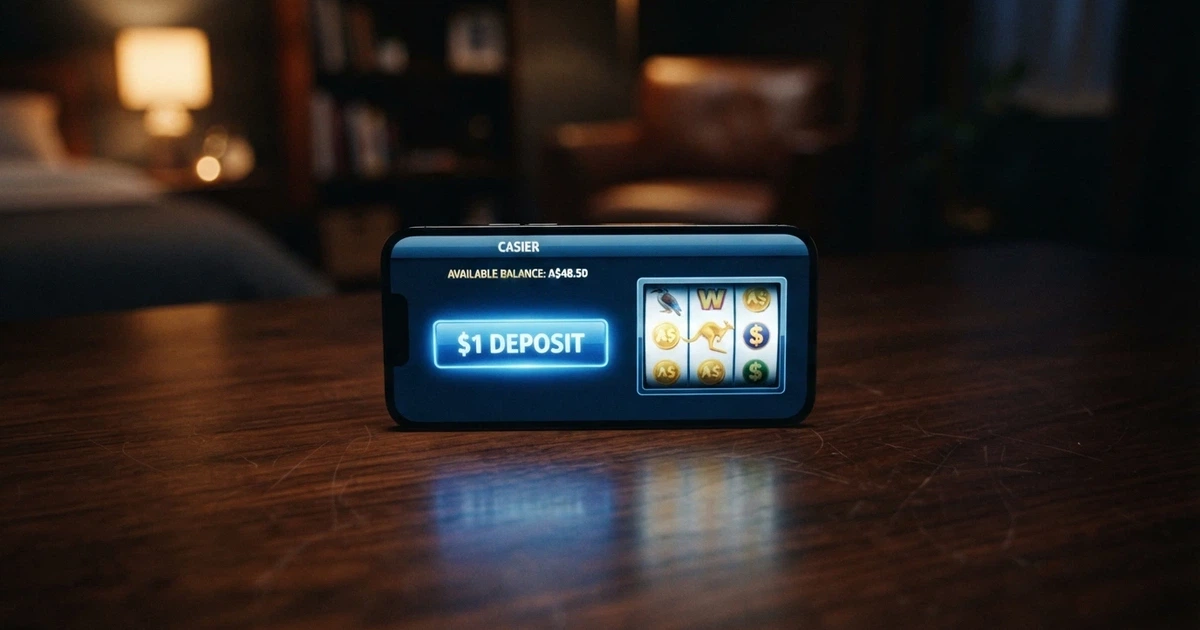
$10 Minimum Deposit Casinos for Australian Players: What a Ten-Dollar Entry Point Really Buys in 2026
 Available in AU
A ten-dollar deposit sounds small enough to be harmless. At an Australian-facing online casino it opens a real-money account on a platform full of pokies, table games and a welcome offer, often with a mobile browser session ready before the kettle has boiled. None of that is the part most readers are missing, though. The part that matters is the gap between a $10 deposit and an Australian licence for the product the deposit buys, because that gap is total. There is no online casino licence anywhere in the country. Every operator on this page is offshore. The $10 entry point is real, the play is real, and the absence of Australian consumer protection is also real. What follows is what the $10 buys, what it costs, and how to play within your means on a platform the regulator cannot reach.

Data current as of 18 October 2026; licence claims verified against the ACMA register and the Interactive Gambling Act 2001.
Table of Contents
- What a $10 Minimum Deposit Actually Means at an Australian Online Casino
- The Best $10 Minimum Deposit Casinos for Australian Players in 2026
- Payment Methods That Take a $10 Deposit — and the Ones That Signal Trouble
- Real-Money Pokies You Can Play with a $10 Deposit
- $10 Mobile Casino Play: Phone, Tablet and Browser Access
- Bonuses You Can Actually Claim with a $10 First Deposit
- New $10 Deposit Casinos Worth Watching in 2026
- The Legal Reality: Why No Online Casino Is Licensed in Australia
- Playing Safely: Responsible Gambling Tools Every $10 Punter Should Know
- How We Chose the Casinos on This Page
- Your $10 Deposit: What It Buys, What It Risks, and How to Play Within Your Means
- Frequently Asked Questions
What a $10 Minimum Deposit Actually Means at an Australian Online Casino
A “minimum deposit” is the smallest amount an online casino will accept to fund a real-money account. Casinos set the floor low to reduce the friction of signing up: a $10 entry point turns a comparison shopper into a funded player with one tap. It is a marketing threshold as much as a banking one, and at the $10 level the marketing is doing more work than the play.
The floor is not the only threshold on the page. Offshore casinos serving Australian players also set a withdrawal minimum, often a multiple of the deposit minimum, and a maximum cashout on bonus-derived winnings. The deposit opens the door; the withdrawal rules decide what comes back. A $10 deposit that wins $200 against a $50 max-cashout cap pays out $50. The floor is the cheapest thing to read about; the ceiling is what changes the maths.
The $10 threshold: what a minimum deposit is and why it matters
A minimum deposit is the smallest amount a casino will credit to a real-money balance. The threshold is set by the operator, not by any Australian regulator, because no Australian regulator licenses online casinos. There is no federal deposit, loss or stake ceiling for online gambling in this country, simply because the product those ceilings would govern is banned outright.
The threshold matters because it is the gateway to a real-money account, not because the dollar amount is itself meaningful. A $10 deposit at a high-stake-per-spin pokie buys a handful of spins; at a 10-cent pokie it buys a long session. The marketing pitch is the dollar, and the experience is the stake. The two are different numbers, and the difference is what a $10 budget actually buys.
Online casino vs land-based: the AUD $10 entry point
The land-based contrast makes the offshore floor look even more striking. Crown Melbourne and The Star Sydney are state-licensed, Australian-regulated venues, and their entry products are table minimums, not casino deposits. A punter walking into a Crown gaming floor typically buys in at table minimums well above $10. The online $10 deposit buys the same product, in a different room, at a fraction of the entry price. AUD-denominated play is the expectation; offshore platforms serving Australian players display balances in AUD and quote bonuses in AUD, even when the operator is incorporated elsewhere.
Who the $10 deposit casino is actually for
The searcher typing “$10 minimum deposit casino Australia” is a commercial-investigation lead, someone comparing real-money platforms where a $10 deposit actually funds a session. The supporting intent is usually transactional: how do I deposit, how do I withdraw, what does the bonus look like. The informational layer sits underneath: is this legal, is it safe, what happens if something goes wrong. The $10-deposit punter is the budget-conscious Australian who wants to test a platform without committing a serious bankroll, the casual player who treats a $10 deposit as a paid evening rather than a position, and the pokies-first player for whom the game library matters more than the deposit multiplier.
What that punter trades off against a $200 depositor is bonus generosity and game-room access. Most welcome offers scale with deposit size, so a $10 deposit typically triggers the smallest rung of the bonus ladder. Game access is broadly the same at the $10 level: a $10 funded account plays the same pokies library as a $200 account on the same platform. The difference is the size of the bankroll, not the catalogue.
The Best $10 Minimum Deposit Casinos for Australian Players in 2026
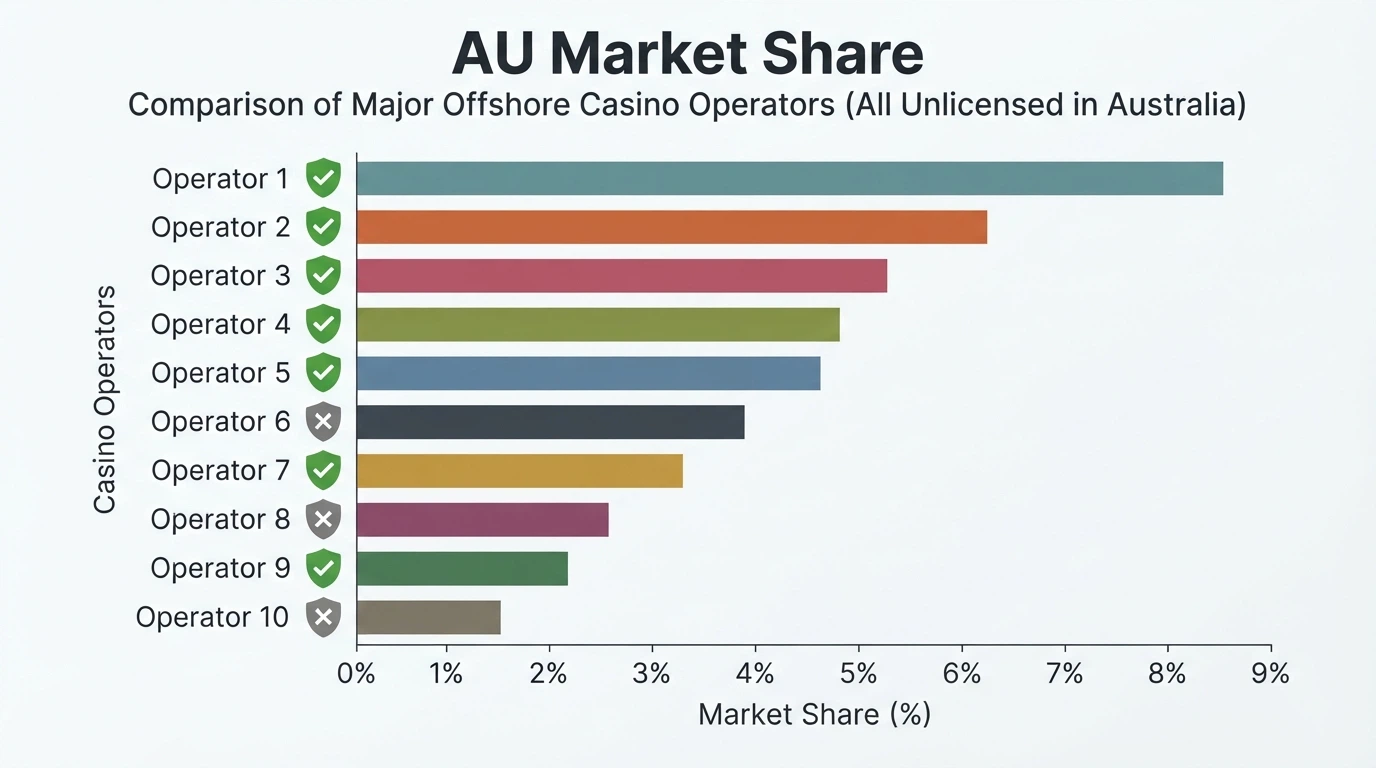
The list below is the set of offshore operators Australian players actually reach with a $10 minimum deposit, ordered by AU market presence. Every brand on the table is an offshore entity. None holds an Australian casino licence because no such licence exists. The market-share and revenue columns come from a market-tracking snapshot and are presented as a context, not as a recommendation. The column the page cares about most is the first one: legal status in Australia.
| Casino | AU Legal Status | AU Market Share | Monthly Revenue (AUD) |
|---|---|---|---|
| Rocket Play | Offshore, unlicensed in Australia | 9.4% | $632.69M |
| Skycrown | Offshore, unlicensed in Australia | 8.55% | $436.07M |
| Royal Reels | Offshore, unlicensed in Australia | 2.51% | $243.99M |
| WinSpirit | Offshore, unlicensed in Australia | 1.55% | $110.3M |
| Stake | Offshore, unlicensed in Australia | 1.28% | $115.67M |
| Rainbet | Offshore, unlicensed in Australia | 1.28% | $83.13M |
| Scream Casino | Offshore, unlicensed in Australia | 0.99% | $94.87M |
| FairGO | Offshore, unlicensed in Australia | 0.8% | $69.11M |
| Bizzo Casino | Offshore, unlicensed in Australia | 0.57% | $51.38M |
| Rocket Casino | Offshore, unlicensed in Australia | 0.57% | $43.22M |
Best overall by minimum deposit
The “best overall” frame, applied to a market with no licensed options, is doing different work than it would in the UK or Malta. The criteria that still matter are the practical ones: whether the platform consistently accepts AUD, whether the deposit method actually clears at $10, how broad the pokies library is, and whether the operator has a track record of paying out. Market presence is a proxy for AU trust in the absence of any AU regulatory body that could be the trust source. Bigger share means more AU players have funded accounts, played, and either withdrawn or not, and the silence of the not-withdrawn is its own form of evidence.
The trade-off is the one a $10 punter always faces: a brand with a large AU footprint tends to have tighter bonus terms because it does not need to compete on generosity; a smaller brand may offer a flashier welcome but with thinner coverage. “Best” at the $10 level means the operator that funds the account cleanly, holds the balance, and pays out without inventing a reason to void the win. The first column of the table above is the one that decides whether any of the others matter.
What “best” means when every operator is offshore
The honest reframe is that the ranking measures the operators Australian players are using, not the operators Australian players should be using. The “should” question has no AU answer, because AU consumer protection does not extend to offshore casinos. ACMA cannot recover a refused withdrawal. BetStop does not bind an offshore operator. The Australian Financial Claims Authority does not have jurisdiction. What the player is choosing between is a set of operators that all share the same structural risk, ordered by how many other Australian players have made the same choice.
The payment method is the clearest tell. An offshore site asking for a credit card or a crypto deposit is operating outside Australian rules by definition: credit cards, credit-related products and digital currency are banned for online wagering since 11 June 2024, with operator penalties up to A$247,500. Legal deposit routes for licensed AU wagering are debit card, bank transfer, PayID/Osko and BPAY. A site that wants the legal routes is at least nodding to the framework; a site that wants a credit card is not.
The enforcement backdrop is not theoretical. Since its first blocking request in November 2019, the ACMA has had 1,564 illegal gambling and affiliate websites blocked by Australian ISPs. More than 225 illegal services have withdrawn from the Australian market since 2017. From 1 January 2027, banks and payment providers gain express authority to block transactions to illegal gambling operators. The “best” of an offshore set is still offshore, but the offshore set itself is shrinking and the rails it runs on are about to be a lot harder to use.
Rocket Play
Rocket Play is the largest AU-facing brand in the snapshot at 9.4% market share and $632.69M in revenue. In a market where the AU regulatory body does not track offshore brands, market share is the closest thing to a usage signal Australian players have. Rocket Play is the operator a $10 Australian punter is most likely to land on after a comparison search, and that is itself worth knowing: a brand with this volume has processed enough deposits and withdrawals to refine its payment flow, and the friction on a $10 entry is usually low.
The platform serves Australian players in AUD and offers a pokies-heavy game library. A $10 deposit unlocks the same real-money account a $200 deposit does, so the entry point is not a separate product — it is the front door of the same platform. The same offshore caveat applies: no AU consumer protection, no BetStop coverage, no ACMA recourse on a refused withdrawal. A self-excluded Australian can fund an account here without the register’s knowledge.
The verdict: Rocket Play is the AU market-share leader for a reason, and a $10 punter looking for a brand with the largest Australian player base is choosing the brand with the most Australian players. That is a real signal, and it is also exactly the signal that breaks the moment a withdrawal goes wrong.
Skycrown
Skycrown holds 8.55% of the AU-facing market by share, with $436.07M in revenue. Runner-up to Rocket Play in the snapshot, the platform has the second-largest Australian player contingent in the featured set and the same offshore structure: no AU licence, no AU consumer protection, AUD-denominated play. A $10 deposit funds the same real-money account a higher deposit would, with the game library and the welcome offer scaled to the deposit size.
Skycrown’s positioning in the AU market is as a generalist offshore casino with a broad pokies catalogue. Like the rest of the set, the practical experience at the $10 level is the small-stake, long-session profile that low deposits produce. The offshore caveat is unchanged: a refused withdrawal has no AU remedy, and BetStop does not extend to the platform.
The verdict: Skycrown is the close second by AU presence, and the read for a $10 punter is the same as for the market leader — market presence is a payment-flow signal, not a protection signal.
Royal Reels
Royal Reels sits at 2.51% AU market share and $243.99M in revenue. The brand is pokies-led in its positioning, and the AU player base is built on the games catalogue rather than on a sportsbook or a live-dealer vertical. A $10 deposit at Royal Reels is, in practical terms, an entry ticket to the platform’s real-money pokies, and the brand is one of the more clearly niched operators in the featured set.
The offshore structure is the same: unlicensed in Australia, no BetStop coverage, no ACMA recourse. The Australian player is choosing between brands within the same structural risk envelope, and the brand-level difference is product positioning rather than regulatory standing.
The verdict: Royal Reels is the right pick for a $10 punter who wants a pokies-led platform with a meaningful AU player base, accepting that the AU player base is a usage signal and not a protection one.
WinSpirit
WinSpirit holds 1.55% AU market share and $110.3M in revenue. A mid-tier operator in the featured set, the brand sits in the range where AU player volume is real but the market presence is not the headline. A $10 deposit at WinSpirit funds a real-money account on a platform that has been used by enough Australian players to clear the threshold of “established” but has not reached the top-tier volume of the first two.
The offshore caveat is the same. A $10 deposit at WinSpirit is the same kind of entry point as a $10 deposit at any of the other featured operators: low friction to fund, no AU consumer protection, no BetStop coverage, and no ACMA recourse if a withdrawal stalls. The brand-level differentiation is in the platform and the game library, not in the regulatory framework, which is identical to the rest of the set.
The verdict: WinSpirit is a credible mid-tier pick for a $10 punter who wants an established AU-facing platform without the volume of the top two, and the offshore gap is unchanged.
Stake
Stake holds 1.28% AU market share and $115.67M in revenue, but the brand reads differently from the rest of the set because Stake is globally recognised. The platform is known for crypto-native deposits and a casino-plus-sportsbook structure, and the AU market share sits behind an international profile. A $10 deposit at Stake is a smaller version of the same real-money account a $1,000 deposit opens, with the same game library and the same platform experience.
The crypto angle is the regulatory tell. Credit cards, credit-related products and digital currency are banned for online wagering since 11 June 2024. A site whose primary deposit route is crypto is, by definition, operating outside the Australian framework on payment. A $10 AUD deposit via debit card or PayID is a different proposition from a $10 crypto deposit, and the legal status of the transaction differs accordingly.
The verdict: Stake is the global profile in the featured set, and the right pick for a $10 punter who wants the brand recognition. The crypto-default structure means the AU regulatory tell is loudest here, and the offshore gap is the same.
Rainbet
Rainbet holds 1.28% AU market share and $83.13M in revenue, in the same volume bracket as Stake but with a different profile: a smaller, more focused brand with a loyal AU base. A $10 deposit at Rainbet funds a real-money account on a platform that has earned a return-visitor AU player base, and the entry point sits in the same low-friction band as the rest of the set.
The offshore caveat is unchanged. Rainbet is unlicensed in Australia, BetStop does not bind the platform, and ACMA cannot recover a refused withdrawal. The brand-level difference is in positioning rather than regulatory standing.
The verdict: Rainbet is the right pick for a $10 punter who values an established AU player base over a market-leading one, and the offshore gap is identical to the rest of the set.
Scream Casino
Scream Casino holds 0.99% AU market share and $94.87M in revenue. A smaller-volume brand in the featured set, the platform has a distinct character and a meaningful AU player contingent relative to its size. A $10 deposit at Scream Casino funds a real-money account on a platform where the entry point is a deliberate choice — the punter has picked the brand, not landed on it by default.
The offshore structure is the same as the rest of the set: no AU licence, no BetStop coverage, no ACMA recourse. The brand-level differentiation is positioning, not regulatory framework.
The verdict: Scream Casino is the right pick for a $10 punter who wants a smaller, character-driven platform, accepting the same offshore gap as the rest of the set.
FairGO
FairGO holds 0.8% AU market share and $69.11M in revenue, and the brand name is itself a tell: it is AU-targeted branding, with the local flavour in the name and the offshore structure underneath. A $10 deposit at FairGO funds a real-money account on a platform that has been positioned for Australian players, even though the operator sits outside Australia.
The branding vs structure gap is the one to watch. An AU-branded offshore casino is still an offshore casino, and the regulatory standing is the same as a brand with no AU flavour at all. The name signals market focus, not Australian licensing.
The verdict: FairGO suits a $10 deposit when the AU-targeted branding is what appeals, with the caveat that AU branding is not AU licensing.
Bizzo Casino
Bizzo Casino holds 0.57% AU market share and $51.38M in revenue, in the smaller bracket of the featured set. A $10 deposit at Bizzo funds a real-money account on a platform with a distinct brand identity and a smaller AU player base. The brand-level differentiation is positioning, and the regulatory standing is identical to the rest of the set.
The offshore gap is the same: no AU licence, no BetStop coverage, no ACMA recourse. A $10 punter choosing Bizzo is choosing a smaller brand within the same structural risk envelope.
The verdict: Bizzo Casino is a smaller-brand pick for a $10 punter, and the offshore gap is unchanged.
Rocket Casino
Rocket Casino holds 0.57% AU market share and $43.22M in revenue, the smallest operator in the featured set. A $10 deposit at Rocket Casino funds a real-money account on a platform at the entry-level end of the ranking, and the AU player base is small but real.
The offshore structure is the same as the rest of the set. The brand-level difference is in size and positioning, not in regulatory standing.
The verdict: Rocket Casino is the smallest-brand pick in the featured set, and the offshore gap is the same as the rest.
Payment Methods That Take a $10 Deposit — and the Ones That Signal Trouble
The payment method is the most readable signal on an offshore casino’s site, because the legal deposit routes for Australian wagering are a closed list. A site that wants a credit card or a crypto deposit is, by definition, operating outside the Australian framework. The table below is the read on each method a $10 punter will encounter, the AU legal status, and what the method signals about the operator.
| Method | Legal for AU Licensed Wagering? | Accepted at Offshore Casinos? | What It Signals to the Player |
|---|---|---|---|
| Debit card | Yes | Yes | The standard legal route, accepted widely |
| Bank transfer | Yes | Yes | A slower but reliable legal route |
| PayID / Osko | Yes | Yes | The fastest AUD-denominated legal route, instant |
| BPAY | Yes | Rare | A legal route, mostly seen at AU-licensed operators |
| Credit card | No, banned since 11 June 2024 | Sometimes | Offshore operator, outside the AU framework |
| Crypto (digital currency) | No, banned since 11 June 2024 | Common at offshore brands | Offshore operator, outside the AU framework |
PayID and Osko: the fastest $10 deposit route
PayID is the instant bank-transfer protocol built into Australian banking, and Osko is the real-time settlement layer that runs on it. A $10 PayID deposit clears in seconds, lands in the casino balance in real time, and uses the same rails the punter’s bank app already runs. For Australian players, PayID is the lowest-friction AUD deposit method, and it is one of the four legal deposit routes for licensed AU wagering.
Offshore casinos that accept Australian players often offer PayID specifically to capture the AU deposit flow. The method is the closest thing to a “good” signal in the offshore set: it indicates the operator has built an AUD rail, which means AU players are a deliberate audience rather than an accidental one. The deposit experience is the same as a bank transfer, just faster.
Debit cards and bank transfers: the standard AU routes
Debit card and bank transfer are the two most familiar methods on the table, and both are legal for AU-licensed wagering. A $10 debit card deposit clears through the standard card rails, with the same processing the punter would see on any other online purchase. A $10 bank transfer is slower, often taking a business day or more, but it is reliable and works at any operator that accepts it.
The distinction that matters at the $10 level is debit vs credit. A credit card is banned for online wagering since 11 June 2024, with operator penalties up to A$247,500. A debit card is legal. The two look identical in a wallet app, and the difference is in the card type, not the deposit experience. A $10 punter who funds the account with a credit card has, in the same transaction, used a banned payment method and funded an offshore account. Both facts are on the regulator’s record, and neither one favours the player.
Credit cards and crypto: why they signal an operator outside the rules
Credit cards and digital currency (crypto) are banned as payment for online wagering since 11 June 2024, under the Interactive Gambling Amendment (Credit and Other Measures) Act 2023. Operator penalties run up to A$247,500 per breach. The ban is enforced against the operator, not the punter, but the practical signal is clear: an offshore casino asking for a credit card or a crypto deposit is, by definition, operating outside the Australian rules.
The risk to the player is layered. A credit card deposit at an offshore casino runs through a payment processor that has agreed to handle gambling transactions, often in a jurisdiction with weaker consumer protection than Australia. A crypto deposit removes the bank from the loop entirely, which means no chargeback route, no bank-side transaction dispute, and no AU consumer protection on the rails. From 1 January 2027, banks and payment providers gain express authority to block transactions to illegal gambling operators, which means the credit card and crypto routes are about to get narrower.
The quote that frames this is the regulator’s own: “An Australian who is asked for a credit card or a crypto deposit by a gambling site is being served by someone outside the Australian rules. The payment method is itself a tell.”
Real-Money Pokies You Can Play with a $10 Deposit
Pokies is the native Australian term for what the rest of the world calls slots, and the game dominates the AU-facing offshore casino. A $10 deposit at any of the featured operators funds access to the same real-money pokies library a higher deposit would, with the difference being the bankroll, not the catalogue. The game is the same; the budget is smaller.

Online pokies are a prohibited service under the Interactive Gambling Act 2001 — every pokie an Australian player accesses online sits on an offshore platform. The fact that the game is illegal to provide in Australia does not change the experience of playing it, but it does change the regulatory framework around the experience, which is the part most pages skip.
What your $10 buys on the reels: stake sizes and session length
The arithmetic of a $10 bankroll is simple: deposit divided by stake-per-spin equals spins. A $10 deposit at 10 cents a spin buys 100 spins, which at a 5-second spin interval is roughly 8 minutes of play. A $10 deposit at $1 a spin buys 10 spins, which is under a minute. A $10 deposit at 10-cent minimum on a low-volatility pokie can fund a long session; the same $10 at the max bet on a high-volatility pokie can be gone before the second spin.
The point is not the specific numbers — those depend on the game the punter picks — but the relationship. Stake size and session length are inversely related at a fixed budget, and the punter’s choice of stake is the choice that determines whether $10 lasts an evening or disappears in a flash. The “low minimum bet” pokies, often advertised with a 1-cent or 10-cent minimum, are the realistic match for a $10 bankroll. The “max bet” pokies, often the headline titles, are not.
Pokies RTP and volatility: what the numbers mean for a $10 bankroll
Return to player (RTP) is the percentage of wagered money a pokie returns to players over a large number of spins. A 96% RTP pokie returns, on average, 96 cents for every dollar wagered. Volatility is the distribution of that return: a high-volatility pokie pays out rarely but in larger amounts, a low-volatility pokie pays out often but in smaller amounts. The two together determine what a $10 bankroll actually experiences.
A $10 deposit on a high-volatility pokie will, on average, lose 4% of every dollar wagered, but the experience will be a long stretch of small losses punctuated by occasional larger returns — or, more often, by no returns at all before the bankroll is gone. A $10 deposit on a low-volatility pokie will lose the same 4% on average, but the experience will be a steady drip of small returns that extends the session. The expected loss over 100 spins at 10 cents a spin is the same in dollar terms, but the session length differs dramatically.
The two numbers are worth checking before spinning. Most reputable pokies display RTP in the information or help section, and volatility is often tagged as low, medium or high. A $10 punter who picks a low-volatility, high-RTP pokie is making a small bankroll last longer; a $10 punter who picks a high-volatility, low-RTP pokie is making it last about as long as it takes to read this paragraph. Both are real choices, and both are available at the $10 entry point.
$10 Mobile Casino Play: Phone, Tablet and Browser Access
A $10 deposit is, in practice, a phone deposit. Most Australian players access offshore casinos through a mobile browser, and the dominant experience of the $10 entry point is a smartphone session, not a desktop one. The platform is the same; the screen is smaller; the deposit flow is built around the thumb.

The mobile experience of an offshore casino is the standard responsive web app, served through the mobile browser. Game loading is fast on a modern phone, deposit flows are built for the touch interface, and the account management tools are accessible on the same screen. The $10 experience does not degrade on a smaller screen in any meaningful way; the play is the same play, the budget is the same budget.
Mobile browser vs dedicated app: what Australian players actually get
The dominant access method for offshore casinos serving Australian players is the mobile browser, not a native app. App store distribution is restricted for gambling apps in many jurisdictions, and offshore operators typically serve the same platform through a mobile browser that the punter can save as a home-screen shortcut. The experience is close to a native app in feel, without the app store download step.
The practical difference is in the loading and the deposit flow. A mobile browser session loads the full game library on first visit, and subsequent visits are near-instant. The deposit flow is the same flow as on desktop, scaled to the touch interface. A $10 PayID deposit from a phone, in particular, is one of the cleanest mobile payment experiences in the offshore set: the punter opens the banking app, authorises the transfer, and the casino balance updates in seconds.
Bonuses You Can Actually Claim with a $10 First Deposit
A $10 deposit typically triggers a welcome offer, and the offer is usually the smallest rung of the bonus ladder. The two structures a $10 punter will encounter most often are a percentage-match bonus (e.g. 100% match, so a $10 deposit unlocks a $10 bonus) and a free-spins bundle (e.g. 20 or 50 free spins on a named pokie). Some operators offer both, and some offer neither. The offer is the carrot; the turnover requirement is the cost.
The AU regulatory backdrop matters here. Inducements — sign-up offers, referral bonuses — are prohibited or tightly limited by several Australian states, with rules differing by jurisdiction. The rules apply to AU-licensed operators, not to offshore ones, which is why offshore casinos can offer the welcome packages they do. From 1 January 2027, direct marketing of inducements is prohibited for 14 days after a customer signs up, for three months after a person deregisters from BetStop, and indefinitely for customers identified as at risk of gambling-related harm. The reform applies to AU-licensed operators; the offshore set is, again, on its own.
Welcome offers that work at the $10 threshold
A percentage-match bonus at the $10 threshold is, by definition, a small bonus. A 100% match on $10 is a $10 bonus. A 200% match on $10 is a $20 bonus. Either way, the bonus funds are real, and either way, the wagering requirement applies to the bonus amount (or the bonus plus deposit, depending on the terms). The headline offer on a $10 deposit is rarely the headline offer on a $200 deposit at the same operator.
Free spins are the more common welcome product at the $10 level, and the structure is more favourable at small deposits: a 50-free-spin bundle is the same 50 spins whether the deposit is $10 or $200, and the per-spin value is fixed by the operator. The catch is in the games the spins are valid on (usually a single named pokie, often a high-volatility one), the wagering on spin winnings (often 35× to 50×), and the max cashout on spin winnings (often capped at $50 to $100). The headline “50 free spins” is the marketing number, and the terms are the cost.
Wagering requirements: why a $10 deposit bonus costs more than it looks
A wagering requirement is a turnover multiplier applied to a bonus before the bonus funds (and any winnings from them) can be withdrawn. A 35× wagering requirement on a $10 bonus means the punter has to wager $350 in real play before the $10 bonus (and any winnings from it) becomes withdrawable. The $10 bonus is real, and the $350 turnover is the cost of converting it into cash.
The arithmetic at the $10 level is unforgiving. A $10 bonus at 35× wagering is $350 in required play. A 100-spin session at 10 cents a spin is $10 in wagering, so the punter has to complete 35 such sessions — or one session at $1 a spin that lasts long enough to clear $350, which is 350 spins. The bonus is real, and the play-through is the cost. The headline “Get $10 free” reads differently once the turnover is on the page.
A $10 punter who claims a bonus on a small deposit is, in most cases, better off declining the bonus and playing the $10 cash balance without the turnover obligation. The bonus is the carrot, and the carrot costs more in time than it returns in bonus funds. The exception is the free-spins bundle with no wagering, which is genuinely free play, and which is rarer at the offshore end of the market than the marketing suggests.
New $10 Deposit Casinos Worth Watching in 2026
A freshly launched $10-deposit casino is harder to assess than an established one, because there is no track record of payouts, no AU player base to read as a signal, and no public history of complaints or resolutions. The new-casino pipeline is also shaped by the AU regulatory framework, which makes the launch a kind of bet on whether the operator will be around in 12 months.
The signals that distinguish a legitimate new operator from a short-lived brand are not in the welcome offer. They are in the licence claim, the payment methods, the game providers, and the terms. A new operator with a clear licence claim (in any jurisdiction), mainstream game providers, a real-money payment method that includes a legal AU route, and transparent bonus terms is a more credible launch than one with vague licensing, unnamed providers, crypto-only deposits, and bonus terms that read like a marketing deck.
Newly launched AU-facing sites and the checklist every player needs
The pre-deposit checklist for a new $10-deposit casino is short and unforgiving. First, check whether the site appears on the ACMA’s blocked list — the ACMA has had 1,564 illegal gambling and affiliate websites blocked since November 2019, and the list is the most current read on the regulator’s enforcement view. Second, check the licence claim against the issuing regulator’s own register; a Curaçao licence is verifiable on the Curaçao Gaming Control Board site, a Malta Gaming Authority licence is verifiable on the MGA register, and a licence that cannot be verified against an issuing authority is not a licence.
Third, check the payment methods. A new site that offers only crypto deposits is operating outside the AU framework, regardless of where else it accepts Australian players. A new site that offers PayID or BPAY alongside crypto is at least acknowledging the AU market’s structure. Fourth, read the bonus terms before funding the account — the wagering multiplier, the max cashout, the game weighting, the bonus validity. A $10 deposit on a new site with a 60× wagering multiplier and a $50 max cashout is a different proposition from a $10 deposit on a 35× wagering multiplier with no cap.
The counterparty risk at a new operator is, by definition, higher than at an established one. A $10 punter who treats the new-casino deposit as a paid test rather than a real bankroll is treating the new-operator risk correctly.
The Legal Reality: Why No Online Casino Is Licensed in Australia
The legal reality of online gambling in Australia is, in one sentence, that the product is banned and the player is not. The Interactive Gambling Act 2001 makes it an offence to provide online casino games, online pokies and in-play sports betting to a person in Australia. The IGA targets the provider, not the individual player. A punter in Australia who opens an account at an offshore casino is not prosecuted; the offshore operator is the one the regulator is built to reach.

The practical consequence of the prohibition is the absence of any Australian licence for the product. There is no licence for online casino anywhere in the country — not federally, not in any state or territory. A page about “the best licensed online casinos in Australia” is describing something that does not exist. What is licensed is wagering on races and sport before the event, lotteries and keno, through state and territory regulators, with the Northern Territory Racing and Wagering Commission as the de facto national licensor for online wagering (licences running for up to 20 years).
The Interactive Gambling Act: what it bans and what it permits
The IGA 2001 is the foundation of the AU online-gambling framework. It prohibits the provision of online casino games, online pokies and in-play sports betting to a person in Australia. The Interactive Gambling Amendment Act 2017 strengthened the IGA, closed the offshore loopholes, and gave the ACMA the enforcement and site-blocking powers that produce the 1,564-blocked-sites figure. The result is a regime in which the product is banned at the source, the operator is the target of enforcement, and the player is left in a structurally unprotected position when choosing to access the product from offshore.
What remains legal and licensable is wagering on races and sport placed before the event begins, plus lotteries and keno, through operators licensed by a state or territory. The minimum age for all commercial gambling in Australia is 18. The Northern Territory is the de facto national licensor for online wagering, with NTRWC licences running up to 20 years, and the NT regime was reformed in 2026 after criticism of the regulator’s structure. The licensed market exists; the licensed product is not online casino.
The offshore reality: what “not illegal for the player” actually costs
“Not illegal for the player” is the regulator’s framing, and it is accurate as far as it goes. The IGA targets the provider, not the player, and no Australian has been prosecuted for placing a bet at an offshore casino. What “not illegal” does not include is any of the consumer protections the licensed market is built on. An offshore casino is not connected to BetStop — a self-excluded Australian can fund an account without the register’s knowledge, and the operator has no obligation to check. An offshore casino is not covered by ACMA dispute resolution — if the operator refuses a withdrawal, voids a win, or simply stops responding, the player has no AU regulatory body to appeal to. An offshore casino can be DNS-blocked by ACMA at any time, with the player’s balance still on it.
The enforcement record is concrete. Since its first blocking request in November 2019, the ACMA has had 1,564 illegal gambling and affiliate websites blocked by Australian ISPs. More than 225 illegal services have withdrawn from the Australian market since 2017. The block is at the DNS level, which is enforceable and visible; the evasion is also real, and a punter who has the URL can still reach a blocked site. The offshore reality is not that the regulator is absent, it is that the regulator’s reach stops at the Australian border and the operator is, by definition, outside it.
The 2026 reforms and what changes on 1 January 2027
The Interactive Gambling Amendment (Gambling Reform) Bill 2026 passed Parliament on 19 August 2026. The measures commence 1 January 2027. The reform package adds federal advertising restrictions (no more than three wagering ads per hour between 6:00 am and 8:30 pm, a live-sport blackout from 15 minutes before until 5 minutes after a live event), a ban on athletes, celebrities and influencers promoting wagering products, and inducement marketing bans — no direct marketing of inducements for 14 days after sign-up, three months after BetStop deregistration, and indefinitely for at-risk customers.
The change that affects the $10 offshore punter most directly is the bank-blocking power. From 1 January 2027, banks and payment providers gain express authority to block transactions to illegal gambling operators. The legal deposit routes today are debit card, bank transfer, PayID/Osko and BPAY; from 2027, the same banks that process those deposits can decline the transaction if the recipient is on the regulator’s list. A $10 punter funding an offshore account in 2027 will, in some cases, find the transaction declined at the bank level. The offshore ecosystem is about to lose one of its rails.
The reforms bind AU-licensed operators, not offshore ones. The advertising and inducement rules do not apply to an offshore casino. The bank-blocking power does, because the bank is the Australian counterparty, not the operator. The asymmetry is the point: the reform reaches the Australian side of the transaction, and the offshore side adapts or loses access.
Playing Safely: Responsible Gambling Tools Every $10 Punter Should Know
The responsible-gambling infrastructure Australia has built is the genuine differentiator from the offshore market, and the $10 punter should know what the AU framework offers before they fund an offshore account. The tools are real, they are well-resourced, and they are free. The offshore gap is also real, and it is the most concrete single cost of the offshore route.

Deposit limits, time-outs and self-exclusion at $10-buy-in sites
The platform-side responsible-gambling tools at offshore casinos serving Australian players typically include deposit limits, session time-outs, reality checks, and self-exclusion options. The quality and enforcement of these tools vary by operator, and they are not connected to BetStop, which is the AU framework’s national register. A $10 punter who sets a deposit limit on the platform is setting it on the operator’s terms, with the operator’s enforcement, and with the operator’s right to remove or modify it. A $10 punter who registers with BetStop is registering with the AU-licensed market, which means every AU-licensed wagering service will exclude them in a single step — and which means the offshore casino is not in the set.
The platform-side tools are useful when they are set before the first deposit, and they are most useful when the $10 punter treats them as a hard ceiling rather than a soft suggestion. A deposit limit set at $10 per week is a hard ceiling; a deposit limit set at $200 with the plan to stay under is not. The most practical advice at the $10 level is to set the limit on the way in, not on the way out.
BetStop, the helpline and the offshore gap: where the safety net ends
BetStop is the National Self-Exclusion Register, live since August 2023. One registration excludes a person from every Australian-licensed online and phone wagering service in a single step. As at 31 July 2026, BetStop had 67,480 registrations in three years, with 41,290 exclusions still active; 78% of registrants were under 40 and 38% chose lifetime exclusion. The register binds AU-licensed services only — an offshore casino is not connected to it, and a self-excluded person using an offshore site receives no protection from the registration.
The helpline is the other end of the safety net, and it is genuinely free. The National Gambling Helpline is 1800 858 858, free, confidential, and staffed 24 hours a day, 7 days a week. Online chat and counselling are available through Gambling Help Online. About 2.1% of Australian adults — roughly 430,000 people — experience problem gambling, with the Australian Institute of Health and Welfare’s high-risk figure at 1.8% in 2022. The helpline does not solve the offshore gap, but it is the one resource that does not need the offshore operator’s cooperation to work.
The hard edge of the AU safety net is the offshore gap. BetStop cannot block an offshore deposit. ACMA cannot recover a refused withdrawal from an offshore operator. The helpline can support a person in distress, and it is staffed 24/7, but it cannot refund a balance held by an offshore operator that has stopped responding. A $10 punter who registers with BetStop is closing one door; a $10 punter who funds an offshore casino is opening another. The two are separate decisions, and the page’s job is to make the second one with the first in mind.
How We Chose the Casinos on This Page
The 10 operators on this page are drawn from an AU market-share snapshot — the brands that Australian players actually reach, ranked by the volume of AU play. The criteria applied were AU market presence, the $10 minimum deposit entry point, and platform transparency at the level the snapshot supports. The regulatory framework checked against is the ACMA’s public enforcement record and the Interactive Gambling Act 2001 prohibition, and every operator on the list is, by definition, offshore and unlicensed in Australia.
The limitations are worth stating. Operator-specific bonus terms, game provider lists, wagering multipliers, and current payment-method availability could not be verified against live operator pages in this assessment, and the ranking reflects market presence and the known regulatory context rather than a per-operator audit. A reader who wants per-operator specifics should check the operator’s own terms page before funding, and treat the market-share column as a usage signal rather than a quality signal.
Your $10 Deposit: What It Buys, What It Risks, and How to Play Within Your Means
A $10 deposit at an offshore casino in Australia opens a real-money account, hundreds of pokies, a mobile-ready platform, and often a welcome bonus. It also opens zero Australian consumer protection, no BetStop coverage, no ACMA recourse, and a payment method that may itself signal the operator is outside the AU framework. The two halves of that sentence are equally true, and a $10 punter is choosing between them with one deposit.

Three things every $10 punter should do before funding an account. First, check the payment method: if the site wants a credit card or a crypto deposit, the operator is outside the Australian rules, and the deposit route is a banned one. If the site offers PayID or BPAY, the operator has at least built an AUD rail. Second, set a deposit limit on the platform before the first deposit, not after. A $10 weekly limit set on the way in is a hard ceiling; a $200 limit with the plan to stay under is not. Third, save the helpline number — 1800 858 858 — before funding the account, and treat it as the one resource that does not need the offshore operator’s cooperation to work.
The $10 deposit is a valid way to test a platform, in the same way a $10 cover charge is a valid way to test a venue. The test is paid, the platform is real, and the absence of Australian consumer protection is also real. The choice is not between a safe option and an unsafe one — it is between playing on a platform the Australian regulator can reach and playing on a platform it cannot, at a deposit size that makes the choice look smaller than it is. From 1 January 2027, the bank-blocking power makes the choice narrower at the rails, even if the offshore operators themselves are unchanged.
Play within your means. Know what you are giving up. Never deposit money you cannot afford to lose to an operator outside the Australian rules. And if the line between a $10 evening and a $10 problem starts to blur, the helpline is free, it is 24/7, and it does not need the operator to be on the line to help.
Frequently Asked Questions
Do I have to pay tax on my winnings from a $10 deposit casino in Australia?
No. Betting and gambling winnings are not assessable income for an individual punter under section 6-5 of the ITAA 1997, and gambling losses are not deductible under section 8-1, unless the person carries on a business of betting or gambling. A $10 punter’s winnings are tax-free, and the ATO’s IT 2655 has not held ordinary punter winnings to be assessable. The tax falls on the operator, not the punter.
What is the minimum age to gamble at an online casino in Australia?
The minimum age for all commercial gambling in Australia is 18, including at an offshore casino accessed from within the country. Offshore operators are required to verify age under their own licensing regimes, and an Australian under 18 who funds an account is using a banned product. The age rule is the same across the AU framework, licensed or not.
Is it safe to deposit $10 at an offshore online casino from Australia?
It is not illegal for the player — the IGA targets the provider, not the individual — but it is not “safe” in the AU consumer-protection sense. There is no BetStop coverage, no ACMA dispute resolution, and no AU recourse if the operator refuses a withdrawal. The $10 deposit funds a real-money account, and the offshore status is the structural risk. The 1,564 blocked sites and the 225 withdrawn services since 2017 are the regulator’s enforcement view, and the bank-blocking power from 1 January 2027 will make the deposit rails harder to use.
Does BetStop cover online casinos I can access from Australia?
No. BetStop binds Australian-licensed wagering services only. An offshore casino is not connected to the register, and a self-excluded Australian can fund an account at an offshore casino without the registration triggering. BetStop excludes the person from every AU-licensed service in a single step; it does not exclude them from the offshore market, and the offshore market is where every online casino Australian players access sits.
Are credit card deposits allowed at $10 online casinos in Australia?
No. Credit cards, credit-related products and digital currency are banned for online wagering since 11 June 2024, with operator penalties up to A$247,500. An offshore casino that offers credit card deposits to Australian players is operating outside the AU framework, and the payment method is the clearest signal. Legal deposit routes for licensed AU wagering are debit card, bank transfer, PayID/Osko and BPAY, and a $10 punter should look for those methods — and decline to fund an account that does not offer them.
Phone-to-tablet experience: does screen size change the $10 session?
A tablet gives a larger game layout, easier multi-line selection on a pokie, and a more comfortable session for a punter who plays for an hour rather than a quick break. A phone gives a more compact experience, easier one-handed play, and the same game library. The deposit and withdrawal flows are identical on both devices, because the platform is the same responsive web app.
The $10 session is the same on both screens. The stake size is the same, the spin count is the same, the game is the same. The screen changes the ergonomics, not the budget. A $10 punter who plays for an hour on a tablet and a $10 punter who plays for ten minutes on a phone are both getting the same product, scaled to the device.
Written by the editors at Live Casino Australia.