
Best 3-Reel Pokies in Australia in 2026: The Format That Refuses to Die
 Available in AU
The three-reel pokie is older than the internet, older than the smartphone, and older than most of the people who still spin it. It came out of bars and suburban clubs as a metal cabinet with a single payline and a pull-arm. Today it lives in browser windows, and a lot of Australian players open it before anything else on the casino lobby. The reason is not nostalgia. Classic 3-reel titles routinely post return-to-player figures closer to 97–98%, against the ~96% that video slots tend to sit at. A punter with a small bankroll gets more spins per dollar, and more of each spin back.
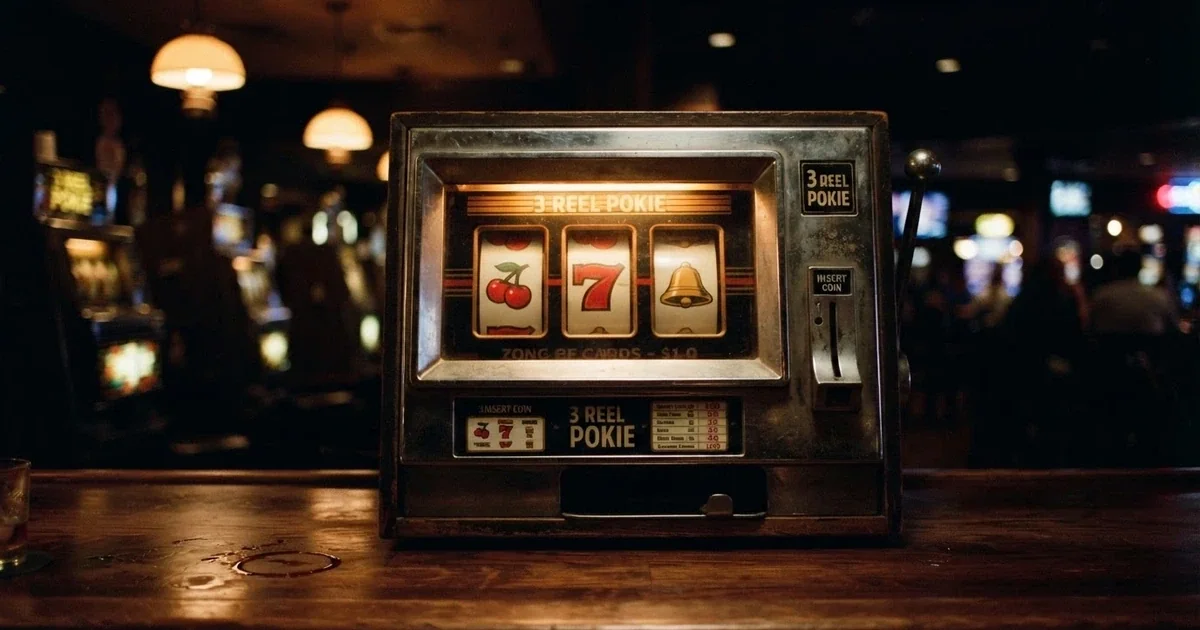
There is a harder reason, too. Every online casino that offers pokies to a person in Australia is breaking the Interactive Gambling Act 2001. No licence exists, and none can. The ten operators reviewed below are all offshore. Every one of them is unlicensed in Australia, and every one of them is operating against the prohibition.
Data current as of 18 October 2026, checked against ACMA enforcement records and operator-published bonus terms.
Table of Contents
- Why three-reel pokies still outlast every screen stuffed with features
- Where to play 3-reel pokies free — and what “no download” really costs you
- Real-money 3-reel pokies: what you risk when you press spin for cash
- Bonuses on 3-reel slots — why the headline number is never what you keep
- Where Australians play 3-reel pokies online in 2026
- The law Australian pokies sites don’t want you to read
- Responsible gambling: help that actually works for Australian players
- How we chose and ranked the operators on this page
- What to do about 3-reel pokies in 2026 — the honest answer
- Frequently asked questions about 3-reel pokies in Australia
Why three-reel pokies still outlast every screen stuffed with features
In a market stuffed with five-reel video slots, cascading reels, megaways engines, and bonus rounds that look like a console game, the three-reel format still pulls a crowd. Australian pokies players in particular have kept the format alive at offline venues, and the offshore online casinos know it. Every lobby reviewed for this page lists classic three-reel titles alongside the modern video slots, often in a separate “Classic” or “Fruit Machines” tab. That placement is a deliberate trade. The operators know the format is what a section of the market wants, and they keep it stocked.
What follows is the case for the format in 2026: what a three-reel pokie actually is, why the heritage still matters, how it plays out online against the land-based cabinet, why fewer reels can mean more for a small bankroll, and the specific titles worth knowing by name.
What a 3-reel pokie actually is
A 3-reel pokie is a slot machine with three spinning reels, each carrying a small set of symbols, and almost always a single horizontal payline running across the middle. The format is the original. It descends from the mechanical one-armed bandit of the late nineteenth century — the Liberty Bell and its descendants — and kept that structure when the reels moved from metal to video to a browser tab. The vocabulary stuck: “reels,” “payline,” “stepper” (a US term for the mechanical-reel format that follows the same logic), and “fruit machine” for the UK and Australian version loaded with cherries, lemons, plums, oranges, bars, sevens and bells.
The visual language is the giveaway. Three vertical reels, one payline, the same bar-and-seven iconography that has been on pub machines since the 1970s. Titles like Fire Joker run a 3×3 grid with five fixed paylines — the closest modern equivalent — but most classic 3-reel pokies stick to the original single payline, the way Red, White and Blue does. Both formats qualify as 3-reel. The difference is whether the modern grid has expanded the win lines.
The format is also called a “classic” pokie, and the term is used loosely. Some providers use it for any three-reel game. Others apply it to three-reel titles with simple symbol sets and no bonus round. Either reading is fair. The underlying mechanism is the same — three reels, a payline or two, and a result every spin.
Classic and traditional fruit-machine variants
The fruit-machine style did not stop when online casinos took over. IGT, NetEnt, Games Global, Play’n GO and the rest of the long-tail providers keep releasing new titles in the old style. Triple Diamond from IGT — three reels, the diamond and bar symbols the IGT name has carried for decades — sits at 95.6% return-to-player. Red, White and Blue, also IGT, runs three reels and a single payline at 93.98% return-to-player, with no Wilds, no Scatters, no Free Spins, no bonus round at all. The format is the game.

Microgaming’s Break da Bank sits at 95.43% return-to-player and high volatility, which on a 3-reel means a long quiet stretch with one big break-the-bank hit. NetEnt’s Jackpot 6000 is the 3×3 fruit-machine layout with five paylines and a Supermeter mode on top — the same Supermeter concept Mega Joker uses to push the return-to-player up to a reported 99%. The form survives because the iconography works. Bars, sevens, cherries and bells are the visual shorthand for “this is a pokie,” and players recognise it before they read a single paytable line.
The modern providers do not always leave the format untouched. Pragmatic Play and Reel Kingdom add hold-and-respin bonuses to fruit-machine chassis. TaDa Gaming’s Fortune Gems 3 keeps the 3×3 grid but bolts on a fourth multiplier reel that turns every winning combination into a multiplied prize. The frame is still the format; the inside has been quietly updated.
Online vs land-based: same game, different feel
A land-based three-reel pokie is a physical cabinet with a coin or note slot, a pull-arm or a button, and a result that clicks into place. The reels spin audibly. The lever provides the small physical commitment of a real wager. An online three-reel pokie is the same game running on a random-number generator, with a click-to-spin button and a result that appears in under a second. The math is identical. The feel is not.
The Australian player in 2026 almost never reaches a land-based three-reel pokie through a legal online route. Crown Melbourne, The Star Sydney and the other state-licensed casinos run physical three-reel machines on their floors — Crown and The Star are the big two — but they do not offer online pokies to a person sitting at home, because the licence they hold is a state venue licence, not an online casino licence, and an Australian online casino licence does not exist.
What an Australian player gets at home is the offshore version. The same titles, the same return-to-player, but no consumer protection backstop on the other end of the spin. The lever becomes a button. The coin slot becomes a deposit. The physical cabinet becomes a tab in a browser, and the operator running it is licensed somewhere — usually Curacao — but not licensed in Australia.
3-reel vs 5-reel: why fewer reels can mean more for your bankroll
The structural case for the 3-reel format starts with the return-to-player. Classic three-reel pokies routinely publish figures in the 96–98% band; some, like Mega Joker in Supermeter mode, are reported up to 99%. Modern five-reel video slots cluster closer to 96%, with the bonus-round mechanics, free-spin triggers and feature-buy pricing eating into the base return. Fire Joker at 96.15% is a representative 3-reel benchmark. Triple Diamond at 95.6% is the IGT floor.
Then there is volatility. Three-reel titles tend toward high variance — a long quiet stretch, then a hit that pays for the dry run. Five-reel video slots spread the action thinner with smaller, more frequent wins through free-spin rounds, expanding Wilds and cascading reels. A punter who wants the session to last will find more entertainment time on a 5-reel. A punter who wants each spin to mean something will find it on a 3-reel.
The bankroll argument is the third leg. With fewer paylines and a simpler symbol set, each spin is cheaper to design for, and providers can push the return higher without paying for it. A 3-reel at 97% return on a dollar spin costs three cents per spin in expectation. A 5-reel at 96% with feature buys costs four cents and adds the cost of triggering the feature. Over a thousand spins the difference is ten dollars out of a hundred, which is the difference between an hour’s play and ninety minutes of play on the same bankroll. The format is not better because it is older. It is better for a player who values time on the reels per dollar wagered.
Notable 3-reel titles worth knowing by name in 2026
Nine specific three-reel pokies carry enough published data to compare them on equal terms. The table below sets them side by side on the points a player actually weighs — provider, return-to-player, volatility, top prize, and the number of paylines.
| Title | Provider | RTP | Volatility | Max win | Paylines |
|---|---|---|---|---|---|
| Fire Joker | Play’n GO | 96.15% | Medium (6/10) | 800× stake | 5 |
| Mystery Joker | Play’n GO | 93.99% | Medium | 6,020× stake | 5 |
| Mega Joker | NetEnt | Up to 99% in Supermeter mode | High | Progressive jackpot | — |
| Triple Diamond | IGT | 95.6% | — | — | — |
| Red, White and Blue | IGT | 93.98% | Medium-high | 2,500 credits | 1 |
| Fortune Gems 3 | TaDa Gaming | 97.13% | Medium | 10,125× stake | 5 + multiplier reel |
| No Limit Bandit | Nucleus Gaming | ~96.92% | Medium | 500× stake | 5 |
| Break da Bank | Games Global / Microgaming | 95.43% | High | — | — |
| Jackpot 6000 | NetEnt | — | — | — | 5 |
The standout on raw return is Mega Joker, on the strength of its Supermeter mode — the headline 99% figure is conditional on the player choosing to play the Supermeter after every base win. Fire Joker is the everyday benchmark, with the widest bet range ($0.05–$100.00) and the cleanest medium-volatility profile. Fortune Gems 3 is the title with the most modern feature bolted onto a 3-reel frame — the fourth multiplier reel — and the largest single spin return at 10,125× stake. Mystery Joker carries the highest listed single-spin payout at 6,020× the stake, but its 93.99% return makes it the lower-value choice on a long session. Red, White and Blue is the purest expression of the format: one payline, no Wilds, no Scatters, no Free Spins, three reels spinning.
Where to play 3-reel pokies free — and what “no download” really costs you
Free play at an offshore casino is not the same as a free spin. The mechanics are identical — same random-number generator, same return-to-player, same symbol set — but the money is virtual, and what the virtual money buys is zero. Demo credits cannot be withdrawn. There is no real win to lose, and no real win to keep. What the player gets is the chance to learn a game’s bonus triggers, watch how the volatility behaves across a few hundred spins, and decide whether the title is worth a real deposit.

Every operator offering free play to Australians is offshore. The demo-mode question is therefore not just “does the casino have it” but “what does it cost the player to use it on an unlicensed site.” The answer in 2026 is the same as it has been since the Interactive Gambling Act was strengthened in 2017: no Australian consumer protection, no BetStop coverage, no ACMA complaint recourse if the operator voids a win or refuses a withdrawal. Free play removes the dollar risk. It does not remove the offshore status.
Free play online: demo mode at offshore casinos
Demo mode on a three-reel pokie loads the game with a virtual credit balance — usually 5,000 in the in-game currency — and lets the player spin without committing a deposit. The mechanism is the same as the real-money version. The return-to-player figure is identical. The volatility is identical. What is missing is the ability to convert the demo balance to a real withdrawal. Any “win” in demo mode is virtual, and any progress through a bonus round ends the moment the demo session closes.
Seven of the ten operators reviewed for this page confirm demo mode on their three-reel catalogues: SkyCrown, Rocket Play, Royal Reels, Stake, WinSpirit and Bizzo all run demo versions of their classic pokie libraries. Fair Go is the exception. Its single-provider Real Time Gaming catalogue does not include demo mode, which is an RTG platform limitation rather than a Fair Go choice. A player who wants to try before they buy at Fair Go has to use a real-money balance.
No download, no install — instant browser play
The “no download” pitch is not a feature in 2026. It is the only option. Every online casino reviewed for this page runs in a browser via HTML5 — there is no .exe to install, no .apk to sideload, no separate client to maintain. The casino loads in a tab, the games load in iframes, and the deposit form takes a debit card, a PayID/Osko transfer or a BPAY bill payment (where the operator is licensed in Australia, which none of these are). The technology has caught up with the marketing.
The trade-off is the security gap. A browser-only product from an unlicensed operator means the player is trusting an offshore entity with their identity documents, their deposit data and their withdrawal history without any Australian consumer protection on the other end. No Australian privacy law reaches it. No Australian dispute resolution body will hear a complaint about a voided withdrawal. The “no download” feature is convenient. The convenience is not the same thing as safety.
Free play without registration: what you can and can’t access
Most offshore casinos reviewed here gate demo mode behind a sign-up form. The KYC requirement is partly an anti-fraud measure and partly a marketing funnel — the casino wants the email address before it gives up the game. A handful of providers allow guest play on a subset of their catalogue, but the featured operators in this guide do not advertise a no-registration demo route in the terms reviewed for this page. The honest expectation for an Australian player in 2026 is that even demo mode requires an account.
What a no-registration session cannot do is also the bigger story. There is no withdrawal, no bonus claim, no real-money history. The session ends at the browser close. The advantage — no email, no password, no KYC document upload — is real, and so is the cost, which is the lack of any record that the session happened. For a player who only wants to test whether a 3-reel title plays the way its return-to-player says it does, that is enough. For a player who wants to track play over time, it is not.
Real-money 3-reel pokies: what you risk when you press spin for cash
Real-money play on a 3-reel pokie at an offshore casino is the same game as demo mode, with the demo credits swapped for real Australian dollars and a real return to the player’s bank. The math does not change. The psychological weight does. A spin that cost nothing in demo mode now has a dollar value, and the same volatility profile that felt like background noise becomes a thing the player is exposed to financially.
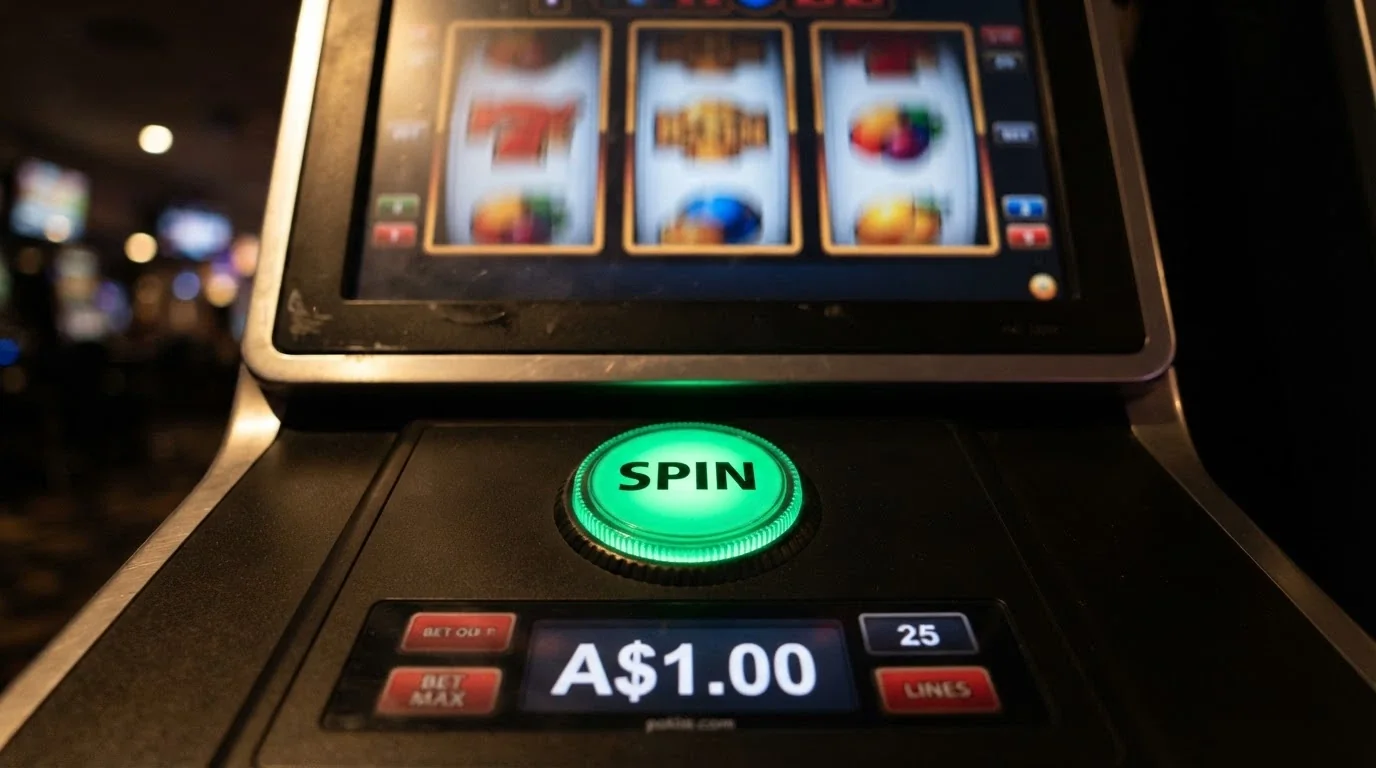
The legal landscape around it is what makes the difference sharper than at any land-based venue. Real-money play at an Australian pub or casino sits inside state gambling laws, with responsible-gambling tools, payout rules and consumer protection in place. Real-money play at an offshore pokies site sits outside all of it.
How real-money play differs from free mode
The structural mechanics are identical. The random-number generator runs the same algorithm. The return-to-player is the same published figure. The bonus rounds trigger on the same conditions. None of this changes between demo and real-money mode, because the game is the same software running on the same server. What changes is what the player stands to lose.
A demo session on Fire Joker at $1 per spin for 500 spins costs the player nothing in real money — the demo balance absorbs it. The same 500 spins at $1 in real-money mode on Fire Joker cost $500 in expectation, with a 96.15% return leaving about $19.25 of expected loss. That is the math under the controlled conditions of a session with no bonus rounds, no chasing losses and no extended play. Real sessions deviate from it in every direction. The structural identity of the game is not the same thing as the structural identity of the outcome.
The harm data is the part that lands hardest. As of March 2026, 15.1% of Australian adults — 3.32 million people — were experiencing some level of harm from their own gambling or someone else’s, according to Roy Morgan. The Australia Institute put the dollar cost of that harm at A$36.0 billion lost in the twelve months to March 2026, up A$1.3 billion on the year before. A real-money session that felt harmless in demo mode is one of the small doors into that larger figure.
Depositing and cashing out: the payment routes that work from Australia
The deposit-method list tells the legal story in shorthand. Since 11 June 2024, credit cards, buy-now-pay-later services (Afterpay, Zip and the rest) and digital currencies like Bitcoin and Ethereum have been banned as payment for online wagering in Australia, under the Interactive Gambling Amendment (Credit and Other Measures) Act 2023. An operator that accepts one of these methods from an Australian player is breaking the prohibition itself, with a civil penalty of up to A$247,500 per incident for bodies corporate.
The methods that ARE legal on a licensed Australian wagering service are debit card, bank transfer, PayID/Osko and BPAY. Each requires identity verification under the operator’s state or territory licence. The offshore casinos in this guide take some of these methods and some do not — most accept debit cards and a handful of cryptocurrencies, fewer accept PayID or BPAY, because the Australian banks have not built the rails for unlicensed operators to receive them cleanly. A player who is asked for a credit card or a crypto deposit is being served by someone outside the Australian rules. The payment method is the tell.
From 1 January 2027, the situation gets tighter. Banks and payment providers gain express authority to block transactions to illegal gambling operators, and the transaction will not even reach the operator. That is the next layer of friction on the offshore route. The deposit that goes through cleanly today is not guaranteed to go through cleanly twelve months from now.
Bonuses on 3-reel slots — why the headline number is never what you keep
A welcome bonus at an offshore casino is a marketing headline that competes with nine other marketing headlines on the same comparison page. The competition is on percentage match and total amount, not on what the player keeps after the wagering, the validity clock and the cap have all run their course. The arithmetic that turns A$1,200 of bonus funds into a smaller real return is where the offer lives or dies.
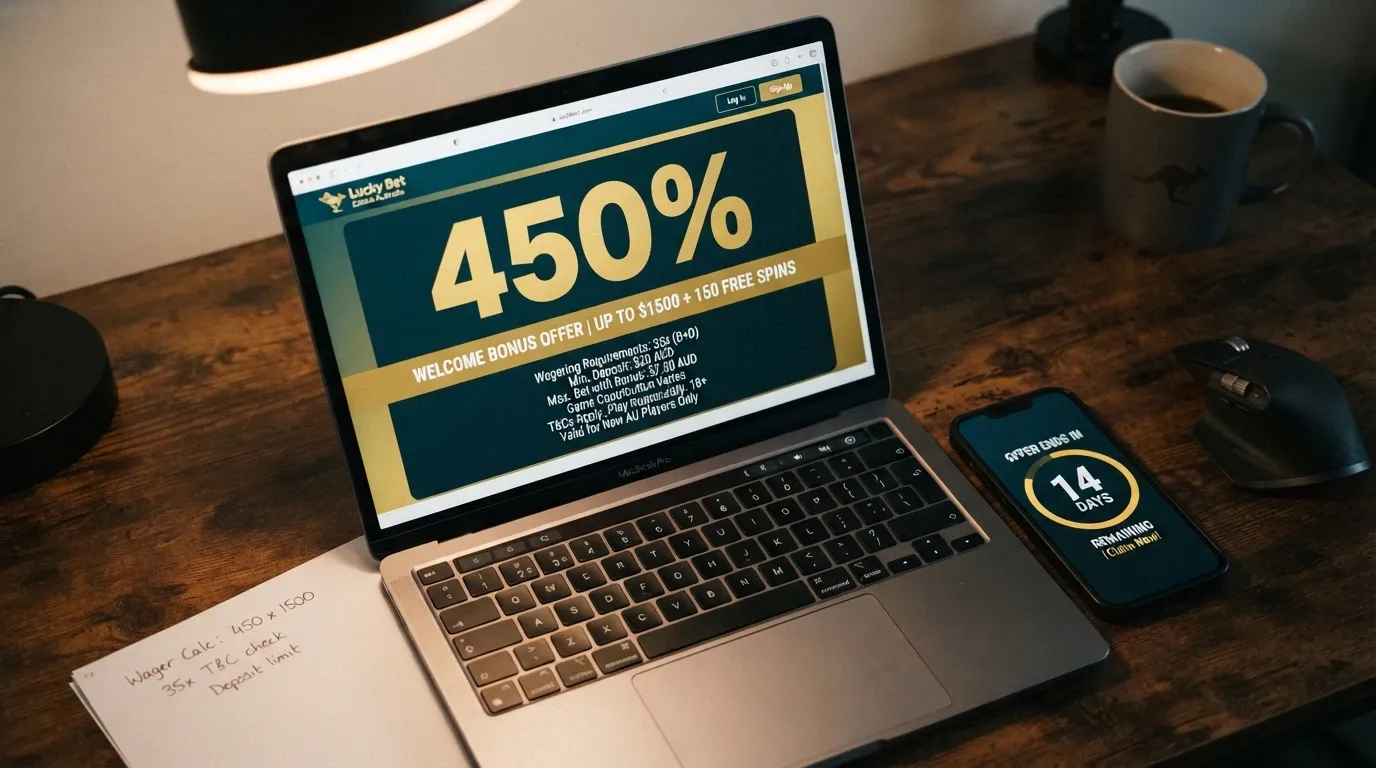
Three things determine the keepable amount: the wagering multiple, the maximum-bet limit while wagering, and the bonus validity window. Free-spin offers add a fourth — the cap on free-spin winnings. Each of these is a lever the operator pulls to keep the headline number large and the realised return modest.
Take SkyCrown’s first-deposit bonus as the worked example — a 120% match paying up to A$1,200 in bonus funds. Clearing the bonus at the 40× wagering multiple requires A$48,000 of real bets through eligible slots. Run those bets at Fire Joker’s 96.15% return-to-player and the 3.85% house edge leaves an expected loss of A$1,848. That is the bonus’s real cost — and it is more than the bonus itself. This is a statistical estimate across many spins, not a guarantee for any single player, and it assumes only the bonus amount is wagered.
Bonus-enabled 3-reel games and how offers attach
Not every 3-reel title at an offshore casino qualifies for bonus play. The standard rule is 100% pokies contribution to wagering — every dollar wagered on a pokie counts a full dollar against the bonus’s playthrough. Table games typically contribute at 10%, and baccarat and craps at 5%. The carve-out matters if a player tries to mix pokies and blackjack through the same bonus. The pokie contribution is full. The table-game contribution is not.
Fair Go runs the cleanest contribution table in the featured set: pokies at 100%, table games at 10%, baccarat and craps at 5%. SkyCrown’s bonus terms tie its 400 free spins to four specific titles — Wolf Treasure, 15 Dragon Pearls, Buffalo Hold and Win Extreme and Gold Express — none of which are 3-reel classics. The free spins on the SkyCrown welcome package are not the free spins a player would use to clear the bonus on a classic pokie.
The operators’ actual approach is to count 3-reel titles toward the wagering multiple but rarely to use them as the headline free-spin game. A player who wants to clear a welcome bonus on Fire Joker, Triple Diamond or Red, White and Blue usually can. The headline free spins will not be on those games.
Free-spins offers on 3-reel titles: what the wagering really means
Free-spin offers at the featured operators come in two shapes: spins attached to a deposit-match bonus (SkyCrown’s 400, Rocket Play’s 100) and spins with no deposit required (Bizzo’s 10–25). Each carries the same wagering arithmetic, but the caps are different.
SkyCrown runs 40× wagering on free-spin winnings, with a A$300 cap on what those winnings pay out. Rocket Play runs the same 40× on its 100 free spins for Aztec Magic, the same A$300 cap, and a five-day validity on the free spins themselves — twenty spins land immediately on first deposit, and the remaining eighty drip out in four daily batches of twenty. A player who takes the Rocket Play welcome bonus has five days to use the spins and convert the winnings into cleared cash, or the bonus expires.
Bizzo’s no-deposit 10–25 free spins run at the same 40× wagering on whatever the spins win. There is no deposit behind them, but the offer is valid only until 31 December 2026, and the operator carries the right to attach game-specific terms on top of the headline.
The maximum-bet limit while wagering is the second lever. SkyCrown caps the bonus wagering bet at A$7.50 per spin. Rocket Play runs the same A$7.50 limit. A player who bets higher than the cap is at risk of having the bonus and any winnings from it voided. The cap is there to slow down the playthrough. A punter with a small bankroll who wants to clear the bonus in two hours cannot do it with a A$7.50 bet on a high-volatility title.
Bonus rounds without download: how they work in demo and real-money modes
The 3-reel format’s defining trait is that most of its titles have no bonus round at all. Red, White and Blue runs three reels, one payline, no Wilds, no Scatters, no Free Spins. The result of every spin is the result of every spin. There is nothing to trigger and nothing to retrigger.
The exceptions are what makes the format interesting in 2026. Mega Joker’s Supermeter mode is the most cited — a second-tier game that opens when the player chooses to gamble the base-game winnings, with the return-to-player reported up to 99% in that mode. Fortune Gems 3 runs a fourth multiplier reel on top of the 3×3 base game; a winning combination gets multiplied by the value on the fourth reel, with the largest fixed prize reported at 10,125× the stake. Jackpot 6000 uses a similar Supermeter mechanic to Mega Joker. These are 3-reel titles with a bonus structure — and they are a minority.
The bonus-round mechanics behave identically in demo and real-money modes. The Supermeter mode in Mega Joker triggers on the same condition whether the player is wagering virtual credits or real Australian dollars. The multiplier reel in Fortune Gems 3 spins the same way. The “bonus” in a 3-reel context is usually a multiplier, a gamble feature or a Supermeter second-tier game — not the free-spin-with-expanding-Wilds feature that defines a 5-reel video slot. A player coming from the 5-reel side of the lobby should expect a simpler feature set, not a thinner version of the same game.
Where Australians play 3-reel pokies online in 2026
The comparison table below sets the ten offshore operators featured in this guide side by side. Every one of them is licensed somewhere — usually Curacao — and none of them is licensed in Australia. The product they offer is prohibited under the Interactive Gambling Act 2001, and the penalties sit with the operator, not the player. The table is a comparison of the offers, not a ranking of legality, because there is no legal option to rank against.

| Operator | Licence status in Australia | Welcome bonus | Free spins | Wagering | Slot library |
|---|---|---|---|---|---|
| SkyCrown | Offshore (Curacao) — unlicensed in AU | 450% up to A$8,000 across four deposits | 400 (split across four deposits) | 40× (bonus + free-spin winnings) | 300+ |
| Rocket Play | Offshore (Curacao) — unlicensed in AU | 100% up to A$500 | 100 (Aztec Magic) | 40× (bonus) | 500+ |
| Fair Go | Offshore (Curacao) — unlicensed in AU | 100% up to A$200 ×5 = up to A$1,000 | — | 30× (deposit + bonus) | Limited (RTG only) |
| Royal Reels | Offshore (Curacao) — unlicensed in AU | 100% up to A$500 | A$10 no-deposit bonus | 30–40× | 2,000+ |
| Stake | Offshore (Curacao) — unlicensed in AU | Crypto-focused; terms vary | — | — | 1,000+ |
| WinSpirit | Offshore (Curacao) — unlicensed in AU | 200% | 25 | ~40× | 1,000+ |
| Bizzo Casino | Offshore (Curacao) — unlicensed in AU | 10–25 free spins, no deposit | 10–25 | 40× (free-spin winnings) | Thousands |
| Rainbet | Offshore — unlicensed in AU | — | — | — | — |
| Scream Casino | Offshore — unlicensed in AU | — | — | — | — |
| Rocket Casino | Offshore — unlicensed in AU | — | — | 45–50× | — |
What the table cannot show is the verification state behind each row. Operators one through seven — SkyCrown, Rocket Play, Fair Go, Royal Reels, Stake, WinSpirit and Bizzo — had their bonus terms confirmed from operator-owned sites and named review sources during the research for this page. Operators eight through ten — Rainbet, Scream Casino and Rocket Casino — did not surface detailed bonus terms in this run. Their AU market presence is confirmed by tracked traffic and revenue data, but the welcome-offer fields remain unverified. Rocket Casino’s 45–50× wagering requirement is the one exception. That figure is confirmed.
What follows is each operator, in the order of the table above, with its specific terms and a verdict on who it suits.
SkyCrown — the biggest welcome package of the featured set, with tight caps
SkyCrown’s headline is the largest in the comparison: a 450% deposit match up to A$8,000 plus 400 free spins, split across the first four deposits. The first deposit runs 120% up to A$1,200 plus 125 free spins (minimum deposit A$30). The second runs 100% up to A$1,300 plus 75 free spins (minimum A$30). The third runs 80% up to A$1,500 plus 50 free spins (minimum A$40). The fourth runs 150% up to A$4,000 plus 150 free spins (minimum A$50). The whole package takes A$150 in deposits to trigger.
The wagering arithmetic is where the headline stops being exciting. The 40× multiple applies to both the bonus and the free-spin winnings. The maximum bet while wagering is A$7.50 per spin. The bonus validity is fourteen days per stage. The maximum cashout per bonus stage is A$5,000. The free-spin winnings are capped at A$300. None of the welcome offer is available to crypto depositors.
For a player who wants the largest headline bonus in the set and is willing to deposit across four stages, SkyCrown delivers on paper. For a player who wants to know what they will actually keep after the wagering, the cap structure and the A$7.50 bet ceiling make the realised return much smaller than the A$8,000 headline suggests. The verdict: a big number for a player with time and patience, and a worse number for a player who reads the terms carefully.
Rocket Play — a leaner match with a free-spins drip and a A$25 entry point
Rocket Play’s welcome is simpler: 100% up to A$500 on the first deposit, plus 100 free spins on Aztec Magic by BGaming. Minimum deposit A$25. Wagering 40× on the bonus amount, with the same A$7.50 max-bet cap as SkyCrown and a A$5,000 maximum win from the bonus. The 100 free spins land as twenty immediate plus four daily batches of twenty over four days, with a five-day validity on the spins and a A$300 cap on free-spin winnings.
The library runs 500+ slots from BGaming and 30+ other providers. Aztec Magic is a 5-reel video pokie, not a 3-reel classic, so the welcome’s free spins are not the format a player reading this page is after. The bonus funds, however, will clear against most of the 3-reel catalogue.
Where a player wants a single-deposit welcome with a low A$25 entry and a clean structure, Rocket Play is the more readable offer in the comparison. The verdict: a smaller headline, a clearer terms sheet, and a player who picks this one for the structure rather than the size.
Fair Go — the RTG-only house with the lowest wagering and no demo mode
Fair Go runs on Real Time Gaming’s catalogue and nothing else. That single-provider status is the trade-off. The welcome offer is 100% up to A$200, redeemable five times for a total of up to A$1,000, with 30× wagering on deposit and bonus combined — the lowest wagering requirement in the featured set. There is no maximum cashout on the deposit bonuses, and no free spins on the welcome. Separate no-deposit bonus offers exist but carry 60× wagering with a A$180 cap, which is the harsher side of the same house.
The minimum deposit is A$20. Pokies contribute 100% to wagering, table games 10%, baccarat and craps 5%. Demo mode is not available — an RTG platform limitation, not a Fair Go policy. The catalogue is smaller than the multi-provider competitors, and the 3-reel offering is narrower.
Where low wagering matters more than catalogue size, Fair Go is the standout in the comparison. Where a player wants to try a 3-reel title before depositing, the lack of demo mode is the reason to look elsewhere. The verdict: the best terms in the set on a small catalogue, and a player who picks it accepts the trade.
Royal Reels — the 2,000+ game library with a A$10 no-deposit entry
Royal Reels runs 2,000+ games from 30+ providers, including Pragmatic Play, Evolution Gaming, Yggdrasil and Hacksaw Gaming — the largest game library in the featured set. The welcome bonus is 100% up to A$500 with a A$30 minimum deposit, plus a A$10 no-deposit bonus for new sign-ups. Wagering runs 30–40× on the deposit bonus; the A$10 no-deposit bonus carries the same multiple. The licence is Curacao.
The standout is the A$10 no-deposit bonus — a genuine no-deposit route into the casino, which is rare in the comparison. The 2,000+ game library is the second standout, because it puts most of the multi-provider 3-reel catalogue within reach without leaving the welcome offer.
For widest game choice and a free entry point to test the casino, Royal Reels is the widest-ranging pick in the comparison. For a player who reads the terms sheet carefully, the bonus validity is not specified in the published terms reviewed for this page, which is a transparency gap. The verdict: the most generous entry in the comparison, paired with one term the operator has not pinned down.
Stake — the crypto-first outlier with a Curacao licence and no fixed bonus structure
Stake runs a different model. The operator is crypto-first, accepts deposits in Bitcoin, Ethereum and a list of other digital currencies, and runs a Curacao licence. The game library runs 1,000+ titles from Pragmatic Play, Evolution, Hacksaw Gaming and the operator’s own “Stake Originals” range, which is the in-house slot product. Demo mode is available on most of the library.
Bonus terms are not pinned down. Stake’s promotional structure shifts — rakeback, giveaways, race-style competitions, occasional deposit matches — rather than running a fixed welcome package in the conventional sense. The research for this page did not confirm a single welcome-offer figure for the operator.
A player with crypto holdings who wants a casino that treats digital currency as the default will find Stake the obvious fit in the comparison. For an Australian player in 2026, the crypto-first model is also a legal issue. Crypto has been a banned payment method for online wagering in Australia since 11 June 2024. The ban targets the operator, not the punter, but a player funding Stake with Bitcoin is on an offshore site using a banned payment method — both sides of that transaction are operating outside the Australian rules. The verdict: the right fit for a crypto-native player who accepts the offshore status, and the wrong fit for anyone who wants to stay on the right side of the payment ban.
WinSpirit — a 200% headline with 25 free spins and thin fine print
WinSpirit runs a 200% welcome bonus plus 25 free spins, with a loyalty program that lets players convert points into further bonuses. The library runs 1,000+ games from a multi-provider stable. Payment methods include credit cards and e-wallets. The licence is Curacao. Wagering is described as industry standard (around 40×) but the specific figure was not confirmed in the research for this page. Bonus validity was not specified either.
The 200% match is the highest percentage figure in the comparison, and the loyalty program is a differentiator for players who plan to stay with an operator for months rather than chasing the welcome and leaving.
The verdict: a 200% match on a 1,000+ library, with the wagering and validity still to be confirmed before the deposit goes in.
Bizzo Casino — the no-deposit free-spins specialist with a 2026 expiry
Bizzo’s standout offer is 10–25 free spins with no deposit required, tied to specific titles (Elvis Frog in Vegas is the cited example). Wagering runs 40× on whatever the spins win. The offer is valid until 31 December 2026 — a hard expiry, not a rolling condition. The library is multi-provider, with thousands of pokies from BGaming, Mascot, Spinomenal, Betsoft and others. The licence is Curacao.
For a player who wants to test a casino without depositing, Bizzo is the cleanest no-deposit route in the comparison. For a player who plans to use the free spins as the start of a longer session, the 40× wagering on spin winnings and the 31 December 2026 expiry are the limits.
The deposit-match terms were not confirmed for this page’s research. The verdict: the best no-deposit entry in the comparison, with the calendar a player has to keep an eye on.
Rainbet — AU market presence confirmed, bonus terms unverified
Rainbet is in the comparison because the AU market presence is real. Tracked data puts Rainbet at 1.28% of the Australian online casino market share, with A$83.13 million in tracked revenue. The licence is offshore; the specific jurisdiction was not confirmed for this page. The library is multi-provider.
Bonus terms — welcome amount, free spins, wagering, validity, slot count, demo mode — were not confirmed during the research for this page. The AU player base is the fact that puts Rainbet on the comparison; the welcome offer is not.
For a player who already plays at Rainbet, the comparison entry is a flag for the kind of details this page could not confirm. For a player choosing an operator for the first time, the gap in the verification is the reason to pick one of the seven operators with confirmed terms above. Rainbet is a real AU-facing casino whose bonus picture stayed unconfirmed here.
Scream Casino — the highest tracked revenue of the unverified tier
Scream Casino carries the largest tracked revenue of the three unverified operators: A$94.87 million, with a 0.99% AU market share. The licence is offshore; the specific jurisdiction was not confirmed for this page. The library is multi-provider. As with Rainbet, the welcome-offer terms were not confirmed.
The verdict: another real AU-facing casino, with a welcome picture that this run’s research did not pin down.
Rocket Casino — confirmed 45–50× wagering, everything else unverified
Rocket Casino is the one operator in the unverified tier with a confirmed number on the table: a 45–50× wagering requirement, the steepest in the featured set. The maximum bet on bonus funds is A$5, against the A$7.50 cap that runs at the other end of the comparison. From September 2026, deposits over A$100 carry a 50× wagering requirement. The licence is offshore.
The welcome bonus amount, free spins, slot library size, demo mode and validity were not confirmed in this run’s research. The 45–50× wagering is the headline, and it is the reason Rocket Casino sits at the bottom of the comparison — it is the highest price of entry in the set, with the bonus terms behind it still to be confirmed.
The verdict: a real operator with a confirmed number, and the number is the worst in the comparison.
The law Australian pokies sites don’t want you to read
The Interactive Gambling Act 2001 (IGA) prohibits the supply of online casino games and online pokies to persons physically in Australia. The prohibition has been in force since the Act passed in 2001, was strengthened by the Interactive Gambling Amendment Act 2017, and was updated again by the Interactive Gambling Amendment (Gambling Reform) Bill 2026, which passed Parliament on 19 August 2026 and commences on 1 January 2027. No licence for online casino exists in Australia — not federally, not in any state or territory. The product the offshore operators in this guide offer is the product the IGA prohibits them from offering.

ACMA — the Australian Communications and Media Authority — is the federal regulator that enforces the online prohibition. Since November 2019, ACMA has had 1,564 illegal gambling and affiliate websites blocked at the DNS level by Australian internet service providers, and more than 225 illegal services have withdrawn from the Australian market since 2017. The civil penalty for bodies corporate is up to A$782,500 per day for continuing contraventions. The individual player is not prosecuted under the IGA — the Act targets the provider, not the punter. As ACMA has put it directly: “Providing a prohibited interactive gambling service to a person in Australia is illegal, and the ACMA pursues it.”
The Interactive Gambling Act: what it prohibits and why no online casino holds an Australian licence
The IGA makes it an offence to provide a prohibited interactive gambling service to a person in Australia. The prohibited services are online casino games, online pokies (slots), and in-play sports betting. The penalty is civil for bodies corporate (up to A$782,500 per day), with infringement notices and formal warnings available for less serious cases. Criminal charges apply in some circumstances, but the typical enforcement pathway is civil penalty proceedings, blocking requests to ISPs and formal referrals to international counterparts.
The 2017 amendment is what gave ACMA the blocking power. Before 2017, offshore operators exploited a loophole that argued the service was provided overseas and was therefore outside Australian reach. The amendment closed that. The 2026 reform (commencing 1 January 2027) layers additional powers on top, including express authority for banks to block transactions to illegal operators.
A player who reads the IGA and concludes “the casino cannot hold an Australian licence” has read it correctly. The product is prohibited. The licence does not exist. Every offshore casino in this guide is operating against the prohibition, and the operator — not the player — carries the legal exposure.
Where Australians can legally gamble online (and why it isn’t pokies)
The Australian gambling products that ARE licensable online are pre-event sports and race wagering, lotteries, and keno. The licensing is state and territory business, and in practice it concentrates through the Northern Territory Racing and Wagering Commission (NTRWC), administered by Licensing NT. The licensed operators — Sportsbet, Ladbrokes, Bet365, Tabcorp’s TAB, Neds, PointsBet, Betr, Picklebet and Betfair among them — offer sports and race betting, not pokies. None of them holds an online casino licence. None of them can. The minimum age for any commercial gambling activity in Australia is 18.
Land-based casinos exist and are state-licensed. Crown Melbourne and The Star Sydney are the two largest. Crown Perth, The Star Gold Coast (now The Star Brisbane), Treasury Brisbane, Adelaide Casino and the Wrest Point and Country Club venues in Tasmania round out the major state-licence holders. They run physical three-reel pokies on their gaming floors. They do not offer online pokies to a person in their home, because the licence they hold is a state venue licence, not an online casino licence.
The licensed route for a player who wants to bet online in Australia is sports and race wagering, with full consumer protection, BetStop coverage, deposit limits and ACMA complaint recourse. The unlicensed route is the offshore casino. The licensed route does not offer pokies.
Offshore vs licensed: what you give up when you play outside the Australian rules
The offshore route costs the player several concrete protections that the licensed route provides by default. The list below is the gap, and the items on it are not theoretical — each one is documented in the sections above and the harm figures in the responsible-gambling section that follows.
BetStop coverage. BetStop — the National Self-Exclusion Register, live since 21 August 2023 — binds every Australian-licensed wagering service. One registration excludes the player from all of them at once. As of 31 March 2026, 59,830 people had registered and 37,247 had active exclusions. An offshore casino is not connected to BetStop. A self-excluded Australian can register at an offshore casino and deposit the next day.
ACMA complaint recourse. If an Australian-licensed wagering operator refuses a withdrawal, voids a win or closes an account unfairly, the player can complain to ACMA. ACMA cannot enforce against an offshore operator in the same way. The offshore casino’s regulator — usually Curacao — is the only recourse, and that regulator’s enforcement record against player complaints is much thinner than ACMA’s.
Blocking risk. A site that is offshore today can be on ACMA’s blocked list tomorrow. ACMA’s blocking requests to ISPs are DNS-level, which means a player with a real-money balance on a blocked site may find the site inaccessible. The balance does not vanish legally, but the practical ability to withdraw it shrinks sharply.
Banned payment methods. Since 11 June 2024, credit cards, BNPL services (Afterpay, Zip) and crypto have been banned as payment for online wagering in Australia. An offshore operator that asks for a credit card or a crypto deposit is advertising its own offshore status. From 1 January 2027, banks gain express authority to block these transactions at the payment rail, which means the deposit may not even reach the operator.
The gap is the price of the offshore route. The bonuses are larger. The libraries are wider. The 3-reel pokies are easier to find. None of that undoes what a player gives up by being outside the Australian consumer-protection framework.
Responsible gambling: help that actually works for Australian players
The harm numbers are large enough that the safer route deserves a section of its own. The legal reality in the section above is one half of the case. The human cost is the other half. Both lead to the same practical advice: if gambling is causing harm, the licensed services have the tools, and the help lines are free.
Self-exclusion, deposit limits and the tools that reach Australian-licensed services
BetStop is the National Self-Exclusion Register, run by ACMA. A single registration excludes the player from every Australian-licensed online and phone wagering service for a chosen period — three months, six months, twelve months, or a lifetime exclusion. As of 31 March 2026, 59,830 people had registered, 37,247 had active exclusions, and 78% of registrants were under 40. Thirty-eight percent chose the lifetime option, which is the strongest single signal of how severe the harm has become for the people who reach for the tool.
Licensed wagering services also offer customer-set deposit limits and activity statements under their state or territory licence conditions. A player can set a daily, weekly or monthly deposit cap on a Sportsbet or Ladbrokes account, and the operator will block deposits above the cap. Activity statements summarise the player’s gambling over a chosen period — deposits, withdrawals, net position, time on site — and are available on request.
The hard limit is the offshore one. BetStop binds Australian-licensed services only. An offshore casino is not connected to the register and will keep accepting a self-excluded person’s money. The deposit-limit tools on licensed services do not reach offshore operators. The activity-statement tool only summarises what happens on the licensed side.
How many Australians gambling hurts — and where to get help now
The numbers below are the scale of what the tools above are designed for. They come from named research bodies, and they are the case for treating any real-money session as consequential rather than casual.
- 3.32 million Australians were experiencing some level of gambling harm as of March 2026 — 15.1% of the adult population, according to Roy Morgan.
- 2.1% of Australian adults, roughly 430,000 people, experience problem gambling at the clinical level (AIHW).
- A$36.0 billion was lost to gambling in the twelve months to March 2026 — up A$1.3 billion year-on-year (Australia Institute).
- 400,000+ years lived with disability is the annual health loss associated with gambling harm in Australian adults (Journal of Gambling Studies, 2026).
The help that reaches Australians right now:
- National Gambling Helpline: 1800 858 858 — free, confidential, 24 hours a day, 7 days a week. Online chat and counselling through Gambling Help Online.
- BetStop: the National Self-Exclusion Register. One registration covers every Australian-licensed wagering service.
- Lifeline: 13 11 14 — crisis support and suicide prevention.
- National Debt Helpline: 1800 007 007 — financial counselling for gambling-related debt.
- SHARC (Self Help Addiction Resource Centre): 1300 660 068 — support for friends and family affected by someone else’s gambling.
The licensed services carry these tools. The offshore sites in this guide carry none of them.
How we chose and ranked the operators on this page
The operators in the comparison table are ranked by the completeness of their published bonus terms, not by the size of their headline bonus. Seven of the ten — SkyCrown, Rocket Play, Fair Go, Royal Reels, Stake, WinSpirit and Bizzo — had their welcome-offer terms confirmed from operator-owned sites and named review sources during the research for this page. The remaining three — Rainbet, Scream Casino and Rocket Casino — were confirmed by tracked traffic and revenue data, which is why they appear in the comparison at all, but their specific welcome terms were not pinned down in this run. Rocket Casino’s 45–50× wagering requirement is the one figure that did get confirmed.
The licence check is the same for every operator. The product they offer is prohibited under the Interactive Gambling Act 2001, and none of them holds an Australian casino licence because none can. The Curacao licence (or equivalent offshore jurisdiction) they do hold is not an Australian licence and is not interchangeable with one. The IGA is the benchmark, and the benchmark applies uniformly.
The ranking weightings, in qualitative order: bonus terms confirmed by the operator’s own published page, wagering transparency, game-library depth, 3-reel title availability, and the presence or absence of demo mode on classic pokie titles. No invented percentages or star ratings appear in the comparison. Where a term was not confirmed, the cell carries an em dash and the operator write-up says so.
The four operators that came up most often in the research — SkyCrown, Rocket Play, Royal Reels and Fair Go — were given the most detailed write-ups, because the published terms justified the detail. The unverified tier (Rainbet, Scream Casino, Rocket Casino) carries a shorter write-up and an honest note about what was not confirmed.
What to do about 3-reel pokies in 2026 — the honest answer
The legal frame is the decision’s frame. Online pokies are prohibited to provide to persons in Australia. No licence exists. Every operator that accepts an Australian player is offshore and unlicensed. That is the starting position, and it does not change with the bonus size, the return-to-player figure or the loyalty program.
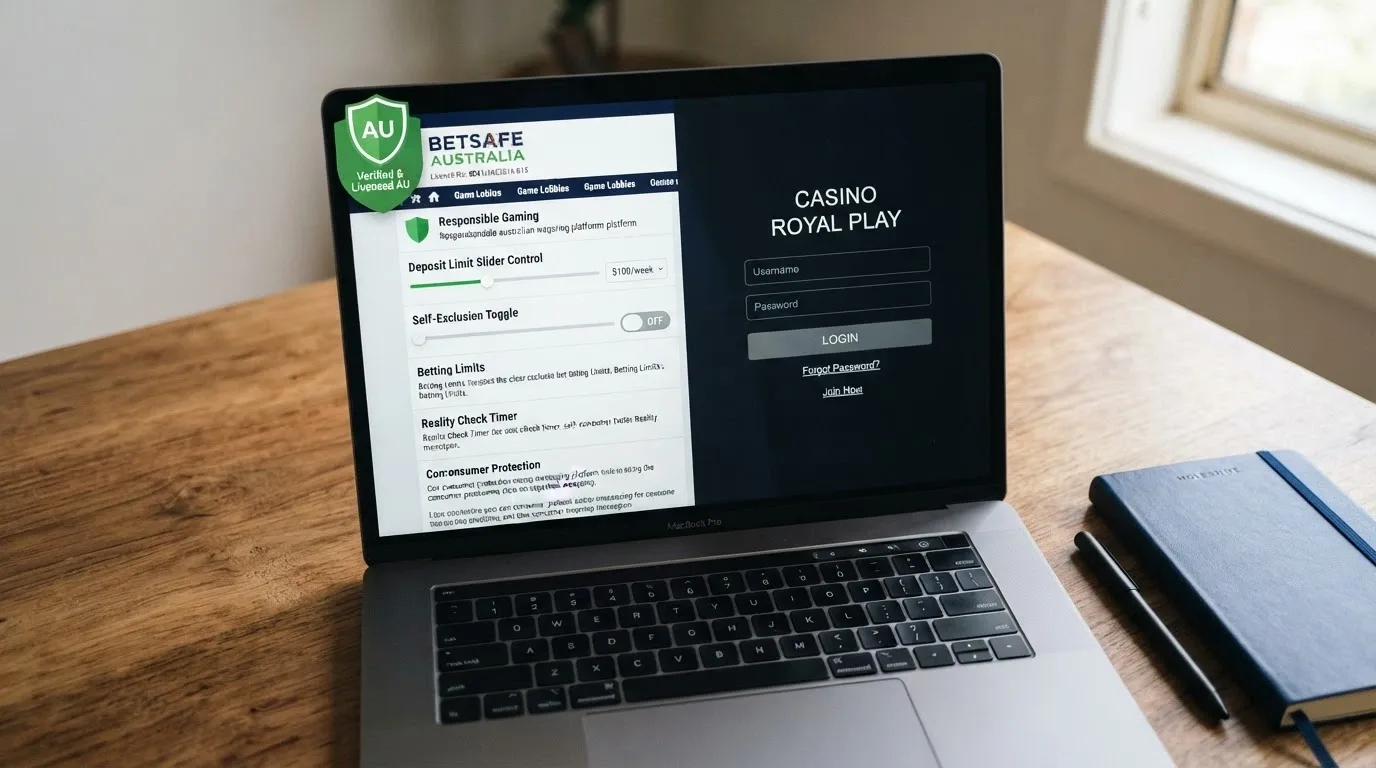
The safer route is the licensed Australian wagering services. Sportsbet, Ladbrokes, TAB, Bet365 and the rest offer pre-event sports and race betting, with full consumer protection, BetStop coverage, deposit limits, activity statements and ACMA complaint recourse. They do not offer pokies. A player who wants pokies cannot reach them through the licensed route, and that is the gap the offshore operators fill.
The riskier route is the offshore casino, and the concrete cost is what the sections above laid out: no BetStop coverage (a self-excluded player can keep depositing), no ACMA recourse (a withdrawal refusal or a voided win is hard to challenge), no guaranteed payout if the site gets blocked at the DNS level (1,564 sites have been blocked since November 2019, and balances have been caught in those blocks), and from 1 January 2027 a real chance the deposit will not reach the operator at all because banks can block it at the payment rail.
The harm numbers make the decision consequential. 3.32 million Australians are experiencing gambling harm as of March 2026. A$36.0 billion was lost in the twelve months to March 2026. The bonus arithmetic earlier in this page — a worked example on SkyCrown’s first deposit — shows how the headline figure turns into a real cost once the wagering, the cap and the validity clock have run: the A$1,200 bonus credit costs A$1,848 in expected loss, more than the bonus itself.
The page’s recommendation is the one the legal and human cost support. The licensed route is the one with consumer protection and the one with help if gambling starts to hurt. The offshore route offers 3-reel pokies, larger bonuses and a wider library, at the price of every safeguard the Australian framework was built to provide. A player who reaches for the offshore offer should know what they are paying for it, and a player who notices the first signs of harm should reach for the National Gambling Helpline on 1800 858 858 before they reach for another deposit.
Frequently asked questions about 3-reel pokies in Australia
What is the best RTP for a 3-reel slot machine?
The highest published RTP in this page’s research is Mega Joker by NetEnt at up to 99% in Supermeter mode. Fortune Gems 3 runs 97.13%, No Limit Bandit around 96.92%, and Fire Joker at 96.15%. Triple Diamond and Break da Bank sit lower at 95.6% and 95.43%. The figure depends on the title, the configuration and whether a bonus mode is active.
How do I deposit at an online casino in Australia if credit cards are banned?
The legal deposit routes for licensed Australian wagering services are debit card, bank transfer, PayID/Osko and BPAY. Credit cards, BNPL services (Afterpay, Zip) and crypto have been banned for online wagering since 11 June 2024. An offshore operator that still accepts credit cards or crypto is advertising its own offshore status.
Does BetStop cover offshore casino sites?
No. BetStop binds every Australian-licensed wagering service in a single registration. Offshore casinos are not connected to the register, and a self-excluded Australian can keep depositing at them. This is the largest single gap in the player-protection framework for anyone using the offshore route.
What happens if an offshore casino refuses to pay my winnings?
The recourse is limited. The Curacao Gaming Control Board (or the equivalent offshore regulator) is the body to complain to, but its enforcement against player complaints is much thinner than ACMA’s. Withdraw any large balance promptly — a delayed withdrawal is the most common staging post for a refusal.
Are 3-reel pokies better than video slots for beginners?
For a player who values simplicity and a higher return-to-player, yes. The format has fewer mechanics to learn and a published RTP that often runs above the 5-reel average. The 5-reel video slot suits a player who wants cascading reels and feature buys. Both work; the better choice depends on the session.
Will the 2026 gambling reform affect online pokies?
The Interactive Gambling Amendment (Gambling Reform) Bill 2026 passed Parliament on 19 August 2026 and commences on 1 January 2027. It does not legalise online pokies — the IGA prohibition stays in force. What it adds: advertising restrictions, inducement bans, an AdStop opt-out register, and express authority for banks to block transactions to illegal gambling operators.
Prepared by the Live Casino Australia editorial staff.