
Free Spins, No Deposit Required: How Australian Pokies Bonuses Really Play Out in 2026
A no-deposit free-spin offer looks like the rare free lunch in online gambling. Fifty spins on registration, sometimes a hundred, occasionally a $10 chip dropped into a brand-new account — for an Australian player who has never deposited a cent, it is the only way to sample a real-money pokie round without paying for the privilege. The terms attached to that free lunch are where its value lives, and where most of it goes.

The arithmetic on the offer is one half of the picture. The other half is the legal landscape underneath it: every operator offering online pokies to Australian players is doing so from outside Australia, under an offshore licence that grants the player no Australian recourse if the bonus is honoured, delayed or voided. The Interactive Gambling Act 2001 prohibits the very product these sites sell. Both halves matter, and a player who reads only one is reading half the page.
Current as of 18 October 2026; verified against the Australian Communications and Media Authority register and the Interactive Gambling Act 2001.
Table of Contents
- What a No-Deposit Free-Spin Bonus Actually Delivers
- The Fine Print That Shrinks Your 2026 Free-Spin Bonus
- 10 Australian-Reachable Operators With Free Spins: 2026
- Online Pokies and the Law: What Every Australian Player Needs to Know
- Play Free Pokies First: Why Demo Mode Saves Your Bankroll
- The Real Cost of Online Pokies: Gambling Harm in Australia by the Numbers
- How We Selected and Ranked These Operators
- Free Spins in 2026: Worth Your Time or a Raw Deal?
- Frequently Asked Questions
What a No-Deposit Free-Spin Bonus Actually Delivers
A no-deposit free-spin bonus is what an online casino hands a player who has registered an account but has not made a deposit. The spins are paid for by the house, the winnings land in a bonus balance, and the player can withdraw — once they have met the wagering requirement, stayed under the cashout cap, and cleared the operator’s identity check. The headline number is the spin count: 20, 50, 100. The realisable value lives in the multiplier, the cap, the eligible games and the expiry window attached to it.
In the Australian offshore market these offers typically run between 20 and 100 spins immediately on registration, with wagering requirements usually between 30x and 50x and a per-spin value of around $0.10 AUD. They are aimed at one reader: the player who wants to find out what a real-money pokie feels like without committing cash first, and who accepts the operator’s terms as the price of finding out. The promotion exists because the operator expects most claimants either to clear the bonus and walk away, or to fund an account along the way.
The gap between the advertised spin count and what actually leaves the casino with the player is the subject of the rest of this page. A 50-spin offer at $0.10 a spin is $5 of spin value at the point of issue. After wagering, after the cashout cap, after the eligible-games filter, the realised cash most players take from such an offer is a fraction of that $5. The arithmetic is the same on every offer in this market.
How Free-Spin No-Deposit Offers Work for Australian Players
The lifecycle of a no-deposit free-spin claim runs through five stages. Stage one is registration, which on most offshore sites takes an email address, a password and a username — sometimes a phone number, occasionally a token deposit (a small amount, usually $1 or so, the operator holds and refunds) used to verify the payment method without charging it. Stage two is activation: the spins are either credited automatically on registration or unlocked by a code, with most offers giving the player 24 to 72 hours to claim them before they expire.
Stage three is the spin allocation itself. The bonus is locked to one specific pokie or to a short list of eligible games, and the spin value — almost universally $0.10 — is fixed by the operator. The player opens the named game, the spins run, and any winnings are credited to a bonus balance, separate from any cash balance. Stage four is the wagering requirement: the bonus balance must be played through a stated multiple — commonly 30x to 60x — before withdrawal. Standard video pokies contribute 100% to that playthrough; progressive jackpot pokies typically contribute 0% to 10%; table games and live dealer games contribute 10% or are excluded entirely.
Stage five is the withdrawal. By the time the player gets here, three gates stand in the way: the wagering requirement, which must be cleared in full; the max cashout cap, which voids anything above the limit; and the operator’s Know-Your-Customer check, which requires photo ID and proof of address before the first withdrawal is processed. Each gate is independent — clearing one does not waive the others. A player who clears a $400 turnover requirement, wins $250, and has a $100 cashout cap walks away with $100 minus the voided $150, regardless of how thoroughly they met the playthrough.
The Fine Print That Shrinks Your 2026 Free-Spin Bonus
The headline spin count is the number the operator wants the player to remember. Every other number on the offer works in the opposite direction.
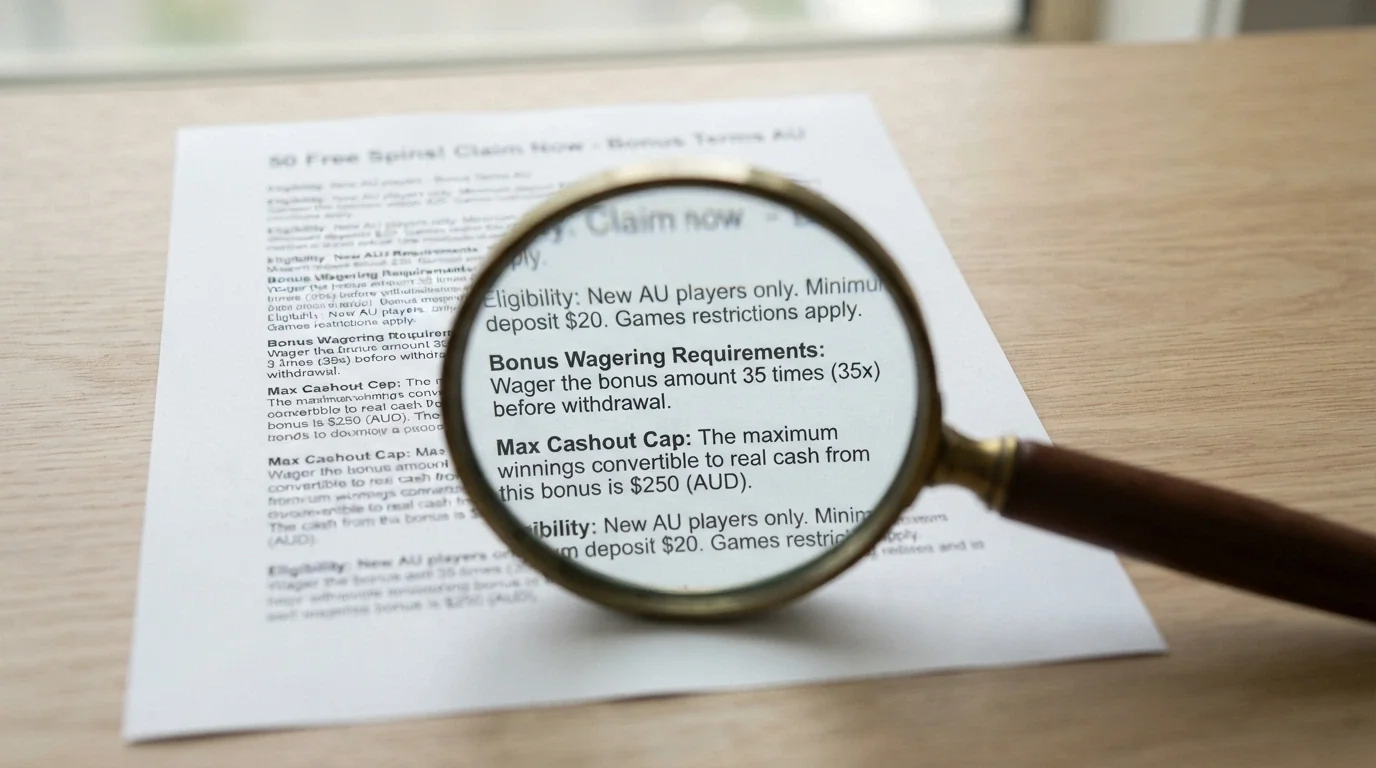
The wagering multiplier is the largest drag. It applies to the bonus winnings, not to the original spin value, and a typical 40x playthrough on a small balance generates a turnover requirement that bears no visible relationship to the spins the player actually got. A $10 no-deposit chip at 40x wagering means $400 of total bets must be placed before any withdrawal is permitted. Standard video pokies contribute 100% to that turnover, but the house takes its 3.5% edge on every dollar of it, which produces a real cost the player cannot negotiate. Assuming a representative 96.5% return — Pragmatic Play’s portfolio average, and a reasonable proxy for the broader pokies market — the house edge on those $400 of required bets works out to roughly $14 in expected loss. That is what the chip is worth to the operator before the player ever sees a withdrawal screen, and the figure before any cashout cap is even applied.
Above 50x wagering, the maths breaks. A no-deposit bonus with a 50x or 60x playthrough on a small balance is, in practice, unclearable for most players — the turnover required exceeds the bankroll any sane staking plan can sustain, and the expected loss on that turnover outpaces the cashout cap before the requirement is met. A 60x requirement on a modest bonus makes the offer valueless for almost everyone. Thirty to thirty-five times on winnings is what the reasonable end of this market looks like.
The cashout cap is the second drag. The headline spin count can imply hundreds of dollars in potential winnings — a 50-spin round at high variance can pay out far more than its $5 spin value — but most no-deposit offers cap what the player can actually withdraw at between AU$50 and AU$200. Anything above the cap is voided. The cap is the single largest reason the realised value of a “100 free spins” offer is a small fraction of what the marketing implies.
The max-bet cap is the third drag, and the easiest to breach by accident. While a bonus is active, bets are usually limited to $5 per spin or hand; above that threshold, the operator reserves the right to void the bonus and any winnings generated under it. A player staking $10 to clear turnover faster does not clear faster — they forfeit the balance. The expiry windows are the fourth: spin validity of 24 to 72 hours from credit, and a separate 7 to 14 days to complete the wagering requirement from the moment the bonus is activated. Miss either, and the bonus and any accumulated winnings are forfeit by default.
| Pokie | RTP | Provider |
|---|---|---|
| Blood Suckers | 98% | NetEnt |
| Mega Joker | 99% | NetEnt |
| 1429 Uncharted Seas | 98.6% | — |
| Sweet Bonanza | ~96.5% | Pragmatic Play |
The right game softens the turnover drag but does not remove it. High-return pokies reduce the house edge per spin, which reduces the expected loss across the required playthrough. Blood Suckers at 98% and Mega Joker at 99% return a larger share of every dollar than the 96.5% portfolio average, which is why they are the conventional recommendations for bonus clearing. A player chasing a 40x requirement on a small no-deposit bonus is well advised to use a pokie from the upper end of the RTP band — but the difference in expected loss between clearing on a 96.5% game and clearing on a 98% game is a few dollars on a $400 turnover, not a transformation.
No-Deposit Free Spins: What the AU Market Actually Offers in 2026
The current Australian offshore market splits into three groups. The first is the genuine no-deposit offer: a spin package or free chip credited on registration, before any payment method is attached to the account. The second is the deposit-gated bonus marketed as a registration reward — a welcome package of hundreds of spins and thousands of dollars in match bonus that requires a minimum deposit to unlock, and which the affiliate pages sometimes list as a “no-deposit” entry because the free-spin component is credited on the first deposit rather than before it. The third is the outright absence of any no-deposit offer, where the operator runs a deposit-only welcome package and the player who wants to test before funding has no free option at all.
The genuine no-deposit side has thinned over the past two years. RocketPlay still runs a 50 free-spin offer on a Gamzix title at $0.10 a spin with a 1-day activation window. Bizzo Casino runs 20 no-deposit spins on BGaming titles. Casino Rocket runs 10. Royal Reels and Fair Go prefer the free-chip route — a $10 AUD chip on registration, which is functionally equivalent to a small spin offer but with no specific pokie lock. WinSpirit, Stake and Rainbet run no no-deposit offer at all: the headline bonus only unlocks after a deposit.
The 2026 gambling reform — passed by Parliament on 19 August 2026, with its inducement marketing prohibitions commencing 1 January 2027 — bears directly on this channel. From that date, direct marketing of sign-up offers is prohibited for the first 14 days after a customer registers with a licensed Australian wagering operator, for 90 days after a person de-registers from BetStop, and indefinitely for customers flagged as at-risk of gambling harm. None of this binds an offshore casino serving Australian players from Curaçao or Anjouan. What it does is shrink the legal marketing surface for licensed operators, which over time may push more player attention toward the offshore channel that the reform is not designed to reach.
How Offshore Licensing Shapes the AU Free-Spin Market
The operators Australian players reach are licensed in Curaçao or Anjouan. These are the two jurisdictions whose licensing frameworks have become the standard for the AU-facing offshore market, and they explain almost every structural feature of the bonuses on offer.
The first thing an offshore licence explains is denomination. The house edge in a Curaçao-licensed pokies catalogue is set in EUR or USD; when the operator denominates a bonus in AUD for an Australian player, it does so at a fixed conversion the operator picks, and the cashout cap of AU$50 or AU$200 may move relative to the underlying EUR stake depending on which way the exchange rate has gone. Bizzo’s €50 cap on a no-deposit spin offer, for instance, can clear to a different AUD figure at different times of year. The player reads a number that the operator can redefine without changing the offer.
The second is bonus conservatism in the face of weak enforcement. An offshore operator licensed under a regulator that has limited reach into Australian player disputes cannot rely on the local courts to enforce a contested bonus — but the operator is also not bound by the inducement restrictions, advertising caps or harm-minimisation obligations that come with an Australian licence. The result is a market that can offer large headline packages (the SkyCrown A$8,000 + 400 free spins welcome is the obvious example) because the operator has no consumer-protection ceiling to meet, and that wraps those packages in wagering requirements high enough to ensure most of the bonus never converts to withdrawable cash.
The third is the segmentation of terms by market. The same Curaçao-licensed operator often runs markedly different bonus structures for players in different jurisdictions, because the operator’s compliance team calibrates the offer to the regulatory risk of each market. An Australian-facing bonus typically carries a higher wagering multiplier and a tighter cashout cap than the equivalent offer in a less-restricted jurisdiction, on the calculation that the player has fewer routes to dispute an unfavourable outcome.
There is no Australian online casino licence, federally or in any state or territory. Every operator on the AU-facing list operates outside Australian rules. The consequences of that fall on the player when something goes wrong, not on the operator when the offer is on the table.
Free Spins on Sign-Up: What “Registration Spins” Really Mean
The affiliate pages blur the line between genuine sign-up spins and deposit-triggered spins marketed under the same heading. The distinction matters because only the first costs the player nothing to claim.
A true no-deposit sign-up offer credits spins to a new account on registration, with no payment method required and no deposit needed. RocketPlay’s 50 free-spin offer on the Gamzix title fits this shape: the player signs up, the spins land in the account, and the only cost is the 1-day activation window — claim them, or lose them. Bizzo’s 20 free spins on BGaming titles sit in the same category, with a 3-day activation window and a 7-day wagering clock once activated.
The grey zone is the token deposit — a $1 or $2 charge the operator places and refunds to verify a payment method without actually funding the account. The player is not out of pocket, but a payment method is now on file with the operator, and a deposit-gated welcome bonus can sometimes be unlocked from there with a small top-up. Affiliate pages list these as “no-deposit” offers because the headline terms do not require a funded balance, but they are a step removed from a pure sign-up promotion.
The third category — deposit-triggered spins marketed as registration rewards — is the one most likely to mislead. SkyCrown’s 400 free spins are credited across four deposits with a A$20 minimum on each; Rainbet’s 60 free spins on Sweet Bonanza require a $30 minimum first deposit. Neither is a no-deposit offer. Both appear on listicle pages next to genuine NDBs because the affiliate gets paid on the deposit, not on the distinction. When you are hunting a genuine zero-cost entry, trust the table’s terms column over the headline’s marketing copy.
Real-Money Free Spins vs Play-Money: What You Can Actually Keep
The free-play pokies a player can launch in demo mode and the free spins an offshore casino credits to a new account look similar from the lobby. They are not the same product.
Demo spins do not generate withdrawable winnings. They are the casino’s way of letting a player test a game’s volatility, hit frequency and bonus features without staking real money; what the player wins in a demo round is credited to a practice balance that the casino can reset at any time. The return-to-player behaviour of the game is real — a high-volatility pokie will look like a high-volatility pokie in demo mode — but no cash leaves the casino with the player.
Real-money free spins pay the same return-to-player rate, and the winnings land in a bonus balance the player can theoretically convert to withdrawable cash. The conversion is what the wagering requirement controls. A 50-spin round at $0.10 a spin, on a 96.5% pokie, returns an expected $4.83 in bonus balance to the player; that $4.83 then has to be played through a multiplier — typically 40x — which produces a required turnover in the high $100s to low $200s. The expected loss on that turnover at the same 96.5% RTP is the single-digit-to-low-teens dollar figure described earlier in this page. The cashout cap then voids anything above its limit, which is most of the windfall outcomes a player hopes for when they spin.
A player who treats the two as the same is treating $4.83 of bonus balance as $4.83 of withdrawable cash. The bonus balance is not cash. It becomes cash only after the operator’s terms let it, and the terms are designed to make that conversion less generous than it first appears.
What 25, 50 or 100 Free Spins Actually Deliver: By the Numbers
Three spin counts cover most of the AU-facing no-deposit market. Translating each into realised cash requires the same calculation repeated.
A 25-spin offer at the standard $0.10 puts $2.50 through the reels. On a 96.5% pokie, the expected return is $2.41 — the gross bonus balance before wagering. Apply a 40x playthrough to that balance and the required turnover sits just below $100; the expected loss on the turnover at 96.5% RTP is a touch over $3. A AU$50 cashout cap applies to most 25-spin offers in this market, which never bites because the realistic balance never threatens it. The realised cash, on average, is in the low single dollars.
A 50-spin offer at $0.10 puts $5 through the reels and produces an expected gross bonus of $4.83. The 40x playthrough on that balance is $193 of required turnover; the expected loss is around $6.76. The cashout cap on a 50-spin NDB is typically AU$75 (RocketPlay), and the realistic balance approaches but rarely crosses that ceiling. A player who lands a clean round on a high-variance pokie and runs hot through the wagering requirement walks away with most of the cap. A player who lands a cold round walks away with whatever the bonus balance clears to after the multiplier is satisfied, less the house edge.
A 100-spin offer is the largest block the market carries. At $0.10 a spin, $10 goes through the reels; the expected gross return is $9.65. The 40x turnover on that is $386; the expected loss is around $13.50. The cashout cap on a 100-spin offer varies widely — some operators set it at AU$50 (effectively rendering the extra 50 spins cosmetic), others at AU$200. The headline count is not the deliverable; the cap is.
The common error is to read the spin count as a number of chances to win the cashout cap. The honest reading is the opposite: every additional spin beyond what the cashout cap allows is wasted, and the operator structures the offer knowing that most claimants will not come close to it.
Instant-Play Free Spins: No Download, No Deposit, No Card
An instant-play casino is one that runs in a browser without a software download, a desktop client or an app installation. Every operator on the AU-facing offshore list is instant-play by default — the modern pokies catalogue is HTML5, and the operator’s bonus terms are served from the same web session that hosts the games.
PayID-triggered offers sit alongside instant-play in the same ecosystem. PayID is the Australian real-time payments overlay that ties a bank account, an email address or a phone number to a payment; some offshore operators advertise PayID compatibility as a way to signal legitimacy, though the operator’s licence status and the PayID acceptance are independent questions. A PayID-accepting offshore casino is still offshore; the payment rail does not domesticate the licence.
What instant play does not mean: no-registration play. The free-spin offer requires an account, because the operator needs to know which bonus balance to credit the winnings to, and to lock the bonus to the eligible games for that account. The free-play demo mode on the same pokie is no-registration; the free-spin offer is no-deposit, not no-registration. The distinction matters because the registration is what attaches the player’s identity, and the identity is what the operator’s KYC check is run against when the player tries to withdraw.
A player who values minimum friction before staking real money is best served by a free-play demo first, then a registered account with a no-deposit offer, then a funded deposit if the operator’s games and terms suit. The instant-play layer underneath all three is the same.
10 Australian-Reachable Operators With Free Spins: 2026
The table below covers the ten offshore operators Australian players most commonly reach in 2026. Every one is unlicensed for online casino in Australia; the ranking is by the real value of the no-deposit and free-spin offer, not by any implied legal standing. None is recommended as a place to play. The table is a comparison of offers, and the comparison is the page’s only interest in them.
| Operator | No-deposit offer | Welcome deposit bonus | Deposit wagering |
|---|---|---|---|
| RocketPlay | 50 FS on Gamzix 3×5 Hold The Spin, $0.10/spin, 1-day activation | 100% up to AUD 1,000 | 40x |
| Royal Reels | $10 AUD chip, auto-credited, 40x, AUD $50 max cashout, 7-day expiry | 100% up to AUD $500 | 35x |
| SkyCrown | No confirmed NDB | A$8,000 + 400 FS across 4 deposits | 40x (bonus) / 30x (FS) |
| Fair Go | $10 chip no deposit, 60x wagering, A$150–A$180 max cashout | Deposit match at 30x | 30x |
| Bizzo Casino | 20 FS on BGaming titles, 40x, €50 max cashout, 3-day activation | 100% up to €100 + 100 FS | 40x |
| Casino Rocket | 10 FS no deposit | Up to $1,500 + 150 FS across 5 tiers | — |
| Rainbet | No confirmed NDB | 250% up to $1,750 + 60 FS | 40x or no-wager gradual release |
| WinSpirit | No NDB available | 100% up to $1,000 + 100 FS (first); 200% up to $1,000 (second) | — |
| Stake | No traditional welcome bonus | None (daily races, VIP rewards) | N/A |
| Scream Casino | — | — | — |
The rank order reflects a single editorial judgement: how much realisable cash a typical Australian player can walk away with under the offer’s terms, after wagering and the cashout cap. The ranking does not reflect safety, recourse, payment speed, game variety or any other consideration a player might reasonably use to choose an operator. None of those belongs on this list, and none is on it.
How We Compare These Free-Spin Offers
The ranking treats the no-deposit offer as the primary criterion and the deposit-match welcome as the secondary one. A genuine no-deposit offer — one that credits spins or a free chip on registration without a deposit — outranks a deposit-gated welcome package, because the no-deposit offer is the only one a player can evaluate without first committing money. Within the no-deposit set, the operators with lower wagering multipliers and higher cashout caps outrank those with harsher terms; RocketPlay’s 50 FS at $0.10 with a AU$75 cap and 40x wagering is a better no-deposit offer than Fair Go’s $10 chip at 60x wagering, even though Fair Go’s cashout cap is higher in absolute terms, because the 60x playthrough is on the steepest end of the market and most players will not clear it.
A confirmed absence of an NDB is treated as a real signal, not as missing data. WinSpirit, Rainbet and Stake run deposit-only welcome packages; SkyCrown’s headline A$8,000 + 400 free spins bundle is deposit-gated. These offers are listed and described because they exist, but they are not ranked at the top of the no-deposit set because they do not have a no-deposit tier to rank. Scream Casino’s bonus terms could not be confirmed this round and most of its specifications are gaps rather than features; it is included for completeness, and the gaps are stated where the operator write-up runs.
Every operator on this list is offshore. None holds an Australian online casino licence, because no such licence exists. The check is against the ACMA register and the IGA 2001, not against a list of bad actors.
RocketPlay
RocketPlay carries the strongest genuine no-deposit offer in the featured set: 50 free spins on Gamzix’s 3×5 Hold The Spin at $0.10 per spin, with a 1-day activation window that requires the player to claim the spins the day the account opens. The NDB carries 40x wagering on winnings and a AUD 75 maximum withdrawal — a cashout cap that sits at the upper end of the no-deposit band and that, on a hot round, the player can clear to.
The deposit side is unremarkable by comparison but solid: 100% up to AUD 1,000 at 40x wagering on bonus and free-spin winnings, with a 5-day validity from credit and a AUD 7.5 max bet during wagering. The 5-day window is tight against the 7-day NDB expiry Royal Reels offers and the 14-day windows other deposit-match packages carry; a player who does not log in and play through within five days forfeits the bonus.
The 50 FS at $0.10 a spin is $5 of spin value at issue, the 40x playthrough on whatever the reels return is the standard drag, and the AUD 75 cap is generous against the offshore norm. The 1-day activation window is the one sharp edge — a player who registers and forgets to claim loses the offer.
Royal Reels
Royal Reels takes the free-chip route rather than spins. A AUD $10 chip is credited automatically on registration — no code, no opt-in — and carries 40x wagering, a AUD $50 max cashout and a 7-day expiry. The chip is playable on eligible pokies rather than locked to a single title, which gives the player more choice in how they spend the bonus balance.
The deposit side is the lighter of the two offers: 100% up to AUD $500 at 35x wagering on the deposit match — a slightly lower multiplier than the 40x most of this market carries, and a smaller headline ceiling than the AUD 1,000 RocketPlay or SkyCrown offer. The deposit match carries a longer 30-day validity, which is more forgiving than RocketPlay’s 5-day window for a player who wants to bankroll the bonus over several sessions.
The chip shape costs the player the chance at a headline-making round on a high-variance game, but the 40x playthrough on a $10 chip is a more achievable turnover target than a 40x playthrough on whatever a 50-spin bonus round happens to return. The deposit match at 35x is also softer than most of this market.
SkyCrown
SkyCrown runs the largest headline welcome package in the featured set — A$8,000 + 400 free spins across four deposits — and that is the only sense in which it tops a comparison. The package requires a A$20 minimum deposit on each tier, with 40x wagering on the bonus and 30x on free-spin winnings, a A$5 max bet during wagering, and a 14-day validity per tier. The free-spin count runs high because the package is deposit-gated, not because the no-deposit side offers anything; SkyCrown has no confirmed no-deposit entry point.
The package has the structure of a long welcome rather than a quick claim. A player who deposits the A$20 minimum across all four tiers receives the full A$8,000 + 400 FS allocation, but each tier’s bonus expires on its own 14-day clock, and the player who pauses the run forfeits the unclaimed tiers.
SkyCrown is a deposit-gated package for a player with bankroll to commit, and that bankroll is the only entry fee. There is no zero-cost route through this operator.
Fair Go
Fair Go is the RTG-powered AU-facing staple with the steepest no-deposit terms on this list. The $10 no-deposit chip carries 60x wagering on winnings — well above the 30x to 35x reasonable band and at the edge of what the rest of the market treats as clearable. The max cashout on the chip is roughly 5x the chip amount, which puts it at A$150 to A$180 — a higher cap than RocketPlay’s AUD 75, but one that few players reach because the 60x playthrough consumes the balance before most claimants can convert.
The deposit-match side is the more attractive offer: 30x wagering on the deposit bonus, which is the lowest multiplier in the featured set. A player funding an account and playing through the deposit bonus is working with saner arithmetic than a player chasing the chip. The RTG catalogue is the draw for players who already know what they want from that studio’s library; for anyone else, it is a narrower selection than the 80+ studios Bizzo aggregates.
Fair Go’s NDB sits at 60x — the ceiling of this market — and most players will not clear it. The deposit match at 30x is the saner arithmetic the operator offers, and the right entry point for anyone funding an account here.
Bizzo Casino
Bizzo runs a modest 20 no-deposit free spins on BGaming titles — Grand Buffalo Hold and Win and Merge Up 2 — at 40x wagering on winnings and a €50 max cashout (denominated in EUR, not AUD). The 3-day activation window is shorter than RocketPlay’s 1-day allowance to claim from credit, but the 7-day wagering clock once activated is in line with the rest of the market. The dual Curaçao and Kahnawake licensing is rare transparency for an offshore operator and is the reason Bizzo appears in more than one regulatory check.
The deposit side is strong on paper: 100% up to €100 + 100 free spins on the first deposit, 50% up to €300 + 50 free spins on the second, both at 40x. The 80+ game studios aggregated into the catalogue is the deepest provider range in the featured set, and the established-2021 operating history under TechSolutions Group N.V. is the longest track record any operator on this list carries.
Twenty no-deposit spins is the smallest genuine NDB in the featured set, and the only one backed by Curaçao and Kahnawake licensing on file. The dual licence is the strongest regulatory signal any operator on this page offers.
Casino Rocket
Casino Rocket’s 10 free spins no deposit is the smallest genuine NDB on this list. Five deposit-match tiers run from 25% to 150% across the first deposit, up to $1,500 + 150 free spins in aggregate, with a $20 USD minimum deposit. The NDB wagering and max cashout could not be confirmed this round; the gap is real and the operator write-up would normally specify those numbers.
The five-tier structure gives Casino Rocket more flexibility than a flat single-deposit welcome. A player who wants to spread their bankroll across smaller bonuses can claim lower-percentage tiers with smaller deposits; a player who wants the full $1,500 + 150 free spins must deposit enough on each tier to clear the maximum. The shape suits a player who wants options rather than a single large bonus.
Ten spins is the smallest taste of any operator on this list, and the rest of the package is for the player who has already decided to deposit. The NDB wagering and cashout terms are gaps this page states rather than fills.
Rainbet
Rainbet runs the highest deposit-match multiplier in the featured set: 250% up to $1,750 across three deposits, plus 60 free spins on Sweet Bonanza (Pragmatic Play) credited 20 per deposit stage. The wagering structure is unusual: 40x on the standard wager-locked option, or a no-wager gradual-release alternative the player can opt into. Games above 97.4% RTP are excluded from the wagering clearance, which is the operator’s way of preventing bonus abuse on the high-return pokies most efficient for clearing.
The headline bonus is large, but it requires a $30 minimum deposit (and caps at $700 per deposit stage), and Rainbet has no confirmed no-deposit offer. A player hunting a zero-cost entry skips this operator; a player funding an account gets the highest match multiplier and the rare no-wager option. The 7-day expiry from activation is on the tight end of the market, and Sweet Bonanza’s high volatility makes the 60 free spins a high-variance addition to the deposit match.
The 250% match and the no-wager option are the headline; the absence of an NDB is the trade-off. A player funding an account here gets the highest match percentage in this market.
WinSpirit
WinSpirit runs a two-deposit welcome package: 100% up to $1,000 + 100 free spins on the first deposit (the free spins credited 20 per day over five days, which forces a five-day login streak to claim in full), and 200% up to $1,000 on the second deposit with a $50 minimum. There is no no-deposit offer available at all.
The free-spin drip is the distinctive feature. A player who logs in on five consecutive days gets the full 100 free spins; a player who misses a day forfeits that day’s allocation. The drip structure lengthens the bonus over a week rather than concentrating it on the first session, which is a different promotional shape from anything else on this list. The wagering on the bonus could not be confirmed this run; the gap is real.
WinSpirit is for the player who will log in five days in a row to claim the full 100 free-spin drip. Everyone else should skip it.
Stake
Stake operates completely outside the welcome-bonus model. There is no deposit match, no free-spin package, no no-deposit chip; the value proposition is ongoing promotions — daily races, weekly giveaways, event-specific bonuses — and a VIP-tier reward structure for high-volume play. The Curaçao licence is the only one confirmed on the operator’s regulatory status this round.
Stake suits a player who has decided to fund an account for the long term and wants ongoing rewards rather than a welcome package. It is the wrong comparison for a list of bonus offers — Stake’s economics are different from the rest of this set, and the absence of a welcome package is the structural point, not a defect.
Scream Casino
Scream Casino rounds out the featured set, and most of its specifications are gaps this round. The offshore status is confirmed — no Australian casino licence exists, and Scream does not hold one — but the welcome bonus, free-spin terms, wagering multiplier, bonus validity, max cashout and eligible games could not be confirmed against a current operator page in this research pass. The operator is included for ranking completeness; the writeup states the gaps rather than filling them with guesses.
A player considering Scream Casino needs to confirm the bonus terms directly on the operator’s site before claiming. The absence of confirmed terms is not a recommendation; it is a reason to read the offer page before staking.
Online Pokies and the Law: What Every Australian Player Needs to Know
Online casino games and online pokies are prohibited to people in Australia under the Interactive Gambling Act 2001. There is no licence for online casino anywhere in the country — not federally, not in any state or territory, not for any operator on any of the lists that rank the offshore sites Australian players actually reach. The Interactive Gambling Act 2001 was strengthened by the Interactive Gambling Amendment Act 2017, and the 2026 reform — passed by Parliament on 19 August 2026 — adds further restrictions commencing 1 January 2027.

The Australian Communications and Media Authority enforces the prohibition. Since its first blocking request in November 2019, the ACMA has had 1,564 illegal gambling and affiliate websites blocked by Australian internet service providers as of March 2026, and more than 225 illegal services have withdrawn from the Australian market since enforcement was strengthened in 2017. The ACMA’s tools include formal warnings, civil penalty proceedings, ISP blocking and market-exit pressure. The individual player is not prosecuted under the IGA — section 15 of the Act targets the provider, not the user. That detail is real, and it is also incomplete.
“Not prosecuted” is not the same as “protected.” A player at an offshore casino has no Australian consumer protection, no Australian complaints body, no recourse if the operator refuses a withdrawal, voids a win or closes the account. The ACMA cannot recover the player’s money. The site can be blocked at any time, with the player’s balance on it. From 1 January 2027, banks and payment providers gain express authority to block transactions to illegal gambling operators, which is a meaningful tightening of the payment layer underneath the offshore channel.
What is licensed in Australia is wagering on races and sport placed before the event begins, lotteries and keno — through operators licensed by a state or territory. Sportsbet, TAB, bet365, Ladbrokes, TABtouch, PointsBet, Neds, Betr, Picklebet and Betfair hold state or territory wagering licences; none of them offers online pokies or online casino games. Wagering on a Saturday race uses a licensed, regulated service; spinning a pokie via an offshore site puts you outside the Australian regulatory umbrella entirely.
Licensed vs Offshore: The Two Universes Australian Players Navigate
A licensed Australian wagering operator and an offshore casino are not variations of the same thing. They operate under different statutes, with different obligations to the player and different recourse available when something goes wrong.
A licensed Australian wagering operator holds a state or territory wagering licence (the de facto national licensor is the Northern Territory Racing and Wagering Commission), complies with Australian advertising and harm-minimisation rules, accepts only the payment methods the IGA permits (debit card, bank transfer, PayID/Osko, BPAY — not credit card and not crypto), and is reachable through the Australian complaints infrastructure if a dispute arises. The player’s bankroll is held by an Australian-regulated entity. The player is in the BetStop register’s coverage. The player can complain to the state regulator and, where relevant, the Australian Financial Complaints Authority.
An offshore casino operating under a Curaçao or Anjouan licence is none of those things. The licence is granted by a regulator with no reach into Australian player disputes. The operator is not bound by Australian advertising rules, harm-minimisation codes, payment-method restrictions or consumer-protection law. The player’s bankroll is held by an entity outside Australian jurisdiction. The player cannot complain to an Australian regulator about a refused withdrawal, because the regulator has no jurisdiction over the operator. The player is not in BetStop’s coverage. The payment-method tell is reliable: an operator that accepts credit cards or cryptocurrency is operating outside Australian rules, because both have been banned for online wagering since 11 June 2024, with non-compliance penalties reaching $247,500.
The player stands on different ground at each. The licensed side has limits — no pokies, no casino games, no in-play betting — but the protections apply to every dollar the player wagers. The offshore side has the games the player wants and none of the protections the player would need if the operator decided to withhold a withdrawal.
What You Lose When You Play Offshore: Protections That Do Not Cross the Water
The specific Australian safeguards that disappear when a player funds an offshore casino account are the ones a player notices only when they are needed.
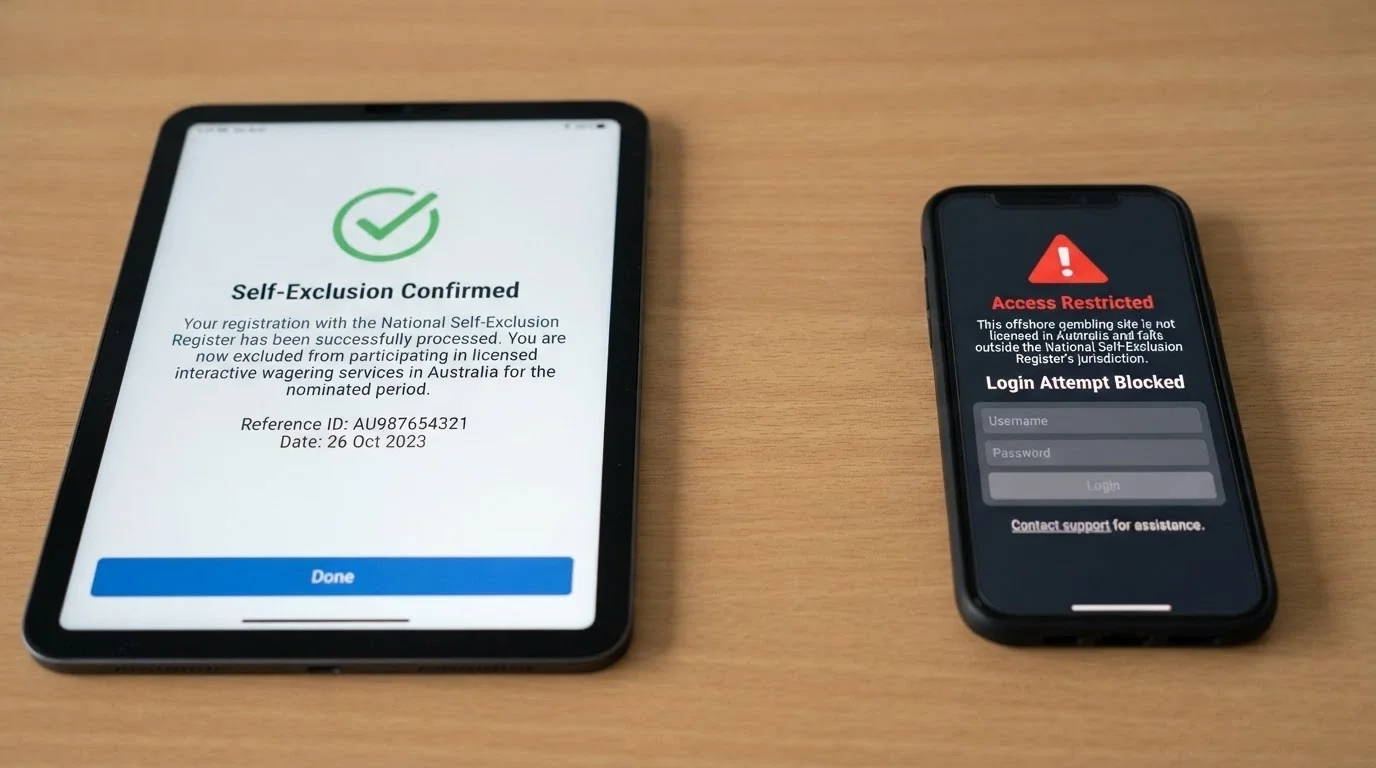
BetStop does not reach offshore casinos. The National Self-Exclusion Register, launched on 21 August 2023, has 54,859 registrations to the end of Q2 FY 2025–2026, with 35,135 active exclusions as of 31 December 2025. The register excludes a person from approximately 150 licensed wagering providers in Australia. It does not exclude a person from any Curaçao-licensed or Anjouan-licensed casino. A player who registers with BetStop because they want to stop gambling has stopped at the licensed operators only; the offshore sites the same player can reach in a browser remain available, funded and willing to take their deposit.
The Australian Financial Complaints Authority has no jurisdiction over an offshore operator. There is no Australian complaints body that will investigate a refused withdrawal, a voided win or an account closure at a Curaçao-licensed casino, because the operator is not within AFCA’s reach. The player can complain to the Curaçao Gaming Control Board or the Anjouan regulator in principle; in practice, the regulator’s responsiveness to individual player disputes from outside the licence jurisdiction is the operative question, and the answer is most often “no useful response.”
The ACMA cannot recover anyone’s money. The ACMA’s enforcement powers run against the operator — blocking the site, formal warnings, civil penalty proceedings — and not against the operator’s bank balance on behalf of an individual player. A player whose offshore casino refuses to release a $400 withdrawal cannot ring the ACMA and ask for the $400 back. The ACMA can, in some circumstances, direct Australian ISPs to block the site, which terminates the player’s future access but does nothing for the balance already on the account.
The operator can refuse a withdrawal, void a win or close an account on terms the player accepted at registration. The bonus terms the player agreed to when they claimed the no-deposit offer typically give the operator wide latitude to void winnings for “irregular play,” “bonus abuse” or a max-bet breach, with the operator’s judgement being the only judgement that applies. There is no Australian court the player can take the dispute to under Australian consumer law, because the operator is not subject to Australian consumer law.
The site can be blocked at any time, with the player’s balance on it. The ACMA’s blocking power is unilateral; the operator receives the direction, the ISPs implement it, and the player’s access ends. What happens to the balance depends on the operator’s withdrawal terms and on whether the operator chooses to honour them once the player can no longer log in to request one. There is no Australian-law obligation on the operator to do either.
Play Free Pokies First: Why Demo Mode Saves Your Bankroll
Free-play pokies — sometimes called demo mode, fun mode or practice mode — are the same games as the real-money catalogue, run by the same providers, with the same reels, the same pay tables and the same return-to-player behaviour. The only thing missing is the wager: every spin is paid for in practice credits, and the balance resets when the player closes the window.

The strategic value of demo mode is that it lets a player test a game’s volatility and feature cadence without staking a cent. A low-volatility pokie like Starburst produces frequent small wins and long play sessions; a high-volatility pokie like Sweet Bonanza produces less frequent wins but larger payouts when they land. The same is true in demo mode as in real-money mode, because the underlying random number generator and the pay table do not change. A player who wants to know whether they will enjoy a game’s hit pattern can find out in 50 demo spins what it would cost them 50 real-money spins to discover.
Free-spin features carry a large share of a pokie’s total return — typically 20 to 40 percentage points of the advertised RTP — which means the bonus round is where most of the game’s mathematical character lives. A three-scatter trigger in a mid-volatility pokie typically pays 10 free spins, and the round itself returns roughly 10x to 30x the triggering bet across its lifetime. Demo mode is the only way to see how often that round triggers and what it actually pays before committing real money.
The difference between a casino’s demo mode and a standalone free-pokies site is mostly cosmetic. Both run the same HTML5 game; both reset the practice balance when the session ends; neither generates withdrawable winnings. A player who wants to evaluate a pokie before depositing can use either.
Instant-Play Free Pokies: No Download, No Registration, No Money
An instant-play free pokie runs in a browser tab, loads without a software download or app installation, and asks for nothing from the player — no account, no email, no payment method. The modern pokies catalogue is HTML5, which means the same game file serves desktop and mobile browsers without an app store intermediary. A player who wants to test a specific pokie for a few minutes can open the game’s URL, run a couple of hundred practice spins, and close the tab.
The providers behind most of the AU-facing free-play catalogue — Pragmatic Play, NetEnt, BGaming, Hacksaw — all offer free-play versions of their games through their own sites and through operator demo lobbies. The player’s experience is the same in either case; the only thing the casino demo lobby adds is a “Play for Real” button the player can press when they decide to fund an account.
The limitation is the one that applies to every demo session: the practice spins do not generate withdrawable winnings. The player’s $10,000 demo balance pays out real-looking numbers that reset when the session ends. It is a testing tool, not an income stream. A player who confuses the two is the player the offshore casino’s no-deposit offer is built to catch.
Using Free-Play Mode to Choose the Right Pokie Before You Deposit
Demo mode is most useful as a deliberate selection tool. The choice of pokie determines the variance of the bonus-clearing session — and the variance is what separates a player who clears the 40x wagering requirement from one who runs out of bonus balance halfway through.
A low-volatility, high-RTP pokie is the conventional recommendation for bonus clearing. Starburst is the standard reference: frequent small wins, low variance, a return that lets the bonus balance stretch across the required playthrough. A high-volatility pokie like Sweet Bonanza pays larger amounts when it lands, but the dry spells between wins are longer, and the bonus balance can run out before the wagering requirement is met. For a player with a small bonus balance and a tight playthrough window, low volatility is the safer bet.
How many demo spins are enough to gauge a game’s behaviour? A few hundred spins is the conventional answer — enough to see the hit frequency settle and a representative sample of bonus rounds trigger. A player who tests three pokies for 200 spins each has a better sense of what the games feel like than a player who plays 600 spins on a single title without comparison.
The pokie that is most fun in demo may be the wrong one for clearing a 40x wagering requirement, because fun and bankroll preservation pull in opposite directions on a high-variance game. A player who likes Sweet Bonanza in demo mode and then claims a no-deposit bonus on Sweet Bonanza is choosing the more volatile clearing path; the player is also the one most likely to watch the bonus balance evaporate before the playthrough is met.
The Real Cost of Online Pokies: Gambling Harm in Australia by the Numbers
The prevalence figures are not background colour. They are the backdrop every no-deposit bonus decision sits against.
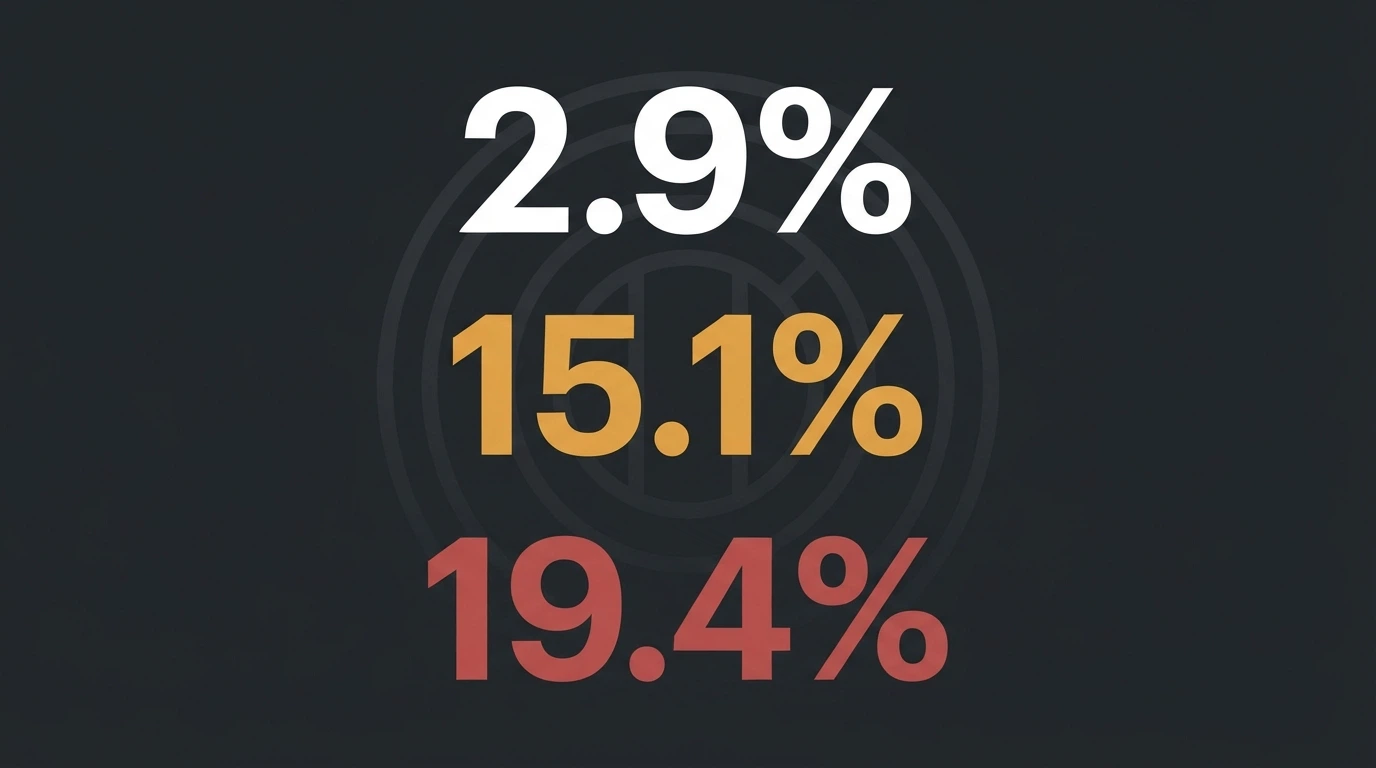
As of March 2026, 13.0% of the Australian adult population — an estimated 2,857,000 people — were experiencing some form of gambling harm from their own gambling behaviours. Including harm from others’ gambling, the figure rises to 15.1% of adults, or 3,320,000 people. The incidence of problem gambling on the PGSI scale has risen for two consecutive years: from 1.9% in 2022–23, to 2.4% in 2023–24, to 2.9% in 2024–25, which is an estimated 620,000-plus Australians. Risky gambling (PGSI) increased from 13.7% in 2024 to 19.4% in 2025, a rise of almost six percentage points in a single year. More than half — 56.1% — of individuals who gambled in the past 12 months did so mainly online.
A model-based estimate in the Journal of Gambling Studies put the annual number of Australians affected by gambling harm at approximately 3.29 million, with the annual health loss exceeding 400,000 Years Lived with Disability. The Australian Institute of Health and Welfare’s separate estimate puts problem gambling at around 2.1% of adults and high-risk gambling at 1.8% as of 2022. The two methodologies disagree at the margin; they agree on the direction.
The 2026 reform’s inducement marketing prohibitions — which commence 1 January 2027 — are aimed squarely at the marketing surface around these figures. Banning sign-up offers for the first 14 days after registration, for 90 days after BetStop deregistration, and indefinitely for at-risk customers is the legislative response to a measurable rise in harm. The reform does not address the offshore channel directly. What it does is remove the legal marketing routes that licensed operators could otherwise use to reach the same Australian players the offshore sites are already reaching.
Deposit Limits, Time-Outs and Session Controls: Tools That Work
Australian-licensed wagering operators are required to offer deposit limits (daily, weekly and monthly), session time limits, reality checks and time-out options as standard harm-minimisation tools. Offshore operators may offer the same controls; nothing in a Curaçao or Anjouan licence compels them to, and the player’s recourse when an operator ignores a self-imposed limit is the operator’s own terms.
A deposit limit is the single most effective tool a player has. Setting a weekly deposit cap before the first session — and keeping it, regardless of whether a winning streak argues for a top-up — is the behaviour the prevalence data says most players do not adopt. The 2026 reform’s inducement prohibitions for at-risk customers assume a player has been identified as at-risk; in practice, the identification is often the player themselves, and the limit is the player’s own decision before the session starts.
Session time limits and reality checks are the second tier. A reality-check prompt every 30 or 60 minutes — showing the player how long they have been in the session and what they have spent — interrupts the time-dissolution effect that drives the late-night sessions the harm data describes. Time-out options, which lock the account for a chosen cooling-off period, sit between deposit limits and the more drastic step of self-exclusion.
Offshore operators may offer these tools, and many do. The tools are not enforceable at an offshore operator the way they are at a licensed Australian wagering provider; if the player sets a deposit limit and the operator does not enforce it, the player has no Australian regulatory body to complain to. Self-imposed controls work when the player commits to them and the operator honours them; the player has more certainty on both counts at a licensed Australian wagering operator.
BetStop, Self-Exclusion and Where to Get Help in Australia
BetStop is the National Self-Exclusion Register, run by the ACMA, launched on 21 August 2023. A single registration excludes the person from every licensed Australian wagering provider — approximately 150 services covering online and phone wagering. Self-exclusion periods run from a minimum of three months to a lifetime. As of 31 December 2025, 54,859 people had registered; 35,135 of those exclusions were active.
BetStop’s coverage has a sharp edge. The register excludes a person from licensed wagering providers only. It does not exclude a person from offshore casino sites that are not licensed in Australia. A player who registers with BetStop has cut off their access to the licensed Australian wagering market; the player has not cut off their access to the offshore casino sites reachable through the same browser. The gambling harm the player was trying to address is reduced, not removed, by a BetStop registration alone.
The National Gambling Helpline is 1800 858 858. It is free, confidential and staffed 24 hours a day, 7 days a week. Gambling Help Online provides live chat and online counselling. State-based services — Gambler’s Help in Victoria, Gambling Help in other states — provide face-to-face, phone and financial counselling. The help infrastructure is Australian, the help infrastructure is free, and the help infrastructure covers harm from gambling at licensed operators and offshore operators alike.
For a player who is funding an offshore casino account and is uncertain whether they should be, the 1800 858 858 number is the most useful thing on this page.
How We Selected and Ranked These Operators
The featured set was drawn from the operators Australian players actually reach in the offshore market, ranked by the real value of the no-deposit and free-spin offers each one carries. The selection criteria were five, applied in this order.

The first criterion was the presence and quality of a genuine no-deposit offer. Operators with a confirmed NDB outranked those without, and within the NDB set the operators with lower wagering multipliers and higher cashout caps outranked those with harsher terms. The second was the size and fairness of the deposit-match welcome package, applied where the NDB was missing or weak. The third was transparency — operators with confirmed licence jurisdictions and publicly stated bonus terms outranked those whose terms could not be verified. The fourth was game catalogue breadth, applied where the bonus terms were comparable. The fifth was the operator’s track record in the AU market, where data permitted a comparison.
The licence status of every operator was checked against the Australian Communications and Media Authority register, the state and territory wagering licensing databases, and the IGA 2001 prohibition framework. None of the operators in the featured set holds an Australian online casino licence, because no such licence exists. None is recommended as a place to play; the ranking is a comparison of offers, not an endorsement of the operators carrying them.
What the ranking does not measure is payout speed, customer service quality, dispute resolution history or any factor the operator controls behind the bonus page. Those factors are real, and they are not on this page, because the bonus comparison is the page’s purpose and the operator behind the bonus is the same operator regardless of how the page ranked it.
Free Spins in 2026: Worth Your Time or a Raw Deal?
The honest answer depends on what “worth” means.
If “worth” means the realised cash a typical player walks away with after claiming a no-deposit offer, then a 50-spin offer at $0.10 a spin produces an expected gross return of about $4.83, a 40x wagering requirement of around $193 of turnover, and an expected house-edge loss on that turnover of about $6.76. The expected loss exceeds the expected return. The player who claims and clears a 50-spin NDB is, on average, slightly worse off than the player who does not claim at all — and the difference is paid in time as well as money, because the turnover target represents hundreds of spins at the eligible pokie.
If “worth” means the entertainment value of a free session at a real-money pokie, the calculation is different. The player who claims a 50-spin offer gets 50 spins on a game they have not played before, with the chance of a hot round that beats the expected outcome by an order of magnitude. The cashout cap is the ceiling on that upside — RocketPlay’s AUD 75, Royal Reels’ AUD $50 — and the player who lands a max-win scenario walks away with most of the cap, which is a real cash outcome for a real-money session that cost nothing to enter.
If “worth” means the protection that applies to the bankroll, the calculation is worst of all. No-deposit bonus or not, the operator holding any winnings the player generates is an offshore entity licensed in a jurisdiction the Australian regulator does not reach. The player’s recourse if the operator refuses a withdrawal is the operator’s own terms. The site’s access can be cut off by an ACMA direction to ISPs, with the player’s balance on it. BetStop does not cover the offshore casino the player is playing at. The Australian Financial Complaints Authority does not have jurisdiction. The ACMA cannot recover the money.
The 2026 reform’s inducement prohibitions — commencing 1 January 2027 — will tighten the legal marketing surface for licensed Australian wagering operators. They will not touch the offshore channel that delivers the no-deposit offers on this page, because the offshore channel is not subject to Australian marketing law. The 2027 reforms will, however, give banks and payment providers express authority to block transactions to illegal gambling operators, which is a meaningful tightening of the payment layer underneath the offshore channel — a layer the player sits on top of every time they fund an account.
The decision framework the page leaves the reader with is straightforward. Read the wagering multiplier before the spin count. Read the cashout cap before the headline package. Read the eligible games list before claiming. Read the licence jurisdiction before depositing. Understand that “no deposit” describes how the offer is claimed, not what it is worth, and that the operator holding the winnings is operating outside Australian law regardless of how the offer is structured. Use demo mode to test the games before any of the above applies.
For a player who is funding an account at one of these operators, the 1800 858 858 helpline is the most useful sentence on this page. For a player who is reading it before claiming, the multiplication above is the same multiplication the operator ran before printing the headline.
Frequently Asked Questions
Can I win real money from free spins with no deposit in Australia?
Yes — no-deposit free-spin winnings are real cash, withdrawable once the offer’s terms are met. Three gates apply: a wagering requirement of 30x to 60x on the bonus balance, a max cashout cap of AU$50 to AU$200, and the operator’s KYC identity check. Cleared in full, the funds reach a verified bank account.
What are wagering requirements on no deposit free spins and how do they work?
A wagering requirement is the multiplier the operator applies to the bonus balance before allowing a withdrawal. A 40x requirement on a $20 bonus balance means $800 of total bets must be placed before withdrawal. Standard video pokies contribute 100% to turnover; progressive jackpots contribute 0% to 10%; table games are usually excluded entirely.
How do I claim no deposit free spins at Australian online casinos?
Register a new account — email, password, occasionally a small token deposit to verify a payment method. The spins are credited automatically or unlocked by a code. Activation windows run 24 to 72 hours; missing the window forfeits the spins. Standard video pokies only; progressive jackpots contribute almost nothing to the wagering requirement.
Which pokies are best for clearing free spins wagering requirements?
Low-volatility, high-RTP pokies are the conventional choice. Blood Suckers by NetEnt at 98% RTP and Mega Joker by NetEnt at 99% are the highest-return options. Starburst (NetEnt) is the standard low-volatility reference for predictable clearing. Sweet Bonanza (Pragmatic Play, ~96.5% RTP) is high-volatility and better suited to a player with bankroll to ride dry spells.
What happens if I win more than the max cashout cap from free spins?
The excess is voided. The operator pays the cashout cap — typically AU$50 to AU$200 at AU-facing offers — and removes anything above it from the withdrawable balance. The bonus balance, wagering clearance, and original spin allocation are unaffected. Only the final withdrawal figure changes, applied at the withdrawal gate after the wagering requirement is met.
Do I need to verify my identity before withdrawing no deposit bonus winnings?
Yes. Every AU-facing offshore operator runs a Know-Your-Customer check before the first withdrawal: photo ID (driver’s licence or passport), proof of address (utility bill or bank statement under three months old), and sometimes a payment-method verification. A player who cannot produce the documents does not receive the withdrawal, however thoroughly the wagering requirement was cleared.