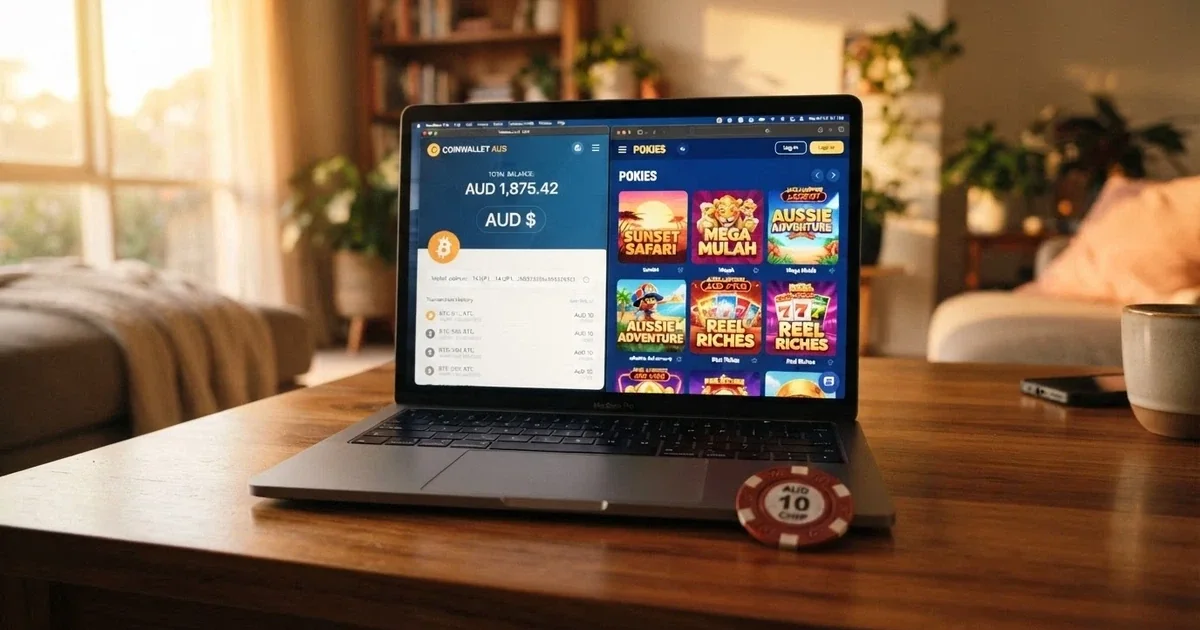
How Anonymous Crypto Casinos Work for Australian Players in 2026
 Available in AU
An anonymous crypto casino lets you deposit Bitcoin, Ethereum, or stablecoins, claim a welcome bonus, and withdraw without anyone asking for your driver’s licence. The promise is genuine at a small handful of offshore brands and substantially softer at the rest. This page ranks ten crypto casinos accepting Australian players at the lightest identity check the offshore market currently offers, names the licence each one runs under, and walks through the bonus terms that decide whether the offer is actually worth the turnover. None of them is licensed in Australia — because no such licence exists.

Data current as of 18 October 2026; licence claims cross-checked against the ACMA blocked-site list, the Curaçao eGaming register, the Anjouan Gaming Authority register, and the Tobique Gaming Commission public records.
Table of Contents
- How No-KYC Casino Play Works — and What It Delivers for Aussie Punters
- Why Crypto Casinos Can Skip the KYC Check
- Top 10 Anonymous Crypto Casinos for Australian Players in 2026
- Jackbit: The No-KYC Promise That Actually Holds
- Bitstarz: Zero KYC With a Five-BTC Welcome Package
- Lucky Block: 200% Match and No Withdrawal Limits
- Wild Fortune: Tobique-Licensed With Tested Payout Times
- Moonbet: Rakeback Over Bonuses, No KYC Under Two Thousand
- mBit: Four BTC and 325 Free Spins for New Players
- 7BitCasino: No-Deposit Spins and a Five-BTC Ceiling
- FortuneJack: A Decade-Old Crypto Casino on an Anjouan Licence
- Lucky Anon: A 420% Welcome Package With Weekly Reloads
- Ignition: A Casino-and-Poker Combo for Australian Players
- Why Your Anonymous Casino Bonus Is Smaller Than It Looks
- The Legal Reality of Offshore Crypto Casinos in Australia
- What You Risk When There Is No BetStop at the Table
- How We Evaluated Every Anonymous Crypto Casino on This Page
- Your Move: What to Check Before You Deposit at an Anonymous Crypto Casino
- Frequently Asked Questions
How No-KYC Casino Play Works — and What It Delivers for Aussie Punters
“No KYC” is a marketing line, and like most marketing lines it loses precision the moment it meets reality. At its strictest, it means you can deposit, play, and withdraw without the casino ever asking for a passport, a driver’s licence, or a proof of address. At its loosest, it means the casino will not ask for documents on day one — but will ask for them when you cross a withdrawal threshold, when you trigger a fraud flag, or when the regulator behind the licence decides to tighten the screws. The Australian player reading “anonymous” should hear “ask me again later” rather than “never”.
The technical reason a no-KYC casino can skip the document step sits with the payment rail, not with the operator’s generosity. A bank transfer or a card deposit carries the sender’s identity in the metadata — the bank already knows who you are, and the casino sees it through the payment processor. A crypto deposit moves wallet to wallet, with no bank, no card network, and no payment processor in between. The casino sees a string of letters and numbers; the on-chain link to a person is not surfaced unless someone goes looking for it. That is the anonymity rail. The casino’s “no-KYC” promise is a downstream consequence of the payment method, not a feature the operator invented.
The Australian counterweight matters here, and the page returns to it. Australia prohibits online casino outright under the Interactive Gambling Act 2001, and the ACMA has had nearly 1,800 sites blocked since November 2019. Crypto and credit card deposits for online wagering have been banned since 11 June 2024 — the payment method itself is a tell that an operator is outside Australian rules. None of the ten casinos on this page holds an Australian licence because no Australian casino licence exists to hold.
What the term delivers in practice is a gradient rather than a binary. Jackbit, at one end, reserves document requests for fraud and AML flags — a normal win pays out without anyone asking who you are. At the other end, several operators publish a withdrawal limit, cross it without comment, and quietly start asking for a passport once you have a balance they would rather keep. The framing from NoKYC Vault is sharp on this: most operators publish a soft withdrawal limit and quietly request documents once you cross it; only a handful reserve verification for genuine fraud and AML flags.
A note on the words. The Australian player searches “anonymous casino” but thinks in pokies. The games on the other side of the lobby are the same ones a local pub pokies room runs in spirit — reels, scatters, free-spin rounds — but loaded as HTML5 from a server in Curaçao, Anjouan, or Costa Rica, with the house edge set by the operator’s configuration rather than by a state gaming authority. The terminology shifts: RTP replaces “payout percentage”, volatility replaces “variance”, max win replaces “jackpot ceiling”. The mechanics do not.
Pokies, Slots and the Words Australian Players Actually Use
The Australian punter who lands on this page from a search engine typed something like “anonymous casino Australia” — but the games they will play once they deposit are pokies. Same reels, same bonus rounds, same near-miss sting when the scatter lands just short of the third reel. The provider studios at the operators on this page are the same ones powering licensed offshore sites worldwide: Pragmatic Play’s Gates of Olympus (RTP 96.50%, Very High volatility, 5,000x max win), Play’n GO’s Book of Dead (RTP 96.21%, with operator variants dropping to 88.25%), and Reel Kingdom’s Big Bass Bonanza (RTP 96.71%, High volatility). These are recognisably the same catalogue the Australian pub market used to offer in pre-ban online form.
The numbers carry weight in two directions. RTP — return to player — is the long-run percentage of stakes a pokie returns to players across millions of spins. Gates of Olympus at 96.50% returns A$96.50 of every A$100 wagered, averaged over time; the house keeps the remaining A$3.50. Volatility describes the distribution: Gates of Olympus is Very High, which means most spins return less than the stake and a small fraction return much more. Book of Dead is closer to medium, with longer stretches of small wins punctuated by the bonus round. Big Bass Bonanza is High — the fishing-theme bonus round pays the bulk of the game’s value.
The Australian reader should hear two things in those numbers. First, the house always has an edge, and RTP figures are long-run averages, not guarantees. Second, operator variants matter — Book of Dead on one operator runs at 96.21%, on another at 94.25%, and on a third at 88.25%. The same title, three different expected returns. A pokie’s RTP is set by the operator’s configuration file, not by the provider, and a no-KYC casino can run any of the variants. That is a comparison tool the page returns to: when two operators carry the same pokie at different RTPs, the higher figure is the better deal for the player, all else equal.
Real-Money Play vs Free-Play Demos at Anonymous Casinos
Every casino on this page runs a real-money lobby and a free-play demo layer on top. The demo is a risk-free way to learn a pokie’s bonus round, its scatter symbol, its feature buy costs. It is the cheapest way to find out whether you actually enjoy the game before committing a crypto deposit. The caveat is that demo RTPs are sometimes configured differently from real-money RTPs — providers and operators occasionally tune the demo to a more generous return to keep players interested — and any demo win is house money anyway, not withdrawable cash.
Real-money play at these operators follows a straightforward path. Connect a crypto wallet, deposit a coin — Bitcoin, Ethereum, Litecoin, USDT, Dogecoin, depending on the operator — and the balance appears in the cashier within minutes for BTC, seconds for stablecoins. Minimum deposits across the featured set run from a low of A$1 equivalent at Lucky Block to USD$20 equivalent at Wild Fortune; the gap is small enough that the practical floor is set by network fees more than by operator minimums. The bonus, if there is one, attaches on deposit. The wagering requirement, if there is one, attaches on the bonus. From there, it is just pokies, blackjack, roulette, live-dealer tables, and the same house edge that licensed wagering sites carry.
A reasonable way to use the demo layer is to spend a session on a pokie’s bonus round before committing real money. A no-deposit free-spin offer — Bitstarz gives 30 free spins with no deposit required, 7BitCasino runs 30 on Deep Sea with a A$50 win cap — is a second-best alternative: real stakes, real money, but with the casino’s bankroll carrying the risk. The no-deposit spin carries its own set of constraints, which the bonuses section covers.
Anonymous Casino Apps and Mobile Play
The anonymous casino on this page does not sit in the Apple App Store or Google Play. There is no downloadable app, no install prompt, no auto-update nagging for permissions. What there is, instead, is a mobile browser that loads the operator’s full site — cashier, lobby, live dealer, sportsbook — over a standard HTTPS connection. Jackbit’s built-in wallet runs in that same browser context; Moonbet’s 10,000-plus games are accessible through the same channel. The mobile experience at a no-KYC casino in 2026 is, in practice, a bookmark to the operator’s web app.
That has practical consequences. The session lives in the browser tab; closing it logs the player out, the way any banking site does. The wallet’s seed phrase or private key — for operators that use an in-browser wallet rather than connecting to an external wallet provider — is stored in the browser’s local storage, which means clearing site data removes the wallet too. Two-factor authentication is typically handled through an authenticator app rather than SMS, since SMS verification on an Australian mobile number pulls a name and a carrier against the player identity the casino is supposed to be ignoring.
What a mobile session actually looks like: open the browser, navigate to the operator’s URL, log in, deposit, play. The same flow as a desktop session, with touch replacing mouse clicks. The lack of an app-store download is not a feature deficit — the browser-based lobby at Jackbit, Moonbet, or Bitstarz carries the full game library without a download step. It is a structural consequence of the offshore status: the app stores do not host unlicensed casino apps in Australia.
New Anonymous Casinos Entering 2026
The offshore landscape moves. New anonymous casinos enter the market each year — some built from scratch, some launched by operators of established brands expanding into a new vertical. Lucky Anon, with its 420% welcome match plus 175 free spins, is one of the more visible entrants this year. Moonbet, on the Anjouan licence with a 4.1/5 Trustpilot score and a 10,000-plus game library, is a rising brand that has accumulated reputation faster than most new entrants.
The standard cautions apply to any new anonymous casino. A licence jurisdiction that takes the operator’s word for responsible gambling is a thinner safeguard than one that audits it. A welcome package that outpaces the rest of the market — Lucky Anon’s 420% is the highest in the featured set — is a marketing budget, not a regulatory endorsement. The practical test for any brand-new operator is the cashout: how fast, in what currency, and whether the first withdrawal goes through without a document request. An established track record is what an anonymous casino has to earn, not what it can claim on a launch page.
A reader evaluating a new entrant should ask three things. What licence jurisdiction is the operator registered under, and does that jurisdiction publish a public register that can be checked? What does the welcome package actually cost in turnover, and does the wagering multiple leave a realistic clearing path inside the validity window? What is the operator’s withdrawal track record — even a short one, even a handful of public reviews — and does it match the marketing claim? The answer to the third question is the answer to whether the brand is worth depositing with, and a one-month-old operator has nothing to point at yet.
Why Crypto Casinos Can Skip the KYC Check
The anonymity promise is built into the payment rail. A bank transfer or a card payment carries identity metadata that the casino sees through the payment processor — the operator knows who the depositor is before the first spin. A crypto deposit moves wallet to wallet, and the casino sees only a string of letters and numbers. There is no bank in the loop to leak the name on the account, no card network to confirm the cardholder, and no payment processor running sanctions checks against the deposit. The technical reason a no-KYC casino can skip the document step is the same as the technical reason an offshore casino can offer crypto at all: the rail was built without a know-your-customer layer in the middle.

That is the headline. The footnote is what happens when the rail meets a regulator’s expectations. Even at a no-KYC operator, KYC can be triggered by three things: a fraud flag on a specific transaction, a cumulative withdrawal or deposit threshold (the typical Curaçao and Anjouan trigger sits at EUR 2,000 to 10,000 in cumulative volume), and a regulator’s request to verify a player under investigation. The first is a security feature. The second is a compliance feature. The third is the regulator doing the operator’s compliance job for it. None of them is the casino being nosy about day-to-day play — but they are real, and they are the point at which “no KYC” becomes “KYC, eventually”.
The marketing line and the practice diverge in two places. Some operators publish a withdrawal limit and treat that limit as a soft ceiling: the casino will not refuse the withdrawal, but it will start asking for a passport at A$4,000 in cumulative withdrawals, even though the marketing page promised nothing of the sort. And some operators treat “no KYC” as a deposit-stage promise — you do not need a passport to deposit — but reserve verification for withdrawal-stage processing. The deposit clears, the play is fine, and the first withdrawal triggers the document request the player thought had been waived. Both are real, and both are why the framing from NoKYC Vault is the right lens to read the marketing through.
The Anonymity Promise: What “Truly Anonymous” Actually Means
“Truly anonymous” is a marketing phrase, and the operators that come closest to it are the ones that have written it into their terms page. Jackbit reserves KYC for fraud and AML flags; that is the deepest anonymity in the featured set, and the NoKYC Vault review is blunt that Jackbit is the operator that most often does what no-KYC promises. Bitstarz is zero-KYC for pure crypto users, with an average withdrawal time of 9 minutes 42 seconds to back the claim. Moonbet holds the no-KYC promise under a A$2,000 cumulative threshold and applies it from day one. None of the three is licensed in Australia.
The spectrum runs from zero-KYC through soft-KYC to threshold-KYC. Zero-KYC means no document request at any normal volume of play; soft-KYC means verification is technically reserved for fraud flags but practically requested on the first withdrawal above a modest figure; threshold-KYC means the operator publishes a withdrawal ceiling and asks for documents once you cross it. Most operators in the featured set fall into the third tier; the first two are the operators where the marketing and the practice match.
A reader who wants the maximum privacy should look for three things. Does the operator publish a withdrawal threshold below which no verification is needed, and is that threshold high enough to clear the player’s planned session volume? Does the operator’s terms page explicitly limit KYC to fraud and AML flags, or does it reserve the right to verify at any time for any reason? Does the operator accept a privacy coin — Monero is the only one that appears in the featured set, at Jackbit — that breaks the on-chain link between deposit and withdrawal? The answer to the second question is the answer that separates a zero-KYC operator from the rest.
Bitcoin, BTC and the Crypto Deposit Route
A Bitcoin deposit at an anonymous casino follows the same path as any other on-chain transaction. The Australian player sends BTC from a wallet — a hardware wallet, a mobile wallet, or an exchange wallet — to the casino’s deposit address, which the cashier generates for each session. The transaction confirms in the next block, typically within ten minutes for BTC’s ten-minute block target. The casino credits the balance once a confirmation threshold is met (usually one to three confirmations). The player then plays in whatever currency the cashier denominates the balance in — most crypto casinos settle the balance in the deposit currency, with BTC stakes and BTC wins.
The altcoin options across the featured set cover the bulk of what an Australian crypto holder is likely to be sitting on. Wild Fortune supports BTC, ETH, LTC, USDT (on both TRC20 and ERC20), DOGE, and BCH. Jackbit adds native Monero. Several operators support stablecoins — USDT in particular — which hedge against the price volatility that turns a 1 BTC deposit into a 0.95 BTC balance during a long session. The TRC20 version of USDT settles on Tron, with low fees and fast confirmation; the ERC20 version settles on Ethereum, with higher fees but broader wallet support. Stablecoin deposits at Wild Fortune, for instance, behave like a USD bankroll without the bank.
The Australian context matters here. Crypto and credit card deposits for online wagering have been illegal at the operator level since 11 June 2024; the page returns to this in the legal section. The deposit rail itself, however, sits outside Australian jurisdiction — the BTC transaction moves from one wallet to another, with no Australian intermediary. The wallet-to-wallet nature of the rail is what makes the deposit possible at all. It is also the reason none of these deposits is supervised by an Australian consumer-protection body.
Instant Withdrawals Through Crypto Rails
The speed gap between a crypto cashout and a bank transfer is the practical reason most Australian players choose this route. A bank transfer from an online casino can take three to five business days; a card refund can take longer. A crypto withdrawal clears in minutes because the rails do not depend on a correspondent banking network or a card scheme settlement window. The casino broadcasts the transaction; the player’s wallet confirms receipt.
The tested withdrawal times at the featured set tell the story. Bitstarz averages 9 minutes 42 seconds end to end. Jackbit’s wallet payouts are typically under 10 minutes. Moonbet clears in about 4 minutes. mBit sits under 15 minutes. Wild Fortune is slower — an average of 5 hours 24 minutes across five test cycles in early 2026, with a range of 3 hours 50 minutes to 7 hours 58 minutes — but that figure is still well inside the bank-transfer bracket. The fastest operator in the set is roughly 80 times faster than a typical bank transfer; the slowest is still inside a working day.
The withdrawal caps and minimums gate the experience. Wild Fortune caps daily withdrawals at USD$4,000 — a ceiling that bites a high-volume player before it bites anyone else. Most operators in the set do not publish a daily cap, which is the marketing-friendly position, though a large withdrawal may still trigger the AML review threshold the section above covered. Minimum withdrawals vary; for BTC, the practical floor is usually the network fee, with operators absorbing a small minimum to keep transaction costs reasonable.
Privacy Coins: Monero and the Next Level of Anonymity
Bitcoin is pseudonymous, not anonymous. Every BTC transaction lives on a public ledger that anyone can read. The wallet address is not a name, but the on-chain activity can be clustered, traced through exchanges, and de-anonymised with off-chain information — a process that is more or less trivial once any address in the cluster has been linked to a verified identity. The pseudonymity is enough to deter casual observation; it is not enough to deter a forensic analyst with a subpoena.
Monero is different. XMR transactions hide the sender, the receiver, and the amount by default. The ring-signature and stealth-address technology that sits under Monero makes on-chain analysis structurally harder than it is for BTC. An Australian player who wants maximum privacy on the deposit side cares about this, because the casino sees only the XMR amount; the player’s on-chain history is not visible to anyone who later gets access to the casino’s transaction log. Jackbit is the only featured operator that accepts Monero natively — deposits, play, and withdrawals flow through a built-in wallet, with the XMR conversion handled at the cashier. No other operator in the set surfaces a Monero integration at the time of writing.
The practical effect on the Australian player is small but real. A BTC deposit at any of the other nine operators leaves a public record that ties the casino’s wallet to the player’s deposit wallet. A Monero deposit at Jackbit does not. The trade-off is liquidity — Monero is less widely supported than BTC, and the cashout path may be narrower — and the trade-off is fee — Monero transaction fees are higher than BTC’s, though still low relative to a bank wire. For the reader who treats the privacy property as the point of the exercise, the trade-off is worth making.
Top 10 Anonymous Crypto Casinos for Australian Players in 2026
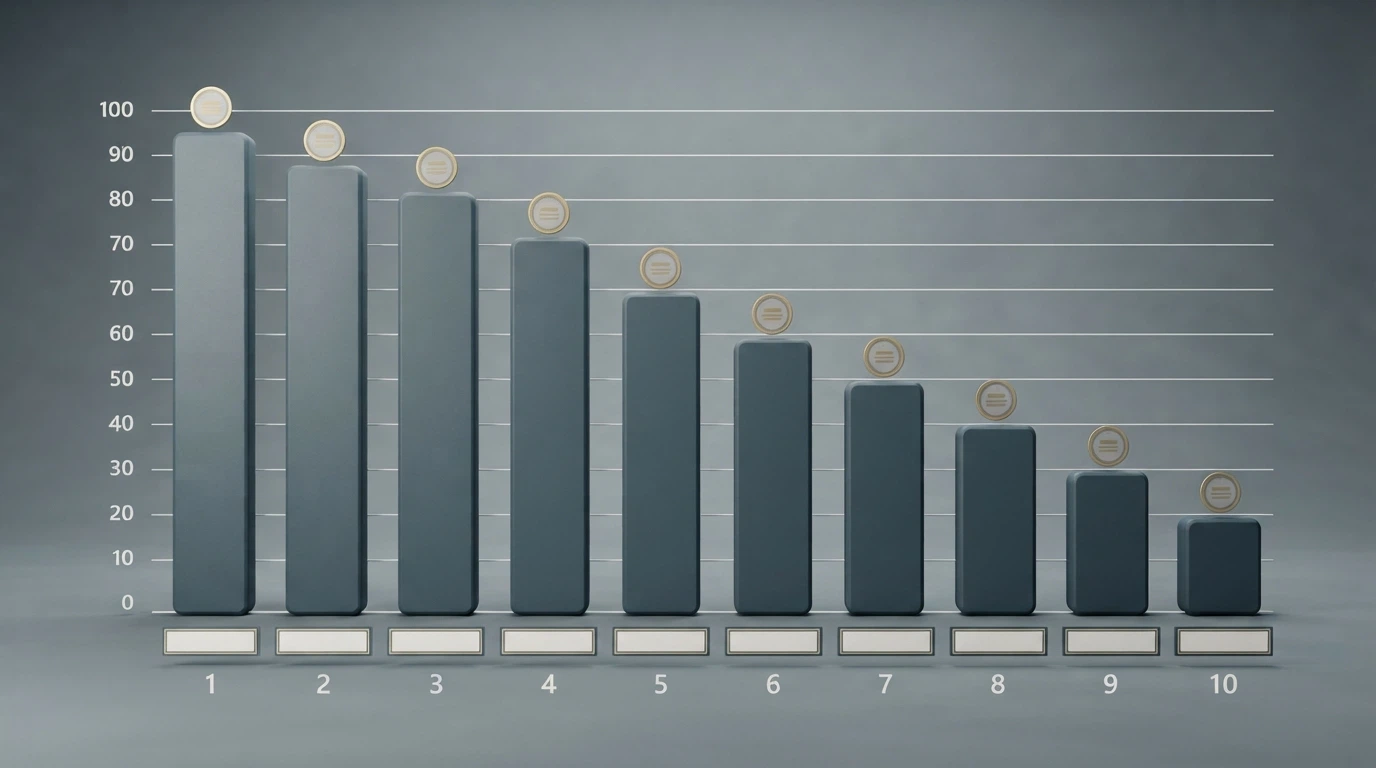
The list below ranks ten crypto casinos where Australian players can sign up with the lightest identity check the offshore market currently offers. None holds an Australian casino licence because no such licence exists. Each operator is offshore, each one accepts crypto, and each one skips at least one stage of the KYC process that a licensed Australian wagering site would run. The ranking was ordered by anonymity depth first, with game selection and payout speed as tiebreakers. The detailed write-ups follow the table.
| Operator | Licence | Welcome Bonus | Crypto Payout Speed | No-KYC Threshold |
|---|---|---|---|---|
| Jackbit | Curaçao (since 2022) | 100% match + 100 wager-free spins on $50+ deposit | < 10 min (built-in wallet) | Reserved for fraud/AML only |
| Bitstarz | Curaçao | Up to 5 BTC + 180 FS across 4 deposits | 9 min 42 sec (avg) | Zero KYC for crypto users |
| Lucky Block | Curaçao | 200% up to A$10,000 + 50 FS | — | No mandatory KYC for crypto |
| Wild Fortune | Tobique Gaming Commission #0000064 (Metlait SRL) | — | 5 h 24 min (avg, 5 test cycles) | — |
| Moonbet | Anjouan Gaming Authority | 20–40% Moonrake rakeback + 4–8% Moonback cashback | ~ 4 min | Under A$2,000 |
| mBit | Curaçao | Up to 4 BTC + 325 FS | < 15 min | — |
| 7BitCasino | Curaçao (founded 2014) | 325% up to 5 BTC + 250 FS across 4 deposits | — | — |
| FortuneJack | Anjouan (ALSI-202411021-FI1) | — | — | — |
| Lucky Anon | Offshore (jurisdiction not specified) | Up to 420% + 175 FS | — | — |
| Ignition | Curaçao | A$3,000 casino and poker package | — | — |
How We Picked and Ordered These Ten Casinos
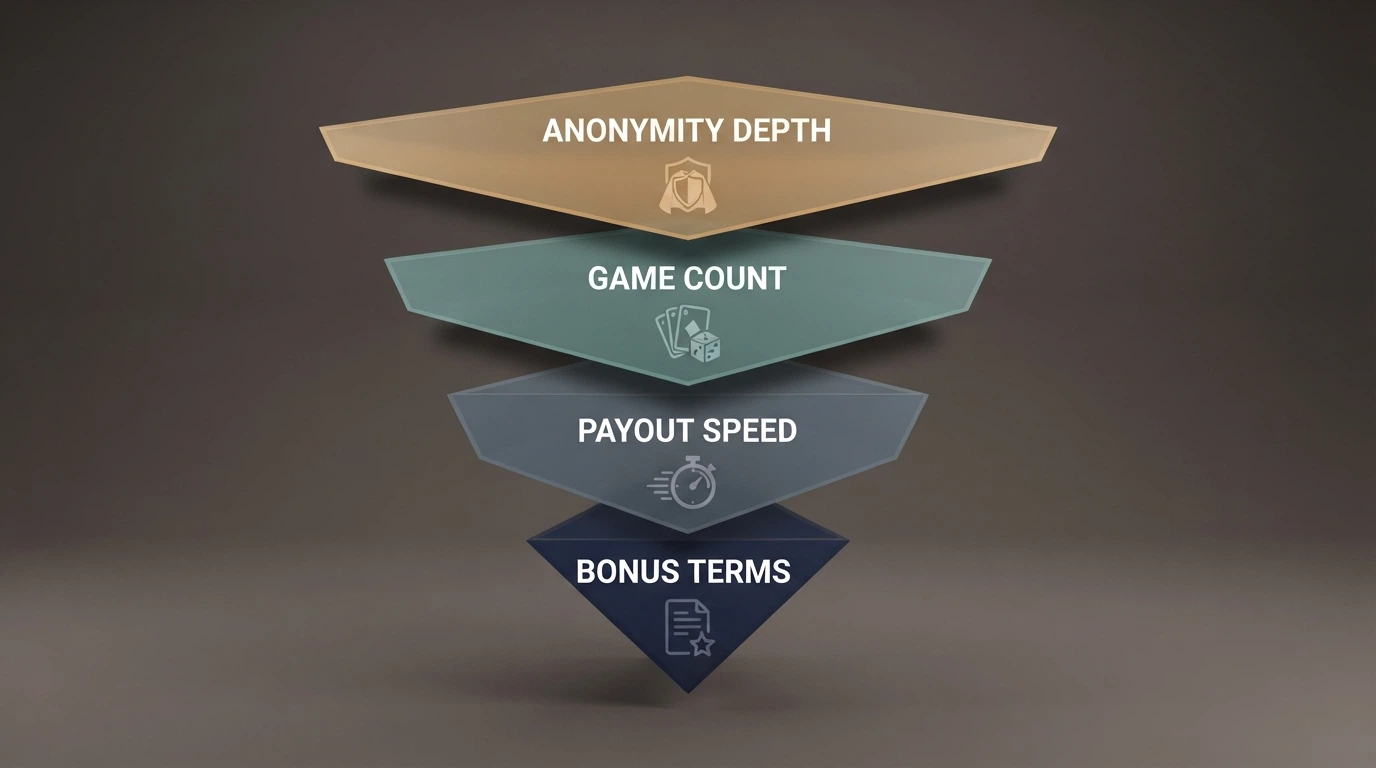
The ranking was ordered by anonymity depth first. Zero-KYC operators — Jackbit, Bitstarz, Moonbet under A$2,000 — sit at the top. Threshold-KYC operators sit lower regardless of how generous their welcome package is. Game-library breadth broke the ties between operators at the same anonymity tier: Jackbit’s 7,000-plus games and Moonbet’s 10,000-plus titles placed them above operators with smaller libraries. Payout speed was the third filter: Bitstarz’s 9-minute-42-second average and Moonbet’s 4-minute benchmark separated operators whose crypto rails were actually fast from operators whose marketing pages claimed they were. No operator was paid for placement, and no operator bought a higher position.
Several operators were excluded by the criteria. Anon Casino carries only a 5% cashback offer and no welcome, deposit, or reload bonus — the absence of a welcome package reads as a thin marketing posture rather than a stripped-down honest offer, and the game-provider lineup was not surfaced in the research set. Operators that required a full KYC submission on signup were excluded by definition; the list is built around the lightest-touch identity checks the offshore market offers, and a brand that runs the same verification as a licensed Australian wagering site is not an anonymous casino in the sense the page is using the word.
What was excluded matters as much as what was included. An Australian player who wants the broadest selection of pokies will find larger libraries at licensed wagering operators that hold state and territory licences — but those operators require full KYC, do not accept crypto, and do not offer the offshore product. An Australian player who wants the lightest-touch anonymity will land on this list and accept the trade-offs the legal section covers.
What the Comparison Table Tells You — and What It Cannot
The table is built around five columns: operator, licence, welcome bonus, payout speed, and no-KYC threshold. Each cell carries a figure from the research set, an em dash where the figure was not surfaced, or a description where a single number would not capture the variation. The blanks are honest. Wild Fortune’s welcome bonus, FortuneJack’s payout speed, Lucky Anon’s no-KYC threshold — none of these were confirmed in the research set, and a fabricated number would mislead the reader more than an em dash.
The columns do different work. The licence column names the jurisdiction each operator runs under, which sets the regulatory floor and the dispute path. The welcome bonus column describes the headline offer, not the real cost — the wagering multiple, the validity window, and the max-bet cap live in the operator write-ups and the bonuses section, not the table. The payout speed column carries the tested withdrawal time where research confirmed one; an em dash means the operator’s marketing claim was not independently verified, and the reader should treat the absence as a reason to test a small withdrawal before committing volume. The no-KYC threshold column describes the document-request trigger: “reserved for fraud/AML” is the lightest, “zero KYC for crypto users” is the next lightest, “under A$2,000” is a published threshold, and an em dash means no threshold was published.
What the table cannot tell the reader is the experience after the first withdrawal. A 9-minute-42-second average masks the variance: the first withdrawal may clear in 4 minutes, the third in 18. A “Curaçao since 2022” licence marker does not tell the reader how the operator handles a disputed withdrawal — that path runs through the Curaçao regulator, and the operator write-ups return to it. The table is a reference; the write-ups are the read.
Jackbit: The No-KYC Promise That Actually Holds
Jackbit operates under a Curaçao licence since 2022 and runs the deepest anonymity model in the featured set: KYC is reserved for fraud and AML flags, not for routine cashouts. A normal win pays out without anyone asking for a passport. The NoKYC Vault review calls Jackbit the operator that most often does what no-KYC promises — and that framing is what separates the brand from the rest of the offshore market, where “no KYC” usually means “no KYC until you have a balance they want to keep”.
The platform runs more than 7,000 games plus a sportsbook, with wallet payouts typically under 10 minutes. The welcome offer pairs a 100% deposit match with 100 wager-free spins on Hot Chilli Bells, available on a deposit of A$50 or more. The wager-free spins are the standout: winnings from those spins are withdrawable as cash, not as bonus credit locked behind a multiplier. A wagering multiple of zero is the rarest feature in the welcome-offer market, and it is the part of the Jackbit offer that pays for itself in player time saved.
The brand also supports native Monero deposits, play, and withdrawals through a built-in wallet — the only operator in the featured set that does. For the Australian player who treats privacy as the point of the exercise, this is the differentiator. A BTC deposit at any other operator leaves a public ledger entry tying the casino’s wallet to the deposit; an XMR deposit at Jackbit does not. The cost is a slightly narrower cashout path and somewhat higher on-chain fees.
For the player who has been burned by a “no-KYC” marketing line elsewhere and wants the marketing and the practice to match, Jackbit is the operator this list was built around. The rest of the set comes second to it on the anonymity axis.
Bitstarz: Zero KYC With a Five-BTC Welcome Package
Bitstarz runs zero KYC for pure crypto users, with an average withdrawal time of 9 minutes 42 seconds across the platform’s tested volume. The game library sits at 7,500-plus titles from multiple studios. The welcome package stretches to 5 BTC plus 180 free spins across four deposits — the 1st deposit is 100% up to A$100 or 1 BTC plus 180 free spins, the 2nd is 50% up to A$100 or 1 BTC, the 3rd is 50% up to A$200 or 2 BTC, the 4th is 100% up to A$100 or 1 BTC. A separate 30 no-deposit free spins offer is available without any deposit, a rare free-play entry point in this market.
The fine print is where the welcome package earns its actual cost. The wagering requirement is 40x, the bonus validity is 7 days, and the maximum bet while the bonus is active is A$5. A player who reads “5 BTC” and skips the 40x is in for a sharp lesson: a 1 BTC bonus requires 40 BTC of cumulative turnover before any of it becomes withdrawable. The 7-day validity window is the real deadline — a player who cannot grind through the turnover inside a week forfeits the bonus balance. The bonuses section walks the arithmetic on the Bitstarz welcome.
For the Australian player who wants the longest track record in the zero-KYC crypto market and is comfortable running the bonus clock at full speed, Bitstarz is the right operator. It treats the welcome package as a turnover sprint rather than a leisurely bankroll extension.
Lucky Block: 200% Match and No Withdrawal Limits
Lucky Block offers a 200% match on first deposit up to A$10,000 equivalent in crypto, plus 50 free spins, on a 35x wagering requirement. The minimum deposit is A$1 equivalent — the lowest entry point in the featured set, and a number that lets a player test the cashier without committing meaningful volume. Withdrawal fees are zero, and no withdrawal limit is published.
The 200% match is the most aggressive single-deposit bonus in the featured set — the headline figure is twice the deposit, which is a structure that turns a A$500 deposit into a A$1,500 starting bankroll. The 35x wagering requirement is below the featured-set average of 40x, which is the difference between a bonus that can be cleared inside a week and a bonus that demands the player grind through a turnover that takes most of the validity window. The library sits at 2,700-plus games across seven or more cryptocurrencies — smaller than Jackbit or Moonbet, but broad enough to cover the standard pokie and live-dealer offering.
For the Australian player who wants a single-deposit welcome package rather than the four-deposit structure Bitstarz and 7BitCasino run, Lucky Block is the right operator. The no-withdrawal-cap policy is the standout: a player who hits a big win does not run into a daily ceiling on the way out.
Wild Fortune: Tobique-Licensed With Tested Payout Times
Wild Fortune is the only Tobique-licensed operator in the featured set, holding licence #0000064 through Metlait SRL (Costa Rica registration #3-102-911867), parented to Samurai Partners. The licence is recent and the Tobique framework is less established than Curaçao’s; the trade-off Wild Fortune offers is tested payout data. Across five test cycles between February and May 2026, crypto withdrawals averaged 5 hours 24 minutes from request to confirmation, with a range of 3 hours 50 minutes to 7 hours 58 minutes. That figure is the published payout benchmark for the brand.
The payment-method roster covers BTC, ETH, LTC, USDT (TRC20 and ERC20), DOGE, and BCH. Minimum crypto deposit is USD$20 equivalent. Daily withdrawal cap is USD$4,000 — a ceiling that bites a high-volume player before it bites anyone else, and the reason the welcome bonus (where it is published) does not stretch as high as the bigger brands. The game library draws from multiple studios, with Pragmatic Play and Evolution confirmed in the research set.
For the Australian player who values a published payout-time benchmark over the deepest anonymity model, Wild Fortune is the right operator. The Tobique framework’s dispute path runs through the regulator, and the regulator is less established than Curaçao’s — that is the trade-off the player accepts in exchange for verifiable payout data rather than a marketing claim.
Moonbet: Rakeback Over Bonuses, No KYC Under Two Thousand
Moonbet runs on an Anjouan Gaming Authority licence with a 4.1/5 Trustpilot score, a 10,000-plus game library drawn from 50-plus studios (Evolution and Pragmatic Play included), and a tested crypto payout of about 4 minutes. The no-KYC threshold is set at under A$2,000 in cumulative volume, which is the published ceiling for skipping document requests — a player who keeps withdrawals under the threshold never sees a passport request.
The bonus structure is the differentiator. Moonbet does not run a welcome-match bonus. Instead, it offers Moonrake — a 20–40% rakeback on play volume — and Moonback — a 4–8% cashback on net losses. Both are wager-free. A player who deposits A$1,000, plays through A$10,000 in wagers, and loses A$500 walks away with up to A$200 in rakeback and up to A$40 in cashback, both withdrawable without a multiplier. The bonuses section returns to this and explains why a 5% cashback offer can outvalue a 420% match after wagering.
The Anjouan licence is the trade-off. The Anjouan Gaming Authority framework is newer than Curaçao’s and lighter on regulatory oversight. The dispute path runs through the regulator; the regulator has a shorter track record. Moonbet’s 4.1/5 Trustpilot score is a meaningful signal in the absence of a longer regulatory history.
For the Australian player who prefers a rakeback-and-cashback structure over a welcome match and who can keep withdrawals under A$2,000 to preserve the no-KYC threshold, Moonbet is the right operator. It treats the bonus as a rebate on losses rather than a deposit multiplier.
mBit: Four BTC and 325 Free Spins for New Players
mBit runs on a Curaçao licence with a welcome package of up to 4 BTC plus 325 free spins and a tested crypto payout benchmark of under 15 minutes. The library draws from multiple studios; the bonus structure is a multi-deposit package that rewards players who stick around past the first deposit.
The 325 free spins component is the headline figure — it is the largest free-spin allocation in the featured set on a single welcome package. The 4 BTC cap is comparable to Bitstarz’s structure, with the difference sitting in the allocation across deposits rather than the headline total. The Curaçao licence is the regulatory floor, with the same dispute path as Jackbit and Bitstarz through the Curaçao eGaming authority.
For the Australian player who values free-spin volume over a higher match percentage and plans to claim the full four-deposit package, mBit is the right operator. The spin allocation is what carries the bulk of the bonus value.
7BitCasino: No-Deposit Spins and a Five-BTC Ceiling
7BitCasino runs a 325% match up to 5 BTC plus 250 free spins across four deposits, plus 75 no-deposit free spins available through the operator’s promotional channel. The library is the broadest in the featured set at 9,000-plus games. The Curaçao licence dates to the operator’s 2014 founding, which is the longest track record of any brand on this list.
The no-deposit free spins sit at the top of the offer structure — 30 free spins on the Deep Sea pokie from BGaming, available without a deposit, with a A$50 maximum win cap, a 3-day validity, and a A$0.15 maximum bet. The cap is the part that takes the gloss off: a player who hits a feature buy or a bonus round on Deep Sea and runs the spins up to A$500 walks away with A$50, not the full amount. The 3-day validity tightens the same constraint — there is no time to spread the play. The deposit-match component, by contrast, runs the standard four-deposit structure with the full 5 BTC ceiling available to a player who runs the wagering.
For the Australian player who wants the broadest game library in the featured set and is comfortable with the no-deposit spin terms, 7BitCasino is the right operator. It treats the no-deposit offer as a free trial rather than a path to a withdrawal.
FortuneJack: A Decade-Old Crypto Casino on an Anjouan Licence
FortuneJack was founded in 2014 and is operated by PlayWave SRL (Costa Rica) under an Anjouan Gaming Authority licence (ALSI-202411021-FI1). The brand is one of the longest-running crypto casinos on the market — ten years and counting at the time of writing — which is a track record most of the featured set cannot match. The specific bonus terms and the current payout benchmark were not confirmed in the research set for this review; a reader who deposits at FortuneJack should verify the current welcome package on the operator’s own terms page before claiming.
The Anjouan licence is the regulatory floor. Like Moonbet, FortuneJack runs under a jurisdiction that is newer than Curaçao and lighter on regulatory oversight; the trade-off for the player is the brand’s operating history, which is the longest in the crypto-gambling market. The game-provider mix draws from multiple studios, and the brand carries a footprint among crypto-only players that predates most of the operators in the featured set.
For the Australian player who values a decade-long track record over a current welcome package and is willing to verify the bonus terms on the operator’s own terms page, FortuneJack is the right operator. The brand’s operating history is the primary signal; the welcome package is a secondary concern.
Lucky Anon: A 420% Welcome Package With Weekly Reloads
Lucky Anon offers the highest welcome-match percentage in the featured set at 420% plus 175 free spins, with VIP reload offers and weekly reload promotions layered on top. The welcome package is the standout feature; the licence jurisdiction was not specified in the sources reviewed for this article, and a reader depositing at Lucky Anon should verify the licence status directly with the operator and on the relevant regulator’s public register before committing volume.
The 420% match is the largest in the featured set — for context, Bitstarz runs 100% on its first deposit, Lucky Block runs 200%, and 7BitCasino runs 325%. The percentage on its own is not the offer’s value; the wagering multiple, the validity window, and the max-bet cap are the offer’s real cost, and these were not confirmed in the research set. A 420% match with a 50x wagering is a worse deal than a 100% match with a 20x wagering, all else equal. The bonuses section explains why the headline figure and the real cost are two different numbers.
For the Australian player who wants the highest welcome-match percentage and is willing to verify the licence jurisdiction and the wagering terms directly with the operator, Lucky Anon is the right operator. The headline percentage is a starting point for evaluation rather than a guaranteed value.
Ignition: A Casino-and-Poker Combo for Australian Players
Ignition is the only operator in the featured set that pairs a full online casino with a dedicated poker room, on a Curaçao licence, with a A$3,000 combined welcome package covering both verticals. The casino carries games from multiple studios; the poker room runs cash games and tournaments separately from the casino lobby.
The combined welcome package is the differentiator for a player who plays both casino and poker. The Curaçao licence is the regulatory floor, with the standard dispute path through the Curaçao eGaming authority. The KYC posture was not surfaced in the research set with the same specificity as Jackbit or Bitstarz; a reader who values the lightest-touch anonymity model should treat Ignition’s no-KYC threshold as unconfirmed until they verify it on the operator’s terms page.
For the Australian player who plays both casino and poker and wants a single wallet for both, Ignition is the right operator. It values the dual-vertical structure over the deepest anonymity model, and the A$3,000 combined package is the entry point for that trade-off.
Why Your Anonymous Casino Bonus Is Smaller Than It Looks
A 5 BTC welcome package reads like free money. It is not. The wagering multiple, the validity window, and the maximum bet cap turn most of the headline figure into turnover the player must grind through before any of it becomes withdrawable cash. The arithmetic on a typical offer: take the bonus amount, multiply it by the wagering requirement, and the result is the cumulative turnover the player must produce to clear the bonus. At A$1 per spin, that is the number of spins; at five seconds per spin, that is the time on the reels.
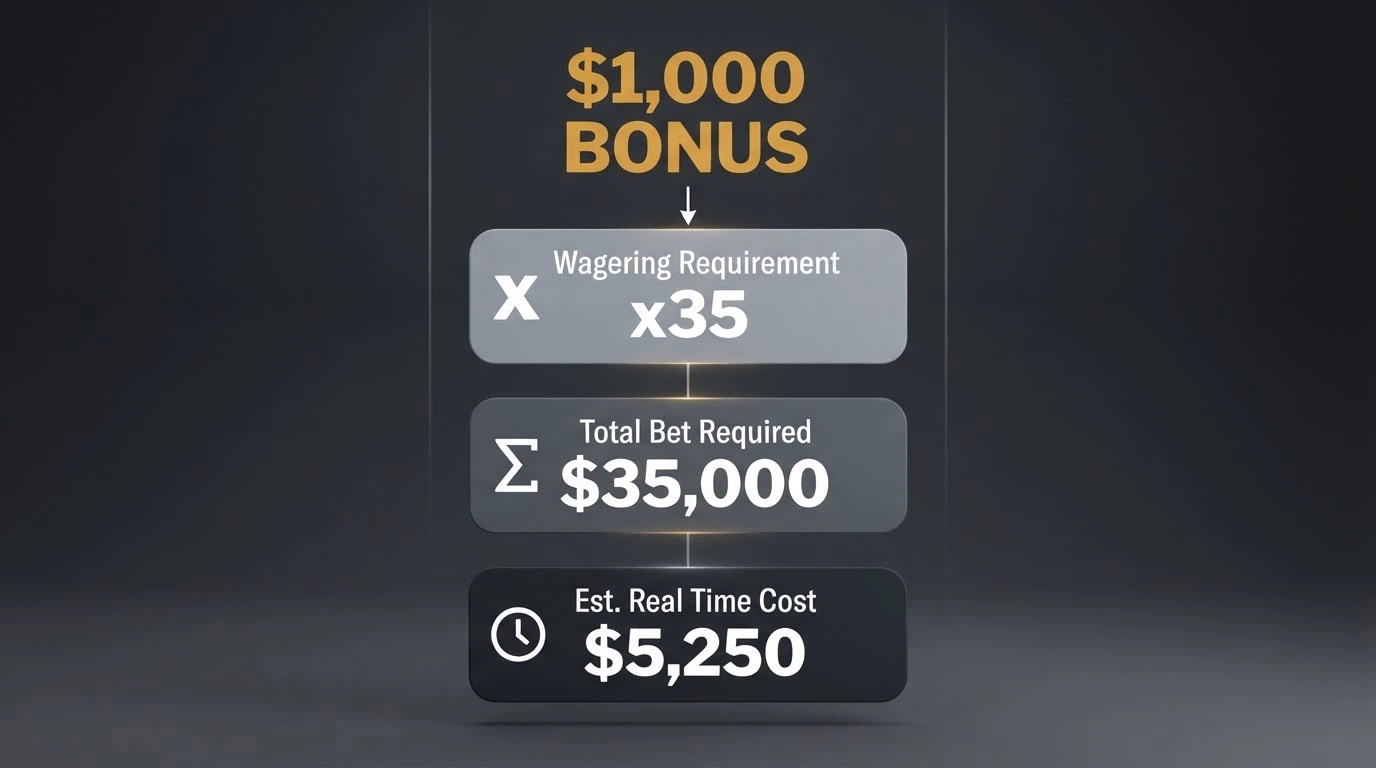
Take Bitstarz’s first-deposit bonus at the AUD floor of A$100 — the cap most Australian crypto depositors actually hit. Apply the 40x wagering factor: A$100 × 40 = A$4,000 in required turnover. At A$1 per spin on Gates of Olympus (RTP 96.50%, Very High volatility, 5,000x max win), that is 4,000 spins, and at five seconds per spin, 20,000 seconds of play, or about 5.6 hours. The seven-day validity absorbs that comfortably — just. The 1 BTC maximum at the BTC cap, at roughly A$100,000 per BTC (illustrative, given BTC’s volatility), comes to 40 BTC of turnover, around A$4 million in stakes, 4,000,000 spins, and 5,555 hours of continuous play. The seven-day validity makes the BTC maximum functionally unattainable; the AUD floor is the figure a realistic player is targeting.
Several featured operators skip the match bonus entirely. Moonbet runs 20–40% rakeback and 4–8% cashback with no welcome match. Anon Casino runs a 5% cashback offer with no welcome, deposit, or reload bonus at all. The argument for skipping the match bonus is that a match bonus carries a wagering requirement by definition; a rakeback or cashback offer does not. The section on wager-free cashback and rakeback walks the comparison.
No-Deposit Bonuses: Free Spins With a Ceiling
A no-deposit bonus costs the player nothing to claim — the casino’s bankroll carries the risk on the spins. Bitstarz’s 30 no-deposit free spins are a free-play entry point with no deposit required. 7BitCasino runs 30 no-deposit spins on Deep Sea (BGaming) with the same no-deposit structure. Both are valuable as a free trial of the operator’s cashier and lobby. Both carry constraints that shrink the real value of any win.
The constraints sit in three places. The maximum win cap is the most visible: 7BitCasino caps no-deposit spin winnings at A$50, which means a feature buy that lands a 1,000x line pays the player A$50, not the headline figure. The validity window is the next constraint: 7BitCasino’s no-deposit spins expire in three days, which is enough for a session or two but not enough for the leisurely pace a real bankroll allows. The maximum bet cap is the third constraint: A$0.15 per spin on the 7BitCasino no-deposit offer is a tight ceiling that limits the player’s flexibility on the spin configuration.
A no-deposit bonus differs from a deposit-match in real terms because the player has not committed any of their own funds. The risk is the casino’s; the win ceiling is the casino’s; the validity window is the casino’s. The player walks away with whatever the casino’s terms say they can walk away with, and the A$50 cap on 7BitCasino’s offer is a more honest framing of the value than the “30 free spins” headline.
Welcome Bonus Packages and Their Wagering Traps
A multi-deposit welcome package multiplies the headline number — and multiplies the turnover the player must grind through. Bitstarz’s four-deposit package runs 100% / 50% / 50% / 100% across deposits, totalling up to 5 BTC plus 180 free spins. 7BitCasino runs a 325% match across four deposits up to 5 BTC plus 250 free spins. Lucky Block runs a single 200% match up to A$10,000 plus 50 free spins. Lucky Anon runs a 420% match plus 175 free spins. The single-deposit structure at Lucky Block is the simplest to evaluate: A$10,000 bonus, 35x wagering, A$350,000 in required turnover, 350,000 spins at A$1 per spin, about 486 hours at five seconds per spin. Doable but tight.
The four-deposit structure at Bitstarz and 7BitCasino spreads the same total across multiple deposits, each with its own wagering requirement. A player who claims the full package is committing to four separate bonus-clearance sessions, each inside its own validity window. The 7-day validity at Bitstarz makes this a sprint; the validity at 7BitCasino on the no-deposit component is 3 days, with the deposit-component terms not surfaced in the research set for this review. A player who treats a four-deposit package as four separate bonuses — each evaluated on its own turnover math — is the player who keeps the package from becoming a trap.
Comparing match percentages across the set, the headline figure and the real cost diverge sharply. A 420% match with a 50x wagering is a worse deal than a 100% match with a 20x wagering, all else equal. The headline calculation on the Bitstarz welcome — A$4,000 in turnover to clear a A$100 bonus at 40x — is the formula to apply to any welcome package. Multiply the bonus by the wagering multiple; that is the turnover. Divide by the stake per spin; that is the spin count. Multiply by the spin interval; that is the play time. The result is whether the validity window can absorb it.
Free Spins at Anonymous Casinos: Wager-Free vs the Rest
A free spin is not a free spin. The difference between wager-free spins and the standard kind is the difference between withdrawable cash and locked-up credit. Jackbit’s 100 wager-free spins on Hot Chilli Bells are the benchmark: winnings from those spins are cash, withdrawable without a multiplier. The wagering requirement on the Jackbit spins is 0x. Bitstarz’s 180 deposit-attached free spins, by contrast, run under the same 40x wagering as the bonus cash — the spin winnings become bonus credit, and that credit must clear the turnover before it converts to cash. 7BitCasino’s no-deposit spins sit in between: no deposit is required, but a A$50 win cap and a 3-day validity substitute for the missing wagering multiple.
The distinction matters at cashout. A player who wins A$200 on Jackbit’s wager-free spins walks away with A$200 in cash, withdrawable, no questions asked. A player who wins A$200 on Bitstarz’s deposit-attached spins has A$200 in bonus credit, which must clear A$8,000 in turnover (A$200 × 40) before any of it becomes cash. The 7-day bonus validity at Bitstarz applies to the spin credit too — the player has a week to grind through the turnover, and any unused credit expires at the end of the week.
Wager-free spins are the honest version of the bonus offer. The casino is paying real cash for the player’s time on a specific pokie, and the player can take the winnings and leave. A wager-free structure is rarer than a wagered one — Jackbit is the standout in the featured set — and it is the part of an offer that pays for itself in player time saved.
Wager-Free Cashback and Rakeback: The Honest Offers
A cashback or rakeback offer carries no wagering requirement because it is not a bonus — it is a rebate on losses. Moonbet’s 20–40% Moonrake rakeback returns a percentage of the player’s wagering volume as cash, and the 4–8% Moonback cashback returns a percentage of net losses as cash. Both are withdrawable without a multiplier. Anon Casino’s 5% cashback offer, in a thinner package with no welcome bonus at all, runs on the same principle: the rebate is real money, paid back to the player on a defined cadence, with no clearing requirement attached.
The cashback-and-rakeback structure compares to a match bonus in two ways. First, the cashback is paid on what the player actually lost, not on what the player deposited — a player who deposits A$1,000, plays through A$10,000, and wins A$8,000 has lost A$2,000, and a 5% cashback on that loss returns A$100. The match bonus, by contrast, pays on the deposit amount and demands the player grind through a multiple of that amount before the bonus becomes cash. Second, the cashback is paid on the player’s losses regardless of the play outcome — a player who wins the session does not get the bonus money back, but the player who loses the session does not have to clear a turnover on what was paid back. The structure favours the player who treats the bonus as a long-term rebate rather than a short-term bankroll extension.
A 5% cashback (Anon Casino) can outvalue a 420% match (Lucky Anon) after wagering. The math: a A$1,000 deposit at 5% cashback returns A$50 on A$1,000 of losses, with no turnover required. A A$1,000 deposit at 420% match returns A$4,200 in bonus credit, but A$4,200 × 50x = A$210,000 in required turnover — the difference between a rebate and a marathon. The wager-free structure is the honest offer; the match bonus is the marketing headline.
The Legal Reality of Offshore Crypto Casinos in Australia
Australia prohibits online casino outright. The Interactive Gambling Act 2001 (IGA), strengthened by the Interactive Gambling Amendment Act 2017, makes it illegal to provide a prohibited interactive gambling service to a person physically in Australia. There is no licence for online casino in any Australian state or territory — not federally, not at the state level, nowhere. Every operator on this page is offshore, unlicensed in Australia, and offering a product the IGA prohibits an Australian player from being offered.

The ACMA — the Australian Communications and Media Authority — is the federal regulator enforcing the prohibition. Since November 2019, the ACMA has directed Australian ISPs to block 1,788 illegal gambling and affiliate websites, and over 230 illegal services have withdrawn from the Australian market since the ACMA started enforcing the new rules in 2017. Q4 2025 alone produced 23 investigations covering 45 sites, 69 breaches of the IGA (38 for providing a prohibited interactive gambling service, 26 for providing an unlicensed regulated interactive gambling service), and 10 formal warnings. The enforcement record is the proof that the prohibition is enforced, not just written.
The player is not the target. The IGA targets the provider of the prohibited service, not the individual player. Using an offshore crypto casino is not, in itself, a criminal offence for the Australian player. What the player gives up is the consumer protection: no Australian complaints body can recover money from an offshore operator, no Australian court has automatic jurisdiction over a Curaçao-licensed brand, and the ACMA cannot order a withdrawal. The site can be blocked at any time, potentially with a balance on it. That is the legal reality the rest of this section unpacks.
The four licence jurisdictions represented in the featured set differ sharply in regulatory maturity, player safeguards, and dispute paths. The table below compares them.
| Licence | Issuing Body | Featured Operators Holding It | Player Safeguard | Dispute Path |
|---|---|---|---|---|
| Curaçao | Curaçao eGaming / Gaming Control Board | Jackbit, Bitstarz, Lucky Block, mBit, 7BitCasino, Ignition | Longest-established in the set; licensing framework dating to the 1990s; limited player recourse | Through Curaçao regulator; no Australian complaints body can assist |
| Anjouan | Anjouan Gaming Authority (Autonomous Island of Anjouan, Union of Comoros) | Moonbet, FortuneJack | Framework revived 2023; lighter regulatory oversight than Curaçao | Through Anjouan authority; limited track record |
| Tobique | Tobique Gaming Commission | Wild Fortune (#0000064, via Metlait SRL) | Newest framework in the set; limited public record | Through Tobique commission |
| Offshore (unspecified) | Not identified in sources reviewed | Lucky Anon | None verified | Unknown |
The Interactive Gambling Act and the Online Casino Prohibition
The IGA 2001 prohibits online casino games, online pokies, and in-play sports betting. The 2017 amendment strengthened the prohibition by clarifying what counts as a “prohibited interactive gambling service” and giving the ACMA the formal blocking authority that has since been used on the 1,788 sites blocked since 2019. There is no carve-out for offshore-licensed operators, no exception for crypto-denominated play, and no grandfather clause for brands that operated before the amendment. The prohibition is binary: providing the prohibited service to a person in Australia is illegal.
What is licensed in Australia is wagering on racing and sport before the event begins, lotteries, and keno, through operators licensed by a state or territory. The Northern Territory Racing and Wagering Commission, administered through Licensing NT, is the de facto national licensor for online wagering, with licence terms running up to 20 years. None of the wagering licence categories covers online casino games; the offshore operators on this page do not hold an Australian licence because the licence category does not exist.
The offshore operator reality is the practical consequence. All ten operators in the featured set are offshore, and none would be eligible for any licence category in Australia even if it applied. The featured set is not a list of “near-licensed” brands waiting for Australian regulation to catch up; it is a list of brands that operate outside Australian law by design.
The ACMA’s Enforcement Record: Blocking, Investigations and Warnings
The ACMA’s enforcement record is the most measurable part of the prohibition. As of August 2026, 1,788 illegal gambling and affiliate websites have been blocked at the ISP level since the first blocking request in November 2019. Over 230 illegal services have withdrawn from the Australian market since the ACMA started enforcing the new rules in 2017 — a figure that includes some of the more visible brands from the early offshore market. Q4 2025 alone produced 23 investigations, 45 sites covered, 69 breaches identified, and 10 formal warnings issued.
The blocking mechanism is technically straightforward. The ACMA directs Australian ISPs to add the operator’s domain to a blocking list, the ISP enforces the list at the DNS level, and the site becomes inaccessible from an Australian IP address without a VPN. The mechanism is imperfect — a player with a VPN or a direct IP can route around the block — but it is the primary enforcement tool, and the cumulative count of 1,788 sites is the visible result. A site that is on the ACMA’s list is, by definition, an offshore operator offering a prohibited service to Australians.
What the enforcement record means for a player holding a balance on a blocked site is structural. The site itself remains operational; the Australian access route is cut. The player can still log in via a VPN, deposit and play, and request a withdrawal, but the player’s recourse if the operator refuses a withdrawal is the operator’s own dispute process — which may or may not exist — or a regulator in Curaçao, Anjouan, or Tobique, none of which has an Australian consumer-protection mandate. The block is the visible sign that the player has no domestic protection.
The 2026 Reform: What Changes for Crypto Casino Players
The Interactive Gambling Amendment (Gambling Reform) Bill 2026 passed Parliament on 19 August 2026, and its measures commence 1 January 2027. The reform changes the advertising and inducement landscape rather than the prohibition itself — online casino remains prohibited — but the changes touch the offshore player directly. From 1 January 2027, no more than three wagering ads per hour will be permitted between 6:00 am and 8:30 pm; no wagering advertising will be permitted from 15 minutes before a live sporting event until 5 minutes after it ends; broadcasting sporting odds will be banned outright; and athletes, celebrities, and influencers will be barred from promoting wagering products.
The inducement marketing restrictions apply to licensed Australian operators but shape the offshore market too. From 1 January 2027, direct marketing of inducements is prohibited for 14 days after a customer signs up, for 3 months after a customer deregisters from BetStop, and indefinitely for customers identified as at risk of gambling-related harm. The offshore casinos on this page are not directly bound by the inducement restrictions — they do not hold Australian licences — but the Australian advertising environment they market into will be tighter.
The most consequential change for the offshore crypto casino player is the bank and payment-provider blocking authority. From 1 January 2027, banks and payment providers gain express authority to block transactions to illegal gambling operators. A deposit from an Australian bank account to an offshore crypto casino may be declined at the bank level, with no recourse for the customer. The fiat on-ramp from a bank to a crypto exchange is one layer removed from this — the bank sees a transfer to an exchange, not to a casino — but the exchange-to-casino leg still moves wallet to wallet, and the bank does not see it. The change matters most for players who use bank cards to buy crypto and then deposit at an offshore casino; the bank may block the card transaction at the buy step, which is the practical friction point.
The Crypto Payment Ban: What the June 2024 Prohibition Actually Means
Since 11 June 2024, it has been illegal for a gambling operator to accept a credit card, a credit-related product, or a digital currency (crypto) as payment for online wagering from an Australian player. The prohibition sits in the Interactive Gambling Amendment (Credit and Other Measures) Act 2023, and an operator that fails to enforce the ban faces penalties of up to A$247,500. The payment method itself is the tell: an Australian who is asked for a credit card or a crypto deposit by a gambling site is being served by someone outside the Australian rules.
What the ban means for the player is operator liability, not player prosecution. The IGA targets the provider, not the customer, and the credit-and-crypto prohibition is enforced against the operator. The Australian player who deposits crypto at an offshore casino is not committing an offence. What the player is doing is using a payment rail the Australian regulator has explicitly told offshore operators not to accept — and the offshore operator is the entity that takes the regulatory risk, not the player.
The practical effect is that every crypto deposit at every operator on this page is, by definition, an offshore transaction. The Australian regulator has flagged the payment method as a marker of unlicensed play, and the offshore operators continue to accept crypto deposits because the offshore jurisdiction’s regulator has not prohibited them. The framing applies throughout this page: the payment method is itself a tell that the operator is outside Australian rules.
What You Risk When There Is No BetStop at the Table
BetStop — the National Self-Exclusion Register — went live on 21 August 2023. As of March 2026, 59,830 Australians have registered to self-exclude from all licensed online and phone wagering providers, and 37,247 of those registrations are currently active. The register binds roughly 150 licensed wagering providers, with self-exclusion periods ranging from a minimum of 3 months to a lifetime. BetStop is the closest thing Australia has to a hard self-exclusion mechanism, and it is the mechanism that nearly 60,000 people have chosen to use.

BetStop does not reach offshore crypto casinos. An offshore casino is not licensed in Australia, is not connected to the register, and will continue accepting a self-excluded person’s money without any flag. The offshore gap is the structural limit on what BetStop can do for an Australian player who has decided to stop gambling: the register covers the licensed wagering market, and the offshore casino market is outside the register’s jurisdiction. A self-excluded player who lands on an anonymous casino has no barrier to play, no cooling-off enforcement, and no regulator to complain to if the operator accepts a deposit the player did not intend to make.
The Australian context matters here. As of March 2026, 13.0% of the Australian population — an estimated 2,857,000 people — were experiencing some form of gambling harm from their own gambling behaviours, and a further 5.4% (1,177,000 people) were experiencing harm from someone else’s gambling. The PGSI rate of problem gambling rose to 2.9% in 2024–25, with 622,000 Australians now classified as problem gamblers. The total losses between March 2025 and March 2026 came to A$36.0 billion. These are the population-scale numbers that make BetStop necessary — and the offshore gap is the limit on what BetStop can do.
BetStop’s Offshore Gap: Why Self-Exclusion Stops at the Border
BetStop covers approximately 150 licensed wagering providers in Australia. The register works by requiring each licensed provider to check the BetStop database before opening a new account, declining the application if the applicant’s name appears on the active exclusion list, and closing any existing account held by the applicant. The mechanism is enforced by the ACMA and integrated into the standard KYC process at every Australian-licensed operator.
The mechanism does not extend to offshore casinos because offshore casinos are not part of the system. An offshore operator does not check BetStop, does not have access to the BetStop database, and has no obligation to refuse a self-excluded Australian player. The player can deposit, play, and withdraw at Jackbit, Bitstarz, Lucky Block, or any other operator on this page even while their BetStop registration is active. The offshore gap is not a feature — it is the structural limit on what an Australian self-exclusion can achieve.
A self-excluded player at an offshore casino faces the same friction as any other player at the cashier, which is to say none. There is no cooling-off period enforced by the operator, no deposit-limit reset, no activity-statement review, no regulator-mandated intervention. The only thing that stops a self-excluded player at an offshore casino is the player’s own decision to stop. That is the limit on what BetStop can offer the offshore player, and it is the reason the help-services section matters.
Responsible-Gambling Tools at Anonymous Casinos: What They Actually Offer
Most anonymous casinos offer a baseline of responsible-gambling tools — deposit limits, session limits, self-exclusion at the operator level — but the enforcement relies on the operator’s own implementation rather than a regulator’s audit. A licensed Australian operator’s deposit limits are auditable, the activity statements are reportable, and the regulator can check the operator’s compliance. An offshore operator’s deposit limits are the operator’s own commitment, and the regulator that audits the operator is the offshore regulator, not the ACMA.
The practical tools a player can typically find at a no-KYC casino include deposit limits (daily, weekly, monthly), session-time reminders, self-exclusion at the operator level (typically 6 months to 5 years), and account closure on request. The implementation varies. Some operators enforce the deposit limit at the cashier in real time; others enforce it as a 24-hour rolling total. Self-exclusion at the operator level is the strongest tool, but it requires the player to commit to it through the operator’s own process, and the offshore operator has no obligation to flag a player who has self-excluded from a competing brand.
The Australian licensed-operator tools that are missing from the offshore set include BetStop integration, ACMA oversight, complaints body access, and the broader National Consumer Protection Framework. The offshore player trades these for the lighter KYC and the crypto rails. The trade-off is the player’s own to make, with the help-services section the right place to start if the trade-off is starting to feel wrong.
Where to Get Help in Australia
The Australian help services that answer the phone are free, confidential, and staffed 24/7. The National Gambling Helpline — 1800 858 858 — runs around the clock, with online chat and email counselling available through Gambling Help Online. Gambler’s Help is the Victorian-specific service; the national framework routes most callers to the helpline or the online service. BetStop itself is not a counselling service but a self-exclusion register, and the ACMA’s BetStop page is the entry point for a player who wants to register.
The numbers behind the help lines tell the scale of the problem. 13.0% of Australians — 2,857,000 people — were experiencing gambling harm from their own gambling as of March 2026. 15.1% of Australians — 3,320,000 people — were experiencing some form of gambling harm, including from someone else’s gambling. The PGSI rate of problem gambling has climbed from 1.9% in 2022–23 to 2.9% in 2024–25. Between March 2025 and March 2026, Australian gambling losses totalled A$36.0 billion. These are not abstract figures; they are the reason the help lines exist, and they are the reason an anonymous crypto casino review takes a help-services section seriously.
If gambling has stopped feeling like a choice, the right next step is the National Gambling Helpline at 1800 858 858. The call is free, confidential, and the line is staffed 24/7. The online chat through Gambling Help Online is the alternative for players who prefer text. BetStop, the National Self-Exclusion Register, is the right next step for a player who has decided to stop and wants the licensed Australian wagering market closed to them — with the offshore gap noted earlier as a limit on what BetStop can do.
How We Evaluated Every Anonymous Crypto Casino on This Page
This ranking was built from operator-level research, tested payout data from independent reviews, and a cross-check against the ACMA’s enforcement record. No operator paid for placement, and no operator’s position in the ranking was negotiated. The data behind the ranking comes from the affiliate-review market — the same sources a player reading “best anonymous crypto casino” would find on a search results page — cross-referenced against the licence registers where the registers publish operator-level data.
The operator set was built around ten brands: Jackbit, Bitstarz, Lucky Block, Wild Fortune, Moonbet, mBit, 7BitCasino, FortuneJack, Lucky Anon, and Ignition. Each operator was checked against the ACMA’s blocked-site list (none of the ten is currently on the list, though the list is updated continuously and the absence of a current block is not a permanent status), against the Curaçao eGaming register where the licence was Curaçao-issued, against the Anjouan Gaming Authority register for the two Anjouan-licensed brands, and against the Tobique Gaming Commission register for the one Tobique-licensed brand. The Wild Fortune licence number (#0000064) was confirmed through a review source rather than through the register itself; the register was not fetched for this review.
The ranking criteria were applied qualitatively. Anonymity depth was the primary criterion: Jackbit, Bitstarz, and Moonbet (under the A$2,000 threshold) carry the lightest-touch KYC models in the set; Lucky Block is next; the rest fall into the threshold-KYC tier. Game-library breadth was the secondary criterion: Jackbit’s 7,000-plus, Bitstarz’s 7,500-plus, 7BitCasino’s 9,000-plus, and Moonbet’s 10,000-plus sorted the operators at the same anonymity tier. Payout speed was the third criterion: Bitstarz’s 9-minute-42-second average, Moonbet’s 4-minute benchmark, Jackbit’s under-10-minute wallet payouts, and Wild Fortune’s 5-hour-24-minute tested average separated the operators whose crypto rails were actually fast from the operators whose marketing pages claimed they were. No formal weighting was applied, and the ranking reflects the editor’s judgement rather than a scored formula.
What was excluded matters as much as what was included. Anon Casino’s 5% cashback offer with no welcome package and no game-provider or licence detail was excluded as too thin to rank. Operators requiring full KYC on signup were excluded by definition. Operators that did not accept Australian players or did not accept crypto were excluded. The featured set is the ten operators that survived all three filters.
Your Move: What to Check Before You Deposit at an Anonymous Crypto Casino
The ten operators on this page all skip identity checks in some form, but the differences between them are the difference between a clean cashout and a locked balance. Four checks the page’s own figures say you should run before you deposit.

The anonymity-depth check asks whether the operator triggers KYC at a withdrawal threshold you will cross. Jackbit reserves verification for fraud and AML flags, Bitstarz is zero-KYC for crypto users, and Moonbet’s threshold is A$2,000 in cumulative volume. Wild Fortune’s threshold was not surfaced in the research set; the absence of a published number is information in itself. A player who plans to withdraw A$5,000 should look for an operator that has explicitly stated how it handles that volume, not an operator whose terms page reserves the right to verify “at any time”.
The bonus-terms check asks whether the wagering multiple, the validity window, and the player’s play frequency can deliver the turnover inside the deadline. A 40x wagering on a A$100 bonus with a 7-day validity is a sprint, not a marathon. A 420% match with unconfirmed wagering is a question mark, not an offer. The bonus section walks the arithmetic; the calculation on Bitstarz’s A$100 first-deposit bonus — A$4,000 turnover, 4,000 spins, 5.6 hours — is the kind of math to apply to any welcome package before claiming it.
The licence check asks what the jurisdiction gives you if something goes wrong. Curaçao is the most established of the four jurisdictions in the featured set; Anjouan is the newest and the lightest; Tobique is newer still; Lucky Anon’s jurisdiction was not specified in the sources reviewed for this article, and the licence check is the one a player must run before depositing there. The offshore licence jurisdictions table in the legal section covers the comparison.
The payment check asks which coins the operator accepts, what the minimum deposit is, and what the daily withdrawal cap looks like. Wild Fortune caps daily withdrawals at USD$4,000 — a ceiling that bites a high-volume player. Jackbit accepts Monero natively — a privacy property the other operators do not. Bitstarz accepts the standard crypto roster. The payment check is the last filter before a deposit.
The verdict, argued from the figures the page already carries. For the player who values the lightest-touch anonymity above game-library breadth, Jackbit sits at the top, with Bitstarz as the runner-up. For the player who wants the broadest library and is comfortable with Curaçao terms, 7BitCasino or Bitstarz. For the player who wants a rakeback structure rather than a welcome match, Moonbet. For the player who plays both casino and poker, Ignition. For the player who treats verified payout data as the primary signal, Wild Fortune. For the player who wants the deepest privacy through Monero, Jackbit again.
The practical advice the page’s own data supports: pick the operator whose profile fits the session you are planning to run, verify the bonus terms on the operator’s own terms page before claiming, run a small test withdrawal before committing volume, and keep the help-services section in mind if the session stops feeling like a choice. The offshore market offers more anonymity than the licensed Australian market — and the trade-off is the consumer protection that comes with a licence. The page describes what each operator offers; the choice is yours.
Frequently Asked Questions
What does “no KYC” actually mean at a crypto casino — will I ever need to verify my identity?
No KYC means the casino does not ask for ID for routine deposits, play, or withdrawals. The promise holds for a normal session but not indefinitely — AML policies at Curaçao- and Anjouan-licensed operators typically trigger verification at EUR 2,000–10,000 in cumulative withdrawals. Jackbit, Bitstarz, and Moonbet (under A$2,000) carry the lightest-touch models in the featured set.
Can Australian banks block payments to offshore crypto casinos?
From 1 January 2027, banks gain express authority to block transactions to illegal gambling operators under the 2026 reform. Crypto deposits move wallet to wallet without a bank in the loop, so the block bites at the fiat-to-crypto on-ramp: a bank may decline a card purchase of crypto on an exchange, but does not see the wallet-to-wallet leg from exchange to casino.
How fast are crypto withdrawals at no-KYC casinos compared to traditional online casinos?
Crypto withdrawals at no-KYC casinos clear in minutes. Bitstarz averages 9 minutes 42 seconds; Moonbet about 4 minutes; Jackbit under 10 minutes; Wild Fortune averages 5 hours 24 minutes. A bank transfer from a licensed online casino takes 3 to 5 business days. The fastest crypto operator in the set is roughly 80 times faster than a typical bank transfer.
What is the difference between Curaçao, Anjouan, and Tobique casino licences?
Curaçao is the longest-established licence jurisdiction in the set, with regulatory oversight dating to the 1990s and a developed — though limited — dispute path through the Curaçao eGaming authority. Anjouan is newest, revived in 2023, lighter on oversight. Tobique is newer still. None provides Australian consumer protection; disputes run through the offshore regulator.
Can I use a VPN to access anonymous crypto casinos from Australia?
Yes, the offshore operators on this page are accessible from Australia through a VPN. The IGA targets the operator, not the player, and using a VPN is not a criminal offence. The ACMA’s site-blocking operates at the ISP level and is bypassed by a VPN or direct IP. Practical limits remain the same.
Do I have to pay tax on crypto casino winnings in Australia?
No. Gambling winnings are not assessable income under section 6-5 of the ITAA 1997 for a recreational punter, and gambling losses are not deductible under section 8-1. No Australian case has held an ordinary punter’s winnings assessable. ATO treatment of crypto as a CGT asset does not change this for recreational play.
Written by the editors at Live Casino Australia.