Offshore Crypto Casinos and What the Experience Costs an Australian Player
 Available in AU
Every crypto casino that takes an Australian player is doing so from outside Australia. There is no licensed online casino to compare one against, no Australian complaints body to call when a withdrawal stalls, and no BetStop registration that reaches the account. The Interactive Gambling Act 2001 prohibits the provision of online casino games to anyone in Australia; Section 8AA targets the operator, not the player, and no Australian resident has faced prosecution for using an offshore betting site. That distinction is the ground the entire offshore crypto casino market in Australia stands on, and it shapes everything on this page.
What follows is a ranked look at the ten offshore crypto casinos that carry the most Australian traffic, a breakdown of how the deposit and withdrawal chains actually work when an Australian bank sits on one end and an offshore operator on the other, and an honest read of the bonus numbers after the wagering and game-contribution maths has run. The page carries the protections an Australian player gives up by going offshore and the friction the banking system adds on the way in and out. This is not a “join this one” page. It is the page that decides whether the offer is worth the trade.
Data current as of 18 October 2026, verified against the ACMA register, AUSTRAC reporting rules and ATO guidance for gambling winnings.
Table of Contents
- What a Crypto Casino Actually Means for Australian Players
- Anonymity, KYC and the “No Verification” Promise at Offshore Casinos
- The 10 Offshore Crypto Casinos Australians Are Playing At — Ranked and Compared
- Crypto Casino Bonuses — Why the Headline Figure Rarely Adds Up
- Pokies and Slots at Crypto Casinos — What Australians Are Actually Spinning
- How We Evaluated and Ordered These Operators
- What Australia’s Offshore Casino Reality Means for Your Next Deposit
- Frequently Asked Questions
What a Crypto Casino Actually Means for Australian Players
A crypto casino is an online casino that takes deposits and pays withdrawals in cryptocurrency rather than in fiat currency. To an Australian player, the relevant model is almost always an offshore operator licensed in Curaçao, Anjouan or another permissive jurisdiction, running thousands of games, advertising in Bitcoin, Ethereum or Tether, and carrying no Australian licence at all because none exists. Land-based casinos in Australia are state-licensed; the online equivalent is prohibited. The product an Australian crypto casino player is buying is, by definition, unlicensed in their country.
How a crypto casino differs from a licensed Australian wagering site
The first difference is the product range. A licensed Australian wagering account (TAB, Sportsbet, bet365 AU, Ladbrokes) sells sports and racing bets placed before an event starts. Online casino games, online pokies and in-play betting are prohibited. A crypto casino account sells exactly those prohibited products: pokies, table games, live dealer tables, jackpots. The legal wall between the two is not a marketing preference; it is the Interactive Gambling Act 2001.
The second difference is the payment menu. Since 11 June 2024, credit cards, credit-related products and digital currency have been banned as payment for online wagering by licensed operators; an operator that fails to enforce the ban faces penalties of up to A$247,500. Crypto deposits are the payment route of the offshore market precisely because licensed Australian operators cannot accept them. The ban is, in effect, a tax on the licensed side and a funnel to the offshore one.
The third difference is the protection layer. A licensed Australian wagering account sits inside BetStop, has a state-based complaints pathway, is subject to customer-set deposit limits under each state regime, and is supervised by a regulator that can compel action. None of that wraps an offshore casino account. The IGA targets the provider, not the player, and that legal fact is the reason an Australian player can sign up, deposit, and play without committing an offence. It is also the reason the operator has no obligation to behave well once the player has done so.
Why the offshore model is the only one available to Australian players
The IGA makes it an offence to provide online casino games to a person physically in Australia. There is no licence category for it; no state or territory issues one. The Northern Territory Racing and Wagering Commission, which is the de facto national licensor for online wagering, can issue a licence only for the products the IGA permits. Online casino is not one of them. Every crypto casino on this page, and every crypto casino an Australian can find through a search engine, is operating outside that regime.
The Australian Communications and Media Authority enforces the prohibition. As at March 2026, ACMA has had 1,564 illegal gambling and affiliate websites blocked by Australian ISPs since its first blocking request in November 2019. More than 225 illegal services have withdrawn from the Australian market since enforcement was strengthened in 2017. The Interactive Gambling Amendment (Gambling Reform) Bill 2026 passed Parliament on 19 August 2026, with its measures commencing 1 January 2027; from that date, banks and payment providers gain express authority to block transactions to illegal gambling operators. The pressure on the offshore end of the market is increasing, not easing.
None of that pressure has been brought to bear on individual players. The IGA targets the operator, and no Australian has been prosecuted for placing a bet at an offshore online casino. The legal reality, in two sentences, is that the casino is breaking Australian law by offering the product and the player is not breaking Australian law by using it. The legal reality, in the next sentence, is that the player is also without any Australian recourse if the operator refuses to pay out.
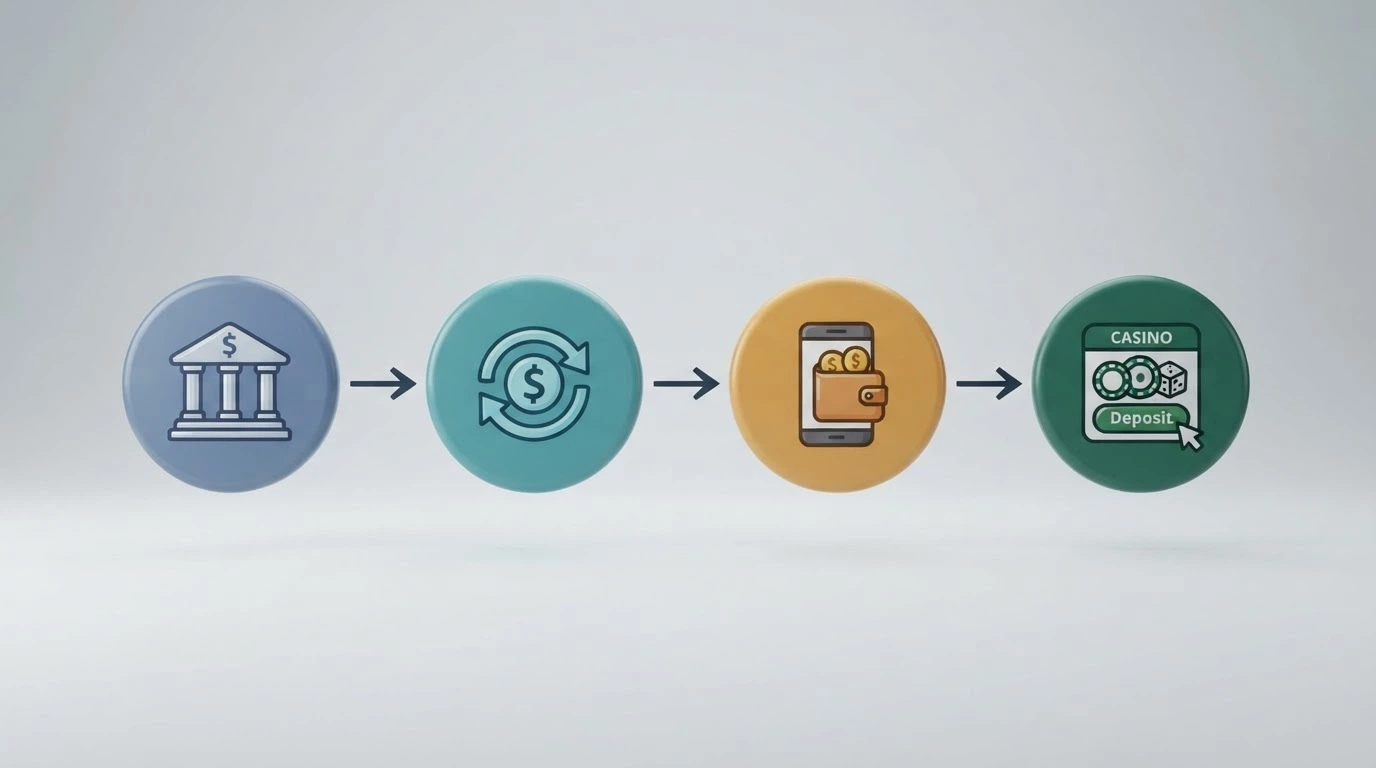
The crypto deposit chain — from AU bank to casino balance
- AU bank → exchange. CommBank and Westpac silently restrict outbound transfers to crypto exchanges. ANZ and NAB flag transactions without fully blocking them. ING and Macquarie are the most permissive of the major retail banks. AUSTRAC requires all Australian-registered digital currency exchanges to verify customer identity; the A$10,000 Travel Rule threshold is the line above which exchanges must report.
- Exchange → personal wallet. CoinSpot and Independent Reserve are the most common Australian entry points. Identity verification happens here, before any crypto is bought. Once verified, the exchange holds AUD and converts to the chosen coin at the spot rate.
- Personal wallet → casino. USDT on the TRC-20 network is the cleanest route: fees run under 50 cents and confirmations land in under 60 seconds. Bitcoin on the main network is slower and costlier; Ethereum mainnet is faster but more expensive; TRC-20 wins on both counts. The player sends from a self-custody wallet (not from the exchange directly) so the casino receives funds from a wallet address, not an exchange hot wallet.
- Casino → gameplay. The casino credits the deposit after the required number of network confirmations. A TRC-20 transfer clears in a few minutes; a BTC transfer can take 30 minutes to an hour depending on mempool conditions.
The cleanest route, according to PayoutVerdict’s 2026 deposit testing, runs: AU bank → CoinSpot or Independent Reserve → USDT TRC-20 → offshore casino → reverse the chain to cash out. The reverse chain is where most of the friction lives.
Getting your money out — withdrawals, bank friction and the AUD cycle
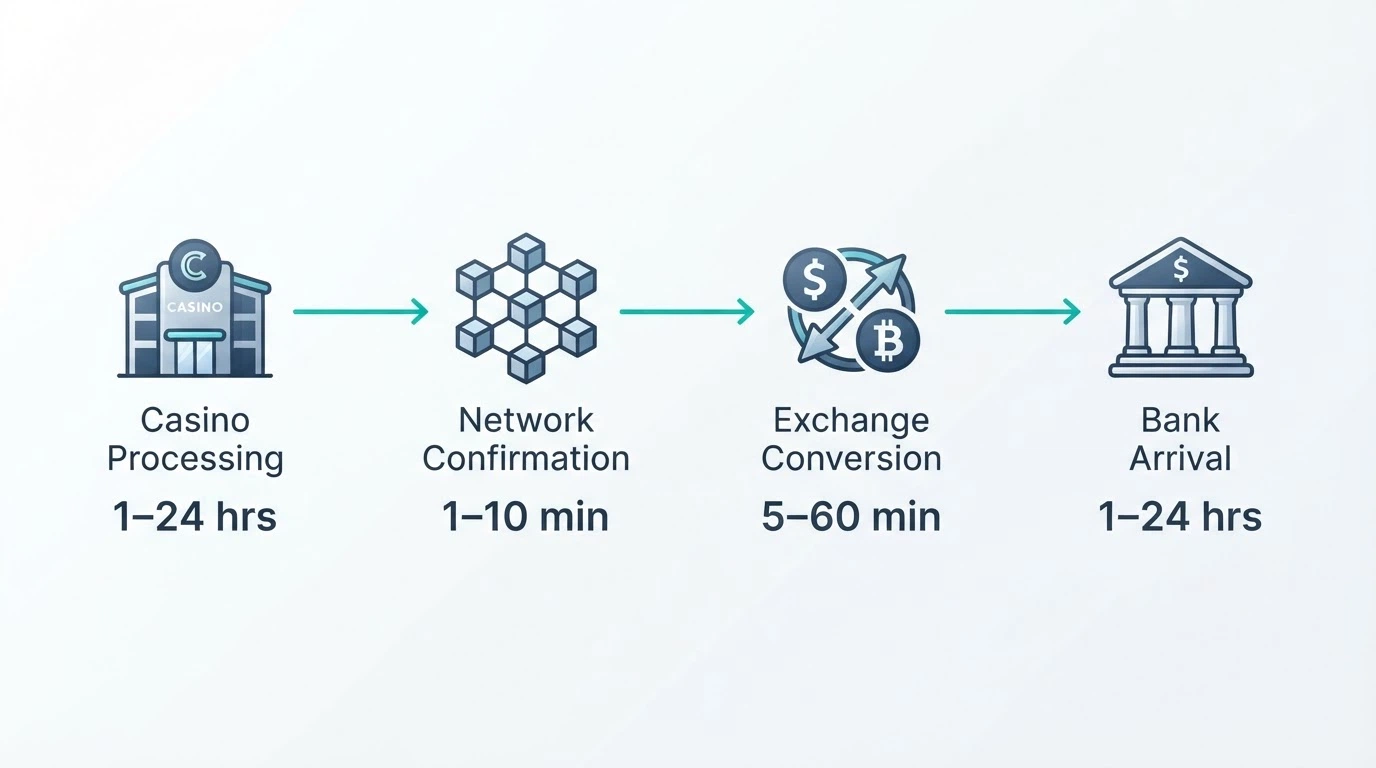
The full crypto withdrawal-to-AUD cycle, from requesting a casino withdrawal to having Australian dollars in a bank account, takes 30 minutes to 24 hours depending on the crypto used and the exchange’s processing time. Tested crypto withdrawals at Wild Fortune Casino averaged 5 hours 24 minutes across five test cycles between February and May 2026, ranging from 3 hours 50 minutes to 7 hours 58 minutes. That figure includes the casino’s processing time, network confirmation, the exchange’s conversion window, and the bank’s acceptance of the inbound transfer.
The reverse chain is not friction-free. Australian banks apply transaction monitoring to inbound transfers from crypto exchanges, and some flag or hold deposits that originate from a digital currency exchange. A transfer that took 10 minutes to initiate can take 24 hours to clear the bank’s review queue. The bank side is the slowest leg, not the network side. USDT on TRC-20 moves faster than a bank’s compliance team, every time.
Responsible gambling tools you lose when you play offshore
- BetStop. The National Self-Exclusion Register launched on 21 August 2023. As at 31 March 2026 it has 59,830 registrations, of which 37,247 people have active exclusions. One BetStop registration excludes a person from every Australian-licensed online and phone wagering service. It binds approximately 150 licensed providers. An offshore casino is not connected to the register. The exclusion is invisible to it.
- National Gambling Helpline. 1800 858 858 — free, confidential, staffed 24 hours a day, 7 days a week. Counselling is also available through Gambling Help Online. The helpline and the website serve every Australian, whether they play at licensed operators or offshore. The tools downstream of a helpline call (account closure, deposit limits, marketing suppression) are not available to an offshore player.
- Harm prevalence. About 2.1% of Australian adults (roughly 430,000 people) experience problem gambling; the Australian Institute of Health and Welfare put high-risk gambling at 1.8% in 2022. 78% of BetStop registrants were under 40 and 38% chose lifetime exclusion. 53% of registrants were using other support options while on the register, most commonly family and friends, gambling help websites, psychologists and counsellors. The fact that offshore play sits outside BetStop does not remove the people who need it; it removes the only mechanism that catches them automatically.
The 2026 reform does not close the offshore gap. It tightens the licensed side: from 1 January 2027, direct marketing of inducements is prohibited for 14 days after a customer signs up, for three months after a person deregisters from BetStop, and indefinitely for customers identified as at risk of gambling-related harm. None of that reaches an offshore casino.
Anonymity, KYC and the “No Verification” Promise at Offshore Casinos
“No KYC” is the second-most-common phrase in offshore crypto casino marketing, after “instant withdrawal.” Both phrases describe a process that exists, and neither describes the experience an Australian player actually has. KYC is deferred, not waived. The withdrawal speed is real, until the casino asks for documents. And the Australian end of the chain has always required identification.
What “no KYC” actually means at offshore crypto casinos
Crypto deposits at licensed offshore casinos do not skip KYC. Curaçao-licensed brands verify identity before the first withdrawal, to comply with anti-money laundering rules. Anjouan-licensed operators carry similar obligations under their own compliance frameworks. “No KYC” in the marketing sense means the casino will not ask for documents before you deposit, and will not ask again until a threshold is crossed. The threshold is the entire point: it is the dollar figure at which the casino decides the risk profile of the account has changed and the documents become mandatory.
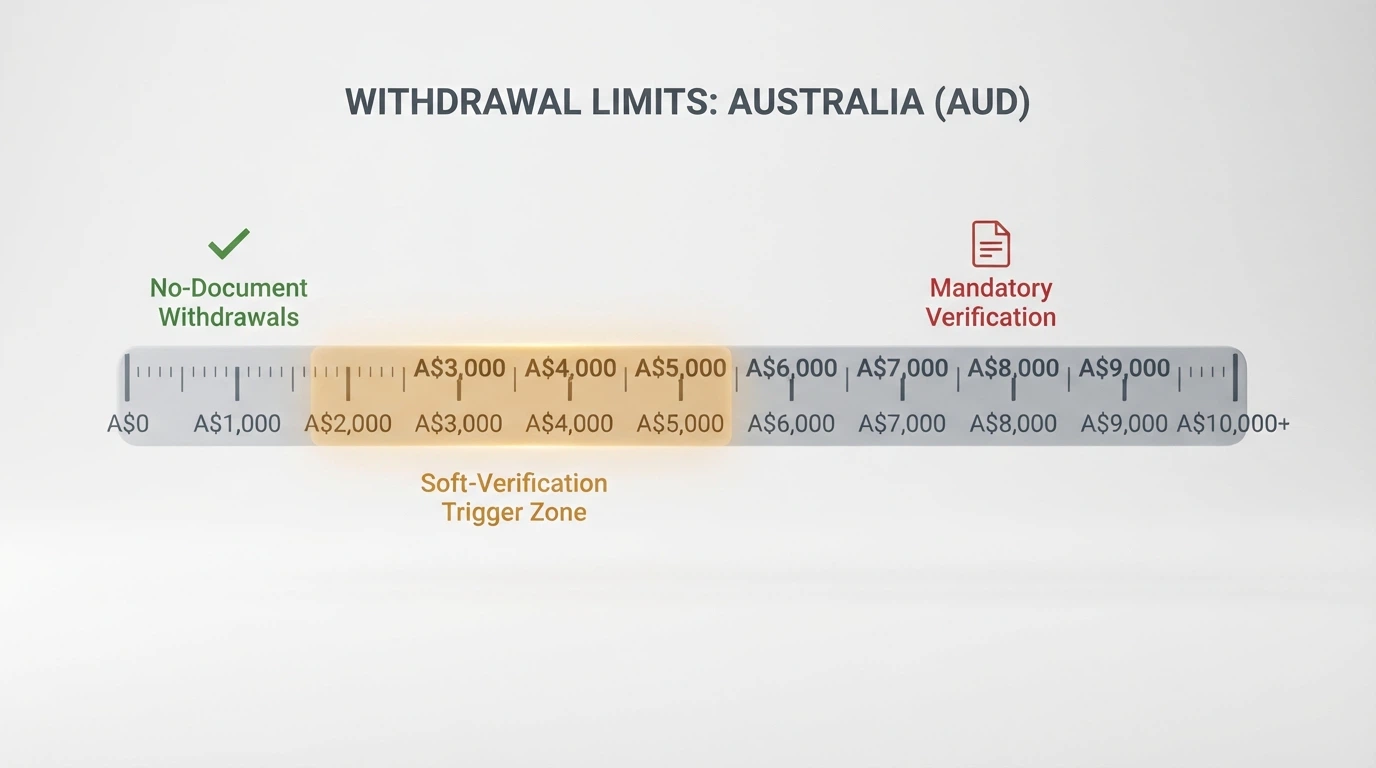
The “no KYC” label also describes a casino policy that sits downstream of an Australian policy. AUSTRAC requires all Australian-registered digital currency exchanges to verify customer identity as a condition of registration. The Australian entry point of the chain is never anonymous. A player who buys Bitcoin on CoinSpot has already provided a driver’s licence, a proof of address, and a selfie before the deposit is even possible. The casino’s “no KYC” promise covers the casino’s leg, not the exchange’s leg, and an Australian player cannot reach a crypto casino without crossing an exchange that has already ID’d them.
The soft-verification trigger — when documents become unavoidable
The typical soft-verification trigger at offshore crypto casinos is A$2,000–A$5,000 in cumulative lifetime withdrawals. Below that band, withdrawals process without documents. Above it, the casino sends a verification request. A$2,200 is the most common industry pattern. AML policies at Curaçao- and Anjouan-licensed casinos typically set a review trigger at EUR 2,000–10,000 in cumulative withdrawals or deposits.
The trigger is per-account, not per-transaction. A player who withdraws A$800 four times in a row may still be asked for documents on the fifth, because the cumulative total has crossed the band. The trigger is also subject to discretionary review: a single large withdrawal below the band can trigger verification if it is unusual for the account’s history. The pattern is well known across the offshore market and is one of the more common points at which an Australian player’s experience diverges from the marketing pitch.
Once verification is requested, the standard documents are government photo ID, proof of address, and proof of ownership of the payment method (a screenshot of a crypto wallet showing the deposit address, or a bank statement showing the AUD purchase on the exchange). The casino’s review window is typically 24 to 72 hours. Some operators are faster; some take longer; none of them guarantee the documents will not be requested twice. Genuine zero-verification casinos are essentially impossible in today’s regulatory environment, because even offshore operators must comply with international anti-money-laundering and counter-terrorism-financing standards.
Why full anonymity is impossible with Australian banking
The Australian end of the chain is the immovable part. AUSTRAC’s Travel Rule reporting threshold is A$10,000, and Australian crypto exchanges require identity verification as a condition of their digital currency exchange registration. The verification is not optional. CoinSpot and Independent Reserve both ID their customers on signup, and the ID is tied to the bank account that funded the purchase. A bank statement for an Australian who buys USDT shows the exchange, the amount, and the date.
The banking side adds another layer. CommBank and Westpac silently restrict outbound transfers to crypto exchanges. ANZ and NAB flag without fully blocking. The flag itself is a record, even if the transfer goes through. The bank that an Australian uses every day is also the bank that monitors their crypto exchange transfers. The “no KYC” label on a casino landing page describes the casino, not the chain. The chain is the part an Australian player cannot change.
The 10 Offshore Crypto Casinos Australians Are Playing At — Ranked and Compared
The ten operators below are ordered by their relevance to the Australian crypto casino market, a mix of crypto acceptance, Australian traffic, and bonus prominence. Every one is offshore and unlicensed in Australia, because no Australian online casino licence exists. The numbers come from published offers and the operators’ own terms; the gaps are the parts of those offers the public listing does not confirm.
| Operator | Licence / Status | Welcome Bonus (AUD) | Wagering | Free Spins | Crypto Bonus |
|---|---|---|---|---|---|
| SkyCrown | Offshore (Curaçao reported) | Up to A$8,000 + 400 FS across four deposits | 40x bonus and FS winnings | 400 | No — crypto deposits excluded |
| RocketPlay | Offshore (Dama N.V.) | Up to A$2,000 + 100 FS across two deposits | 40x | 100 | Accepted; no separate crypto bonus |
| Stake | Offshore; 1.28% AU market share | Not confirmed this run | — | — | — |
| Bizzo Casino | Offshore | Up to A$7,250 + 175 FS + 1 bonus game across four deposits | 40x; 14-day validity | 175 | Yes — 200% up to A$800 on first crypto deposit |
| WinSpirit | Offshore (Curaçao); 1.55% AU market share | Up to 300% (AUD amount not confirmed) | 40x | 100 | Accepts BTC, ETH, USDT, LTC; 35 FS no-deposit on registration |
| Royal Reels | Offshore; 2.51% AU market share, A$243.99M revenue | Not confirmed this run | 30×–40× | Part of no-deposit offer | Not confirmed |
| Rainbet | Offshore (Anjouan ALSI-152406029-FI2); 1.28% AU market share | 250% up to A$2,100 + 60 FS across three deposits | 40x (Wager Lock) or No Wager Lock | 60 | Instant crypto payouts across 25+ coins |
| BitStarz | Offshore | Multi-deposit welcome (AUD$5,300 + 620 FS per one source) | 40x | 620 across package; 50 FS no-deposit | Accepts AUD and crypto |
| FairGO | Offshore; 0.80% AU market share | Not confirmed this run | — | — | — |
| Scream Casino | Offshore; 0.99% AU market share | Not confirmed this run | — | — | — |
SkyCrown — The Biggest Library, But Crypto Deposits Miss the Bonus
SkyCrown’s headline offer is up to A$8,000 plus 400 free spins across four deposits, with 40x wagering on both the bonus and the free-spin winnings. The library is one of the largest available to Australian players: more than 7,200 games, spanning slots, table games, and a live casino. Pokies contribute 100% toward the wagering requirement at SkyCrown; table games contribute a fraction and live casino games typically contribute nothing, which is the standard weighting for the offshore market.

The catch is in the terms. SkyCrown limits most bonuses to fiat deposits. Crypto deposits do not qualify for any bonus. An Australian depositing USDT sees the same 7,200+ games but no welcome package, no free spins, and no 40x to clear. The headline figure is the fiat figure, and the crypto player reads past it to nothing.
For an Australian crypto player who treats the bonus as secondary and the library as primary, SkyCrown still earns its slot. For anyone who joined to claim the A$8,000, the offer is closed before the first deposit.
RocketPlay — Solid Provider Range, But Transparency Gaps
RocketPlay’s welcome package runs to A$2,000 plus 100 free spins across two deposits, with 40x wagering on the bonus. The provider list is unusually deep for an offshore operator: 82 software providers including NetEnt, Evolution Gaming and Pragmatic Play. The library spans slots, jackpots, live dealer tables, and a sportsbook.
The transparency gaps are where RocketPlay loses ground. The operator does not publish RTP rates and has no live chat support, a combination reviewers have flagged as a red flag. No published RTP means an Australian player cannot check the theoretical return of any game on the platform; no live chat means a withdrawal question or a verification question waits on email. Both gaps are fixable. Both are also signals about how much the operator values the kind of player who would ask.
For a player who values the provider range and accepts that the operator does not publish its numbers, RocketPlay fits. Any player who reads game RTPs before they spin may find the lack of published figures a significant obstacle.
Stake — The Crypto Giant With Sparse AU-Specific Detail
Stake is one of the highest-profile crypto casinos in the world and holds 1.28% of the Australian market by traffic. The platform runs proprietary Stake Originals alongside major third-party providers, supports a wide range of cryptocurrencies, and is known for its sportsbook and live betting integration. The public profile is large; the AU-specific bonus detail is thin.
Stake’s bonus terms for Australian players were not confirmed in this research cycle. The operator runs regular promotions, but the headline welcome offer that applies to a new Australian sign-up could not be verified from the public sources swept here. For an Australian player considering Stake, the absence of a confirmed welcome offer is itself information: there is no published AUD figure to weigh against the rest of the market, and the comparison table is shorter because of it. The platform’s reputation and its AU traffic stand on their own; the comparison numbers do not.
Bizzo Casino — One of the Few With a Crypto-Specific Welcome Bonus
Bizzo’s main welcome package is up to A$7,250 plus 175 free spins plus one bonus game across four deposits, with 40x wagering and 14-day validity. The 14-day window is the short one in the market: most operators give 30 days. Alongside the fiat offer, Bizzo runs a separate 200% crypto welcome bonus up to A$800 on the first crypto deposit, which is a rare structure. Most operators treat the crypto deposit as the bonus-eligible path or the bonus-ineligible path; Bizzo runs both, and the crypto path is labelled.
The bonus-active rules are tight. Maximum bet with an active bonus is A$8. A single spin above that limit during the wagering window can void the bonus and any winnings tied to it. The 14-day validity tightens the second pressure point. For an Australian crypto player who reads the terms before they spin, Bizzo’s two-path bonus structure is the clearest crypto-specific welcome on the comparison table.
WinSpirit — One of the Few No-Deposit Offers on the Board
WinSpirit offers 35 free spins on registration with a 7-day wagering window, no deposit required. The same operator accepts Tether, Bitcoin, Ethereum and Litecoin, holds a Curaçao licence, and carries 1.55% of the Australian market. The welcome package is published in EUR for the European market; the AUD-specific welcome amount was not confirmed in this cycle. The structure runs up to 300% in EUR-denominated terms, but the AUD figure that applies to a sign-up from Australia is not in the public source.
The no-deposit component is the differentiator. A free-spins offer before any deposit is uncommon in the offshore market, and the 7-day wagering window is short enough that the bonus favours a player who plans to play within the week. The crypto acceptance list is the standard four-coin set: BTC, ETH, USDT, LTC. For a player who wants to test a casino without funding the account first, WinSpirit is the one with a no-deposit path on the comparison table.
Royal Reels — High AU Market Share, Thin Public Detail
Royal Reels holds 2.51% of the Australian market with A$243.99M in revenue, the largest AU market share on this comparison. The bonus terms that do appear in the public listings run to 30x–40x wagering with a A$200 maximum cashout and 7–14 day expiry. A no-deposit component is available; its full terms were not confirmed in this cycle.
The gap between the AU market share and the published detail is the issue. A 2.51% share is not built on an empty offer; it is built on a player base that has signed up, deposited, and continued to play. The terms that brought them in and the terms that keep them are not visible from the outside. For an Australian player evaluating Royal Reels, the public detail is enough to put it in the comparison; it is not enough to rank the bonus against the others with confidence.
Rainbet — Anjouan-Licensed, But Australia Listed as Restricted
Rainbet operates under an Anjouan gaming licence (ALSI-152406029-FI2), an entry-level offshore licence with no independent dispute resolution body. The welcome package is 250% up to $2,100 plus 60 free spins across three deposits, with two paths: a traditional Wager Lock (40x wagering) and a No Wager Lock gradual release. Instant crypto payouts are claimed across 25+ coins, and a VIP rakeback structure is payable every 15 minutes.
The anomaly is in the terms. Rainbet lists Australia under “Fully restricted” countries in its own terms, and yet holds 1.28% of the Australian market by traffic. The contradiction is worth naming without editorialising: an operator that says it does not serve Australians is serving Australians at a measurable share of the market. The reason matters less than the practical consequence, which is that an Australian player depositing at Rainbet has no licence-based protection and no Australian-based complaint pathway, and is also playing against an operator’s own stated restrictions.
For a player who is comfortable with the Anjouan-licence risk profile and accepts the restriction contradiction, Rainbet fits. For anyone who treats the operator’s own restrictions as a signal, the signal is loud.
BitStarz — The No-Deposit Free Spins Standout
BitStarz’s no-deposit offer is 50 free spins on registration, with 40x wagering on winnings and a A$100 cashout cap. The spin value is A$0.20, which puts the bonus’s real ceiling at A$10 in crypto-equivalent value. The library runs to over 5,000 games, and withdrawals are processed within seconds once the account is in good standing. The welcome package beyond the no-deposit component runs to A$5,300 plus 620 free spins across multiple deposits, per one source.
The A$100 cashout cap is the term that defines the bonus. 50 free spins at A$0.20 is A$10 of spin value. 40x wagering on A$10 of winnings is A$400 of turnover. The cap is what makes the bonus readable: an Australian player can calculate the maximum realistic return before they claim, and the answer is A$100. For a player who values the no-deposit entry and the seconds-fast withdrawals, BitStarz fits. For a player who treats 50 free spins as a path to a payout, the math is the path.
FairGO — AU Presence Without a Public Track Record
FairGO holds 0.80% of the Australian market, a meaningful share for an offshore operator, but the public detail on its bonus terms, provider list, and current offers was not confirmed in this research cycle. The operator’s Australian traffic is real and the search results put it in front of Australian players; the comparison numbers to weigh it against the other nine on the table are not on the public record.
The gap is not unusual. Some offshore operators run on repeat-player loyalty rather than on a published headline offer, and the absence of a public welcome figure does not mean the offer is empty. It means the offer is not visible from the outside. Players choosing between FairGO and one of the operators above with confirmed terms must balance a known offer against an unknown one, a real comparison even if it lacks a published figure.
Scream Casino — AU Traffic Without a Public Track Record
Scream Casino holds 0.99% of the Australian market, a slightly larger share than FairGO, and the same gap. Bonus terms, game providers, and current welcome offers were not confirmed in this cycle from the public sources swept. The AU traffic is real; the published offer is not visible.
For an Australian player who has already encountered Scream Casino through affiliate or aggregator listings, the same logic applies: a known offer is weighable and an unknown one is not. The market share is a signal of where Australian players have landed, not a guarantee of where the next one should.
Crypto Casino Bonuses — Why the Headline Figure Rarely Adds Up
The welcome figures on the comparison table above are the figures the operators want an Australian player to see first. They are also the figures that mean the least after the terms are read. A A$8,000 welcome is not one deposit; it is four. A 200% match is paid on the first deposit, not on the package. A 40x wagering requirement turns a A$1,000 bonus into A$40,000 of turnover before a dollar can leave. The headline figure is the bait. The terms are the catch.
Welcome packages — how the multi-deposit structure stretches the headline figure
SkyCrown’s A$8,000 plus 400 free spins is spread across four deposits. Bizzo’s A$7,250 plus 175 free spins plus one bonus game is also across four. Caswino’s 600% up to 15,000 AUD plus 255 free spins runs across four with 35x wagering and a 7-day validity per tier. Wazamba’s crypto welcome runs to 100 mBTC plus 100 free spins, with 35x wagering on deposit plus bonus and 40x on free-spin winnings, and a minimum deposit of 1 mBTC or 30 AUD.
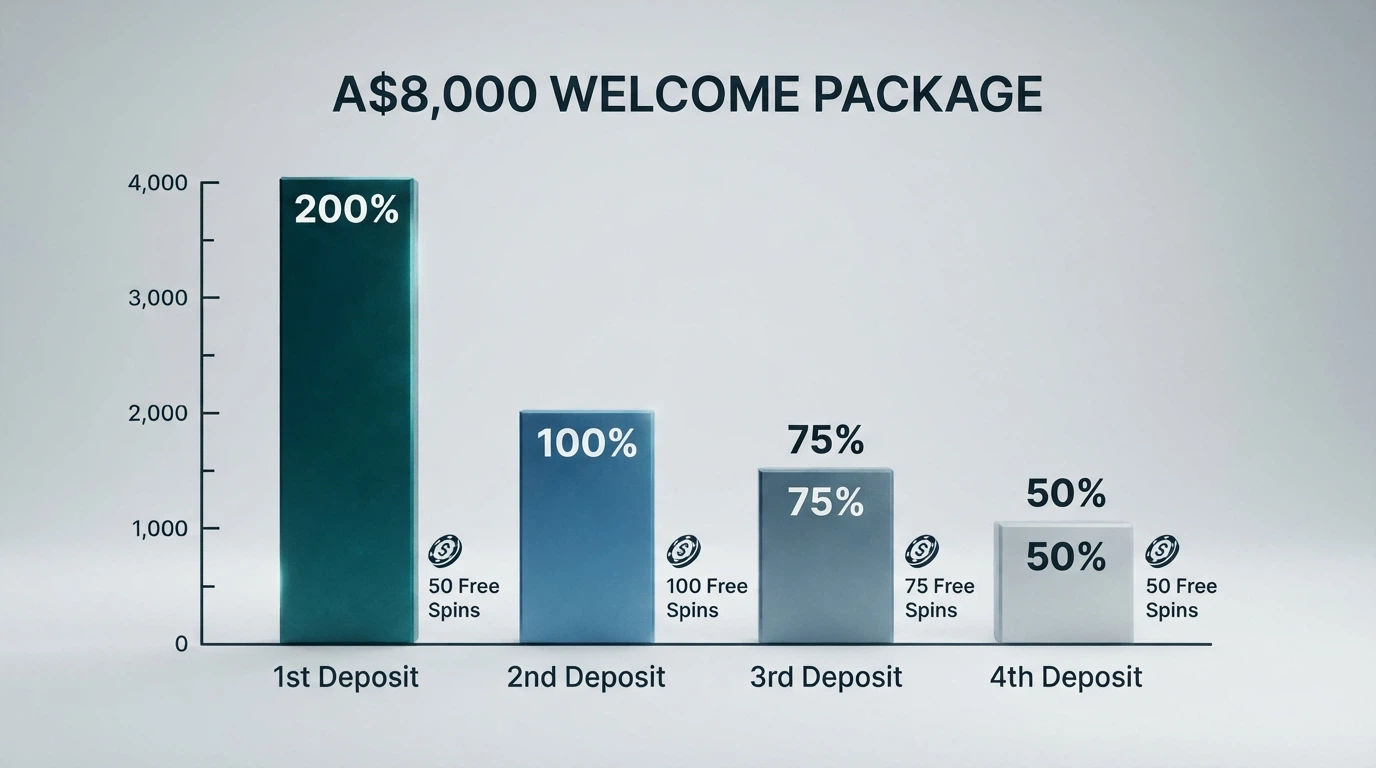
The pattern across the market is consistent. A four-deposit structure with a declining match percentage at each tier is the standard offshore welcome. The first deposit carries the heaviest match; the fourth carries the lightest. A player who claims the first deposit’s bonus and walks away has claimed a small fraction of the headline figure. A player who claims all four has committed a stack of fresh deposits and a stack of fresh wagering windows. The 7-day validity at Caswino is the tightest in the set; the 14-day window at Bizzo is the next tightest. Most operators give 30 days, which is the loose end of the range.
No-deposit bonuses and free spins for Australian sign-ups
Two of the ten operators above offer something before a deposit: WinSpirit’s 35 free spins on registration, with a 7-day wagering window, and BitStarz’s 50 free spins on registration, with 40x wagering on winnings and a A$100 cashout cap. Royal Reels has a no-deposit component on its public listings; the full terms were not confirmed in this cycle. A no-deposit bonus in the offshore market is uncommon enough that two of ten on a single comparison table is above the average for the segment.
The cashout cap is the term that defines the no-deposit value. BitStarz’s A$100 cap on a 50-spin no-deposit bonus with a A$0.20 spin value is a A$10 ceiling on the bonus’s spin value, gated by a A$100 ceiling on the winnings. The A$100 is the realistic upper bound. WinSpirit’s 35 free spins with a 7-day wagering window reads better on the headline, and the cap (if any) on the winnings was not confirmed for the AUD market in this cycle. The real-world no-deposit offer is not a free ride; it is a test, with a ceiling on what the test can return.
Wagering requirements — the 40x multiplier that rewrites the deal
A 40x wagering requirement is the industry standard across the operators on this page. SkyCrown’s 40x applies to both the bonus and the free-spin winnings. RocketPlay’s 40x applies to the bonus. BitStarz’s 40x applies to the no-deposit winnings. Wazamba’s 35x applies to the deposit plus bonus, with 40x on the free-spin winnings. Caswino’s 35x applies to the bonus. Rainbet offers two paths: a 40x Wager Lock or a No Wager Lock gradual release.
The 40x applies to the bonus alone on most structures, not to the deposit plus bonus. A A$1,000 deposit with a 100% match and 40x on the bonus means A$40,000 of turnover on the bonus alone, plus the original A$1,000 of deposit turnover. The game-contribution weighting makes it worse. Pokies contribute 100% toward wagering at SkyCrown. Table games contribute a fraction. Live casino games typically contribute nothing. A player who wants to clear a 40x requirement on live blackjack is, in practical terms, not clearing it; the contribution rate is too low. The bonus is cleared on the pokies, and only on the pokies.
Why crypto deposits often miss the bonus altogether
SkyCrown is the clearest case in the comparison set. Crypto deposits do not qualify for any bonus at SkyCrown. The headline A$8,000 plus 400 free spins is a fiat figure, and a USDT deposit sees the same 7,200+ games but no welcome package, no free-spin allocation, and no 40x to clear. The crypto player is paying full price, in effect.
Bizzo runs the other way. The main welcome is a fiat offer, and a separate 200% crypto welcome up to A$800 is layered on top. An Australian depositing USDT at Bizzo can claim the crypto path. The structure is the opposite of SkyCrown’s, and the contrast is the point: an Australian crypto player cannot assume the welcome they have read about is the welcome they will receive. The terms need to be read against the deposit method.
Pokies and Slots at Crypto Casinos — What Australians Are Actually Spinning
The pokies libraries at offshore crypto casinos overlap heavily. A short list of providers — BGaming, Play’n GO, Pragmatic Play, Yggdrasil, AvatarUX — appears across most of the major operators serving Australia, and the same titles tend to dominate the lobby tiles. The crypto-themed slot has become a small genre in its own right, with a handful of titles that lean on the theme hard and a much larger library of standard pokies that do not.
The pokies that dominate crypto casino lobbies
Elvis Frog in Vegas (BGaming) is a 96.79% RTP high-volatility pokie with a 5,000x max win and 262,144 ways on a TrueWays layout. Book of Dead (Play’n GO) is the long-running 96.21% RTP high-volatility staple with a 5,000x max win and 10 paylines with an expanding wild. Gates of Olympus (Pragmatic Play) is the 96.50% RTP high-volatility title that has run across the offshore market for years, with a 5,000x max win and tumble mechanics on a 6-reel layout. Sweet Bonanza (Pragmatic Play) is a 96.51% RTP high-volatility cluster-pay pokie with a 21,175x max win. Big Bass Bonanza Megaways (Pragmatic Play) runs 96.71% RTP high volatility with up to 117,649 ways and a 4,000x max win. Ozwin’s Jackpots (Yggdrasil) is the AU-themed title on the list, a 96.70% RTP medium-volatility progressive with no capped max win.

The crypto-themed set is small but visible. Crypto Bro (AvatarUX) is a 95.98% RTP high-volatility title with a 20,000x max win on a 6×4 grid with 4,096 ways. Crypto Crown 5 (AvatarUX) is a 96.16% RTP medium-volatility three-reel pokie with a 5,000x max win. Crypto Crown 20 (AvatarUX) is a 96% RTP high-volatility 5-reel pokie with 20 paylines and a 5,000x max win. Crypto Genesys (Pragmatic Play) is a newer release (2 July 2026) with up to 96.50% RTP, high volatility, and a 15,000x max win on a 6×5 cluster-pays grid. The Gates of Olympus 1000 and Sugar Rush 1000 variants from Pragmatic Play both run 96.50% RTP at very high volatility with cluster pays.
Real-money play versus demo mode at offshore crypto casinos
Demo mode availability is provider-dependent rather than operator-uniform across the offshore market. The major providers named above — Pragmatic Play, Play’n GO, BGaming, Yggdrasil, AvatarUX — support demo mode on their titles at most licensed operators, including the offshore ones. The implementation is not consistent. Some operators expose the demo on every title; others restrict demo to a subset of games; a handful gate demo mode behind account registration. An Australian player who wants to try a pokie before depositing will, in most cases, be able to, but the experience is not uniform across the ten operators above.
The transition from demo to real-money spins is the same at every offshore crypto casino. The player switches from the demo balance to a real crypto balance, the same RNG is used, and the same RTP applies. The maths does not change between free and real-money play. The psychology does.
Slot RTPs at a glance — which titles give you the best run
| Slot Title | RTP | Provider | Volatility | Max Win |
|---|---|---|---|---|
| Elvis Frog in Vegas | 96.79% | BGaming | High | 5,000x |
| Big Bass Bonanza Megaways | 96.71% | Pragmatic Play | High | 4,000x |
| Ozwin’s Jackpots | 96.70% | Yggdrasil | Medium | Progressive (uncapped) |
| Sweet Bonanza | 96.51% | Pragmatic Play | High | 21,175x |
| Gates of Olympus | 96.50% | Pragmatic Play | High | 5,000x |
| Gates of Olympus 1000 | 96.50% | Pragmatic Play | Very high | — |
| Sugar Rush 1000 | 96.50% | Pragmatic Play | Very high | — |
| Crypto Genesys | Up to 96.50% | Pragmatic Play | High | 15,000x |
| Book of Dead | 96.21% | Play’n GO | High | 5,000x |
| Crypto Crown 5 | 96.16% | AvatarUX | Medium | 5,000x |
| Crypto Crown 20 | 96% | AvatarUX | High | 5,000x |
| Crypto Bro | 95.98% | AvatarUX | High | 20,000x |
The spread runs 95.98% to 96.79% — a 0.81 percentage point range across the titles above. The two AvatarUX crypto-themed titles sit at the bottom of the range. The high-volatility Pragmatic Play cluster sits in the middle. Elvis Frog in Vegas leads the published list at 96.79%, with Big Bass Bonanza Megaways close behind. The volatility column matters more than the RTP column for the player experience: a 96.5% RTP high-volatility pokie will produce longer losing runs and larger wins than a 96.5% RTP low-volatility one, and the same RTP can read very differently across two sessions.
How We Evaluated and Ordered These Operators
The ten operators above were ordered by relevance to the Australian crypto casino topic, not by market share alone. Relevance is a combination of crypto acceptance, Australian traffic, the size and structure of the welcome offer, and the public availability of bonus terms. Stake, Royal Reels, WinSpirit, Rainbet, FairGO and Scream Casino were ranked with reference to their Australian market share; SkyCrown, RocketPlay, Bizzo and BitStarz were ranked on the combination of crypto acceptance and the public detail of their bonus terms.
The first check on every operator is the licence question. The Interactive Gambling Act 2001 prohibits the provision of online casino games to a person in Australia, and there is no Australian online casino licence. Every operator on this page is offshore, and none holds an Australian casino licence. The offshore licence (Curaçao, Anjouan, or a Dama N.V. operation) is named where it is publicly stated. Where the licence number is not in the public source, the gap is noted in the operator write-up.
The second check is bonus terms. Where the published offer is detailed — SkyCrown, Bizzo, BitStarz, RocketPlay — the wagering multiplier, free-spin allocation, validity window, maximum cashout, and crypto-bonus status are transcribed from the operator’s own terms. Where the offer is fragmentary — Royal Reels, WinSpirit’s AUD figure, FairGO, Scream Casino, Stake — the gap is named and the operator is described qualitatively rather than padded with values the public source does not carry.
The third check is withdrawal data. The Wild Fortune tested-withdrawal figure (5 hours 24 minutes average across five cycles, February to May 2026) is the only public test data the research cycle returned; it is included as a reference point for the broader 30-minute-to-24-hour crypto withdrawal-to-AUD window, not as a measure of any operator on the comparison table.
The fourth check is the protection gap. Every operator on this page sits outside BetStop, outside any Australian complaints body, and outside any Australian consumer protection. ACMA’s blocking list runs to 1,564 sites as at March 2026, and there is no recourse for a balance left on a blocked site. The 2026 reform (commencing 1 January 2027) gives banks express authority to block transactions to illegal gambling operators, which adds another layer of friction to the deposit side. None of that changes the licence status. It changes the operational environment.
The fifth check is the gap in the data. Stake, FairGO and Scream Casino carry no confirmed bonus terms from the sources swept. WinSpirit’s AUD welcome figure is not confirmed. Royal Reels’ no-deposit terms are not confirmed. Where a number is not in the public source, the operator is described qualitatively. A write-up that announces a number as missing reads unfinished; a write-up that says the offer is real but the public detail is thin reads finished.
What Australia’s Offshore Casino Reality Means for Your Next Deposit
The cost of playing at an offshore crypto casino as an Australian is not in the wagering requirements or the bonus terms alone. Those are the costs an operator can put a number on. The harder cost is the protections that are not on the page at all.
BetStop is the clearest one. The National Self-Exclusion Register holds 59,830 registrations as at March 2026; 37,247 of them are active. One BetStop registration excludes a person from every Australian-licensed wagering service. An offshore casino is not connected to the register. A player who has self-excluded and then opens an offshore crypto account has not broken a rule; they have moved to a place where the rule does not reach them. That is also a place where the support downstream of a self-exclusion call does not reach them either. The helpline (1800 858 858) and Gambling Help Online still serve every Australian; the automatic account closure and marketing suppression that BetStop triggers on the licensed side do not.
The bank side is the second cost, and it is a friction cost, not a protection cost. CommBank and Westpac restrict outbound transfers to crypto exchanges. ANZ and NAB flag them. The bank an Australian uses every day is also the bank monitoring their crypto-related transactions. From 1 January 2027, banks have express authority to stop transactions to illegal gambling services, which is a signal the policy environment is moving against the offshore market rather than away from it. The friction is not an inconvenience; it is a signal of where the regulatory pressure is heading.
The bonus numbers are the third cost, and they are the cost the marketing pages work hardest to obscure. A 40x wagering requirement on a A$1,000 bonus is A$40,000 of turnover. A no-deposit offer with a A$100 cashout cap is a A$100 ceiling on the return. A multi-deposit welcome spread across four tiers is a commitment of fresh deposits, not a single headline figure. The bonus numbers are real. The terms are also real. The terms are where the cost lives.
The ACMA blocking reality is the fourth cost. As at March 2026, 1,564 illegal gambling and affiliate websites have been blocked by Australian ISPs. The site an Australian is depositing at today can be on the blocked list next month. A balance left on a blocked site is a balance the player has no Australian-based path to recover. ACMA cannot compel a payout from an offshore operator. The block is a one-way door.
The arithmetic on the cost of a SkyCrown welcome bonus, assuming the A$8,000 headline is fully claimed and wagered at 40x on the bonus, looks like this. The bonus at full headline value is A$8,000. Required turnover on the bonus alone, at 40x, is A$320,000. A representative pokie like Gates of Olympus, the title that recurs across the offshore lobbies, runs an RTP of 96.50%, which means an expected house edge of 3.50% across the turnover. The expected loss on clearing the bonus at full headline value, on a representative pokie, runs to roughly A$11,200. That is the statistical cost of clearing the A$8,000 headline, and the figure assumes every cent of the bonus is wagered once at the 40x rate on a 96.50% RTP title. The real cost to a real player varies with the games played, the bonus actually claimed (rarely the full A$8,000), and the volatility of the session. The order of magnitude is the point: the headline figure is the bait, and the expected loss is the catch.
The decision is the player’s. The IGA targets the provider, not the player, and no Australian has been prosecuted for placing a bet at an offshore online casino. That is the legal ground the decision stands on. The same ground is also where the protections end: no Australian complaints body, no BetStop coverage, no consumer protection, no recourse if the operator refuses a withdrawal, voids a win, or closes the account. An Australian player who decides the offer is worth it has decided to accept those gaps. An Australian player who decides the offer is not worth it has decided that the bonus numbers do not offset what the licensed side, for all its restrictions, actually provides.
Frequently Asked Questions
Is it legal for Australians to play at crypto casinos?
The Interactive Gambling Act 2001 prohibits the provision of online casino games to a person in Australia, and no Australian licence exists for online casino or pokies. The IGA targets the operator, not the individual player. Section 8AA makes it an offence to provide services to Australian residents; it does not make it an offence to use them. No Australian has been prosecuted for placing a bet at an offshore online casino. The legal status is: the casino is breaking Australian law by offering the product, and the player is not breaking Australian law by using it.
What cryptocurrencies can I use at online casinos that accept Australian players?
Bitcoin, Ethereum, Tether and Litecoin are the most common across the featured operators, with WinSpirit naming all four explicitly. USDT on the TRC-20 network is the cleanest route for cost and speed: fees run under 50 cents and confirmations land in under 60 seconds. Bitcoin on the main network is slower and more expensive per transaction. Ethereum mainnet is faster than Bitcoin but costlier than TRC-20. The fastest end-to-end deposit and withdrawal experience runs through USDT on TRC-20, with the casino-to-exchange leg clearing in minutes rather than hours.
Are crypto casino winnings taxable in Australia?
No, not for an ordinary player. Betting and gambling winnings are not assessable income under section 6-5 of the ITAA 1997, and gambling losses are not deductible under section 8-1. The ATO’s position is that an ordinary punter’s winnings are not taxable and their losses are not refundable. The exception is the narrow case of a person carrying on a business of betting or gambling, which the ATO sets out in IT 2655. No Australian case has held the winnings of an ordinary punter assessable. The practical answer for an Australian crypto casino player is: keep records, declare nothing on the winnings side, claim nothing on the loss side, and the ATO position covers the position.
What is the fastest crypto for casino withdrawals from Australia?
USDT on the TRC-20 network is the fastest end-to-end route. Network fees run under 50 cents and confirmation lands in under 60 seconds. The full crypto withdrawal-to-AUD cycle, from requesting a casino withdrawal to having Australian dollars in a bank account, runs 30 minutes to 24 hours depending on the exchange’s processing time and the bank’s acceptance of the inbound transfer. Tested crypto withdrawals at Wild Fortune Casino averaged 5 hours 24 minutes across five test cycles between February and May 2026, ranging from 3 hours 50 minutes to 7 hours 58 minutes. BitStarz claims withdrawals within seconds on the casino side, with the bank leg still subject to monitoring.
What happens if a crypto casino gets blocked by ACMA?
ACMA has had 1,564 illegal gambling and affiliate websites blocked by Australian ISPs as at March 2026, with 225+ illegal services withdrawn from the Australian market since 2017. A site can be blocked with a balance still on it, and ACMA cannot compel a payout from an offshore operator. There is no Australian consumer protection covering the account, no Australian complaints body to call, and no BetStop coverage. The site is unreachable from an Australian IP after the block, and the player has no Australian-based path to recover the balance. The 2026 reform gives banks and payment providers express authority to block transactions to illegal gambling operators from 1 January 2027, which tightens the deposit side of the same risk.
Prepared by the Live Casino Australia editorial staff.