Casino Payment Methods for Aussie Players: The Honest Comparison for 2026
 Available in AU
The deposit method is the first real decision an Australian online casino player makes, and it is the one that locks in speed, cost, privacy and legal exposure before a single spin. The cashier page is also the most reliable indicator of which side of Australia’s regulatory line a site sits on. A licensed wagering operator takes debit cards, bank transfer, PayID/Osko and BPAY; an offshore casino takes credit cards, crypto, e-wallets and prepaid vouchers as well. The menu itself is a tell.

This guide walks the full landscape of payment methods Australian-facing casinos accept in 2026, what each one actually costs in time and money, and where the speed-versus-protection trade-off lands. The comparison is built from the methods and operators in the table below, then framed by the Australian regulatory context most competitor pages skip past. The verdict is plain: no single method wins on every axis, and the method that suits a player chasing speed is rarely the one that suits a player chasing privacy.
Data current as of 18 October 2026 and verified against the Australian Communications and Media Authority (ACMA) register, the Australian Business Register and the Parliament of Australia bill digests.
Table of Contents
- Deposit vs Withdrawal: Why the Same Method Can Feel Completely Different
- Every Deposit Method Australian Online Casinos Accept in 2026 — and What Each One Costs You
- Crypto Casino Payments: Faster Money, but Not Inside Australia’s Rules
- The Offshore Casinos Aussies Actually Use: Ranked by Payment Speed and Choice in 2026
- Is It Legal to Deposit at an Online Casino from Australia? The Answer Isn’t a Simple Yes or No
- Fast Deposits, Real Harm: Keeping Your Casino Spending Under Control
- How We Evaluated and Ranked These Casino Payment Methods
- What Your Casino Payment Method Actually Decides: The Verdict for Aussie Players
- Frequently Asked Questions
Deposit vs Withdrawal: Why the Same Method Can Feel Completely Different
A method that deposits instantly can crawl on the way out, or not work for withdrawals at all. POLi, Neosurf and CashtoCode are deposit-only at every Australian-facing casino tested. PayID, crypto and a standard bank transfer work both ways, and the difference in the user experience is large.
Two clocks run on every withdrawal. The first is the rail itself — how long PayID, a card network or a blockchain takes to move the money once it is released. The second is operator approval, which is independent of the rail and is where “instant withdrawals” usually slow down. A casino can advertise a five-minute crypto payout and still hold the withdrawal in its approval queue for forty-eight hours. The fastest rail paired with the slowest approval queue is the same experience as the slowest rail. The first withdrawal almost always triggers full KYC (Know Your Customer — the identity verification check casinos are required to run before paying out), which adds days regardless of the method.
Three concrete pairings make the point. POLi deposits clear in seconds but POLi withdrawals do not exist. Neosurf accepts a A$10 voucher at the deposit step and offers no way to put winnings back onto the same voucher. BPAY takes one to two business days to deposit and three to five business days to withdraw, which is slower than cards or e-wallets but is the one rail that handles the very large transactions some banks allow.
Every Deposit Method Australian Online Casinos Accept in 2026 — and What Each One Costs You
Offshore casinos serving Australia carry more than thirty named deposit methods across six categories. The list varies by operator, but the categories are stable: cards, e-wallets, instant bank transfer (PayID, POLi, BPAY), bank transfer, crypto, and prepaid vouchers. The comparison below covers the methods that show up in the featured-operator set; methods research could not confirm for the Australian market are noted as gaps rather than filled in.
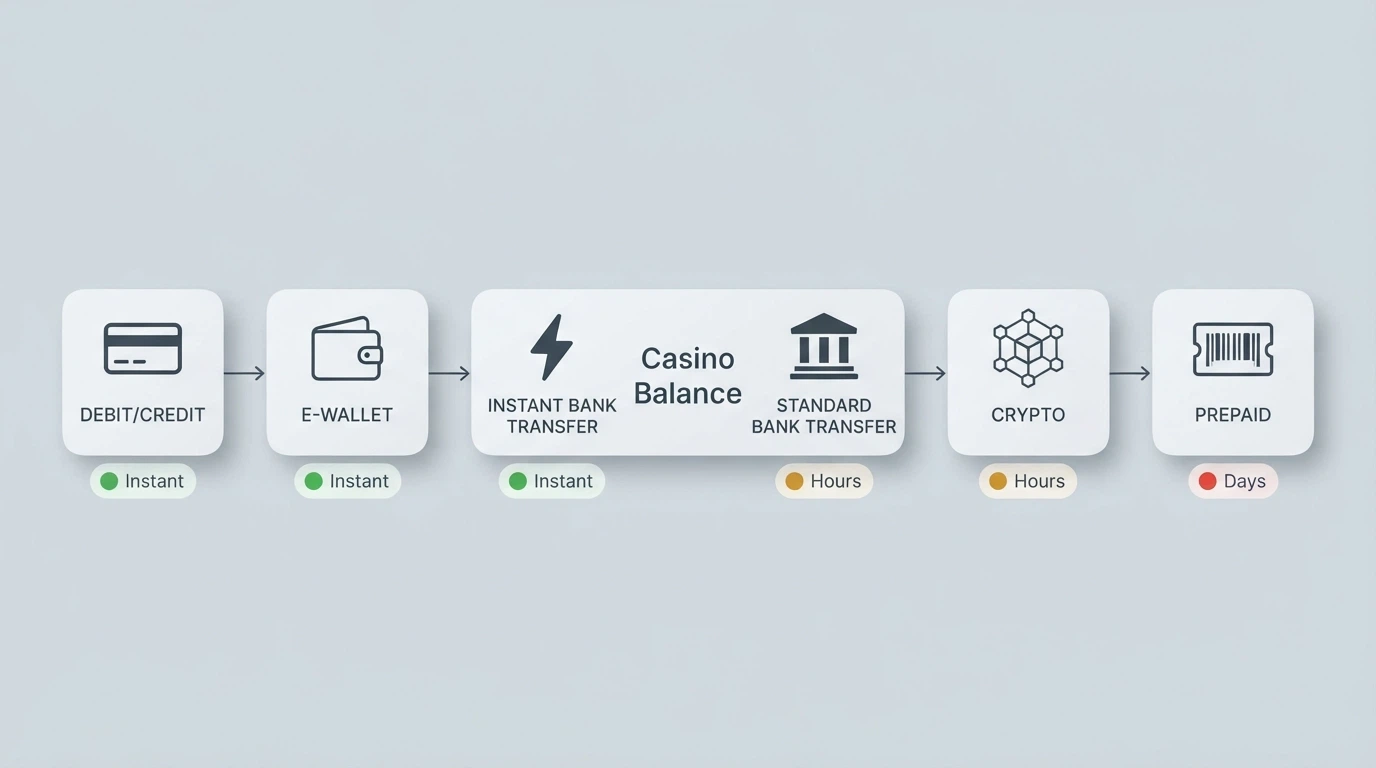
| Method | Deposit Speed | Withdrawal Speed | Fees | Min Deposit | Withdrawals Available |
|---|---|---|---|---|---|
| Debit card (Visa/Mastercard) | Instant | 1–3 business days | 0–2.5% (operator-dependent) | A$20–A$25 | Yes |
| Credit card (Visa/Mastercard) | Instant | 1–3 business days | 0–2.5% | A$20–A$25 | Yes (offshore only) |
| PayID / Osko | Under 30 seconds | Under 60 minutes (some 5–10 min) | 0% | A$20 | Yes |
| POLi | Instant (where available) | — | 0% | A$20 | No |
| BPAY | 1–2 business days | 3–5 business days | 0% | Varies (banks allow A$20,000+) | Yes |
| Bank transfer (standard) | 1–3 business days | 3–7 business days | 0–A$50 wire fee | Varies | Yes |
| JET Bank Transfer | Instant | — | Varies | A$20 | No |
| Skrill / Neteller | Instant | 1–6 hours | 3–5% (deposits, withdrawals, FX) | A$20 | Yes |
| MiFinity | Instant | Instant to 24 hours | Varies | — | Yes |
| Neosurf (voucher) | Instant | — | 0% | A$10 | No |
| CashtoCode | Instant | — | 0% | Up to A$800 | No |
| Bitcoin (BTC) | 10–60 min (3–6 confirmations) | 30–60+ min | Network fee only | A$20–A$100 | Yes |
| USDT (TRC20) | Under 5 min | Under 5 min | Network fee only | A$20 | Yes |
| USDT (ERC20) | 5–30 min | 5–30 min | Network fee (higher) | A$20 | Yes |
| Ethereum (ETH) | 5–30 min | 5–30 min | Network fee | A$20 | Yes |
| Litecoin (LTC) | 5–30 min | 5–30 min | Network fee | A$20 | Yes |
| Solana (SOL) | Under 5 min | Under 5 min | Network fee | A$20 | Yes |
| Apple Pay / Google Pay | Instant | — | 0% | — | No |
The rest of this section takes each category in turn and explains what the table does not: why a fee exists, what the catch looks like, and which method category pairs with which kind of player.
Card Payments: Visa and Mastercard at Offshore Casinos
Cards are the most familiar rail and still the most common deposit method at Australian-facing casinos. Two changes have reshaped the picture since 11 June 2024.
The first is legal. Australia banned credit cards and credit-related products as payment for online wagering under the Interactive Gambling Amendment (Credit and Other Measures) Act 2023, with the prohibition effective from 11 June 2024. Penalties for non-compliance reach A$247,500. The ban applies to licensed wagering operators. Offshore casinos are outside Australian enforcement, so a credit card may still be accepted at the deposit step at an offshore site. The transaction may still be declined at the bank level, because Australian banks are now flagging gambling merchant category codes (MCCs — the four-digit codes card networks attach to a transaction’s category, which gambling transactions carry) for credit and credit-like instruments.
The second is operational. Minimum card deposits cluster in the A$20 to A$30 range across the featured operators — A$25 at Rocket Play, A$20 at SkyCrown and Fair Go. Card withdrawals take one to three business days after operator approval. Some Australian banks decline casino card transactions regardless of whether the card is debit or credit, and the decline usually surfaces as a generic “transaction not authorised” rather than a specific reason.
The debit-versus-credit distinction is the regulatory line. Offshore casinos will not ask which one you are using at the deposit step, but the player’s protection on a credit card transaction is thinner — no chargeback path is guaranteed for gambling, and the bank’s fraud team is more likely to block a credit card than a debit card. The path of least friction at an offshore casino is a debit card linked to a transaction account with sufficient funds.
E-Wallets: Skrill, Neteller, MiFinity and the Privacy Trade-Off
E-wallets sit between the player’s bank and the casino. The casino sees a transfer from the wallet, the bank sees a transfer to the wallet, and neither side sees the other. That is the privacy benefit, and it is the main reason players who want a clean statement reach for an e-wallet.
The cost is real. Skrill and Neteller charge fees on deposits, withdrawals and currency conversions that can total three to five per cent of the transaction amount, and both are owned by Paysafe Group under UK Financial Conduct Authority and Malta Financial Services Authority licences. The fees compound: a player who deposits in Australian dollars, plays in euros and withdraws back to Australian dollars pays three currency conversions on one transaction.
Withdrawal speed is the upside. E-wallet withdrawals from Australian-facing casinos typically process in one to six hours after operator approval, with some operators clearing in twenty-four hours or less. MiFinity sits in the same category and is offered by several featured operators with instant-to-twenty-four-hour timelines.
The practical test is whether the privacy is worth the fee. For a player who keeps a small balance and plays occasionally, the fee is a few dollars per cycle. For a player moving larger amounts in and out frequently, the compounding fees can erode a meaningful share of any edge. The third category — MiFinity — is the newer alternative and tends to charge less aggressively, but the fee schedule varies by operator and currency pair, and the player should check the wallet’s published rates before committing.
PayID, POLi and BPAY: The Australian Trio Compared
PayID, POLi and BPAY are the three rails built for the Australian banking system. Only two are still in active use for casino deposits, and they sit at opposite ends of the speed spectrum.
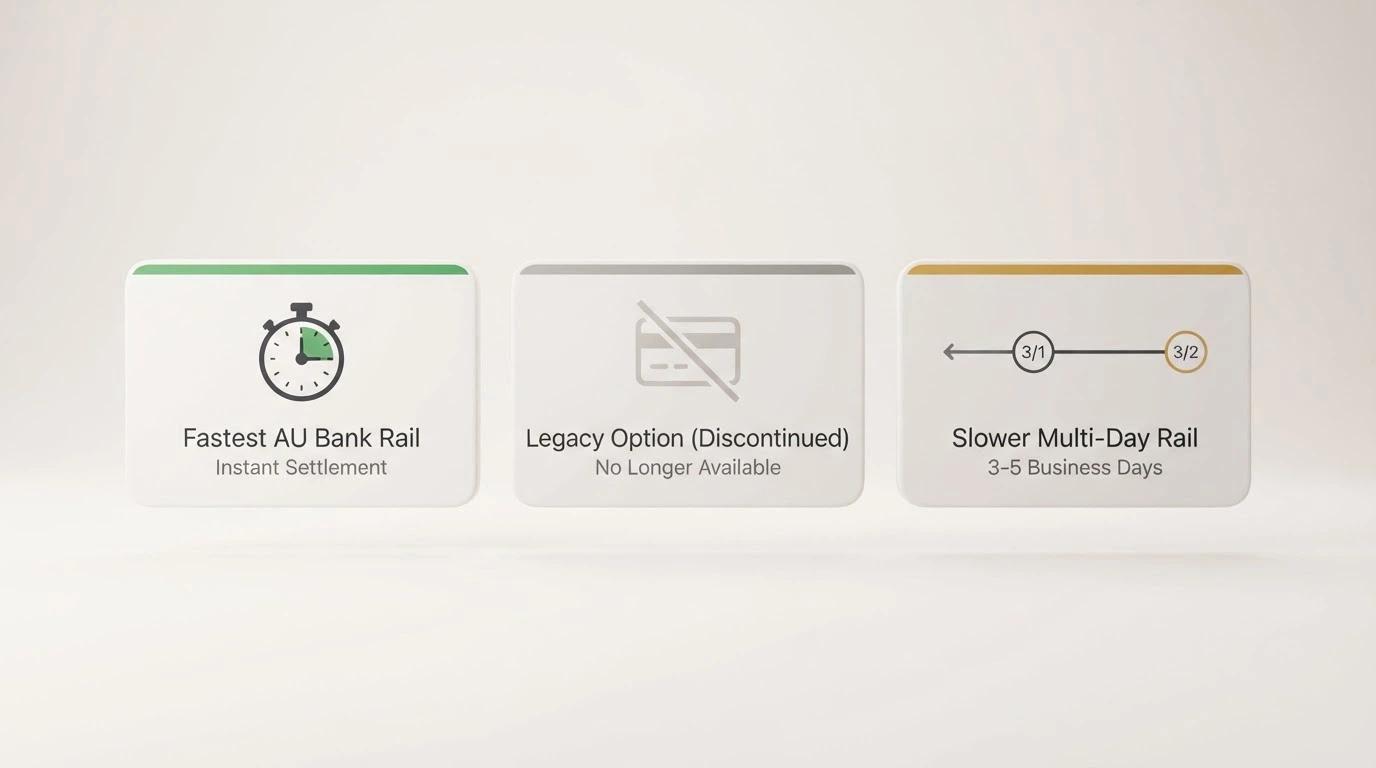
PayID is the fastest Australian bank rail. Deposits clear in under thirty seconds across more than one hundred financial institutions connected to the New Payments Platform (NPP), the real-time settlement infrastructure that underpins PayID and Osko. Withdrawals from casinos that support PayID outbound typically reach the player’s bank in under sixty minutes once approved, with some operators processing in five to ten minutes. Bizzo Casino and SkyCrown both offer PayID for both deposits and withdrawals in the featured set.
POLi was once a routine deposit method at Australian-facing casinos. POLi Payments Pty Ltd’s Australian Business Number was cancelled from 22 July 2025, and the company’s status page now lists only New Zealand banks. POLi remains a deposit-only rail where it is offered at all — there has never been a POLi withdrawal at any Australian-facing casino — and the Australian side is now a legacy option. Players who still see POLi on a cashier page are seeing a method that may not work for new sign-ups.
BPAY is the slow, reliable rail for high-volume deposits. Deposits take one to two business days, withdrawals take three to five business days, and some Australian banks allow A$20,000 or more per transaction — which is why BPAY is the only rail in the comparison that handles the very large deposits other methods cap out. The cost is time. A player chasing fast withdrawals is not using BPAY. A player depositing five figures a week is not using PayID’s per-transaction limits, and BPAY becomes the only rail that does not force a wire.
Prepaid Vouchers: Neosurf, CashtoCode and Depositing Without a Bank Trail
Prepaid vouchers let a player fund a casino account with cash and leave no bank record at all. The trade-off is one-directional: the voucher handles deposits, and the player must use a different method — typically bank transfer or crypto — to cash out.
Neosurf is the lower-floor option. Vouchers are available from A$10, and the deposit clears instantly with no fee. CashtoCode goes up to roughly A$800 per voucher, and Rocket Play, Fair Go and other featured operators accept it for instant deposits. The privacy benefit is the reason these methods exist at all: a player buying a Neosurf voucher with cash at a retail outlet and redeeming it at a casino leaves a payment trail that ends at the retail outlet, not at the bank.
The cost is the asymmetry. A player who wins on a Neosurf-funded balance has to withdraw to a bank transfer, a card, an e-wallet or crypto, and that withdrawal carries the rail’s normal fees and timelines. For a player who treats the casino balance as a closed loop — deposit, play, withdraw to crypto — prepaid vouchers are an effective, anonymous funding source. Players seeking a single method to handle both deposits and withdrawals should look elsewhere, as vouchers are strictly one-way.
Bank Transfers: Slow but Reliable for High-Volume Deposits
A standard bank transfer is the least exciting rail on the list and the one that handles the largest transactions. Three to seven business days is the typical window at the featured operators, with some — SkyCrown, for example — quoting three to five business days. The JET Bank Transfer variant offered at Fair Go is instant at the deposit step and removes the wait.
The cost of a slow rail shows up in the operator-approval step. Bank transfer withdrawals almost always trigger full KYC, because the receiving bank account has to be verified against the player’s name. A first withdrawal to a new account is the longest wait the casino imposes regardless of method, and a bank transfer makes that wait longer, not shorter.
The right reader for a bank transfer is a player moving large sums who has already been through KYC and who values certainty over speed. The wrong reader is a player who wants to test a casino with a small deposit and cash out quickly — that player will wait a week, not a day.
Crypto Casino Payments: Faster Money, but Not Inside Australia’s Rules
Crypto is the fastest deposit and withdrawal rail at offshore casinos, and it is the one most clearly outside Australia’s licensed payment framework. Credit cards and digital currency have been banned as payment for licensed online wagering since 11 June 2024; the ban attaches to the licensed wagering product, not to the individual player, and offshore casinos continue to accept crypto from Australian accounts.
Crypto payments in Australia doubled to twelve per cent of digital transaction volume in 2026, with online shopping the dominant category. The use case has broadened well beyond speculation, and casino deposits are part of the broader shift. The cost of that shift is that the consumer protections built for the licensed payment system do not reach crypto transactions at offshore sites.
Bitcoin, Ethereum, Stablecoins and Altcoins: What Offshore Casinos Actually Accept
The coin menu at Australian-facing offshore casinos ranges from a Bitcoin-only setup to a twenty-five-token lineup. The standard four are BTC, ETH, LTC and USDT; the longer lists add BNB, SOL, DOGE, BCH and a layer of stablecoins pegged to fiat.
Rainbet supports twenty-five crypto tokens across the featured set. Rocket Play runs six. Fair Go runs five. The chain the player picks determines how long the money takes to arrive. USDT on TRC20 (Tron) and Solana settle in under five minutes. Ethereum and Litecoin settle in five to thirty minutes. Bitcoin takes thirty to sixty-plus minutes for three to six network confirmations, depending on the fee the player is willing to pay. Platform withdrawal fees are zero at Rainbet and operator-dependent elsewhere; the network fee is paid by the player to the blockchain, not the casino.
For a player who already holds crypto, the speed is unmatched. For a player buying crypto specifically to fund a casino, the bank leg is the slow part — outbound transfers from Australian banks to crypto exchanges were flagged or delayed in roughly forty per cent of cases in 2026 testing, and a flagged transfer can take days to clear.
Why Aussies Choose Crypto for Casino Deposits Despite the 2024 Ban
Two things pull Australian players toward crypto: speed and privacy. USDT TRC20 lands in under five minutes, and the player’s bank sees a transfer to an exchange, not a deposit at a casino. Every other part of the experience is outside Australian consumer law.
There is no BetStop coverage at an offshore crypto casino, no ACMA recourse on a dispute, no Australian chargeback path, and the site can be DNS-blocked — that is, removed from Australian internet service providers’ name servers so that attempts to reach it fail — with a balance still on it. The 1,788 illegal gambling and affiliate sites ACMA has had blocked since November 2019 include crypto-accepting offshore casinos, and the blocking list grows every quarter. A player whose balance sits at a blocked site has no Australian-side recovery mechanism.
The 2026 doubling of crypto payment volume in Australia is a fact about the broader digital economy, and it is also a fact about the offshore gambling economy, and the same dollar sits in both. The regulatory test is plain: a licensed Australian wagering operator will not ask for crypto from a customer. A site that does is outside the rules. The payment method is itself a tell.
The Offshore Casinos Aussies Actually Use: Ranked by Payment Speed and Choice in 2026
Online casino is prohibited in Australia under the Interactive Gambling Act 2001. No Australian casino licence exists, and no offshore operator in the featured set holds one — because none can. The ten operators below are ranked by the breadth of their cashier, the speed of their payouts and the minimum they ask to get started. Every operator is offshore-licensed (Curaçao unless noted), not Australian-licensed. The payment method is the clearest signal of which side of the line each operator sits on.
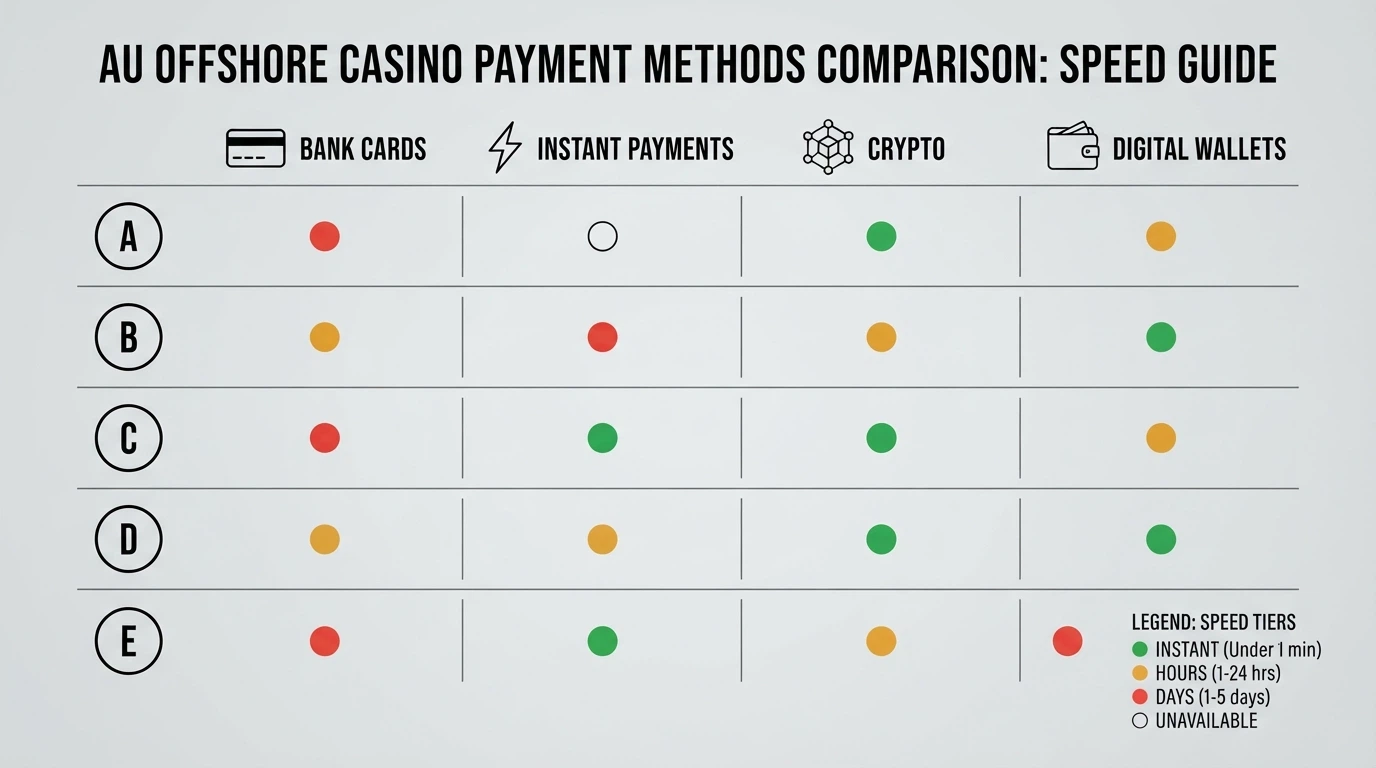
| Operator | Licence | Deposit Methods | Withdrawal Speed | Min Deposit |
|---|---|---|---|---|
| Rocket Play | Curaçao | Visa/MC, MiFinity, CashtoCode, PayID, 6 cryptos, bank transfer | Crypto instant; MiFinity instant; bank 3–7 days | A$25 (card); A$30 (bonus) |
| SkyCrown | Curaçao | Visa/MC, PayID/Osko, POLi, PayPal, Skrill, Neteller, crypto, bank transfer | E-wallets 24 hr; cards 1–3 days; bank 3–5 days | A$20 |
| Royal Reels | Curaçao | Crypto, fiat (specific methods not confirmed) | — | A$30 |
| WinSpirit | Curaçao | Cards, e-wallets, crypto (confirmed) | — | — |
| Stake | Curaçao | Crypto (primary); fiat varies by region | Crypto instant to minutes | — |
| Rainbet | Not confirmed | 25 crypto tokens, bank transfer, cards, e-wallets, AstroPay | Crypto instant to ~10 min; fiat 1–5 days | ~A$23 |
| Fair Go | Curaçao (RTG/SpinLogic) | Visa, MC, Apple Pay, Google Pay, BTC, Lightning BTC, BCH, LTC, ETH, Neosurf, CashtoCode, eZeeWallet, JET Bank Transfer | Up to 2 business days | A$20 |
| Bizzo Casino | Curaçao (TechSolutions Group N.V., 2021) | PayID (deposits + withdrawals), cards, crypto | PayID and crypto fastest; KYC may delay | Varies |
| Scream Casino | Not confirmed | — | — | — |
| Rocket Casino | Not confirmed | — | — | — |
The deep dives below cover each operator in the order they appear in the table. Where a method, speed or minimum is not confirmed for the Australian market, the section states that fact plainly and the cell carries an em dash.
Rocket Play
Rocket Play is the broadest cashier in the ranking that pairs traditional methods with a real crypto lineup. The full method list runs from Visa and Mastercard at a A$25 floor to MiFinity and CashtoCode (the latter deposit-only, up to A$800 per voucher), six cryptocurrencies (BTC, ETH, LTC, DOGE, BCH, USDT), PayID and a standard bank transfer that takes three to seven business days. The bonus-qualifying minimum sits at A$30, ten dollars above the card floor, so a player who wants the welcome offer has to deposit more than the cashier minimum.
Crypto withdrawals are instant and carry no platform fee, which puts Rocket Play in the small group of featured operators that charges nothing extra on top of the blockchain network fee. MiFinity withdrawals are instant. The bank transfer option is the slowest in the set and is the path a player will use for very large balances. The Curaçao licence is the standard offshore frame; there is no Australian licence, because no Australian casino licence exists.
For a player who wants one cashier that handles cards, e-wallets, bank transfer, prepaid and crypto at reasonable minimums, Rocket Play is the most complete option in the ranking. The catch is the typical offshore one: no BetStop coverage, no ACMA recourse, the site can be blocked. The payment breadth is real; the protections attached to the licensed side are not present.
SkyCrown
SkyCrown is the rare offshore operator that takes PayPal alongside PayID, POLi, Skrill, Neteller, cards, crypto and a standard bank transfer. The A$20 minimum applies across every method, which makes it the lowest flat floor in the featured set. E-wallet withdrawals process in twenty-four hours, card withdrawals in one to three days, bank transfers in three to five days, and the weekly and monthly caps are A$7,500 and A$45,000 respectively.
The welcome bonus structure is the one to read carefully. SkyCrown’s total welcome package for Australian players reaches 450 per cent deposit match up to A$8,000 plus 400 free spins across four deposits, with forty times wagering on the deposit match and on free-spins winnings, a maximum bet of A$7.50 per spin, fourteen-day validity on the standard offer, and a maximum conversion from bonus to real money of A$5,000 per welcome bonus. A high-roller first-deposit alternative runs 380 per cent up to A$9,800 plus 275 free spins with five-day validity.
A player who wants PayID for both directions and a low flat minimum is well served here. A player who wants the full welcome bonus needs to clear the A$5,000 conversion cap with a bankroll that can survive forty times the deposit-and-bonus figure in turnover. The arithmetic: a player who takes the full A$8,000 bonus must wager A$8,000 × 40 = A$320,000 in turnover to clear it. At a conservative slot stake of A$1 per spin at a five-second interval, A$320,000 of turnover works out to 320,000 spins, which at five seconds per spin is 1,600,000 seconds, or roughly 444 hours of continuous play. That is the time cost of clearing the headline offer, and it is the right number to hold next to the A$5,000 conversion cap. The offer is large; the path to cashing it out is long.
Royal Reels
Royal Reels’ pitch is a small no-deposit bonus to get a new sign-up through the door: AUD 10 free on registration, no deposit required, with a A$30 minimum deposit to unlock the main 100 per cent match up to AUD 500. The wagering sits at thirty to forty times. The licence is Curaçao, the game count is 2,000-plus across thirty-plus providers.
The cashier detail is thinner than the top tier. Royal Reels accepts crypto and fiat, but the specific fiat methods, withdrawal speeds and max-cashout terms are not confirmed in the available Australian-facing data. A player choosing Royal Reels is choosing it for the no-deposit entry and the broad game lobby, not for a verified payment-method list. That is a real trade-off: the bonus is small, the game count is large, and the cashier specifics sit behind the registration wall.
The verdict is a niche fit. A player who wants to test a Curaçao-licensed site with a small free bonus and AUD 30 of their own money can do that here. A player who wants a verified payment-method list before signing up has better-documented options higher in the ranking.
WinSpirit
WinSpirit runs a Curaçao licence and a thousand-plus-game lobby, and the cashier confirms three method categories: credit cards, e-wallets and crypto. The welcome bonus, wagering, minimum deposit, withdrawal speed and max-cashout terms are not confirmed in the available data for Australian players.
The honest read is that WinSpirit is on the ranking for completeness rather than for a verified payment profile. A player who has a specific reason to look at WinSpirit — a game they cannot find elsewhere, a promotion they have been offered — should expect to confirm the payment specifics at the cashier page after sign-up. A player whose first filter is payment-method transparency will be better served by the operators with full data in the table.
Stake
Stake is a crypto-native platform, and the cashier is built around it. Deposits and withdrawals in supported tokens settle in minutes, and the platform’s bonus structure is the Stake model rather than a conventional welcome offer: rakeback (a percentage of house edge returned to the player over time) and a vault system rather than a large deposit match with high wagering. The Curaçao licence is the frame; the AU-specific deposit minimums and the full fiat method list were not confirmed in this round.
For a player who holds crypto and prefers a rakeback system to a standard welcome bonus, Stake is the natural pick. Those prioritizing traditional deposit-match offers or reliable fiat payment methods will find better-documented choices higher in the table.
Rainbet
Rainbet is the broadest crypto cashier in the ranking. Twenty-five tokens — BTC, ETH, USDT, LTC, BNB, SOL and more — with deposits and withdrawals settling in seconds to roughly ten minutes, a standard minimum around A$23 equivalent, and zero platform withdrawal fees. Fiat routes are present and take one to five business days. The welcome bonus runs three deposits plus sixty free spins (100 per cent plus 20 FS / 50 per cent plus 20 FS / 100 per cent plus 20 FS), from about A$46 equivalent and up to about A$1,070 equivalent, at forty times wagering.
The licence status was not confirmed in the available data, and the platform fee-free structure is the standout. A player who wants the widest token choice and no platform withdrawal fee has the best fit here. A player who needs a confirmed Australian-facing licence on the page is looking at the operators higher up the table. The A$46 bonus-qualifying minimum is roughly double the standard deposit floor, so a player chasing the welcome offer is funding more than the cashier’s natural entry point.
Fair Go
Fair Go is the RTG (Realtime Gaming) single-provider operator, and the cashier list is the most distinctive in the set. Thirteen deposit methods — Visa, Mastercard, Apple Pay, Google Pay, Bitcoin, Lightning Bitcoin, Bitcoin Cash, Litecoin, Ethereum, Neosurf, CashtoCode, eZeeWallet and JET Bank Transfer — all instant at the deposit step. The minimum deposit is A$20, the lowest flat floor alongside SkyCrown. The Curaçao licence is held on the RTG/SpinLogic platform.
The withdrawal terms are the operator’s signature. Bitcoin and eZeeWallet withdrawals carry a A$100 minimum, a A$2,500 per-transfer cap and a A$5,000 weekly limit. Wire transfer withdrawals carry a A$50 fee on top of the same limits. The welcome bonus — 100 per cent up to A$200 on each of the first five deposits, thirty times wagering on deposit plus bonus, no maximum cashout on deposit bonuses — is the only bonus in the featured set without a conversion cap. The trade-off is the slower per-transfer limit: a player with a large balance has to stage withdrawals across multiple weeks.
Fair Go suits a player who wants every common deposit method on one cashier and who values the absence of a max cashout more than the speed of the payout. The payout is slower per transfer than the crypto-native operators, and the absence of a conversion cap on the bonus is a genuine edge.
Bizzo Casino
Bizzo is the 2021-launched TechSolutions Group N.V. operator with a Casino.Guru Safety Index of 8.4 (a third-party safety rating that aggregates complaint data, licensing checks and terms review — a higher score means fewer unresolved player issues and clearer terms). The game count runs eight thousand-plus across seventy-plus studios. The cashier takes PayID for both deposits and withdrawals alongside cards and a wide crypto list.
Two details shape the read. The first is the no-deposit free-spins cap: ten free spins on PWA (Progressive Web App) install carry a A$75 cap on winnings, which is the tightest no-deposit conversion in the ranking. The second is the first-withdrawal KYC delay: a first withdrawal to PayID is the fastest rail, but the verification step before release is independent of the rail and can take longer than the settlement itself.
A player who wants PayID both ways, eight thousand games and a Safety Index at the high end of the offshore range has a strong fit at Bizzo. A player whose priority is the no-deposit free spins needs to weigh the A$75 cap against the absence of a deposit at that step.
Scream Casino
Scream Casino is on the ranking for completeness. The licence is not confirmed in the available data, the payment methods are not confirmed, and the bonus, wagering, minimum deposit, withdrawal speed and max-cashout figures are not confirmed. A player choosing an operator from this list is choosing an unknown profile, and the better-documented operators above are the more efficient path for any player who has the choice.
The honest framing is that Scream Casino is listed because it shows up in the Australian-facing offshore set, not because the data supports a comparison. A player who has been directed here by a specific promotion or affiliate link should verify the cashier page before depositing.
Rocket Casino
Rocket Casino is a separate entity from Rocket Play — the names are similar and the brands are not the same. The licence, payment methods, bonus, wagering, minimum deposit, withdrawal speed and max-cashout figures for Rocket Casino are not confirmed in the available data. A player who arrived looking for Rocket Play’s A$25 card floor and six-coin crypto lineup is looking at the wrong brand.
The honest read is that Rocket Casino is on the list because the name overlap is real and a reader searching for one will find the other. The two should not be confused, and the verified payment data in the table belongs to Rocket Play only.
Is It Legal to Deposit at an Online Casino from Australia? The Answer Isn’t a Simple Yes or No
The IGA prohibits online casino games, online pokies and in-play betting to persons in Australia. There is no licence for online casino anywhere in the country — not federally, not in any state or territory. The Act targets the provider, not the individual player. Depositing from an Australian bank account at an offshore casino is not, in itself, a criminal offence for the player. The legal exposure sits with the operator, and the enforcement — investigations, formal warnings, civil penalties, ISP blocking — runs through the ACMA.
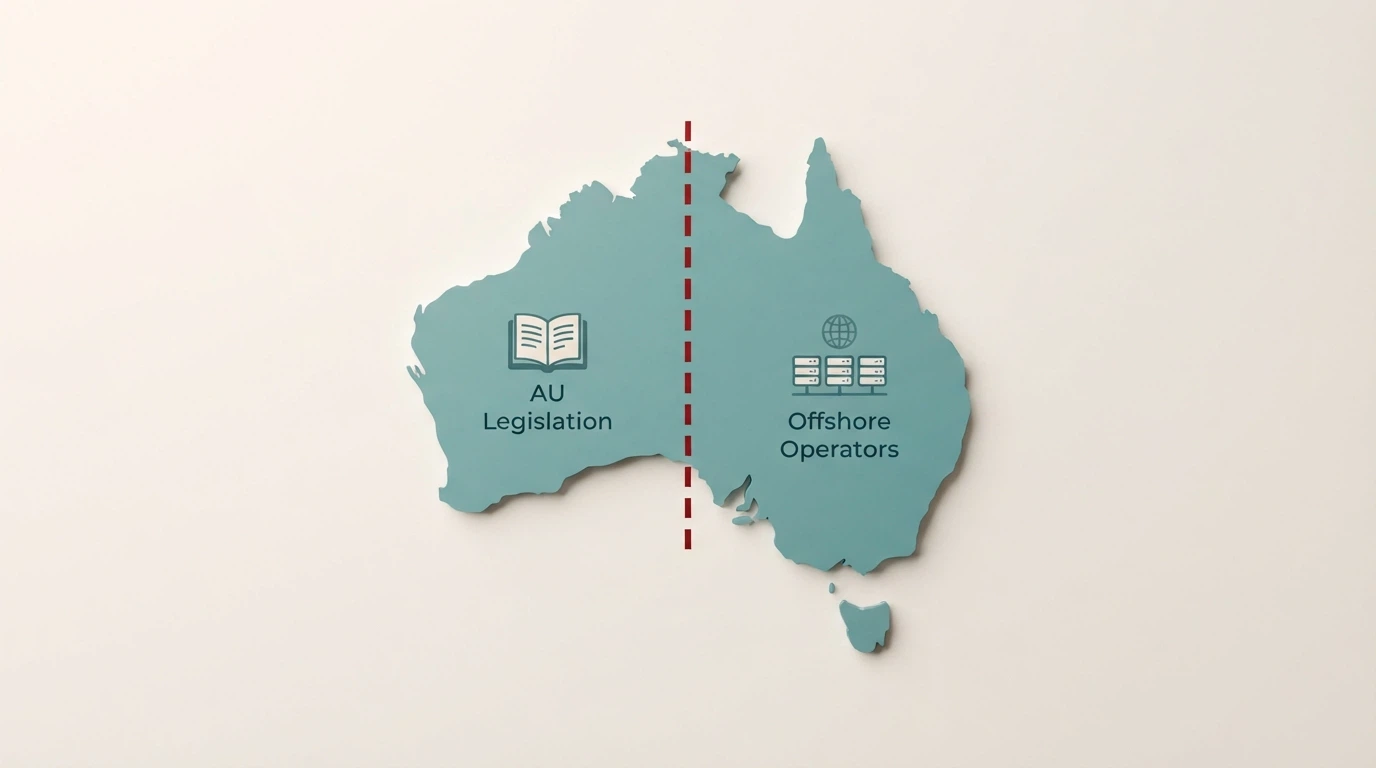
The real question is not whether depositing is illegal. It is what the player gives up by depositing offshore, and the answer is concrete. There is no Australian consumer protection, no ACMA recourse on a dispute, no BetStop coverage, no Australian chargeback path, and the site can be DNS-blocked with a balance still on it. The licensed Australian wagering market — sports and race betting, lotteries, keno — has a deposit-method framework, a self-exclusion register and a regulator attached to it. The offshore casino market has none of those.
What the Interactive Gambling Act Actually Prohibits — and What It Doesn’t
The IGA draws a bright line. The three prohibited products are online casino, online pokies and in-play betting on a sporting event once it has started. The three licensable products are pre-event wagering on races and sport, lotteries and keno. The credit-card and crypto ban attaches to the licensed side: the prohibition is on accepting those payment methods for online wagering by an Australian-licensed operator.
ACMA enforces the online prohibition. The agency investigates complaints, issues formal warnings, brings civil penalty proceedings and directs ISPs to block illegal sites. Since the first blocking request in November 2019, 1,788 illegal gambling and affiliate websites have been blocked as of August 2026. Over 230 illegal services have withdrawn from the Australian market since ACMA started enforcing in 2017. In Q4 2025 alone, ACMA completed 23 investigations into 45 gambling sites, found 69 breaches of the IGA, issued 10 formal warnings and referred 133 websites for ISP blocking. The enforcement is active, ongoing and growing in volume.
The licensed wagering side, by contrast, runs through state and territory regulators. In practice, the licensing concentrates with the Northern Territory Racing and Wagering Commission (NTRWC), administered through Licensing NT. Licences run for terms of up to twenty years. The licensed product is different from the prohibited one: a Sportsbet or bet365 account is for pre-event sports and race wagering, not for online casino or pokies.
Licensed Wagering vs Offshore Casinos: Your Payment Method Tells the Story
The payment method is the cleanest test. A licensed Australian wagering operator takes debit card, bank transfer, PayID/Osko and BPAY. An offshore casino adds credit cards, crypto, e-wallets, prepaid vouchers and a handful of mobile wallets. A site that asks an Australian customer for a credit card or a crypto deposit is, by that request, outside the Australian rules.
The legal difference is not the only difference. A licensed wagering customer has Australian consumer protection on disputes, ACMA as a recourse body, BetStop as a self-exclusion tool and an Australian bank chargeback path. An offshore casino customer has none of those. The offshore site can be blocked at any time; the player’s balance can be stranded; the operator’s terms govern every dispute, and the operator’s terms favour the operator. The “instant withdrawal” the casino advertises is the operator’s approval speed, not a payment the player can compel.
The 2026 reform, passed in August 2026 and commencing 1 January 2027, narrows the gap on the bank side. Banks and payment providers gain express authority to block transactions to illegal gambling operators, which means a deposit at an offshore casino may be declined at the bank level rather than at the cashier. The reform does not legalise online casino and does not criminalise the individual player. It adds a layer of friction on the payment side and leaves the prohibition on the product side intact.
The 2026 Gambling Reform Bill: What Changes on 1 January 2027
The Interactive Gambling Amendment (Gambling Reform) Bill 2026 passed Parliament on 19 August 2026, and its measures commence on 1 January 2027. The bill does not legalise online casino. It does three things.
The first is bank and payment-provider authority to block transactions to illegal gambling operators. The licensed product gets a new layer of payment-side enforcement, and offshore operators get a new reason for an Australian deposit to be declined at the bank. The second is advertising restrictions: a cap of three wagering ads per hour on TV between 6:00 am and 8:30 pm, a live-sport blackout from fifteen minutes before to five minutes after each event, radio ads barred during school times, broadcasting of sporting odds banned, online ads limited to logged-in and verified-over-18 users with an opt-out, and a bar on athletes, celebrities and influencers promoting wagering. The third is inducement marketing rules: no direct marketing for fourteen days after sign-up, for three months after a customer deregisters from BetStop, and indefinitely for customers identified as at risk of gambling harm.
What the reform does not do is the other half of the picture. It does not legalise online casino, does not introduce a licensing regime for offshore operators, and does not prosecute the individual player. It tightens the licensed product and adds friction to the unlicensed one. The deposit at an offshore casino becomes harder to make; it does not become illegal to attempt.
Fast Deposits, Real Harm: Keeping Your Casino Spending Under Control
Instant deposits make it easy to chase a loss. The harm numbers in Australia are the largest per person on earth, and the tools that exist to manage spending reach only the licensed side.
Between March 2025 and March 2026, Australians lost A$36.0 billion to gambling — more per person than any other country. Roy Morgan’s March 2026 figure puts 15.1 per cent of the Australian population, or 3,320,000 people, in some form of gambling harm, including 2,857,000 from their own gambling and 1,177,000 from others’. The Journal of Gambling Studies’ modelled national estimate for 2026 puts the affected population at 3.29 million Australians aged five and over, with an annual health loss exceeding 400,000 Years Lived with Disability. Gamblers at the highest risk levels affect an average of six other people, and 67 per cent of those who participate in sports and race betting are classified at some risk of gambling harm.
BetStop, the National Self-Exclusion Register, has recorded 67,480 registrations since launching in August 2023, with 41,290 exclusions still active as at 31 July 2026. Seventy-eight per cent of registrants are under 40, and 38 per cent chose a lifetime exclusion. The register binds Australian-licensed wagering services. It does not reach an offshore casino, and a self-excluded player who opens an account at an offshore site will find the site accepts the deposit and offers the games. The register is real; its scope is the licensed market only.
Deposit Limits, Activity Statements and the Controls Every Aussie Punter Should Set
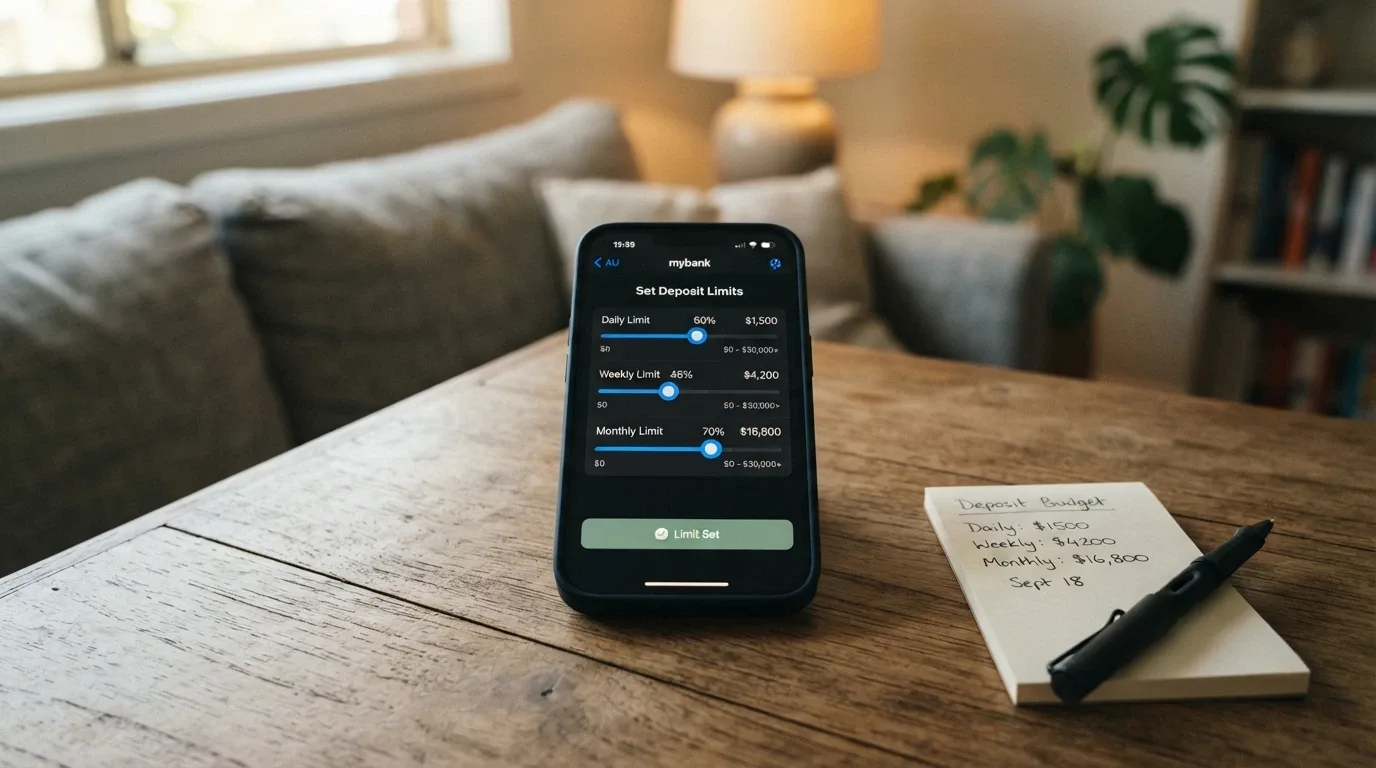
The licensed wagering product requires customer-set deposit limits and activity statements, with conditions that vary by state. A player can set a daily, weekly or monthly deposit ceiling, and the operator is required to honour it. Activity statements give the player a regular view of what they have spent, won and lost. Take-a-break and self-exclusion tools are also part of the licensed product.
The offshore product is unregulated by Australian authorities. Some offshore operators offer deposit limits voluntarily, and the better ones honour them; others offer the controls as a marketing feature without enforcement. There is no Australian regulator checking the offshore side, and a player who has set a limit at an offshore site and then tries to raise it has only the operator’s word on whether the change is processed cleanly.
A player who wants controls that hold regardless of the platform can set them at the bank. Most Australian banks allow gambling transaction blocks at the card level, and the credit-card ban at licensed wagering operators has pushed banks to extend the same block to offshore merchants. Prepaid voucher caps (the A$10 floor on Neosurf, the A$800 ceiling on CashtoCode) are a structural limit: the player can only deposit what the voucher allows. A combination of a bank-level block and a low voucher ceiling is the closest a player gets to an enforced deposit limit at an offshore casino.
Where to Get Help: The Numbers Every Australian Player Should Have
The help infrastructure is free, confidential and available 24/7. The National Gambling Helpline is 1800 858 858. Gambling Help Online, at gamblinghelponline.org.au, offers online chat and counselling. BetStop registration is at the ACMA website and covers licensed wagering operators.
The hard truth is that none of these reach an offshore casino directly. A player who needs help with a balance held at an offshore site has fewer levers: the helpline and Gambling Help Online can support the player, but the operator is outside Australian consumer law and the self-exclusion register does not bind it. The licensed-side tools are real and effective; the offshore-side gap is the part of the picture competitors do not draw, and the part that matters most when the harm is already done.
How We Evaluated and Ranked These Casino Payment Methods
The comparison rests on operator payment pages, regulator publications and the methods and operators the research confirmed for the Australian market. The primary sources are the ACMA register, the Australian Business Register, Parliament of Australia bill digests and the published cashier and terms pages of each featured operator. The ranking is built on four criteria: breadth of payment methods, withdrawal speed, minimum deposit, and licence transparency, applied qualitatively rather than as a weighted score.
Every operator in the featured set is offshore-licensed. None holds an Australian casino licence, because no Australian casino licence exists. The product is prohibited under the IGA, and the comparison is between offshore operators rather than between an Australian option and an offshore one. Where an operator’s payment, bonus or speed data is not confirmed in the available sources, the table carries an em dash and the operator write-up states the gap. Where a method is named in competitor pages without AU-specific confirmation, the method is named in the section it belongs to with the data caveat attached.
What Your Casino Payment Method Actually Decides: The Verdict for Aussie Players
The payment method sets four things at once: how fast the deposit lands, how fast the withdrawal clears, what the player pays in fees, and what the player keeps in protection. No method wins on all four.

PayID and crypto (especially USDT on TRC20 and Solana) win on speed — deposits in under thirty seconds for PayID, withdrawals in under five minutes on the fastest crypto chains. E-wallets win on privacy — the bank sees Skrill, Neteller or MiFinity, not the casino. Prepaid vouchers win on the no-bank-trail floor, at the cost of being deposit-only. Bank transfer and BPAY win on transaction size, at the cost of three-to-seven-day timelines. Cards are the most familiar, with the credit-card ban hanging over the licensed side and a fee structure that is generally low but not zero.
The licensed-versus-offshore frame is the harder comparison. A licensed wagering operator gives the player ACMA recourse, BetStop coverage, an Australian chargeback path and a regulator to complain to. An offshore casino gives the player broader method choice, larger bonuses and faster rails, and gives up every one of those protections. The 2026 reform adds bank-side friction to the offshore side from 1 January 2027, but it does not legalise the product.
The practical takeaway is to match the method to the value the player is protecting. Speed and breadth: PayID, USDT TRC20, Solana, or a multi-coin cashier like Rainbet or Rocket Play. Privacy: Skrill, Neteller, MiFinity, or a prepaid voucher with a crypto or e-wallet withdrawal path. Protection: licensed wagering with debit, PayID or BPAY, where the Australian framework applies. High volume: BPAY or a standard bank transfer, accepting the three-to-five-day timeline. The decision is the reader’s, and the method the reader picks is the one that sets every other variable.
Frequently Asked Questions
Can I use a credit card to deposit at an Australian online casino?
No, not at a licensed Australian wagering operator. Credit cards and credit-related products have been banned as payment for online wagering since 11 June 2024, with penalties for non-compliance reaching A$247,500. Offshore casinos may still accept a credit card at the deposit step, but the bank is increasingly likely to decline the transaction at the merchant category code level, and the player loses the dispute path that a debit card would offer.
How fast are PayID withdrawals from online casinos?
PayID withdrawals typically reach the player’s bank in under sixty minutes once the operator has approved the payout, with some operators processing in five to ten minutes. The distinction that matters is between operator approval time and PayID settlement time: the operator may take hours or days to release the funds, but once the release happens, PayID clears fast. Bizzo Casino and SkyCrown are the featured operators that offer PayID for both deposits and withdrawals.
Why was my casino deposit declined by my Australian bank?
The most common reasons are a credit card being used at a licensed wagering operator (banned since 11 June 2024), a bank fraud flag on an offshore casino transaction, a card issuer blocking a gambling merchant category code, or, for crypto-funded deposits, a flagged or delayed outbound transfer from an Australian bank to a crypto exchange — roughly forty per cent of transfers in 2026 testing were affected. The first check is whether the card is a credit card; the second is whether the casino is on the ACMA blocked-site list; the third is whether the bank has applied its own gambling block independently of the merchant.
What is the minimum deposit at Australian online casinos?
The floor ranges from A$10 to A$46 across the featured operators, with prepaid vouchers typically setting the lowest bar — Neosurf is available from A$10. SkyCrown and Fair Go sit at A$20, Rocket Play at A$25 for cards and A$30 for the bonus-qualifying deposit, Rainbet around A$23 standard and A$46 for the welcome bonus, and Royal Reels at A$30 for the deposit match with a separate A$10 no-deposit bonus. The catch is that the lowest deposit floor often gates the welcome bonus behind a higher threshold, so a player chasing the bonus is funding more than the cashier minimum.
What is the fastest way to withdraw winnings from an online casino in Australia?
Crypto on the fastest chains and PayID are the two fastest withdrawal rails, but speed depends on the chain, the operator’s approval queue and whether the player has cleared KYC. USDT on TRC20 and Solana settle in under five minutes, PayID in under sixty minutes once approved, ETH and LTC in five to thirty minutes, e-wallets in one to six hours, BTC in thirty to sixty-plus minutes for three to six confirmations, cards in one to three business days, and bank transfers in three to seven business days. The operator-approval bottleneck is the variable that usually decides the actual experience: a fast rail paired with a forty-eight-hour approval queue is no faster than a slow rail with an instant release. First-withdrawal KYC is the universal delay and is independent of the method.
Is it legal to deposit at offshore online casinos from Australia?
Providing an online casino to a person in Australia is prohibited under the Interactive Gambling Act 2001, and the individual player is not prosecuted under the Act — the IGA targets the provider, not the customer. The practical risks are not legal but protective: no Australian consumer protection, no ACMA recourse on a dispute, no BetStop coverage, the site can be ISP-blocked at any time with a balance on it, and there is no Australian chargeback path. Legality and safety are not the same question. A deposit at an offshore casino is not prosecuted; it is also not protected.
Mobile and Phone-Billing Casino Deposits: Real Option or Gimmick?
Phone-billed and SMS-billed deposits sound frictionless: confirm by text, the deposit lands in the casino balance, the charge appears on the next phone bill. In practice, the caps are low, the fees are high, and Australian carrier support is thin. The carrier fees typically run at fifteen to thirty per cent of the deposit amount, and the daily cap is usually under A$30. The combination rules out a meaningful bankroll.
The handful of Australian-facing casinos that list mobile or phone payment in their cashier page are usually routing through an international SMS-billing aggregator with limited AU carrier integrations, and the deposit either works the first time or never works. The few competitor pages that mention SMS payment as a method do not give AU-specific data on which carriers support it, which means the player is gambling on the rail as well as the casino.
Mobile payment as distinct from paying by card on a phone is the cleaner concept: a player using Apple Pay or Google Pay to fund a Visa or Mastercard transaction is paying by card through a mobile wallet, not paying by phone bill. The distinction matters for the fee structure and the withdrawal options.
Written by the editors at Live Casino Australia.