7-Reel Pokies for Australian Players: The Real-Money Reality in 2026
 Available in AU
Pokies with seven reels are the small, opinionated corner of the online slots market that rewards players willing to chase larger, less frequent payouts from a denser grid. For an Australian reader, that product sits inside a paradox. There is no online casino licence available anywhere in the country, so every real-money route to a 7-reel pokie runs through an offshore operator the ACMA cannot regulate. This page maps what the 7-reel format actually is, which titles carry verified RTP data, and what an Australian punter is realistically signing up for when they deposit.
Data current as of 18 October 2026, verified against the ACMA licensed wagering register and the Interactive Gambling Act 2001.
Table of Contents
- What a 7-Reel Pokie Actually Is (and Why It’s Different)
- Play 7-Reel Pokies for Free — No Download, No Account
- The Real-Money Question Every Australian Punter Asks
- 7-Reel Bonuses Worth Reading the Fine Print For
- Mobile 7-Reel Pokies: Browser, Not App Store
- The Law Australian Pokie Players Actually Need to Know
- Staying in Control When the Pokie Site Has No BetStop
- 10 Offshore Casinos With 7-Reel Pokies Australians Can Access
- How We Selected and Ranked These 7-Reel Pokie Operators
- Your Next Play: Staying Safe With 7-Reel Pokies as an Australian
- Frequently Asked Questions
What a 7-Reel Pokie Actually Is (and Why It’s Different)
A 7-reel pokie is a slot machine built around seven vertical columns rather than three or five. The standard layout these days is a 7×7 grid: 49 symbol positions per spin against 15 on a regular 5×3 pokie. That single number — 49 versus 15 — is the difference the rest of the format follows from. More positions per spin means more ways for a winning pattern to form, which is why most 7-reel titles abandoned the payline altogether.

The category exists separately from 5-reel Megaways for a reason worth getting straight at the top of a guide like this. Megaways is a random-reel mechanic licensed by Big Time Gaming that swaps a fixed reel layout for a variable number of symbols per reel on every spin — a 6-reel Megaways game can produce up to 117,649 ways to win. A 7-reel pokie uses a fixed grid with cluster pays, not a variable reel. The maths models overlap (both lean high-volatility, both produce feature-round-driven outcomes), but the player experience is structurally different. Megaways plays like a turbocharged 5-reel game with shifting reel heights; a 7-reel pokie plays like a board where symbols fall into groups.
For an Australian reader: throughout this page the term pokie is used in place of slot. The mechanics — reels, paylines, cluster pays, RTP, volatility — are identical; only the word changes. The legal status, which is the subject of its own section further down, is also identical: online pokies are prohibited to provide under the Interactive Gambling Act 2001, and every real-money route to one is offshore.
The 7×7 Grid Versus Every Reel Layout You’ve Seen Before
The 3-reel classic is the slot machine most Australian readers remember from the front bar — three vertical columns, one payline, cherries and BARs and 7s. The 5×3 video pokie added two reels and somewhere between 9 and 243 paylines, depending on the design. Both formats resolve a win by checking a fixed line from left to right. The 7-reel grid breaks that logic entirely. With 49 symbol positions on a 7×7 layout, the left-to-right line stops being a useful way to describe what counts as a win, and designers moved to cluster pays — any group of five or more matching symbols touching horizontally or vertically registers as a payout.

The shape of the play area is also wider — close to square — which changes the way wins feel as they cascade. The visual difference between a 5×3 pokie and a 7×7 grid on the same screen is the difference between a long thin strip of symbols and a dense, almost checkerboard-feeling board. That density is also why most 7-reel titles lean heavily on tumble and cascade mechanics. When a winning cluster pays out and disappears, the symbols above drop into the gap and a new pattern can form on the same paid spin.
How Cluster Pays Replaced Paylines — and Why It Matters
Cluster pays is the rule that wins form from groups of adjacent matching symbols — five or more connected horizontally or vertically — rather than from a specific line of symbols reading left to right. The mechanic has been the dominant win-formation system on grid-style slots since the mid-2010s, and it pairs naturally with grids that range from 5×5 to 7×7. The geometry of the grid is what makes cluster pays readable: on a 5×3, clusters barely form, but on a 7×7 there is room for several overlapping groups to resolve in one spin.
A cluster-pays spin typically runs longer than a payline spin because of cascading reels. When a cluster pays, those symbols vanish. The symbols above drop down to fill the gap. New symbols appear at the top. If the new arrangement produces another cluster, that cluster pays too — all on the same spin, all on the same stake. The spin does not end until either no new cluster forms or a feature round kicks in. On a high-volatility 7-reel title with sticky wilds, multiplier positions and charge meters layered on top, a single paid spin can resolve into four, five or six payouts in succession.
The other mechanic that has clustered around this format is the bonus buy. Paying, say, 100× the stake to trigger the feature round immediately rather than waiting for it to land organically. Bonus buy is most useful for players who want to test what the feature round actually pays, and is the reason demo mode and bonus buy together make the 7-reel format unusually easy to evaluate before staking real money.
The 7-Reel Titles Worth Knowing by Name and Number
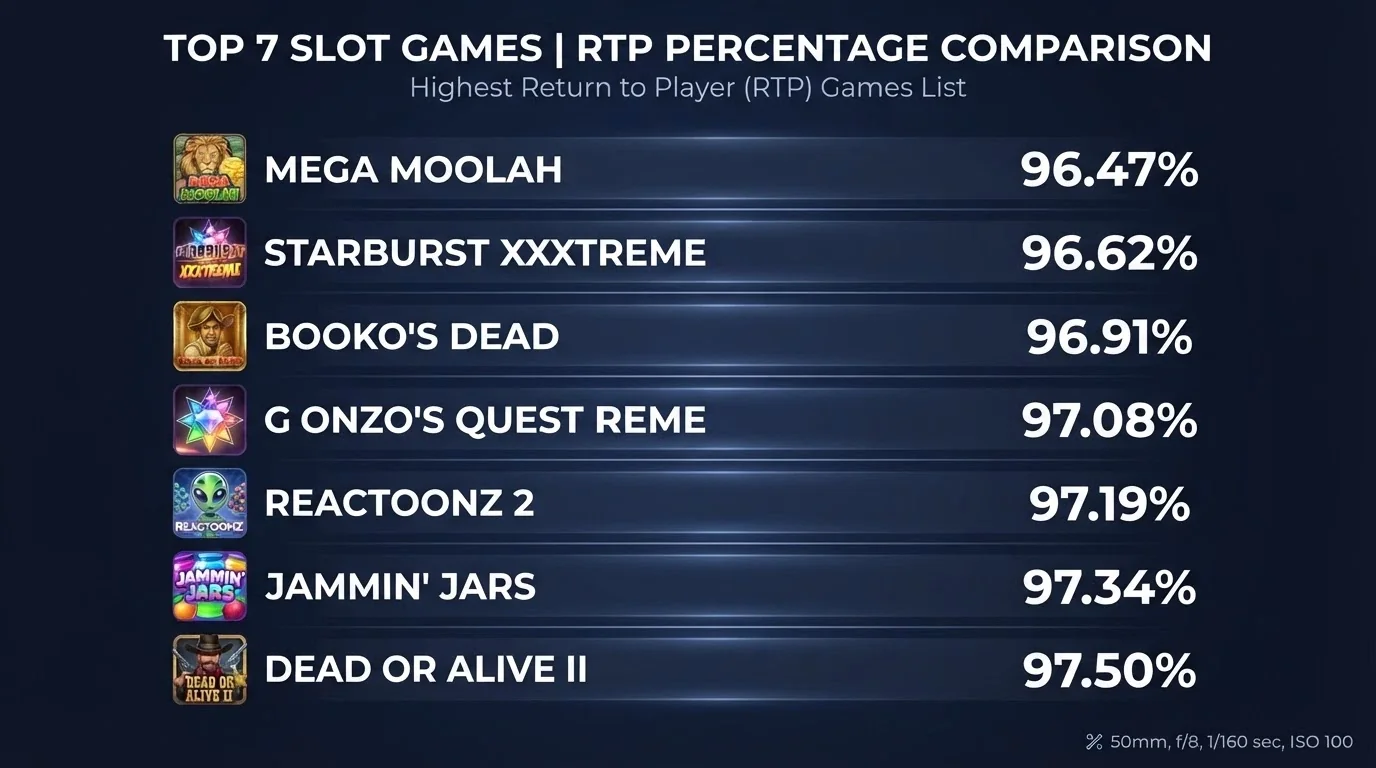
The titles below are the shortlist of 7-reel pokies with verified RTP, volatility and max-win data — not a catalogue, a comparison. White Rabbit sits on the list because its base game uses a 7-symbol reel layout with a Megaways-style expanding feature; the rest of the table are fixed 7×7 grids. RTP, in particular, is configurable per casino: providers ship multiple certified RTP bands per title (often 96.x%, 94.x%, 92.x% and 88.x%), and the operator selects the version. Always check the in-game info screen before staking.
| Title | RTP | Volatility | Max Win | Provider |
|---|---|---|---|---|
| Sugar Rush 1000 | 97.5% | High | 25,000× | Pragmatic Play |
| Reactoonz | 96.51% | High | 4,750× | Play’n GO |
| Gemix | 96.83% | Medium | 4,500× | Play’n GO |
| Fiesta Clusters | 97.0% | High | 5,000× | BGaming |
| Seven 7’s | 96.6% | High | 25,000× | — |
| Jurassic Party | 96.47% | High (5/5) | 20,000× | Relax Gaming |
| White Rabbit | 97.24% | — | 13,000× | Big Time Gaming |
The RTP band across the seven titles runs from 96.47% to 97.5% on the version research verified — but a player walking into an offshore casino should expect a lower version of one or more of these titles, not the headline figure. Two of the seven (Seven 7’s, White Rabbit) carry a missing cell that research did not surface; the comparison is honest rather than padded. The max-win figures are the ceiling, not the typical payout; the section on volatility below explains why that gap is the operating reality of the format.
From Arcade Cabinet to Browser Window
The 7-reel format is older than its current audience. Land-based cabinets with grid-style layouts existed in arcades and large-floor casinos from the early 2000s, when game designers were experimenting with grid mechanics and matching-symbol payouts. The format moved online in the late 2000s and found its natural home once studios stopped building downloadable clients and shipped everything through the browser. Every title on the shortlist runs in HTML5 — meaning the same build plays on desktop and mobile, no app download required, and the demo and real-money versions are the same game with the stake switched.
The practical consequence for an Australian reader is that the barrier between “I want to see what a 7-reel pokie looks like” and “I am playing one” is one click. No plugin, no client, no App Store detour. Most of the operators further down this page also expose a demo mode that runs without a sign-up, so the test drive is genuinely free and genuinely complete.
High Volatility Is the Format’s Default, Not a Bug
Most 7-reel slots lean toward high volatility — wins come less frequently but pay larger amounts when they hit. That is not a quirk of one or two providers; it is structural. A 7×7 grid with cluster pays and cascading wins produces a more variable outcome than a 5×3 payline pokie, because each spin resolves a longer chain of events. Multiply that by sticky wilds and multiplier positions and the variance increases again. Megaways games — a separate but related format — show the same shape, with certified RTPs usually sitting between 94% and 96.5%.
For a player, the practical meaning is straightforward. A 7-reel session will eat a small bankroll faster than a low-volatility pokie will, and the bigger payouts come from feature rounds rather than base-game clusters. Treat the bankroll accordingly. A useful framing is to budget per session what you would spend on a couple of cinema tickets and treat anything left after the session as the cost of the entertainment.
Play 7-Reel Pokies for Free — No Download, No Account
The single best way to evaluate a 7-reel pokie is to spin it in demo mode before staking real money. Every title on the comparison table above supports demo play through at least one of the operators further down this page — usually through several. Demo mode is the same game, same RTP, same maths model, with the only difference being that the stakes are virtual.
Instant Browser Play: Demo Mode Without the Download
HTML5 has collapsed the difference between “demo” and “real money” into a single build. Open a browser tab, navigate to a 7-reel pokie, choose demo or fun mode, and the game loads in seconds. No client download, no app install, no email confirmation. On mobile the same flow applies: open the operator in Safari or Chrome, pick a 7-reel title, and the demo loads directly. Rainbet, the operator with the deepest library in the operator set, runs its 14 provably fair Originals in demo mode by default, so the test drive is friction-free for that catalogue in particular.

The technical reason this works is that the game runs in the browser rather than on a server. The result of every spin is computed locally and then verified against a server-side hash, which is how provably fair systems reconcile the player and the operator. The player does not need to understand that part — only that the demo is the game, not a marketing reel.
No-Registration Free Play Versus Casino-Tethered Demos
Two demo models exist across the offshore operators reaching Australian players. The first is no-registration demo: open the title, spin, close the tab. No email, no marketing follow-up, no KYC step. Rainbet runs its full catalogue this way for the Originals and most third-party games. The second is casino-tethered demo: the title loads only after a soft account is created, even if no deposit is taken. The tethered model usually adds a marketing email and an offer to deposit within a session timeout.
The tradeoff is straightforward. No-registration demos are faster and leave no trace. Casino-tethered demos require an account but give the player a clearer sense of what the operator’s lobby, banking and bonus screens look like before any deposit. Neither demo commits the player to anything. The smarter route for an Australian reader is to spend a session or two on the no-registration demos to learn the format, then — if real-money play is going to happen — open an account at one of the operators further down and read the bonus terms before depositing.
The 7-Reel Free-Play Titles Where the Bonus Round Actually Triggers
Demo mode is a useful test only if the feature round actually fires in a reasonable number of spins. Most 7-reel high-volatility titles run long dry spells between bonus triggers, which makes demo evaluation slow if the player is waiting on the feature. Four titles on the shortlist are reliable on this front. Sugar Rush 1000 (Pragmatic Play), Reactoonz (Play’n GO), Gemix (Play’n GO) and Jurassic Party (Relax Gaming) all trigger their feature rounds often enough that a 200-spin demo session almost always sees the bonus. Use those four for the format test drive.
The point of running the bonus round in demo is to see what it actually pays. Sugar Rush 1000’s bonus is a multiplier-trail round that escalates as cascades continue; Reactoonz’s Gargantoon feature builds a 3×3 wild across the grid; Gemix runs a pattern-collection feature across three crystal worlds; Jurassic Party combines a free-spin round with random dinosaur modifiers. None of those feature structures is obvious from the base-game symbols alone. Demo is the only way to see them before staking real money.
Classic-Reel Nostalgia in a 7-Reel Package
The 7-reel format also hosts titles built around classic fruit-machine themes — bells, 7s, BARs — but with the modern cluster-pays grid underneath. Seven 7’s is the clearest example: RTP of 96.6%, high volatility, max win of 25,000×, on a 7×7 cluster grid dressed in neon fruit-machine iconography. Pragmatic Play’s Fruit Party is the same idea with a different colour palette — cherries, grapes and strawberries on a 7×7 grid with cluster pays and a tumble mechanic.
The hybrid works because the dense grid rewards a larger symbol count than a 3-reel classic can carry, while the symbols themselves feel familiar. A player who grew up on the 3-reel BAR-and-cherry pokie at the pub can play Seven 7’s and recognise the symbols immediately, even though the underlying maths model is structurally closer to Sugar Rush 1000 than to a 3-reel mechanical machine.
The Real-Money Question Every Australian Punter Asks
Online pokies in Australia sit on the prohibited side of the rule book. Every real-money route to a 7-reel pokie runs through an operator that sits outside Australian consumer protection, self-exclusion and payment-ban rules. The rest of this section walks through what that means for the deposit-to-withdrawal lifecycle at an offshore casino; the statute itself is unpacked in the legal section further down.
What Staking Real Money on 7-Reel Pokies Actually Means Offshore
The Interactive Gambling Act 2001 makes it an offence to provide online casino games, online pokies or in-play sports betting to a person in Australia. No licence exists for that product anywhere in the country. Every operator further down this page that takes AUD deposits is doing so from offshore — Curaçao, Anjouan, or another non-Australian jurisdiction — and the ACMA’s enforcement tools reach the operator, not the player. The statute itself is detailed in the legal section below; the practical effects are what matter here.
For an Australian punter, the practical consequences are these. There is no Australian consumer protection if a withdrawal is delayed or refused. The ACMA cannot recover money from an illegal operator — that pathway simply does not exist. The site can be DNS-blocked by Australian ISPs at any time, with a balance still on it. The offshore operator is not connected to BetStop, so a self-exclusion registered through BetStop does not stop a deposit. And the legal payment restrictions — the credit-card and crypto ban on licensed wagering — do not bind the offshore operator, which may still accept both, even though that is itself a signal the operator sits outside the Australian regime.
Deposit, Play, Withdraw: the Real-Money Route Without an AU Licence
The deposit-to-withdrawal lifecycle at an offshore casino looks like this in practice. The player opens an account, completes whatever identity check the operator requires (some offshore brands run full KYC; others, particularly crypto-first operators like Stake, do not require it for standard crypto deposits), and funds the account in AUD or in a cryptocurrency that the casino accepts. The player plays, requests a withdrawal, and waits. Withdrawal times range from a few hours at the better-run operators to several days where compliance is slow. KYC is the friction point most likely to stall the process — the operator asks for documents, the player supplies them, and a slow review can hold the payout.
The concrete example worth naming is WinSpirit. WinSpirit’s Casino.Guru Safety Index sits at 3.2 — the “Very low” band — with a very high volume of restrained-payout complaints relative to the operator’s size. That is the single most important signal in the operator comparison table further down. WinSpirit’s terms include a 100% up to AU$500 welcome plus 50 free spins, but the safety indicator is the more useful figure for a player evaluating whether to deposit. A note on the operator table: WinSpirit is named here precisely because the safety data is available and unflattering; suppressing it would not help any reader.
For a player choosing between the operators further down, the rule of thumb is simple: shorter track records, smaller complaint volumes, and faster KYC are all better signals than a bigger bonus number with weaker protections behind it.
7-Reel Bonuses Worth Reading the Fine Print For
The headline numbers on welcome bonuses — 450% up to A$8,000, 300% up to A$3,000, 250% up to $1,750 — read like generosity. The fine print rewrites them. The four constraints that compress a welcome offer the most are wagering multipliers, free-spin winnings caps, the deposit-gated versus bonus-only structure of the playthrough, and the time window in which the wagering has to be completed. This section works through what those constraints cost the player.
What “Free With Bonus” Actually Delivers
A “free” bonus that requires 35× the bonus in turnover is not free; it is a precondition. Take Royal Reels’ first-deposit offer: 100% up to A$500 at 35× wagering on the bonus only. On a A$500 bonus, the required turnover is A$17,500 — the player has to place A$17,500 in bets before the bonus converts to withdrawable cash. Compare that to a 30× deposit-and-bonus structure on a similar headline: a A$500 deposit plus a A$1,500 bonus carries a A$60,000 playthrough, because the multiplier is applied to both halves of the combined balance. Bonus-only wagering is friendlier, but it is still a serious volume of play.
The cost is not only the time spent wagering. It is the expected loss on the turnover itself, which is a function of the RTP of the game the wagering is run on. Take Sugar Rush 1000, the 7-reel title with the highest verified RTP at 97.5%, which means a house edge of 2.5%. Running A$17,500 of required turnover against a 2.5% house edge produces an expected loss of A$437.50 — a statistical estimate, not a guaranteed outcome, but the right number to plan against. That is the cost of clearing a A$500 bonus on the friendliest RTP available in the format, before any of the bonus becomes withdrawable.
The maths of the calculation deserves a clear statement. An A$500 bonus with 35× bonus-only wagering, run on a 97.5% RTP game, has an expected cost of A$437.50 against the player before any of the bonus converts to withdrawable cash. The bonus is still worth playing for in some scenarios — but only because the expected loss is less than the bonus amount, and only when the player chooses a high-RTP title for the wagering. Move the wagering to a 94% RTP title and the expected loss climbs past A$1,000, on a A$17,500 turnover. Move it to an 88% RTP configuration and the expected loss outruns the bonus value, and claiming the offer becomes a worse deal than depositing the same A$500 without it.
No-Deposit Chips and Free-Spin Packages Side by Side
The two low-commitment offer types are no-deposit chips and free-spin packages. The clearest no-deposit chip in the surfaced data is Royal Reels’ A$10 free chip at 30× wagering — a small amount, modest playthrough, no deposit required. The no-deposit chips at Fair Go are more demanding: 60× wagering with a A$180 cashout ceiling, which turns most wins over A$180 into a non-event because the ceiling caps the withdrawal before the wagering can pay out.
Free-spin packages have a different shape. SkyCrown’s 400 free spins across four deposits come with 30× wagering on the spin winnings and a A$5,000 maximum cashout on the welcome bonus. Rocket Play’s 100 free spins sit behind a 40× wagering requirement with a AU$5,000 cap on free-spin winnings. Rainbet’s 60 free spins across three deposits are paired with either a 40× wagered bonus or a no-wager gradual-release option, the latter of which is the only no-wager free-spin structure on this page.
The cashout ceiling is the constraint most worth reading before claiming any of these offers. A A$5,000 cap on free-spin winnings does not mean the player cannot win more than that on a single spin — it means anything over the ceiling is forfeited on withdrawal. Combined with the wagering requirement, that ceiling is the moment an offer’s marketing number collapses into its real number. Run the maths the way the previous paragraph does it, on the title you intend to use the spins on, and the picture becomes readable.
Mobile 7-Reel Pokies: Browser, Not App Store
A 7-reel pokie app does not exist in the App Store or Google Play, and it does not need to. Every title on the comparison table runs in HTML5 — meaning the same build serves desktop and mobile through the browser. The reason is technical: the games run in the browser rather than on a server, so the same code path serves every device that supports a modern browser. Mobile compatibility is a default, not a feature, on every platform further down.
For an Australian reader the practical effect is that opening the operator in Safari on iPhone or Chrome on Android produces the same lobby, the same demo mode and the same real-money flow as the desktop build. No native app to download, no sideloaded APK, no version mismatch between desktop and mobile. The only mobile-specific consideration is data usage: a 7-reel title with cascading animations and continuous tumble mechanics consumes more bandwidth than a 5×3 pokie, so players on a metered mobile plan should use Wi-Fi for sessions longer than a few minutes.
The Law Australian Pokie Players Actually Need to Know
The law on online pokies in Australia is unambiguous. The Interactive Gambling Act 2001 (IGA) makes it an offence to provide an online casino, online pokies or in-play sports betting to a person in Australia. No licence for that product exists anywhere in the country — not federally, not in any state or territory. The law targets the provider, not the individual player, but the consequence for an Australian punter is that every operator offering real-money 7-reel pokies to an Australian customer is doing so from offshore and outside Australian consumer-protection rules.
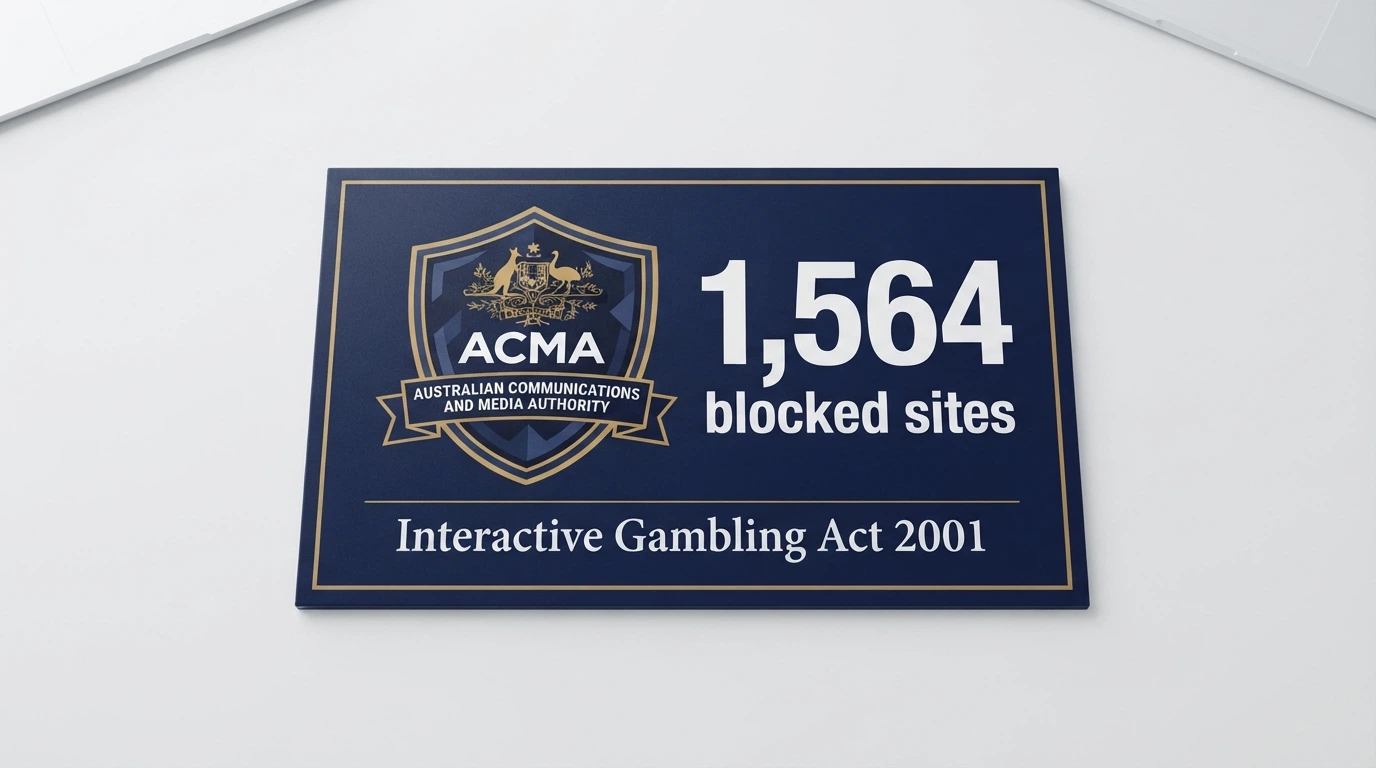
The ACMA — the Australian Communications and Media Authority — enforces the prohibition through ISP-level blocking. Since its first blocking request in November 2019, the ACMA has had 1,564 illegal gambling and affiliate websites blocked by Australian ISPs. A second, parallel effect is that more than 225 illegal gambling services have voluntarily withdrawn from the Australian market since the ACMA began enforcing new illegal online gambling rules in 2017. The withdrawal number is the more interesting of the two because it shows operators deciding that serving Australians from offshore is no longer worth the regulatory exposure.
The IGA 2001: What the Prohibition Actually Says
Section 15 of the Interactive Gambling Act 2001 prohibits the provision of three services to a person in Australia: online casino games, online pokies, and in-play sports betting. The statute is aimed at the provider, not the player. No Australian has been prosecuted for placing a bet with an offshore casino; the law gives the ACMA the power to go after the people running the site, the people advertising the site, and the Australian banks that move money to the site.
What is licensed, and often confused with the prohibited services, is wagering on races and sport placed before the event begins. The major Australian-facing bookmakers — Sportsbet, bet365, Ladbrokes and roughly fifty others — operate under Northern Territory Racing and Wagering Commission (NTRWC) licences administered through Licensing NT. The NTRWC is the de facto national licensor for online wagering. Those operators cannot legally offer an online pokie product; they can offer pre-event sports and racing bets. The minimum age for any form of Australian wagering is 18.
What the 2026 Gambling Reform Means for Online Pokies
The Interactive Gambling Amendment (Gambling Reform) Bill 2026 passed Parliament on 19 August 2026, and its measures commence on 1 January 2027. The reform is the most significant tightening of the IGA since the 2017 amendments. Three of the reform’s measures matter most for an offshore-pokie reader. Banks and payment providers gain express authority to block transactions to illegal gambling operators — today the legal ground for a transaction block is thinner; from 1 January 2027, an Australian bank can refuse a card transaction headed for an offshore casino without a separate court order. The ACMA’s expanded takedown powers let it act faster on illegal sites, with shorter procedural timelines. Direct marketing of inducements is prohibited for 14 days after a customer signs up, for three months after a BetStop deregistration, and indefinitely for customers identified as at-risk.
The wagering-advertising rules are also tightened: no more than three wagering ads per hour between 6:00 am and 8:30 pm, a live-sport blackout from 15 minutes before to 5 minutes after an event, an athlete/celebrity/influencer ban, and a prohibition on broadcasting sporting odds. Foreign matched lotteries and online keno are added to the prohibited-services list. None of these changes legalise online pokies; they only tighten the prohibition. For an Australian reader using offshore casinos, the bank-blocking authority will make it harder to fund an offshore account from an Australian debit card, and the ACMA’s expanded takedown powers will shorten the half-life of an offshore site that is on the ACMA’s radar.
Offshore Versus Licensed: the Two Markets Side by Side
The cleanest way to see the difference is to compare what an AU-licensed wagering operator must do against what an offshore casino does not have to do. An AU-licensed operator is connected to BetStop — one registration excludes the player from every Australian-licensed wagering service simultaneously. The same operator must offer deposit limits, take-a-break tools, and an internal complaints process that the ACMA can supervise. It cannot accept credit cards or crypto for wagering. Its marketing is constrained by both state-level inducement rules and (from January 2027) the federal advertising cap.
An offshore casino does none of this. It is not connected to BetStop — meaning a self-excluded Australian can deposit the same day. It offers no deposit-limit infrastructure that an Australian regulator can enforce. The ACMA cannot accept a complaint about a withheld payout because the operator is outside the ACMA’s jurisdiction. Credit cards and crypto may still be accepted, in spite of the ban on licensed wagering; in fact, that acceptance is itself a tell that the operator is offshore. The trade-off the player is being offered is access to a prohibited product in exchange for every protection that an Australian licence would have required.
Staying in Control When the Pokie Site Has No BetStop
Offshore casinos sit outside every Australian harm-minimisation system. BetStop binds Australian-licensed wagering services only — an offshore casino is not connected to the register and will keep taking a self-excluded person’s money. The same is true of deposit limits, take-a-break tools, and the activity-statement reminders that AU-licensed wagering operators must provide. When the operator is offshore, the player has to set their own limits, because the operator has no obligation to set any.
The BetStop register itself is real and active. To the end of Q2 of FY 2025-2026, 54,859 people had registered to self-exclude from all licensed Australian wagering services. As at 31 December 2025, 35,135 of those exclusions were still active. The BetStop gap is the single most important practical harm-minimisation issue for an Australian who also wagers with licensed operators: a BetStop exclusion does not reach offshore casinos.
Budgeting and Limits When the Operator Sets None
AU-licensed wagering operators must offer deposit limits, take-a-break options, and activity statements. Offshore casinos offer none of these. The practical substitute is to set the limits before opening the account — not after the first deposit. A session-time budget (for example, a fixed session length, a fixed loss ceiling, or a fixed spin count) is the simplest version. A more structured approach is a weekly deposit ceiling held at the banking side, through a separate account the casino does not have access to.
Free-play demo mode is the zero-stakes version of the same discipline. Every title on the comparison table supports demo play; spending time in demo before staking real money is the cheapest way to evaluate a 7-reel pokie, and the cheapest way to back away from one that is consuming more bankroll than it should be. None of this is a substitute for professional help if gambling is escalating, and the resources in the section below are the right next step when play stops being a choice.
The Help That IS There: Australian Harm-Minimisation Resources
The harm-minimisation infrastructure is domestic, free and 24/7. The National Gambling Helpline is 1800 858 858 — free, confidential, staffed around the clock, with online chat and counselling available through Gambling Help Online at gamblinghelponline.org.au. BetStop registration itself is at betstop.gov.au and excludes the registering person from every Australian-licensed wagering service with a single registration, though it does not reach offshore casinos.

The prevalence figures behind these resources frame the choice. As of March 2026, 13.0% of the Australian population — an estimated 2,857,000 people — were experiencing some form of gambling harm from their own gambling behaviours. 15.1% of Australians, or roughly 3,320,000 people, were experiencing gambling harm from their own or someone else’s gambling. Problem-gambling incidence climbed from 1.9% in 2022-23 to 2.9% in 2024-25. The trajectory is the one that makes the help line non-optional in a guide of this kind — and it is the reason an article about 7-reel pokies has to include this section rather than treat harm minimisation as someone else’s topic.
10 Offshore Casinos With 7-Reel Pokies Australians Can Access
The operators below are listed for comparison. They are not endorsed as places to play. Every operator in the table is offshore, holds no Australian licence, and sits outside the consumer-protection rules that an Australian-licensed wagering service must follow. None of them appears on the ACMA licensed wagering register.

The ranking is by fit to the topic — game count, provider mix covering 7-reel titles, bonus transparency, and the safety indicators where research surfaced them — not by market share. Three of the ten operators (Bizzo, Scream Casino, Rocket Casino) had bonus terms that were not surfaced in the research that fed this page; the table marks them as unsurfaced, and the operator write-ups below explain what to look for when a reader encounters a similar gap elsewhere.
| Operator | AU Licence Status | Welcome Bonus | Wagering | Free Spins | Standout Detail |
|---|---|---|---|---|---|
| SkyCrown | Offshore, no AU licence | 450% up to A$8,000 + 400 FS across 4 deposits | 40x bonus / 30x FS winnings | 400 | A$7.50 max bet, 14-day validity, A$5,000 cashout cap |
| Rocket Play | Offshore, no AU licence | 100% up to AU$1,000 + 100 FS (1st), 200% up to AU$1,000 (2nd) | 40x | 100 | Pragmatic Play & BGaming on roster, AU$5,000 FS winnings cap |
| Royal Reels | Offshore, no AU licence | 100% up to A$500 + 75% up to A$750 + 100% up to A$1,250 (3 deposits) | 35x bonus only | 50 | A$10 no-deposit chip, 30x wagering, A$5/spin cap |
| Fair Go | Offshore, no AU licence | 300% up to A$3,000 + 50 FS on Cash Bandits 2 | 30x deposit + bonus | 50 | RTG-exclusive library, no max cashout on deposit bonus |
| WinSpirit | Offshore, no AU licence | 100% up to AU$500 + 50 FS | 30x–40x | 50 | Safety Index 3.2, very high restrained-payout complaints |
| Stake | Offshore, no AU licence | None (rakeback model) | N/A | — | 3,000+ games, $1.86B monthly volume, provably fair |
| Rainbet | Offshore, no AU licence (Anjouan) | 250% up to $1,750 + 60 FS across 3 deposits | 40x or no-wager | 60 | 7,000+ games, 14 provably fair Originals, demo mode |
| Bizzo | Offshore, no AU licence | — | — | — | Bonus terms not surfaced this run |
| Scream Casino | Offshore, no AU licence | — | — | — | Bonus terms not surfaced this run |
| Rocket Casino | Offshore, no AU licence | — | — | — | Bonus terms not surfaced this run |
Rainbet
Rainbet is the deepest game library in the featured set: 7,000+ titles across providers, plus 14 provably fair Originals that run in demo mode by default. The licence is in Anjouan, which is the offshore jurisdiction the brand sits under — not Australia, and not subject to ACMA jurisdiction. The welcome structure is 250% up to $1,750 across three deposits plus 60 free spins, with a 40× wagering requirement or a no-wager gradual-release option on the same offer, a 7-day expiry, and a $30 minimum deposit. The no-wager option is the standout feature on this page; it is the only structure in the operator set that does not condition the bonus on a playthrough volume.
Rainbet is the right pick for a reader who wants to evaluate 7-reel format variety in one place. The Originals are the cleanest test bed because they run provably fair — verifiable on-chain — and the demo mode covers most of the third-party catalogue too. Volume handle is $301M monthly, which is meaningful without being at the top of the market. Rainbet is the standout choice here for players who prefer a no-wager bonus option over high-volume play, accepting the Anjouan jurisdiction as the trade-off.
Stake
Stake is the operator that runs on a rakeback model rather than a welcome bonus — meaning there is no headline match, no free-spin package, and no wagering requirement, because the operator pays a share of the house edge back to active players as a rebate. The library runs to 3,000+ games, the monthly volume handle is $1.86B, and the provably fair infrastructure covers the in-house Originals. Stake does not run mandatory KYC for standard crypto deposits, which is the cleanest onboarding experience on the page for a crypto-funded player.
The tradeoff is the absence of a welcome bonus. A reader evaluating Stake should not compare it directly against the 450% match on SkyCrown; the comparison is between a no-bonus rakeback model and a high-headline-bonus model whose playthrough collapses most of the headline number. Verdict: best fit for a high-volume crypto player who values the rakeback over a one-off match, and who wants a venue that runs provably fair Originals at scale.
SkyCrown
SkyCrown has the highest headline bonus on the page — 450% up to A$8,000 plus 400 free spins across four deposits — and the terms compress it hard. The wagering is 40× on the bonus and 30× on free-spin winnings, the maximum bet during bonus play is A$7.50, the bonus validity is 14 days per tier, and the maximum cashout from the welcome bonus is A$5,000. A$20 is the minimum deposit.
The 400 free spins come in tranches — 125 + 75 + 50 + 150 across the four deposits — and the A$5,000 cashout cap applies across the whole welcome, not per tier. The terms are explicit, which is itself a quality signal: an operator that states the limits is easier to evaluate than one that buries them. Verdict: worth evaluating if the bonus size is the deciding factor, but read the cap, the validity window and the per-spin bet limit before depositing, because those three numbers do most of the work.
Rocket Play
Rocket Play runs a two-deposit welcome — 100% up to AU$1,000 plus 100 free spins on the first deposit (minimum AU$30) and 200% up to AU$1,000 on the second deposit (minimum AU$75). Wagering is 40×, the maximum bet during bonus play is AU$7.50, and free-spin winnings carry a AU$5,000 cap. The provider mix includes Pragmatic Play and BGaming, which puts Sugar Rush 1000 and Fiesta Clusters — two of the titles on the 7-reel comparison table — directly inside the lobby.
The standout detail is the provider line. Pragmatic Play and BGaming together cover the highest-RTP titles on the 7-reel list, and Rocket Play’s 12+ studio roster adds depth beyond those two. Verdict: best fit for a player who wants the verified 7-reel titles behind a clean two-deposit structure with a modest free-spin component, and who reads the AU$5,000 FS winnings cap before claiming.
Fair Go
Fair Go is the RTG-exclusive operator in the set — RealTime Gaming is the only studio on the lobby, which means Sugar Rush 1000, Reactoonz, Jurassic Party and the rest of the 7-reel comparison table are not on this operator. The welcome offer reflects that focus: a 300% match up to A$3,000 plus 50 free spins on Cash Bandits 2, with no maximum cashout on the deposit bonus, 30× wagering on deposit plus bonus, and a A$10 maximum bet during bonus play. The no-deposit chips run at 60× wagering with a A$180 cashout ceiling.
The two standout details are the no-cashout-cap on the deposit bonus and the A$180 cap on no-deposit winnings. The first makes Fair Go unusual in this set — most operators cap the welcome bonus payout — and the second makes the no-deposit chips less attractive than Royal Reels’ A$10 free chip, even though the headline number is bigger. Verdict: the right pick for a player who values no cashout cap on the deposit bonus and is comfortable with the RTG-exclusive library.
Royal Reels
Royal Reels carries the only surfaced no-deposit offer on the page that does not collapse under its own terms: a A$10 free chip with 30× wagering. The three-deposit welcome runs 100% up to A$500 + 75% up to A$750 + 100% up to A$1,250, with 35× wagering on the bonus only and a A$5 per-spin cap during bonus clear-down. The combination of a no-deposit chip and a bonus-only wagering structure is the friendliest no-cost entry point in the operator set.
The bonus-only wagering is the key detail. A 35× bonus-only playthrough on a A$500 bonus is A$17,500 in turnover — the same number the calculation in the bonus section works through — and the A$5 per-spin cap keeps the player inside the bonus terms. Verdict: the right pick for a player who wants a no-deposit chip and a clean bonus-only structure, and who is willing to work through the playthrough on a high-RTP title to keep the expected loss low.
WinSpirit
WinSpirit’s 100% up to AU$500 plus 50 free spins welcome is mid-pack on the headline — but the operator’s Casino.Guru Safety Index of 3.2, in the “Very low” band, with a very high volume of restrained-payout complaints relative to the operator’s size, is the more important number. Wagering runs 30×–40× on bonus amount, and the maximum cashout from the welcome is A$3,000.
The safety index is the reason this write-up reads differently from the others. The headline number does the marketing work; the safety index does the operator’s actual track-record work. A player evaluating WinSpirit should weigh the complaint data against the bonus before depositing, because the Safety Index sits well below the operator average on Casino.Guru’s scale. Verdict: a concrete reason to verify before depositing. The bonus terms on their own are reasonable; the complaint record makes them insufficient.
Bizzo
Bizzo is an active brand reaching Australian players from offshore, but its bonus terms were not surfaced in the research that fed this page. That gap is worth naming directly rather than papering over with general praise. The operator is real, the lobby exists, and no AU-facing player has reported it as inaccessible — but the specific numbers a player needs to evaluate a welcome offer (match percentage, free-spin count, wagering multiplier, maximum cashout, expiry) are not in the data this article can cite.
For a player landing on Bizzo, the same discipline that applies to any unsurfaced operator applies here. Read the wagering multiplier before claiming. Read the free-spin winnings cap. Read the validity window and the maximum bet during bonus play. Check the licence jurisdiction on the footer of the site. None of those checks is exotic — they are the same five checks that would apply to any operator on the comparison table — but they are the only checks available when the headline numbers are not in the data this page can quote.
Scream Casino
Scream Casino is in the same position as Bizzo: confirmed active and AU-facing, but with bonus terms not surfaced in this run. The evaluation method section below lays out the criteria used to rank the operators that did surface data; that same framework — licence jurisdiction, game providers, wagering, free-spin caps, expiry, safety indicators — applies to Scream Casino, even though this article cannot quote its specific numbers. The methodology is the right cross-reference for any operator whose data is partial.
The honest version of an unsurfaced-operator write-up is short on purpose. Inflating it with general claims an Australian reader cannot verify is worse than acknowledging the gap.
Rocket Casino
Rocket Casino rounds out the set in the same position: confirmed active, AU-facing, and not fully evaluated in this run. The same checks apply as for Bizzo and Scream Casino. The methodology section is the right reference for what to look for; the operator comparison table above shows what an evaluated entry looks like.
Verdict across the three unsurfaced operators: any of them can be evaluated using the same five criteria listed above, and the absence of surfaced numbers in this article is the reason the table cells are em-dashes rather than fabricated figures.
How We Selected and Ranked These 7-Reel Pokie Operators
The selection criteria were applied in order, with each filter narrowing the set. The first filter was reach: the operator had to accept Australian players and offer real-money online pokies from offshore, and that filter alone produces the entire set, because every operator reaching Australian players on real-money pokies is doing so from outside Australia. The second filter was content fit: the operator had to surface a game count and a provider mix that included at least one of the 7-reel titles in the comparison table above — Pragmatic Play, Play’n GO, BGaming, Relax Gaming or Big Time Gaming. The third filter was verifiable bonus terms, drawn from a verifiable source rather than the operator’s own marketing page. The fourth filter was a safety indicator from Casino.Guru or equivalent, preferred where available. The fifth and binding filter was the ACMA licensed wagering register, and none of the ten operators appears on it.
The sources used in the evaluation were the ACMA register (for the licensing check), the operator’s own terms pages (for bonus conditions), Casino.Guru (for safety indices), SlotRandomizer (for provider-level RTP data), the Australian Institute of Family Studies and Roy Morgan Research (for the prevalence figures in the harm-minimisation section), and the Parliament of Australia record (for the 2026 reform bill and its commencement date). Where two sources disagreed on a number, the more conservative figure was used.
The licence-register check is the binding constraint. Because online casino games are prohibited under the Interactive Gambling Act 2001, no operator on this page can hold an Australian licence for the product it is offering. The ranking is therefore not a ranking of licensed-versus-offshore — it is a ranking of offshore operators against each other, on criteria that the Australian regulatory framework does not apply to.
Your Next Play: Staying Safe With 7-Reel Pokies as an Australian
The honest reading of the situation is straightforward. The 7-reel format is a genuinely interesting corner of the online slots market — denser grids, cluster pays, cascading mechanics, and verified RTP figures in the 96.5%–97.5% band on the top titles. Demo mode is the right way to experience it, and it costs nothing to evaluate. The moment real money enters the picture, an Australian reader is on the offshore side of a prohibition, with no AU consumer protection, no ACMA complaints pathway, no BetStop coverage, and a balance that can be left on a site that gets DNS-blocked.
Demo mode is also the cheapest test drive for any 7-reel title before staking real money. If real-money play is going to happen, choose the operator using the five criteria in the methodology section above, and prefer the operators whose safety data, bonus terms and licence jurisdiction are surfaced clearly. The third checkpoint is the help line itself: if gambling is escalating — if sessions are getting longer, if the budget is being chased, if the activity is showing up in the rest of life — the harm-minimisation section above is where the phone numbers and the BetStop details live. Use them before play becomes a problem, not after.
The numbers behind that last checkpoint are not abstract. 13.0% of the Australian population — 2,857,000 people — were experiencing some form of gambling harm from their own gambling as of March 2026. Problem-gambling incidence has climbed from 1.9% in 2022-23 to 2.9% in 2024-25. BetStop has 54,859 registrations to the end of Q2 FY 2025-2026, and 35,135 active exclusions as at 31 December 2025 — most of them from people under 40. The infrastructure exists because the harm is real, and an honest article about 7-reel pokies for Australian readers has to end where the help lives.
Frequently Asked Questions
What is the highest RTP 7-reel slot I can play in Australia?
Sugar Rush 1000 by Pragmatic Play holds 97.5% RTP on the verified version, with high volatility and a 25,000× maximum win. White Rabbit by Big Time Gaming sits at 97.24%. Providers ship multiple RTP bands per title — often 96.x%, 94.x%, 92% and 88% — so check the in-game info screen before staking.
Are 7-reel slots legal to play online in Australia?
The Interactive Gambling Act 2001 prohibits the provision of online casino games and online pokies to a person in Australia; no licence exists for that product anywhere in the country. The law targets the provider, not the player. Every operator offering real-money 7-reel pokies to Australians does so from offshore, outside Australian consumer-protection rules.
Which providers make the best 7-reel slot games?
Pragmatic Play (Sugar Rush 1000), Play’n GO (Reactoonz, Gemix), Relax Gaming (Jurassic Party), BGaming (Fiesta Clusters) and Big Time Gaming (White Rabbit) are behind the highest-RTP titles. SlotRandomizer data puts NetEnt, Big Time Gaming and Push Gaming at the top of the provider-level mean-RTP table, with Play’n GO and Hacksaw Gaming lower.
Is it safe to play 7-reel slots for real money at offshore casinos?
The product is prohibited under the IGA 2001. Offshore operators are not connected to BetStop, are not subject to ACMA complaints processes, and cannot be compelled to honour a withdrawal. Credit-card and crypto payments are banned for licensed wagering, so an offshore casino accepting either sits outside that framework. Risk sits with the player.
What is the maximum win on popular 7-reel slots like Sugar Rush 1000?
Sugar Rush 1000’s verified max win is 25,000× the stake. Seven 7’s matches that figure. Reactoonz peaks at 4,750×, Gemix at 4,500×, Fiesta Clusters at 5,000×, Jurassic Party at 20,000×, White Rabbit at 13,000×. These are maximum-payout ceilings, not typical outcomes — high-volatility maths models pay out at those levels rarely.
What should I do if I think I have a gambling problem in Australia?
Call the National Gambling Helpline on 1800 858 858 — free, confidential, 24/7 — or use the chat at gamblinghelponline.org.au. For AU-licensed wagering, register with BetStop at betstop.gov.au; BetStop does not cover offshore casinos. If gambling is escalating, professional help through Gambling Help Online is the right next step.
Created by the ”Live Casino Australia” editorial team.