Ethereum Casinos in Australia: The Offshore Reality in 2026
Online casino is prohibited in Australia. There is no licence for it anywhere in the country — not federally, not in any state or territory — and the Interactive Gambling Act 2001 has made it an offence to provide such a product to a person physically in Australia since long before Ethereum existed. Every casino on the page that follows is offshore, Curaçao-licensed, and unlicensed in Australia. None of them can be Australian-licensed for online casino, because the licence does not exist. The crypto deposit they ask for is itself a tell: since 11 June 2024, under section 15C of the IGA, digital currency has been banned as a payment method for interactive wagering. A site that asks an Australian for ETH is, by construction, being served from outside the Australian rules.

That is the starting position, and it is the one most affiliate pages soften into a grey area. It is not grey. The ACMA has had 1,788 illegal gambling and affiliate websites blocked at the DNS level since November 2019, with 133 sites blocked in the October to December 2025 quarter alone; over 230 illegal services have pulled out of the Australian market since enforcement hardened in 2017. None of that stops an offshore ETH casino from accepting an Australian player. What it stops is any claim that doing so is licensed, regulated or protected by Australian law.
So the question this page answers is the one real players actually ask: which offshore Ethereum casinos are Australians using in 2026, how do ETH deposits and withdrawals actually work, what do the bonus terms cost, and what does a player give up by going offshore. Read it before you send a single wei.
Current as of 28 October 2026. Operator licence claims and Australian regulatory references verified against the ACMA public register, the Federal Register of Legislation and the Northern Territory Racing and Wagering Commission.
Table of Contents
- What an Ethereum Casino Actually Is — and Why Aussies Are Searching for One
- 10 Offshore Ethereum Casinos Australian Players Are Using in 2026
- Why Your ETH Deposit Lands Faster Than a Bank Transfer — and Where It Can Go Wrong
- Anonymity, No-KYC Play and the Provably Fair Promise — How Crypto Casinos Sell Privacy
- Pokies, Live Dealer and Table Games You Can Actually Play with Ethereum
- Why Your 2026 Ethereum Casino Bonus Is Smaller Than It Looks
- Playing ETH Casino Games on Your Phone in 2026
- New Ethereum Casinos Worth Watching in 2026
- The Legal Reality: Offshore Casinos, the ACMA and What Australian Law Actually Says
- Staying in Control When Crypto Makes It Easy to Lose Track
- How We Picked and Ranked These Ethereum Casinos
- What Your Next ETH Deposit Should Actually Look Like
- Common Questions About Ethereum Casinos in Australia
What an Ethereum Casino Actually Is — and Why Aussies Are Searching for One
An Ethereum casino is an online casino that takes deposits — and pays withdrawals — in ETH rather than in fiat currency. The interface looks the same as any other online casino: pokies, live dealer tables, a cashier, a balance, a login. What changes underneath is the payment rail. Instead of PayID, BPAY or a bank card, the player funds the balance by sending Ether from a self-custody crypto wallet to a deposit address the casino provides. The casino credits the account at the current ETH/AUD rate, the player plays, and any winnings come back in ETH to the player’s wallet.

That last move is the part traditional banking cannot do quickly. A bank transfer takes hours to clear; an ETH transfer settles in seconds to minutes on mainnet, faster still on a Layer 2 network. The friction that Australians use to slow themselves down — the bank statement, the BPAY delay, the daily transfer limit — does not exist on the ETH side. That is genuinely useful for a player who wants to move money fast, and it is genuinely dangerous for the same reason. The same rail that gets a withdrawal out in eleven minutes is also a rail with no bank-side circuit breaker.
For an Australian player, the search for an ETH casino usually starts with one of three frustrations. The first is speed: a bank transfer to a TAB account clears in a working day, sometimes longer; an ETH deposit to an offshore casino clears in minutes. The second is the licensed-product ceiling: a TAB account takes bets on horse races and pre-event sport. Online pokies and live dealer are not legal in Australia at all, and the licensed bookmakers do not offer them. The third is friction around payments themselves — credit cards are banned for online wagering since June 2024, and a growing number of Australian banks decline gambling-related transactions even where the law is silent. Crypto sits outside the bank screen entirely. All three frustrations point at the same place: an offshore, Curaçao-licensed operator that takes ETH.
The offshore framing is not a footnote. It is the shape of the product. Curaçao is the dominant licence issuer for ETH-accepting casinos targeting Australians, not because it protects players particularly well — it does not — but because it is the licence most of these operators can actually obtain. Australian licences exist only for pre-event wagering (racing and sport), lotteries and keno, and the Northern Territory Racing and Wagering Commission is the de facto national licensor for online bookmakers like Sportsbet, bet365 and Ladbrokes. None of those offer online casino. The ETH casino market Australians actually use is, by definition, the market that sits outside that system.
How an Ethereum Casino Works — From Wallet to Wager
The flow has four moves, and skipping any of them breaks something. The first is the wallet. To send ETH anywhere, an Australian player needs a self-custody wallet — MetaMask, Rabby, Trust Wallet, Ledger paired with a hot wallet interface — that controls the private keys. A player who holds ETH on a centralised exchange such as Coinbase or Binance cannot send directly from that exchange account to a casino, and should not try. Exchange compliance systems flag gambling-linked transfers and have been known to freeze funds while the player proves the transfer was not for an IGA-prohibited product. The exchange account is a custodial account: it is not “your” wallet in the sense that matters here.
The second move is funding the wallet. The player buys ETH on an exchange, withdraws it to the self-custody wallet, and from there controls where it goes. The third is the deposit itself. The casino’s cashier generates a unique deposit address (or a deposit address tied to the player’s account), and the player sends ETH from the wallet to that address. The casino credits the account once it sees the transaction on-chain — usually after a small number of confirmations, around twelve seconds a block on Ethereum mainnet, longer if the network is congested.
The fourth move is where the mistakes happen. The player must select the correct network when sending. Ethereum itself runs on mainnet, but ETH also exists on Layer 2 networks — Arbitrum, Optimism, Polygon, Base — and on sidechains. Sending mainnet ETH to a Polygon deposit address, or vice versa, can make the funds unrecoverable. The network selector in the wallet is the single most important part of the deposit flow, and it is also the easiest part to misread.
The casino itself rarely charges a deposit fee. What the player pays is the network gas fee — paid to validators, not to the operator. On a calm day post-Dencun, a mainnet transfer runs around $0.10 to $0.20; on a Layer 2 network, the fee drops to fractions of a cent. When the network is busy, mainnet gas climbs. The fee is never refundable, and it is never controlled by the casino. It is the cost of using Ethereum itself.
Real-Money Play vs Demo Mode — What You Can Actually Do with ETH
Every featured casino on this page runs on two modes. Real-money mode is what the player came for: deposit ETH, get a playable balance, spin pokies, play live blackjack, withdraw back to the wallet in ETH. Demo mode (also called fun mode or practice play) is the same games, the same Random Number Generator, the same Return to Player percentages, but played with virtual credits that cannot be withdrawn. Demo mode is the only way to test a game, a provider or a casino’s interface without risking money.
The demo flag matters more for an ETH depositor than it does for a fiat player. A fiat player can put a small amount on a credit card, lose it, and consider the test paid for. An ETH player is paying gas on every deposit, and the gas is the same whether the deposit is A$10 or A$1,000. A player who wants to evaluate a new casino before committing real ETH benefits from being able to load the lobby in demo first, run a few spins on the pokie they actually want to play, and only then deposit. Skycrown, Rocket Play, Stake, HellSpin, BC.Game, LuckyDreams and PlayAmo all confirm demo mode at the lobby level. FairGO’s demo mode was not confirmed this round, and Rainbet and WinSpirit did not return specifics on either demo availability or game count. A player scouting either of those last two will need to load the site directly to check.
No-deposit ETH bonuses are nearly absent from the featured set. Where they exist, they carry heavier conditions than the standard welcome package — wagering in the 50x range, cashout caps that look punitive next to a deposit bonus, and short validity windows. They are also, frequently, a way for the casino to collect verified contact details without paying for the privilege. Treat them as marketing, not as value.
10 Offshore Ethereum Casinos Australian Players Are Using in 2026
Every operator below is Curaçao-licensed. None is licensed in Australia. None can be. The table compares what the research carried for each; gaps are honest gaps, not refusals to disclose.
| Operator | Licence | Welcome Bonus (AU$) | Free Spins | Wagering | ETH Networks | Slot Count | Demo Mode |
|---|---|---|---|---|---|---|---|
| Skycrown | Curaçao | — | 350 | ~40x | ERC-20 | 5,000+ | Yes |
| Rocket Play | Curaçao | Multi-tier | — | ~40x | Yes | 3,000+ | Yes |
| Stake | Curaçao | Varies | Varies | Varies | Multi-chain | 3,000+ | Yes |
| HellSpin | Curaçao (TechOptions) | 5,200 | 150–225 | 40x | Yes | 4,000+ | Yes |
| BC.Game | Curaçao | Multi-deposit | Included | ~40x | Mainnet, Arbitrum, Optimism | 6,000+ | Yes |
| FairGO | Curaçao | 1,000 (5-tier) | Included | — | Yes | 280 | — |
| LuckyDreams | Curaçao | 1,000 | 100 | 35x bonus-only | Mainnet, Arbitrum, Optimism, Polygon | 4,000+ | Yes |
| PlayAmo | Curaçao | — | — | — | Yes | 3,000+ | Yes |
| Rainbet | Curaçao | — | — | — | Yes | — | — |
| WinSpirit | Curaçao | — | — | — | Yes | — | — |
What the table says, taken together: every operator in the featured set accepts ETH, every one carries Curaçao, and the wagering on confirmed offers clusters around the standard 35–40x band. Where the cell is a dash, the operator’s published terms either did not surface this round or the figure is region-variable and could not be locked to an Australian context. The number of free spins is the most lopsided column: Skycrown’s 350 stands well clear of the rest, and three operators did not surface a confirmable count.
Skycrown: 350 Free Spins Lead a 5,000-Plus Pokie Library
Skycrown is a Curaçao-licensed offshore casino whose welcome package leads with 350 free spins distributed across the first deposits, set against wagering in the ~40x range. The catalogue runs to 5,000-plus slots from 70-plus providers — Pragmatic Play, NetEnt, Evolution, Hacksaw, Nolimit City among them — which makes Skycrown the deepest pokie library in the featured set alongside BC.Game. ETH deposits run via the ERC-20 standard on Ethereum mainnet, and demo mode is available at the lobby level so a player can test games before committing a deposit. For a player whose play is going to be predominantly pokie-based and who values breadth of catalogue over the size of a match bonus, Skycrown reads as the strongest spin-heavy pick on the page — 350 free spins is a real number, and the 5,000-plus library means the spins have somewhere useful to land.
Rocket Play: Multi-Tier Welcome Across a 3,000-Plus Game Floor
Rocket Play runs a Curaçao licence with a multi-tier welcome package that splits the headline offer across the first several deposits rather than concentrating it on the first. The casino carries 3,000-plus slots from Pragmatic Play, Evolution, NetEnt and others, demo mode is available, and ETH is accepted. Specific free-spin counts and bonus-validity windows for the Australian version of the offer were not confirmed this round; the wagering on confirmed components runs in the ~40x band typical of Curaçao welcome packages. The shape is familiar: a tiered welcome that rewards players for coming back across deposits rather than handing the lot over on day one. A player who plans to deposit multiple times in the first week gets more value here than one who plans a single deposit and a withdrawal — that is the trade the multi-tier welcome is built around.
Stake: The Crypto-Native Giant with Proprietary Originals
Stake is the most recognisable crypto-first casino in the world, and the only one in the featured set whose platform was built around crypto from day one rather than adapted to it. The Curaçao licence sits behind a product that includes Stake’s own proprietary Originals — Crash, Dice, Plinko, Mines, Limbo — alongside 3,000-plus slots from Pragmatic Play, Evolution, Hacksaw and Push Gaming. ETH deposits are supported across mainnet plus other chains, demo mode is available, and the bonus structure varies by region. The Australian-specific ETH welcome offer was not confirmed this run; Stake tends to run rakeback and reload-style promotions more than a single headline match. Verdict: a player who values platform depth, proprietary games and crypto-native UX gets the most out of Stake. A player hunting a single big welcome number may find the offer quieter than the marketing suggests.
HellSpin: Up to AU$5,200 in Bonus Value with a 4,000-Plus Catalogue
HellSpin’s welcome package reads up to AU$5,200 plus 150 free spins — though different sources give different numbers (Casinorevizor lists €1,450 plus 225 free spins; Gambtopia lists the A$5,200 plus 150 version) — under 40x wagering with a 7-day validity window. The 7-day clock is the part to read carefully. A player who cannot realistically turn over A$5,200 × 40 in seven days will lose most of the bonus before clearing it, and the rest will go the same way. The 4,000-plus slot catalogue from Pragmatic Play, Nolimit City, Evolution and others gives the wagering somewhere to land. Curaçao licence under TechOptions Group B.V., ETH accepted. For a player who can deposit the full qualifying amount on day one and grind the wagering inside a week, HellSpin’s headline is the largest single welcome number in the featured set. Players with more modest bankrolls or slower play patterns may find the effective value evaporates well before the 7-day limit expires.
BC.Game: 6,000-Plus Games and Layer 2 ETH on a Crypto-First Platform
BC.Game carries the largest slot catalogue in the featured set — 6,000-plus titles from Pragmatic Play, Evolution, Hacksaw and BC.Game’s own proprietary originals — and accepts ETH across mainnet plus the Arbitrum and Optimism Layer 2 networks. Layer 2 deposits are the part of BC.Game worth knowing: a Layer 2 transfer typically costs A$0.001 to A$0.075 in gas and clears close to instantly, against the $0.10 to $0.20 mainnet fee in calm conditions. The welcome is structured as a multi-deposit package denominated in BTC equivalent across the first four deposits, with free spins bundled into some tiers and 24-hour validity windows on individual free-spin batches. Wagering runs ~40x, Curaçao licence, demo mode available. BC.Game suits a player who plans to deposit repeatedly, wants the lowest-cost ETH deposits on the page, and values catalogue size over a single headline match number.
FairGO: AU$-Denominated Welcome with RTG-Only Library and Sub-Hour Crypto Cashouts
FairGO is the odd one out in the featured set: a Curaçao-licensed casino running on the RealTime Gaming platform — the same RTG catalogue that powered most of the Australian-facing offshore market in the 2010s — with a five-tier welcome package totalling A$1,000, a minimum withdrawal of A-denominated bonus terms, sub-hour crypto cashouts and a familiar game library, FairGO is the closest thing to the old-school Australian offshore experience still operating.
LuckyDreams: Four ETH Networks and a 35x Bonus-Only Wagering Requirement
LuckyDreams runs 100% up to A$1,000 plus 100 free spins at 35x bonus-only wagering — and the 35x matters. It is the lowest wagering multiple on the featured set, and “bonus-only” means the A$1,000 deposit itself is not part of the turnover requirement; only the bonus funds carry the 35x. ETH deposits are accepted across mainnet and three Layer 2 networks — Arbitrum, Optimism, Polygon — with a 0.005 ETH minimum deposit, roughly A$25 at current prices. Withdrawals tested across 14 logged transfers average 4 minutes via Arbitrum, 6 via Optimism, 5 via Polygon and 11 via mainnet. That is the fastest tested withdrawal profile in the set, and it is the one operator where a Layer 2 deposit saves more than gas — it also shortens the wait to winnings. The 4,000-plus slot catalogue includes Pragmatic Play, NetEnt and Evolution, demo mode is available. LuckyDreams is the math-favouring pick on the page: a player who reads wagering terms closely gets the easiest clearing requirement and the fastest withdrawal.
PlayAmo: Sub-Hour Crypto Cashouts and a 4.8 Out of 5 Player Rating
PlayAmo runs Curaçao-licensed, with e-wallet and crypto withdrawals that clear in 0 to 1 hours, a per-withdrawal cap of A$6,000 and a 4.8 out of 5 player rating on one independent comparison. The 3,000-plus slot catalogue draws from Pragmatic Play, Evolution, NetEnt and Betsoft, demo mode is available, and ETH is accepted. The welcome bonus specifics for the Australian-facing version of the site were not confirmed this round. PlayAmo’s case is the cashout: a player who values a clean, fast withdrawal over a headline bonus number gets the most out of the A$6,000-per-transaction cap and the 0–1 hour clearing time. For higher-volume players moving larger balances, the A$6,000 cap can mean splitting withdrawals across days; for a player moving typical pokie-sized amounts, it rarely bites.
Rainbet: ETH-Accepting Platform with Pragmatic Play and Evolution Titles
Rainbet carries a Curaçao licence, accepts ETH, and the provider lineup is confirmed at Pragmatic Play, Evolution and Hacksaw. Beyond that, specifics on welcome bonus amount, free-spin count, wagering multiple, bonus validity, total slot count and demo mode availability were not confirmed this round. What the operator site shows in 2026 is the right reference; the page here is honest about the gap rather than guessing at numbers a player would have to re-check. A player who already has an account at Rainbet or has done their own homework on its current terms can use it as a familiar option. A player starting from zero has thinner evidence to lean on than at any of the eight operators above, and the absence of confirmed wagering, demo and slot count makes it harder to recommend as a first choice.
WinSpirit: Pragmatic Play and Evolution Titles on an ETH-Friendly Platform
WinSpirit holds a Curaçao licence, accepts ETH, and the confirmed provider set includes Pragmatic Play and Evolution. Welcome bonus value, free-spin count, wagering multiple, bonus validity, slot count and demo mode were not confirmed this round, and the operator site is the right reference. The shape is similar to Rainbet: an ETH-accepting Curaçao casino with a known provider set and the rest of the profile still to be pinned down. A player who has a working WinSpirit account already knows the rest. A player choosing between WinSpirit and the rest of the set has thinner confirmed evidence to lean on than at the operators above, and the trade-off should be made on the player’s own research rather than the column above.
Why Your ETH Deposit Lands Faster Than a Bank Transfer — and Where It Can Go Wrong
An ETH deposit to a quality offshore casino clears in minutes. A bank transfer to an Australian TAB or Sportsbet account takes hours to clear on a working day and longer on weekends. That is the entire pitch for ETH on the deposit side, and it is also the entire reason Australian banks have started flagging gambling transactions. The licensed side has friction because the licensed side is regulated to have friction; the offshore ETH side has speed because nothing in its jurisdiction requires friction. The player pays for that speed with the protections an Australian licence would have given.
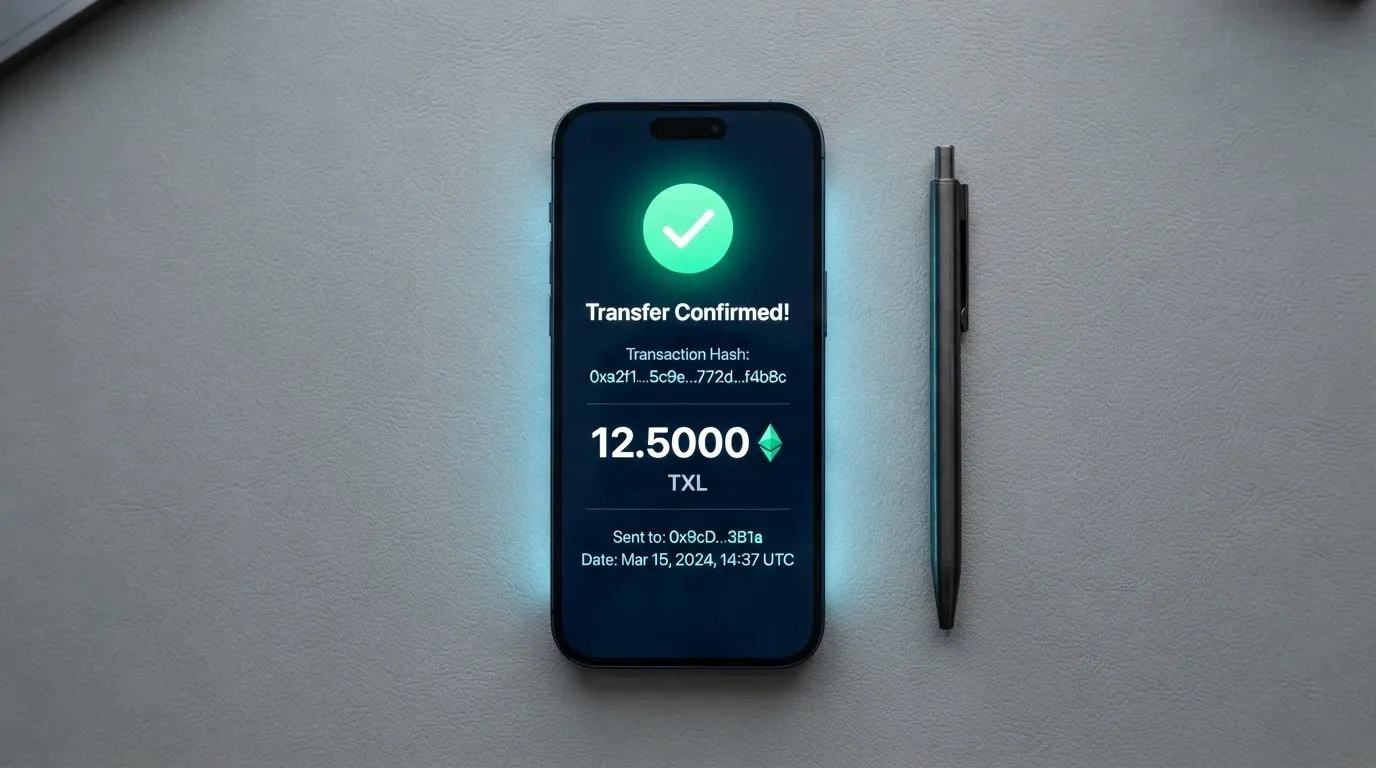
The deposit minimums across the featured set are modest: most operators accept between 0.001 and 0.01 ETH, which works out to roughly A$3 to A$35 depending on the ETH/AUD rate, with a handful of operators setting a flat A$10 to A$20 floor instead of an ETH-denominated minimum. The casino rarely charges a deposit fee on top of that — the player pays the network gas fee, and that fee goes to Ethereum validators, not to the operator. On Ethereum mainnet after the 2024 Dencun upgrade, a simple transfer costs $0.10 to $0.20 in calm conditions, though it can climb to a few dollars when the network is busy. Mainnet confirmation is typically about 12 seconds a block; congestion stretches that out. Layer 2 networks — Arbitrum, Optimism, Polygon, Base — run cheaper and faster, with fees that drop to fractions of a cent and transfers that feel close to instant.
The wrong-chain trap is the deposit-side failure that costs the most. Sending ERC-20 ETH to a Polygon deposit address, or Polygon-bridged ETH to a mainnet deposit address, can make the funds unrecoverable. The wallet’s network selector is the single most important part of the deposit flow. A player who deposits without checking which network the casino expects is gambling twice — once on the games, once on getting the deposit back.
How to Deposit Ethereum at an Online Casino — Step by Step
- Buy ETH on a registered Australian exchange and withdraw it to a self-custody wallet such as MetaMask, Rabby, Trust Wallet or a Ledger-paired wallet. Keep the exchange account out of the deposit path.
- Log into the chosen casino and open the cashier. Copy the deposit address the casino shows for your account. Confirm the network label the cashier displays — Ethereum mainnet, Arbitrum, Optimism, Polygon or whichever Layer 2 the operator accepts.
- Open your self-custody wallet, paste the deposit address, and select the matching network in the wallet’s network selector. The network in the wallet must match the network the cashier showed. Mismatched networks can make the funds unrecoverable.
- Enter the deposit amount, review the gas fee, and send. Wait for the casino’s required number of confirmations — typically a small handful for mainnet, fewer for Layer 2. The casino credits the account once the confirmations clear.
- Route every deposit through the self-custody wallet, never directly from the exchange account. Exchange compliance systems flag gambling-linked transfers, and the account freeze that follows is harder to undo than the gas fee was to pay.
How Fast Your ETH Withdrawal Really Arrives — and the Caps That Slow It Down
The marketing number is “instant ETH payouts”. The tested number is more honest. Across 12 sites advertising instant ETH payouts, seven delivered withdrawals in under 30 minutes in independent testing; the remaining five took longer. On quality platforms, ETH withdrawals typically process within 5 to 15 minutes. LuckyDreams, with four ETH networks supported, averages 4 minutes on Arbitrum, 6 on Optimism, 5 on Polygon and 11 on mainnet across 14 logged transfers. PlayAmo clears e-wallet and crypto withdrawals in 0 to 1 hours with a per-transaction cap of A$6,000. FairGO processes crypto withdrawals in 15 to 45 minutes during business hours and 2 to 4 hours on weekends. Wild Fortune, by contrast, averaged 5 hours 24 minutes from request to confirmation across five tested cycles between February and May 2026, with a range from 3 hours 50 minutes to 7 hours 58 minutes.
The withdrawal caps are where speed meets size. PlayAmo’s A$6,000 per withdrawal is generous for a player moving pokie-sized amounts and tight for a player cashing out a five-figure win in one go. LevelUp sets the cap lower: A$3,000 per day, A$7,500 per week and A$15,000 per month, which means a larger balance takes most of a month to clear at the cap. FairGO sets a minimum withdrawal of A$100 — modest for a returning player, annoying for a player who wants to test the cashout on a small balance first. The caps are the operator’s, and the operator’s word is what governs — there is no Australian regulator to escalate to when a withdrawal is stuck under a cap.
The split between business hours and weekends is the quiet drag on FairGO’s otherwise fast profile. A player who requests a withdrawal at 11pm Friday is not getting it in 15 minutes; they are getting it sometime Saturday afternoon when the weekend window kicks in. PlayAmo’s 0–1 hour figure holds closer to round-the-clock. The fairest read on a withdrawal profile is the worst-case time, not the best case — and the worst case is what the player’s bankroll waits on.
Anonymity, No-KYC Play and the Provably Fair Promise — How Crypto Casinos Sell Privacy
Three claims sit at the front of every crypto casino homepage: privacy, no KYC, and provably fair games. The first is partially true; the second is conditional; the third is a useful tool with a narrower meaning than the marketing gives it.
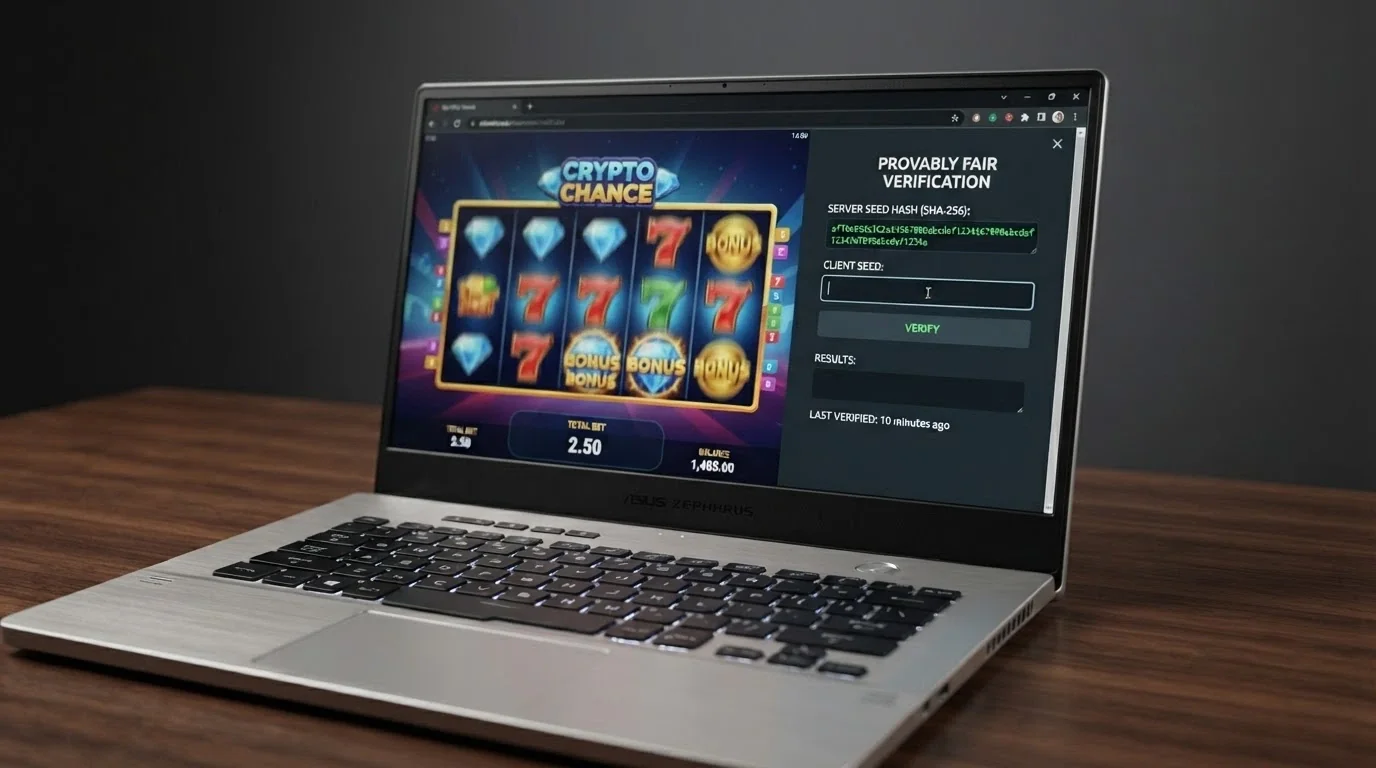
The privacy claim rests on the payment rail. Paying with ETH does not require a card number or a bank account number; it requires a wallet address and the gas to spend. On a blockchain explorer, the deposit is a string of alphanumeric characters tied to a wallet, not to a name. That is genuinely more private than a BPAY transfer with an account holder’s full name attached. The privacy is not anonymity in the strict sense — every ETH transaction is publicly visible on-chain, and chain analytics firms can cluster addresses — but it is meaningfully more private than the bank rail for a player who values that.
The no-KYC claim is what the player usually means by “anonymous”. Most Curaçao-licensed ETH casinos allow deposits with minimal or no verification at the cashier level, and many allow play up to a withdrawal threshold without ever asking for ID. The threshold varies by operator, and at withdrawal — particularly at the first withdrawal, or at a withdrawal above a set ceiling — KYC almost always triggers. The casino wants to satisfy its own AML obligations under Curaçao’s lighter regulatory regime, and it knows that a withdrawal is where a regulator notices. No-KYC at deposit, KYC at withdrawal, is the common pattern across the featured set. The trade is the next section.
The provably fair claim is the most often mis-sold of the three. A provably fair casino game lets the player verify that the outcome of a specific spin or hand was not tampered with after the bet was placed. The mechanism uses cryptographic commitments: the casino commits to a server seed before the bet, the player contributes a client seed, and the result is derived from both. After the bet, the player can verify the server seed matches the original hash. The proof the player gets is that no one changed the result after the bet was placed. The proof the player does not get is that the casino will pay out a winning result. Provably fair is a useful tool, and it is narrower than the marketing uses it as.
The crypto-specific bonus is the fourth pitch, and it is the one that often decides which operator a player picks. Crypto-specific boosts add 10% to 25% extra on the welcome match when the player deposits in ETH rather than fiat — a real edge for an ETH-funded player, paid out of the marketing budget rather than out of the game’s RTP.
No-KYC Ethereum Casinos — What You Trade for Your Privacy
A casino that never asks for ID is also a casino that can refuse a withdrawal with no external accountability. That is the trade, and it is the one most crypto casino pages under-explain.
In practice, the pattern across the featured set is the same. Deposit: minimal or no verification, especially for small amounts. Play: continues without interruption. Withdrawal: KYC triggers, usually at the first cashout or above a set threshold, and the player is asked for proof of identity, proof of address, and sometimes proof of source of funds. The casino’s stated reason is anti-money-laundering compliance under Curaçao’s regulatory regime; the practical effect is that the player who values no-KYC for its own sake is often the player most unprepared for the documentation request when it arrives.
The recourse gap is the part that follows. An Australian player with a withdrawal dispute at a TAB or Sportsbet can escalate to the Northern Territory Racing and Wagering Commission, the state gambling regulator, or ultimately the courts. The ACMA cannot recover an individual’s money from an offshore operator — its blocking power operates at the DNS level, not at the dispute level. An Australian player with a withdrawal dispute at a Curaçao-licensed ETH casino has, in practice, the casino’s own complaints process and the option to raise the issue with Curaçao’s Gaming Control Board. The first option depends on the operator’s goodwill. The second option is real but slow, and the operator’s licence is in Curaçao, not in Australia.
Privacy is the thing a player buys from a no-KYC casino. Recourse is the thing a player gives up. The trade is not necessarily wrong, but it is a trade, and it is the trade that ought to be understood before the first deposit rather than discovered at the first withdrawal.
Pokies, Live Dealer and Table Games You Can Actually Play with Ethereum
The game catalogue at an ETH casino is, on the surface, identical to the catalogue at any other online casino. Pokies, live dealer blackjack and roulette, table games, crash games and a few proprietary Originals at the crypto-native operators. The mechanics that matter for a real-money ETH player are game weighting toward wagering, RTP configuration across operators and the gap between advertised RTP and the configuration actually loaded at the casino the player picks.

The table below lists the titles the research carried an RTP figure for, with the provider, volatility band and maximum win where research stated one. Where research did not state a figure, the cell is a dash.
| Pokie Title | RTP | Provider | Volatility | Max Win |
|---|---|---|---|---|
| Book of Dead | 96.21% | Play’n GO | High | 5,000x |
| Gates of Olympus | 96.50% | Pragmatic Play | High | 5,000x |
| Gates of Olympus 1000 | 96.50% | Pragmatic Play | High | 15,000x |
| Sweet Bonanza 1000 | 96.53% | Pragmatic Play | High | 25,000x |
| Sugar Rush 1000 | 96.53% | Pragmatic Play | High | — |
| Temple Tumble Megaways | 96.25% | Relax Gaming | Very High | — |
| Crypto Genesys | 96.50% | Pragmatic Play | Very High | 15,000x |
| Trigger Happy | 96.58% | Big Time Gaming | High | 50,000x |
| Gold Rush | 96.50% | Pragmatic Play | High | — |
Three things the table makes plain. First, the providers concentrate around Pragmatic Play — five of the nine titles — with Play’n GO, Relax Gaming and Big Time Gaming carrying the rest. Pragmatic’s grip on the ETH casino lobby is a feature of the supplier-agreement market, not a quirk of any single operator. Second, every title in the table sits in the High or Very High volatility band; none of the standard low-volatility, long-session pokies made the researched list. Third, the maximum wins are unevenly stated — Sweet Bonanza 1000’s 25,000x and Trigger Happy’s 50,000x are the headline figures, but the figures themselves only matter to a player whose session reaches the bonus round that triggers them.
The Best-RTP Pokies at Ethereum Casinos in 2026
Book of Dead is the title the research carried the most RTPs for, and the spread is the point. At its standard setting, Book of Dead pays back 96.21%; the same title at a different operator can run at 95%, 94%, 92%, 91.2% or, in the worst researched configuration, 84.2%. The 12-point spread between the best and worst Book of Dead configuration is the difference between a pokie that loses the player A$379 per A$10,000 wagered and a pokie that loses the player A$1,580 per A$10,000 wagered. The game on the screen looks the same. The math underneath does not.
Sugar Rush 1000 carries the same trap with a tighter spread. The default RTP is 96.53%; the top configuration runs at 97.5%, the lower configurations at 95.50% and 94.50%. Crypto Genesys, a Pragmatic Play title, sits at 96.50% standard with reduced tiers at 94%, 92% and 88%. The lower configurations are not broken games — they are legal versions of the same title, configured for operators in higher-tax or higher-cost jurisdictions. A player cannot tell which configuration a casino is running from the game screen. The information is in the game’s help file or in the casino’s published RTP list, and a player who wants to know has to look.
For an ETH player grinding a wagering requirement, the RTP spread turns into a direct cost. The expected loss on A$35,000 of turnover at 96.21% is A$1,326.50. The expected loss on the same turnover at 91.2% is A$3,080. The wagering requirement is the same; the cost to the player is more than double. This is the next section.
Live Dealer and Table Games — What Counts Toward Your Wagering
Live dealer blackjack, live roulette, live baccarat — these are the products an Australian player used to associate with the Melbourne Crown experience, now streamed from studios in Malta, Latvia and the Philippines to an offshore Curaçao-licensed casino. The Pragmatic Play Live and Evolution lobbies carry hundreds of tables running 24 hours a day. The product is genuinely good. The contribution to wagering is not.
Standard ETH casino bonus terms weight slots at 100% toward the wagering requirement, and live casino and table games at 10% — sometimes not at all. A$1,000 of slots turnover counts as A$1,000 toward clearing. A$1,000 of live blackjack turnover counts as A$100, or zero. A player who prefers live tables and tries to clear a 35x bonus on them will be still grinding at the 35x-equivalent rate, ten times slower than a pokie player. The bonus terms allow it. The economics punish it.
The max-bet cap is the second trap. While a bonus is being cleared, the maximum bet is typically capped at A$5 to A$10 equivalent per spin or hand. Betting A$15 a hand at live blackjack while the cap is A$10 voids the bonus and any winnings derived from it. The cap exists to stop players from “grinding out” the wagering with one giant spin. The practical effect is that a player used to betting A$50 a hand at the Crown has to recalibrate to A$10 or less for the duration of the bonus, and the recalibration is what slows the clearing down.
The straight rule: while a bonus is being cleared, play pokies, bet at or below the cap, and accept that the live tables are for after the bonus is gone or for play on real money with no bonus attached. The games are better at the live lobby than the table is for clearing.
Why Your 2026 Ethereum Casino Bonus Is Smaller Than It Looks
The headline number on a Curaçao-licensed ETH casino welcome package runs from A$1,000 to several thousand dollars, sometimes equivalent to a five-figure AUD sum. The bonus is smaller than it looks because the headline is the amount the casino promises to credit, and the turnover is the amount the player has to wager before any of it is withdrawable.
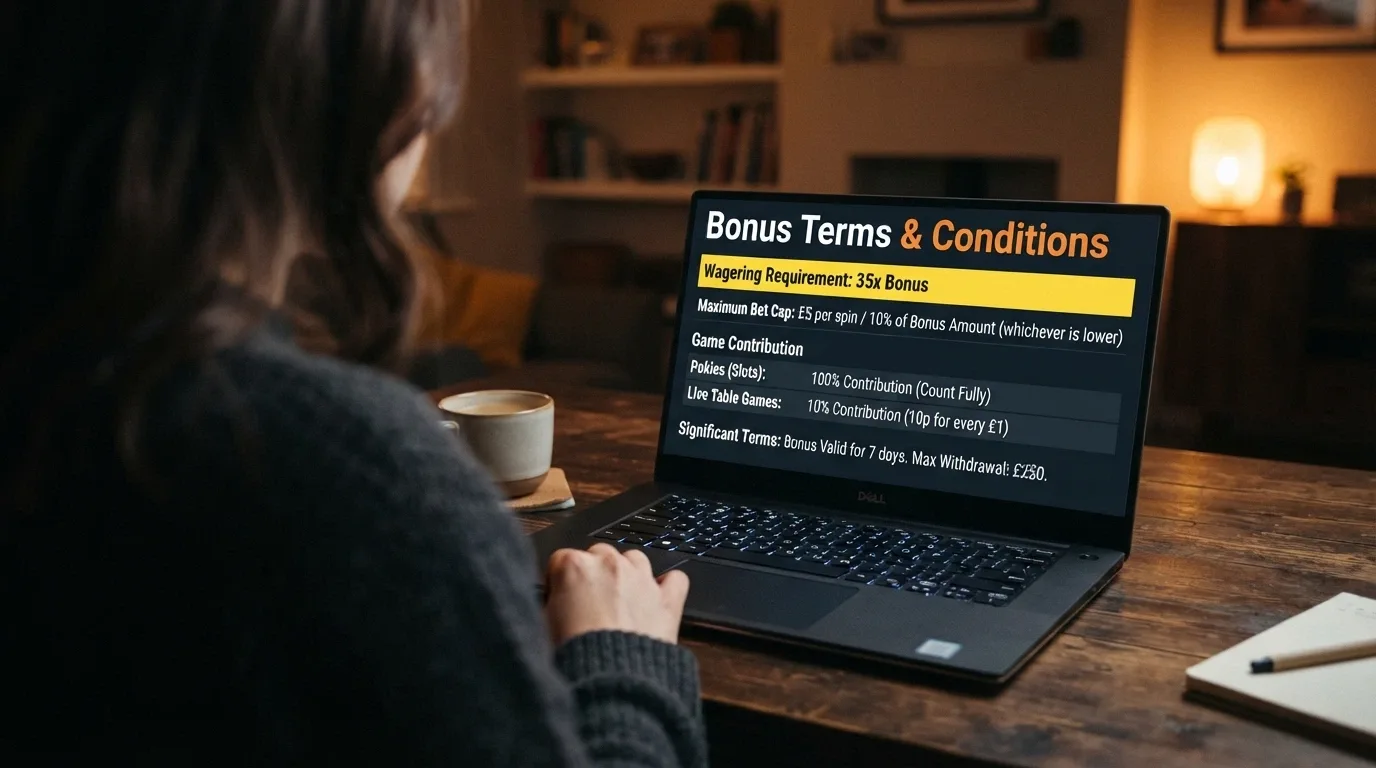
Welcome match bonuses at ETH casinos typically sit at 100% to 200% on the first deposit, with caps between A$1,000 and A$30,000 AUD equivalent. Standard wagering requirements run 35x to 40x. Anything above 40x is a red flag — it means the casino has stacked the terms against the player to a degree that even a lucky run on a high-RTP pokie is unlikely to clear. While a bonus is being cleared, the maximum bet is typically capped at A$5 to A$10 per spin or bet. Slots count 100% toward the requirement; live casino and table games count at 10% or not at all.
Free spins packages sit alongside the deposit match — 50 to 500 free spins on a featured pokie, bundled into the welcome. Free spin winnings carry separate wagering of 25x to 35x, and the cashout caps range from A$100 to A$500. Free spin winnings expire within 7 days of credit at most ETH casinos.
Welcome Match Bonuses — How 100% Up to A$5,200 Actually Clears
Take the HellSpin headline: 100% up to A$5,200 plus 150 free spins, 40x wagering, 7-day validity. A player who deposits A$5,200 receives A$5,200 in bonus funds, and the turnover required before any withdrawal is A$5,200 × 40 = A$208,000. The 7-day clock starts at deposit.
A$208,000 at A$5 a spin — the max-bet cap for the bonus — is 41,600 spins. At 5 seconds a spin, that is 208,000 seconds, or roughly 58 hours of continuous play. The player who plays for four hours a day needs 14.5 days to clear the bonus. The 7-day clock runs out on day 7, and the bonus expires with whatever turnover has been done. The arithmetic punishes the headline.
Run the same math at LuckyDreams: 100% up to A$1,000 at 35x bonus-only. A$1,000 in bonus funds, A$35,000 in turnover required, 17,500 spins at A$5 a spin, around 24 hours of play. The bonus-only construction means the A$1,000 deposit is not part of the turnover — only the bonus funds carry the 35x. That is the difference the 35x at LuckyDreams versus the 40x at HellSpin makes in real turnover: A$35,000 versus A$208,000. The wagering gap is six times the headline gap.
The expected cost clears faster than the bonus does. Take a bonus of A$1,000 cleared at 35x wagering — A$35,000 in required turnover — on a high-volatility pokie at 96.21% RTP, the standard Book of Dead configuration. The house edge on the turnover is 3.79%, so the expected loss is A$35,000 multiplied by 0.0379, which gives A$1,326.50. That is the bonus’s real cost, given away by the headline figure before a player pulls the first lever. It assumes only the bonus amount is wagered, that the wagering contribution is 100% on the chosen game, and that the standard RTP configuration is loaded at the casino. It is a statistical estimate — an average over many spins under those assumptions, not a guaranteed outcome for any individual session. A player who hits a bonus round early will lose less; a player who grinds through will lose more or less exactly that figure. The house edge does not negotiate.
Free Spins, Cashback and Crypto Boosts — The Bonuses That Sit Beside the Match
Free spin packages are the second tier of the welcome, and they carry their own terms. Skycrown’s 350 free spins sit at the top end of the 50–500 free spin band the research covered. Free spin winnings are usually credited as bonus funds, not as real cash, and carry their own 25x to 35x wagering on top of any deposit-match wagering. The cashout cap on free spin winnings is A$100 to A$500. The expiry is typically 7 days from credit, sometimes shorter — BC.Game runs 24-hour windows on some free-spin batches. A player who plans around the bonus needs to plan around the shortest clock in the package.
Cashback pays back 10% to 25% of net losses over a set period — daily, weekly or monthly — in cash or bonus credits. Cash cashback is real value; bonus-credit cashback carries its own wagering, usually lower than the welcome match but still real. A player who plays heavily and finishes a week down gets back a slice of the loss. A player who finishes a week up gets nothing. Cashback is a hedge, not an income.
The crypto-specific boost is the offer that decides which payment method a player picks. ETH depositors often get 10% to 25% extra on the welcome match compared with fiat depositors at the same casino. The boost is paid out of the casino’s marketing budget and is the cleanest extra value on the welcome package — no separate wagering, no separate cap, just a higher headline. Where two otherwise-comparable offers sit side by side and one carries a 15% crypto boost and the other does not, the crypto version is the one that costs the player less per dollar of bonus.
No-deposit ETH bonuses are nearly absent from the featured set. Where they exist, they typically carry 50x or higher wagering, low cashout caps, and short validity. The economics work against the player by design. A no-deposit bonus is a marketing cost the casino recoups through aggressive terms; a deposit bonus is a marketing investment the casino recoups through house edge on the turnover. The deposit bonus is the better deal.
Playing ETH Casino Games on Your Phone in 2026
Every operator in the featured set offers mobile-responsive browser play. The lobby loads in a mobile browser, the cashier accepts a wallet connection, the games run in HTML5, and the ETH deposit flows through the same deposit address as on desktop. The product is mature enough that “does it work on mobile” is no longer a useful question for the established operators in the set.
The mobile experience has one structural feature worth knowing. A crypto wallet on a phone — MetaMask mobile, Rabby mobile, Trust Wallet, Ledger Live paired with a wallet interface — is the natural partner for a mobile browser casino. The wallet app handles the address, the network selection and the gas confirmation in the same screen the player is using for the casino. The flow is shorter on mobile than on desktop: copy the deposit address from the casino, switch to the wallet app, paste, send, switch back. Two screens, one transfer.
Browser vs App — How Most Aussies Actually Play
Most Australians playing at ETH casinos in 2026 are doing it through a mobile browser, not through a dedicated casino app. Apps exist at some operators, but the offshore Curaçao-licensed set mostly does not ship a dedicated iOS or Android app through the Australian stores — the App Store and Google Play restrict real-money gambling apps by region, and an offshore operator is not in the priority queue for inclusion. Where apps do exist, they tend to be web wrappers around the mobile site rather than native applications.
The browser is the better default anyway. A dedicated app asks for storage, asks for permissions, and lives on the home screen as a permanent invitation to play. A mobile browser is opened when the player chooses to play and closed when the player is done. The friction difference is the same as the difference between carrying a TAB account open in a browser tab and carrying a TAB app pinned to the home screen — the latter is always one tap closer.
The deposit flow on mobile is the one to test before committing real ETH. Connect the wallet app, deposit A$10 worth of ETH, withdraw A$10 worth of ETH, and confirm the round trip clears before treating the casino as a working mobile option. A desktop casino that pays out in 11 minutes can become a 30-minute experience on a phone with a flaky connection, and a Layer 2 deposit that feels instant on Wi-Fi can stall on a congested mobile network.
New Ethereum Casinos Worth Watching in 2026
“New” in the offshore ETH casino market is not the same as “new” in a regulated market. A brand-new Curaçao-licensed casino that launched in 2026 sits under the same regulatory framework as a five-year-old Curaçao-licensed casino — and Curaçao’s framework is, by international standards, light. The licence date on the badge matters more than the launch date on the marketing page. A casino launched this quarter under a Curaçao licence issued three years ago is not meaningfully newer than the established set; a casino launched this quarter under a Curaçao licence issued this quarter is newer in the only way that matters for player risk.
The ETH-accepting casino market in 2026 is not, on balance, a launch market. Most of the featured operators — Skycrown, Rocket Play, HellSpin, BC.Game, LuckyDreams, PlayAmo, Stake — are established platforms with multi-year track records on the Curaçao register and ETH deposits that have been live for the better part of the last several years. A genuinely new entrant in this space is rare, and a genuinely new entrant worth trusting is rarer.
Latest 2026 Arrivals and What a New Casino Needs to Earn a Spot
A new ETH casino has to clear a higher bar than an established one, because the player has no payout history to lean on. The first three things to check, in order:
The licence entity, not the licence badge. “Curaçao licensed” on the footer is not enough; the operator’s legal entity on the Curaçao Gaming Control Board’s register is the question to answer. A licence issued to a shell company with no operating history is the most common red flag in genuinely new operators. The entity name is usually in the terms and conditions; the entity’s registration date and the licence number are searchable on the Curaçao register.
The provider lineup and the game catalogue size. A new casino with 6,000 slots from Pragmatic Play, Evolution, Hacksaw, NetEnt and the rest has supplier agreements in place; a new casino with 200 generic slots and no Evolution live lobby is a wrapper around a small white-label operation. The latter is not automatically a scam; it is a smaller operation, with a smaller budget for dispute handling.
The withdrawal terms in writing, tested. A new casino that publishes withdrawal caps, processing windows and KYC thresholds clearly on the terms page is a different proposition from one that asks the player to deposit first and learn the terms at the cashier. The first deposit is the cheapest test the player can run: deposit the minimum, play briefly, withdraw the full balance, and time the round trip. A new casino that handles a small withdrawal cleanly is one to consider. A new casino that delays or refuses a small withdrawal is one to leave.
For an Australian player choosing where to put a real bankroll in 2026, the established operators in the featured set are the lower-risk option. The new arrivals are worth watching. They are not, on current evidence, worth switching to.
The Legal Reality: Offshore Casinos, the ACMA and What Australian Law Actually Says
Online casino is prohibited in Australia. The Interactive Gambling Act 2001, as tightened by the Interactive Gambling Amendment Act 2017, makes it an offence to provide online casino games, online pokies or in-play sports betting to a person in Australia. There is no licence for online casino anywhere in the country — not federally, not in any state or territory. Any operator that takes Australian players on online casino games is doing so outside Australian law.

What is licensed is narrower than most players assume. Wagering on races and on sport placed before the event begins, lotteries, and keno — all licensed at state or territory level. The Northern Territory Racing and Wagering Commission, administered through Licensing NT, is the de facto national licensor for online bookmakers; large operators like Sportsbet, bet365 and Ladbrokes hold NT licences with terms of up to 20 years. None of them offer online casino, because the licence does not extend to it.
The 2026 reform — the Interactive Gambling Amendment (Gambling Reform) Bill 2026 — passed Parliament on 19 August 2026, and its measures commence on 1 January 2027. The reform caps wagering advertising at three ads per hour between 6:00 am and 8:30 pm, imposes a live-sport blackout on wagering ads, bans athletes and celebrities from promoting wagering, gives banks and payment providers express authority to block transactions to illegal gambling operators, and tightens the marketing rules around BetStop. None of it legalises online casino. The reform tightens the prohibition; it does not open it.
The individual player is not prosecuted under the IGA. The Act targets the provider. That is the legal reality most relevant to a punter deciding whether to deposit ETH at an offshore casino: the law does not come after the player; it comes after the operator, and the player is the customer the operator has chosen to take.
What the Interactive Gambling Act Actually Prohibits — and What It Doesn’t
The IGA’s online prohibition is narrow in scope but absolute in application. Online casino — meaning casino games delivered over the internet — is prohibited. Online pokies are prohibited. In-play sports betting — placing a bet on a sporting event after it has started — is prohibited. The carve-outs are equally narrow: pre-event wagering on racing and sport is licensed and lawful; lotteries and keno are licensed and lawful; the licensed bookmakers run their product under those carve-outs.
What is not prohibited is also worth saying plainly. A licensed Australian bookmaker can offer a pre-event multi-leg bet on the AFL, the NRL and international racing. A licensed Australian lottery can sell tickets to Tuesday night’s draw. An Australian player who wants to bet on the Melbourne Cup through a licensed channel can do so legally at a TAB, through a licensed corporate bookmaker, or via the NT-licensed online bookmakers. What an Australian player cannot do legally is play online pokies or online casino games with an Australian-licensed operator — because that operator does not exist.
The credit and crypto ban came in with the Interactive Gambling Amendment (Credit and Other Measures) Act 2023, with section 15C of the IGA prohibiting the use of credit and digital currency for certain interactive wagering services. The provisions commenced on 11 June 2024. An operator that fails to enforce them faces penalties of up to A$247,500. The provision is aimed at the operator, not the player; the practical effect is that an Australian player who tries to fund a wagering account with a credit card or with ETH at a licensed operator will find the payment method blocked, because the operator is required to block it.
The tax treatment of player winnings is the part that does not require a lawyer to read. Player gambling winnings are not assessable income under section 6-5 of the ITAA 1997. Gambling losses are not deductible under section 8-1. The exception is a person carrying on a business of betting or gambling, which is not the position of an ordinary punter. No Australian case has held the winnings of an ordinary gambler assessable income. The licensed operator pays point-of-consumption tax where the customer is — typically 10% to 15% of net wagering revenue per state — and the Northern Territory levies its own 5% wagering tax plus a 0.05% racing levy. The tax burden sits with the operator, not the player.
What You Give Up When You Play at an Offshore Ethereum Casino
Five protections an Australian-licensed operator provides, and an offshore ETH casino does not:
BetStop coverage. The National Self-Exclusion Register, live since August 2023, binds Australian-licensed wagering services. A self-excluded Australian who registers with BetStop cannot deposit at a TAB, at Sportsbet, at bet365, at Ladbrokes, or at any other NT-licensed operator. An offshore Curaçao-licensed ETH casino is not connected to the register. The self-exclusion does not reach it. The site will keep taking the self-excluded person’s money. As of 31 July 2026, 41,290 active exclusions sit on the BetStop register — over 60% of the 67,480 Australians who have ever registered — and the gap between those exclusions and the offshore market is the part that matters most for harm.
Australian consumer protection. There is no Australian complaints body that can recover an individual’s money from an offshore operator. The ACMA’s blocking power operates at the DNS level — it stops Australians from reaching the site, but it cannot reach into the operator’s wallet and reverse a withdrawal. A player with a dispute at a Curaçao casino has the operator’s own complaints process, the option to raise the matter with Curaçao’s Gaming Control Board, and that is largely the extent of the route.
Recourse for unfair treatment. An Australian-licensed operator that voids a winning bet, closes an account without justification or refuses a withdrawal can be challenged through the state or territory regulator and ultimately the courts. An offshore operator that does any of those things can be challenged through Curaçao’s regulator and whatever goodwill the operator has. The two paths are not equivalent.
DNS blocking risk. The ACMA has had 1,788 illegal gambling and affiliate websites blocked at the DNS level since November 2019, with 133 sites blocked in the October to December 2025 quarter alone. A blocked site can disappear overnight, and a player with a balance still on it has no Australian path to recover. The block is the operator’s problem on paper; it is the player’s problem in practice.
The payment-method signal. A site that asks for an ETH deposit from an Australian is, by construction, sitting outside the Australian rules. The crypto prohibition is the clearest tell: a licensed Australian operator cannot legally accept the deposit, so any site that does is unlicensed. That is not, on its own, a reason not to play at the site. It is a reason to know what playing at the site does not include.
Staying in Control When Crypto Makes It Easy to Lose Track
Crypto deposits remove friction. That is the entire pitch from the operator’s side, and it is the part that matters most from the player’s side. A bank transfer takes a working day to clear and gives a player hours to change their mind; an ETH deposit clears in minutes and gives the player none. A bank statement surfaces gambling transactions in a place a player has to look at; an ETH deposit is one wallet transaction among dozens. The speed that makes ETH useful is the same speed that makes it harder to control.
The harm data is not theoretical. About 2.1% of Australian adults — roughly 430,000 people — experience problem gambling, and high-risk gambling adds another 1.8%, on the most recent Australian Institute of Health and Welfare figures. The crypto-specific layer on top of that is the missing bank circuit-breaker. A player who hits their daily limit on a TAB account sees the bank decline the transfer; a player who hits their limit at an offshore ETH casino sends the next transaction from a self-custody wallet and the casino credits it. There is no intermediary to slow it down.
BetStop, the National Self-Exclusion Register, is the structural answer for Australian players who have decided to stop. Since its launch in August 2023, 67,480 Australians have registered. 41,290 exclusions are still active as at 31 July 2026 — over 60% of everyone who ever registered. 78% of registrants were under 40, and 38% chose lifetime exclusion. The register binds Australian-licensed wagering services. It does not bind offshore ETH casinos, which is the central gap for any Australian using crypto to gamble.
Licensed wagering operators offer customer-set deposit limits and activity statements under their state or territory conditions. The conditions differ between jurisdictions; the principle does not. An offshore ETH casino is not required to offer any of these, and most do not match the licensed baseline. A player who needs a deposit limit set below their normal impulse will not find one pre-configured at most of the operators on this page.
Where to Get Help — Australian Resources That Actually Work
- National Gambling Helpline — 1800 858 858. Free, confidential, staffed 24 hours a day, 7 days a week. The first call for an Australian who is worried about their own gambling or someone else’s.
- Gambling Help Online — gamblinghelponline.org.au. Online chat and professional counselling, free of charge. The web route for a player who would rather type than talk.
- BetStop — National Self-Exclusion Register. Free registration, exclusions of three months, six months, twelve months or lifetime. Covers Australian-licensed wagering services; does not reach offshore ETH casinos.
- Self-assessment and budget tools. Available through Gambling Help Online, including a self-test that takes about five minutes and a budget planner for players who are not ready to stop but want to track what they are spending.
The crypto-speed warning is the part to keep front of mind. Near-instant deposits and 5-to-15-minute withdrawals remove the cooling-off friction of traditional banking. A player who would have walked away from a TAB account after a transfer delay does not get that delay at an ETH casino. The tools above help; nothing replaces the player’s own decision to use them.
How We Picked and Ranked These Ethereum Casinos
The ranking is qualitative, and the criteria are five: ETH network support including Layer 2 availability, bonus terms and wagering fairness, game catalogue breadth and provider quality, withdrawal speed from independently tested data, and licence transparency. No numerical weighting was applied to convert the five criteria into a single score; the order of the operators reflects editorial judgement across the criteria, not a published formula.
The sources the ranking draws on are public. Operator terms and conditions pages, the published bonus terms at each casino, the Curaçao Gaming Control Board register for entity verification, the ACMA public register for blocked services, the ACMA Action on Interactive Gambling quarterly reports for enforcement data, and the Federal Register of Legislation for the IGA and its amendments. The withdrawal times for LuckyDreams come from 14 logged transfers published by an independent testing source; the FairGO, PlayAmo and Wild Fortune withdrawal figures come from independent casino-testing publications. Each operator was checked against the ACMA register and the Northern Territory wagering licence database, and every operator in the featured set returned as unlicensed for Australian online casino — which is the expected outcome, given that the licence does not exist.
Where a fact did not surface — a bonus amount for one operator, a slot count for another, a wagering multiple for a third — the gap is left in the table and in the prose rather than estimated. A reader can update the table themselves from the operator’s published terms; a reader cannot correct an estimated figure once it is on the page.
The operators checked but not ranked high enough to feature include several brands that appeared in the source research with weaker evidence on one or more of the five criteria, and at least one brand that did not surface an Australian-facing ETH deposit option at all. The featured set is the ten that best fit the topic across the criteria; it is not a comprehensive list of every offshore ETH casino serving Australian traffic.
What Your Next ETH Deposit Should Actually Look Like
Three things to check before sending a single wei.
First, the licence. A Curaçao badge is not Australian consumer protection. It is a Curaçao licence, granted under Curaçao’s regulatory framework, governed by Curaçao’s enforcement, and offering the recourse that Curaçao’s framework provides. A player who understands that is making an informed choice. A player who thinks the badge means Australian regulation is being told something the badge does not say.
Second, the wagering terms. The headline match figure on the welcome package — 100% up to A$1,000, up to A$5,200, up to A$30,000 — means nothing without the turnover multiple beside it. At 40x, the A$1,000 bonus asks for A$40,000 in turnover. At 35x bonus-only at LuckyDreams, the same A$1,000 bonus asks for A$35,000 in turnover, with the deposit itself not counted. The headline is the casino’s marketing; the turnover is the player’s real cost. Read the turnover before reading the headline.
Third, the wallet path. Every ETH deposit should route through a self-custody wallet. Sending ETH directly from an exchange account to a casino runs the deposit through the exchange’s compliance system, and exchange compliance systems flag gambling-linked transfers. The flagged transfer can mean a frozen account, a request for source-of-funds documentation, and weeks of waiting. A self-custody wallet in the middle is a ten-minute setup that prevents a much longer problem.
The bottom line is the bottom line. Offshore Ethereum casinos are widely used by Australians. They are unlicensed. The crypto deposit is itself a tell that the operator is outside the Australian rules. The protections an Australian punter gets from a TAB or Sportsbet account — BetStop coverage, state-regulator recourse, the bank’s declined-transfer circuit-breaker — do not apply. A player who knows all of that and decides to play is making an adult choice about an offshore, lightly-regulated product. Those who choose to play without knowing these risks accept the consequences entirely.
Common Questions About Ethereum Casinos in Australia
How do I deposit and withdraw Ethereum at an online casino?
Deposit by sending ETH from a self-custody wallet to the deposit address in the casino’s cashier, making sure the network you select in the wallet matches the one the cashier shows. Withdraw by requesting a payout from the casino to your wallet address; quality platforms process ETH withdrawals in 5 to 15 minutes. Never send from an exchange account directly — route through your own wallet.
How fast are Ethereum casino withdrawals compared to Bitcoin?
On the operators where both are supported, ETH withdrawals are typically faster than BTC, often clearing in 5 to 15 minutes against Bitcoin’s 10 to 60 minutes on the same platform. Layer 2 ETH on Arbitrum or Optimism is the fastest rail in the research, with LuckyDreams logging 4 and 6 minute averages respectively across 14 transfers.
Are Ethereum casino winnings taxable in Australia?
No, not for ordinary players. Gambling winnings are not assessable income under section 6-5 of the ITAA 1997, and losses are not deductible under section 8-1. The exception is a person carrying on a business of betting or gambling, which is not the position of an ordinary punter. No Australian case has held an ordinary punter’s winnings assessable.
Is it safe to use a crypto wallet for casino deposits — and should I use Layer 2 networks?
Self-custody wallets such as MetaMask, Rabby, Trust Wallet and Ledger Live are the standard tool for casino deposits and are safe when the player keeps the seed phrase offline. Layer 2 networks — Arbitrum, Optimism, Polygon — are cheaper and faster than Ethereum mainnet, with fees of cents rather than $0.10 to $0.20 and transfers that feel close to instant. They are also supported by fewer operators; check the cashier before depositing.
What happens if an Ethereum casino blocks my account or refuses a withdrawal — what recourse do I have as an Australian player?
The operator’s own complaints process is the first step. If that fails, the Curaçao Gaming Control Board is the regulator, and complaints can be raised through its licensed-operator framework. The ACMA cannot recover an individual’s money from an offshore operator — its blocking power operates at the DNS level. Australian consumer protection and state-regulator recourse do not apply to offshore ETH casinos, which is the trade the player accepts when choosing to play offshore.