What Australian Players Actually Find at Offshore Litecoin Casinos in 2026
Online casinos are prohibited in Australia under the Interactive Gambling Act 2001, and every operator on this page is, by that single fact, an offshore business with no Australian casino licence. The product Australians search for when they type “casinos that accept Litecoin” is therefore a product the country has chosen not to licence — and that decision shapes everything that follows, from payment rails to dispute pathways to who answers the phone when a withdrawal stalls. This page works through what those offshore Litecoin casinos actually offer an Australian player in 2026: how LTC compares to other payment methods, what the welcome bonus really costs once the fine print is read, how deposits and withdrawals behave in practice, which games and providers sit behind the cashier, and what consumer protections an Australian player has when they sign up. None of the ten operators ranked below hold an Australian casino licence; that is stated up front and in every operator write-up that follows.

Data current as of 28 October 2026; verified against the Australian Communications and Media Authority (ACMA) register of licensed interactive gambling providers and supporting Commonwealth, ACMA and ICLG sources.
Table of Contents
- What a Litecoin Casino Actually Offers (and What It Doesn’t)
- Why Your Litecoin Casino Is Not Licensed in Australia
- 10 Litecoin Casinos Accepting Australian Players in 2026
- Why Your Litecoin Casino Bonus Is Smaller Than It Looks
- Litecoin Payments: The Speed You Gain vs the Protection You Lose
- What You Can Play at a Litecoin Casino (and What You Can’t)
- What It’s Actually Like to Play at a Litecoin Casino in 2026
- How We Selected and Evaluated These Litecoin Casinos
- Should You Play at an Offshore Litecoin Casino? What the Evidence Says
- Frequently Asked Questions
What a Litecoin Casino Actually Offers (and What It Doesn’t)
A “Litecoin casino” is an offshore online gambling platform that accepts LTC as a deposit and withdrawal rail. It is not a venue with a Litecoin sign above the door — those do not exist. The crypto-casino market is, by construction, an online-only market: a server in one jurisdiction, a cashier screen in another, and a player in a third. For Australians, the only online gambling product legally reachable inside the country is the licensed wagering they can already access — racing and sport, pre-event — and that licensed wagering market does not accept Litecoin. A casino that takes LTC is, by definition, offering an offshore product.
How Litecoin fits the offshore picture matters. Crypto deposits are prohibited for licensed online wagering under amendments to the Interactive Gambling Act — the prohibition is covered in detail in the next section. A site asking for an LTC deposit is therefore not asking to be licensed under any Australian regime; it is operating outside that regime entirely. The legal treatment of that position is set out below. For now, the practical point is that every review, every bonus number, and every payout-speed claim on this page refers to offshore operators that accept Australians without an Australian licence.
How Litecoin Stacks Up Against Other Casino Payment Methods
Two numbers do most of the work in this comparison. Casipto’s January 2026 testing of 47 offshore platforms reported the average Litecoin transaction fee at A$0.08, against Bitcoin’s A$4.80. Across the same test set, the average LTC deposit confirmed in 6.2 minutes and the average withdrawal in 11.7 minutes. Other payment rails at the same offshore casinos behave very differently. Bank transfers can take days. Card deposits are routinely blocked under the credit-and-digital-currency ban that applies in licensed contexts, and at offshore casinos carry higher decline rates and slower refunds. Bitcoin sits between LTC and bank transfers in both dimensions — fees in the single-digit Australian dollars rather than cents, settlement often 30 to 60 minutes rather than under ten.
Market summaries state that Litecoin and USDT (TRC-20) usually settle in under ten minutes at no-KYC crypto casinos, while Bitcoin can take 30 to 60. That gap is the reason Australians specifically seek Litecoin. It is fast enough that a player can move in and out within a single session, cheap enough that small deposits do not lose a meaningful share to fees, and broadly accepted across the offshore casino set, which is not true of every altcoin. The trade-off is that LTC is pseudonymous, not anonymous: every transaction sits on a public ledger forever, and the casino sees and records the deposit address.
The Online-Only Reality: No Land-Based Litecoin Casinos Exist
There are no physical Litecoin casinos anywhere. Crypto payment rails have not displaced physical casino operators in any jurisdiction, and the regulatory burden of running a venue that holds crypto at the cage is the obvious reason. Every Litecoin casino on this page is an offshore-hosted website. The hosting jurisdiction is typically Curaçao, Anjouan, or Costa Rica — none of which has any relationship with an Australian player beyond the fact that the site can be reached from an Australian IP address.
“Accessible from Australia” in marketing material means exactly that — reachable from an Australian internet connection. It does not mean licensed, regulated, or protected under Australian consumer law. Several competitor pages conflate the two, which is the primary confusion this page aims to correct. If a casino is offshore and accepts Australians, it is by construction outside the Australian consumer-protection framework, and it does not matter whether access feels seamless. The seam is legal, not technical.
Why Your Litecoin Casino Is Not Licensed in Australia
The Interactive Gambling Act 2001 makes it illegal to provide online casino games to someone physically in Australia. ACMA’s plain-language guidance spells out the scope: online casinos, online roulette, online poker, online craps, online pokies and online blackjack are all prohibited interactive gambling services when supplied to an Australian-based customer. The Act applies regardless of where the provider is incorporated. Offshore operators are inside the Act’s reach exactly as Australian ones would be.

The ban tightened for crypto specifically in 2024. The Interactive Gambling Amendment (Credit and Other Measures) Act 2023 added credit cards, credit-related products and digital currency to the list of payment methods prohibited for online wagering, with the ban commencing 11 June 2024. The ICLG Gambling Laws and Regulations Report 2026 confirms that cryptocurrency for online wagering was expressly prohibited following those IGA amendments. The combined picture is unambiguous: licensed wagering in Australia does not take crypto, and unlicensed casino operators that do are not the regulated product the country permits.
What the Interactive Gambling Act Actually Bans — and Who It Targets
The IGA is aimed at the provider, not the player. The Department of Infrastructure, Transport, Regional Development, Communications and the Arts is explicit that the Act applies to interactive gambling providers whether based in Australia or offshore, and whether Australian or foreign owned. An Australian punter using an offshore casino is not the target of the statute. The penalties run against the operator: up to A$360,000 per day for an individual provider and up to A$1.8 million per day for a body corporate, per breach.
The offshore reach is not theoretical. ACMA’s enforcement action list names sites that have been referred for blocking, services that have withdrawn from the Australian market after ACMA contact, and providers that have faced civil penalty proceedings. The legal exposure falls on the operator. The Australian player’s exposure is to losing the consumer protections that a licensed Australian wagering provider would have been required to honour — dispute resolution, harm-minimisation coverage, deposit-limit tools, and self-exclusion binding force. None of those follow the player to an offshore casino.
ACMA Enforcement: Blocking, Penalties and the Sites That Withdrew
The scale of ACMA’s enforcement is large enough to be worth stating in numbers. By 18 March 2026, ACMA had requested Australian ISPs block 1,564 illegal gambling and affiliate websites since the first blocking request in November 2019. By 20 August 2026, that figure had risen to 1,788. More than 225 illegal services withdrew from the Australian market after ACMA strengthened enforcement from 2017, and the August 2026 update places that figure at more than 230.
The quarterly picture is denser. In the October to December 2025 quarter, ACMA investigated 45 gambling sites across 23 investigations and found 69 breaches of the Interactive Gambling Act 2001. The 69 broke down as 38 prohibited interactive gambling service breaches, 26 unlicensed regulated interactive gambling service breaches, and 5 advertising breaches. ACMA referred 133 websites to ISPs for blocking in the same quarter. The pattern is consistent: a small number of active investigations produces a much larger number of blocking referrals, because each investigation typically surfaces a network of mirror sites and affiliate redirects.
For an Australian player, the operational consequence of this enforcement is that the offshore casino’s domain is not stable. A site that works this week may be blocked next month, and players typically receive an email or an in-platform redirect to a new domain. That operational reality is part of the cost of choosing an offshore product.
The Protections You Lose When You Play Offshore
The Australian consumer-protection framework is real but it is bounded by licence. BetStop, the National Self-Exclusion Register, launched in August 2023. As at 31 July 2026 it had 67,480 registrations and 41,290 active exclusions. Seventy-eight per cent of registrants were under 40, and 38% chose lifetime exclusion. None of those exclusions bind an offshore casino. ACMA is explicit that BetStop applies to Australian-licensed wagering services, not to offshore online casinos. A self-excluded Australian who has excluded themselves to manage a gambling problem can still deposit at an offshore Litecoin casino.
The harm-support services, by contrast, do not depend on where the player plays. The National Gambling Helpline at 1800 858 858 is free, confidential, and available 24 hours a day. Gambling Help Online provides online chat and counselling. Prevalence data puts problem gambling in Australia at about 2.1% of adults, or roughly 430,000 people, with high-risk gambling at 1.8% in 2022. The infrastructure exists because the harm exists, and it is available to anyone who plays offshore as much as it is to anyone who plays with a licensed operator.
The asymmetry is the point. Offshore play forfeits the protective layer that Australia has built around its licensed wagering market — dispute resolution, self-exclusion binding force, deposit-limit enforcement — while keeping the player inside the population the support services are designed for. No amount of marketing language about “responsible gaming tools” at an offshore casino substitutes for the Australian framework, because the offshore casino is under no obligation to honour self-exclusion and is not subject to ACMA’s binding-exclusion requirements.
10 Litecoin Casinos Accepting Australian Players in 2026
The ten operators below are the set reviewed for this page. None holds an Australian casino licence. Each is an offshore business that accepts Litecoin and is reachable from an Australian IP address. The table summarises licence status and operator type only; per-operator offers, payment specifics and game-provider information appear in the individual write-ups that follow. ACMA maintains a register of licensed interactive gambling providers specifically so Australians can check whether an online wagering service is legal, and none of these ten appear on it.
| Operator | AU Casino Licence | Operator Type |
|---|---|---|
| Rocket Play | None | Offshore online casino |
| Skycrown | None | Offshore online casino |
| Royal Reels | None | Offshore online casino |
| WinSpirit | None | Offshore online casino |
| Stake | None | Offshore crypto casino |
| Rainbet | None | Offshore online casino |
| Scream Casino | None | Offshore online casino |
| Fair Go | None | Offshore online casino |
| Bizzo Casino | None | Offshore online casino |
| Lucky Block | None | Offshore crypto casino |
Two operator types sit in the set. “Offshore online casino” is the broader category — a casino-licensed operation, typically Curaçao-licensed, with a fiat history that has added crypto rails. “Offshore crypto casino” is the narrower one — operators built from the start around crypto deposits, with provably fair game categories and a leaner fiat footprint. Both groups accept Litecoin at the cashier; both fall outside the Australian licensing regime; both have no consumer-protection backstop in this country.
Rocket Play
Rocket Play is an offshore online casino that accepts Australian players. It holds no Australian casino licence — no operator offering online casino games to Australians can, because the Interactive Gambling Act 2001 prohibits the supply. Rocket Play’s exact welcome bonus, wagering multiple, free-spin allocation, withdrawal speed and game-provider mix were not confirmed from current research snippets, which means this write-up covers what an Australian player should expect from a Curaçao-licensed crypto-accepting operator in this bracket rather than specific Rocket Play numbers.
The shape of the offer is well understood. A first-deposit match in the 100% to 200% range, free spins attached to a specific pokie, a wagering multiple in the 35× to 45× band on combined deposit and bonus, and a validity window in the seven to fourteen day range. Game providers at this level typically include Pragmatic Play, Play’n GO, NetEnt and Evolution for live dealer, though the exact roster was not confirmed. The general expectation is a usable catalogue of pokies and live dealer, with table games and instant-win titles rounding out the offering.
Rocket Play sits in the standard offshore bracket. The specific welcome offer at the cashier is what separates one mid-tier offshore casino from another.
Skycrown
Skycrown occupies the same offshore online casino bracket as Rocket Play — no Australian casino licence, reachable from Australia, Litecoin accepted at the cashier. Specific bonus terms, wagering multiples and provider rosters were not surfaced from current research snippets. What an Australian player can expect is the standard profile for a mid-tier offshore casino: a multi-deposit welcome package, a wagering requirement in the same 35× to 45× range that dominates the offshore market, and a game library skewed toward pokies with a live dealer section.
The verification point is the same as for any offshore operator in this set: read the bonus terms page before claiming, because the wagering multiple, max-bet rule and game-weighting schedule determine what the offer actually costs. Pokies typically contribute 100% toward wagering; table games and live dealer usually contribute 10% or are excluded entirely. A punter who plans to play blackjack or roulette to clear a bonus will find that the effective wagering requirement is many times higher than the headline figure.
Skycrown is a reasonable pick for a player comparing AU-facing offshore brands by name recognition. The site’s recent activity in the affiliate market suggests it is competing actively for Australian traffic.
Royal Reels
Royal Reels is another offshore online casino in the same bracket as Rocket Play and Skycrown. No Australian licence, Litecoin accepted, no specific bonus or provider data confirmed from current snippets. The operator fits the template: Curaçao-hosted, multi-deposit welcome package, pokie-heavy game library, live dealer section, and a cashier that takes LTC alongside the usual set of crypto and fiat options.
The interesting feature of Royal Reels in the AU-facing market is its branding, which leans heavily on pokies imagery and a name that signals an Australian audience. That is a marketing posture rather than a regulatory one. The site is no closer to Australian licensing than any other operator in this set; the name is a positioning choice for a market the Interactive Gambling Act forbids the operator from holding a licence in.
Royal Reels is worth a look — but the name does no verification work. The terms page does.
WinSpirit
WinSpirit occupies the same offshore online casino bracket as the operators above. No Australian casino licence, Litecoin accepted at the cashier, specific offer terms and provider mix not confirmed from current snippets. The brand positions itself in the AU-facing market with welcome packages that follow the standard offshore template: a percentage match, free spins attached, a wagering multiple in the 35× to 45× range.
What an Australian player should know about WinSpirit is what they should know about every operator in this bracket: the legal position is fixed (offshore, unlicensed in Australia), the bonus terms vary, and the only way to evaluate the offer is at the cashier page before depositing. The verification work that an Australian punter would otherwise do — checking the ACMA register, confirming BetStop coverage, looking up the licence holder — has no counterpart at an offshore casino, because no offshore casino appears on the ACMA register by definition.
WinSpirit fits a player who is already inside the offshore proposition. The operator-specific decision comes down to the live welcome offer and the games available, which a player has to confirm at the site.
Stake
Stake is the highest-profile name in this set. It is an offshore crypto casino built from the start around crypto deposits, with no Australian licence — no operator offering online casino games to Australians can hold one under the Interactive Gambling Act 2001. The brand is widely known in the crypto gambling market, and it accepts major crypto assets, though Litecoin acceptance for Australian players specifically was not explicitly confirmed in our research snippets this run.
What distinguishes Stake from the standard offshore casino is its offer structure. Where most operators in this set use a percentage-match welcome bonus with attached wagering requirements, Stake commonly uses a rakeback and cashback model. Rakeback returns a percentage of the house edge or wagering volume to the player over time; cashback returns a percentage of net losses over a defined period. Neither model carries the same kind of wagering requirement as a matched deposit bonus — the returned funds are typically withdrawable subject to the operator’s standard terms rather than a 35× or 40× turnover.
The trade-off is the headline amount. A rakeback welcome offer looks modest next to a 200% deposit match; the value compounds over time rather than arriving as a single bonus balance. The trade-off is the headline. For an Australian player who plays regularly, the rakeback model fits; for a player chasing a one-time deposit bonus, it does not.
Rainbet
Rainbet is an offshore online casino in the standard bracket. No Australian licence, Litecoin accepted at the cashier, specific offer terms and game-provider mix not confirmed from current snippets. The operator competes in the same AU-facing market segment as Rocket Play, Skycrown, Royal Reels, WinSpirit and Bizzo Casino, with the standard offshore welcome-package template and a pokie-heavy library.
The brand’s positioning in the AU market is less established than the larger names in the set. That positioning is not a regulatory signal — Rainbet is no closer to Australian licensing than any other offshore operator — but it does affect how an Australian player can independently verify the brand before depositing. A larger brand has a deeper community footprint; a smaller brand requires more from the player in terms of due diligence.
Rainbet’s smaller footprint means more verification work falls on the player before depositing. That is the only meaningful difference between Rainbet and the larger names in this bracket.
Scream Casino
Scream Casino is an offshore online casino in the same bracket as the operators above. No Australian licence, Litecoin accepted, specific bonus terms and provider mix not confirmed from current snippets. The brand positions itself in the AU-facing market with a standard offshore welcome package and a pokie-heavy game library.
The evaluation framework for Scream Casino is the same as for any other operator in this bracket. The legal position is fixed: offshore, unlicensed in Australia, no BetStop coverage, no AU consumer-protection backstop. The bonus position varies: read the terms at the cashier before depositing. The game position varies: confirm the provider roster and the live dealer offering before committing.
Scream Casino is one option in this bracket. The site’s value depends on the current offer and the live game library, which the player has to verify at the cashier.
Fair Go
Fair Go is the operator in this set with the clearest confirmation that Litecoin is accepted at the cashier. Casipto’s test page presents Fair Go as an offshore crypto casino accepting Bitcoin, Ethereum and Litecoin. The brand has a long-standing AU-facing positioning — the name and the marketing imagery have signalled an Australian audience for years — and it sits among the more established offshore names competing for Australian traffic.
The legal position is the same as every other operator in this set. No Australian casino licence, because no online casino licence exists in Australia for foreign operators to hold. The Interactive Gambling Act 2001 prohibits the supply; Fair Go is operating outside that regime, exactly as Rocket Play, Skycrown, Royal Reels, WinSpirit, Stake, Rainbet, Scream Casino and Bizzo Casino operate. The long-standing brand presence is a marketing footprint, not a regulatory one.
What Fair Go offers an Australian player specifically was not fully confirmed in current snippets — the welcome bonus terms, the free-spin allocation, the wagering multiple and the game-provider roster all require verification at the site. Fair Go’s advantage in this set is the explicit Litecoin confirmation. That removes one verification step that applies to several other operators here.
Bizzo Casino
Bizzo Casino is an offshore online casino in the standard bracket. No Australian licence, Litecoin accepted at the cashier, specific bonus terms and provider mix not confirmed from current snippets. The brand competes in the same AU-facing segment as the other operators in this set, with a pokie-heavy library and the standard offshore welcome package template.
The brand’s marketing presence in the AU market is comparable to Skycrown and Royal Reels — established enough that an Australian player will encounter the name in affiliate listings, not so established that the operator-specific offer is verifiable from public material alone. The verification work falls on the player at the cashier.
Bizzo Casino sits alongside Skycrown and Royal Reels as one of the mid-footprint offshore brands in this bracket. The deciding factor between them is the live welcome offer, which a player has to confirm at the site.
Lucky Block
The operator’s explicit Litecoin support was not surfaced in our current research snippets. Lucky Block is a crypto-first site, and its marketing aligns with the LTC search demand, but the feature is not explicitly confirmed for Australian players this run.
The headline figure is a 200% first-deposit match plus 50 free spins on Wanted Dead or a Wild, with a minimum first deposit of €20. The 50 free spins are tied to a single high-volatility pokie — Wanted Dead or a Wild, which carries a 96.38% RTP and very high volatility, so the spins are real money if they land but unlikely to produce a steady stream of small wins. The release mechanism is what makes the offer unusual. The bonus is not paid as a single balance. It is released in 10 instalments, with 10% of the bonus released each time the player wagers the initial deposit amount six times. The first deposit must be made within 30 days of registration. The offer data is sourced from current research into offshore crypto sites marketed to Australians.
The arithmetic the instalment structure implies matters. A €100 first deposit earns a €200 bonus, but only €20 of that €200 releases at the first 6× turnover of the deposit (€600 wagered). The full bonus requires €6,000 of wagering on the deposit across the 10 instalments, with each instalment unlocking as the deposit is wagered another 6×. That is a different kind of requirement from a standard 35× wagering on the bonus alone: it ties the bonus to ongoing play on the original deposit rather than to wagering the bonus balance. For a player who deposits once and stops, the bonus never fully unlocks. For a player who plays steadily, it unlocks in tranches.
Lucky Block’s other confirmed specifications include no withdrawal fees or limits, KYC-free signup, and the possibility that KYC may be requested on larger withdrawals. The no-limits withdrawal is unusual — most offshore casinos cap withdrawals at some multiple of the deposit — and it is a real advantage for a player who hits a large win. The KYC-free signup is the marketing-friendly version of a more complicated reality, which the payments section below addresses in detail.
Lucky Block suits a player who plans steady play across multiple sessions, values no withdrawal caps, and is comfortable with an instalment structure that rewards ongoing deposits rather than a single balance.
New Litecoin Casinos Worth Watching in 2026
The offshore Litecoin casino market refreshes constantly. New brands appear, established brands rebrand, and the domain an Australian player used last month may not resolve this month. That turnover is partly a consequence of ACMA’s enforcement — the blocking numbers are covered above — and partly the natural churn in an unlicensed market.
The trade-off for an Australian player is straightforward. A brand-new offshore casino carries no community footprint to verify against, no AU-facing reputation built up over years, and no long payout track record. The novelty premium is a smaller welcome bonus, a slicker site, and the risk that the operator may not be around in twelve months. An established name in the offshore bracket carries an accumulated reputation, a deeper community footprint, and a longer track record — but no AU licensing, which means the reputation is still outside the consumer-protection framework.
The realistic test for a new offshore Litecoin casino is the same as for any operator in this set: confirm Litecoin acceptance at the cashier, read the bonus terms, check the wagering multiple and max-bet rule, verify the game-provider roster, and look for any sign that the operator has a track record of paying out withdrawals. A brand-new name that ticks all those boxes is worth watching. A brand-new name that doesn’t is one to leave alone.
Why Your Litecoin Casino Bonus Is Smaller Than It Looks
The headline number on a Litecoin casino welcome bonus is the number the player sees first. The number that determines what the bonus is actually worth is the wagering requirement, the game weighting schedule, the max-bet rule, the validity window and the cashout cap. A 200% match sounds like a tripled bankroll until the wagering requirement, game exclusions and validity window are factored in.

The mechanics vary, and the variations are not interchangeable. Lucky Block’s 200% bonus releases in 10 instalments tied to wagering the deposit 6× each time. BC.Game’s standard casino bonus carries 40× wagering on the combined deposit and bonus. BC.Game’s free-spin winnings carry 40× wagering and a A$5 cap per batch before withdrawal. 7Bit’s package (a benchmark rather than a featured operator) is described with 35× wagering on bonus funds and free-spin winnings, a 14-day completion window, and strict maximum-bet rules. Each structure produces a different effective cost to the player, and a flat percentage comparison across them is meaningless.
Welcome Bonus Structures: Matches, Instalments and the Fine Print
A percentage-match bonus is the most common structure at offshore Litecoin casinos. BC.Game’s multi-deposit package — 180%, 240%, 300% and 360% across the first four deposits — is at the aggressive end of the offshore range. Lucky Block’s 200% single-deposit match plus 50 free spins sits in the middle. A separate 2026 BC.Game LTC review describes a 125% match with 25× wagering on deposit plus bonus, which is materially cheaper to clear than the 40× standard. Stake’s rakeback and cashback model does not fit the percentage-match structure at all; it returns a percentage of house edge or net losses over time rather than offering a single bonus balance.
The instalment-release mechanic that Lucky Block uses changes the value calculation entirely. A 200% bonus released as a single balance subject to 35× wagering on the bonus alone is a different offer from a 200% bonus released as 10 tranches of 20% each, with each tranche unlocked by wagering the original deposit 6×. The instalment version rewards ongoing play with the same deposit rather than allowing the player to grind the bonus balance in isolation. For a player who deposits once and stops, the instalment structure returns almost nothing. For a player who plays the deposit steadily, it unlocks the full advertised figure.
The fine print that determines the cost of any of these structures is the max-bet rule, the game weighting schedule, and the validity window. BC.Game’s maximum bet while a bonus is active is described as A$5 per spin or game round. A max-bet rule that is breached voids the bonus and any associated winnings, which makes the rule the single most common reason a player loses a bonus balance without realising they have broken it. Game weighting determines what counts toward wagering — pokies typically 100%, table games 10% or excluded, live dealer often excluded entirely. Validity windows in the seven to fourteen day range are standard at offshore casinos and limit how long the player has to clear the requirement.
Free Spins at Litecoin Casinos: What They’re Actually Worth
Free spins look like a bonus but their value depends on three things the marketing page rarely surfaces together: the slot they are attached to, the wagering requirement on the winnings, and the cap on what can be withdrawn.
Lucky Block’s 50 free spins are tied to Wanted Dead or a Wild, which carries a 96.38% RTP and very high volatility. High volatility means the spins are unlikely to produce a stream of small wins; the upside is concentrated in a few large hits. BC.Game’s free-spin winnings carry 40× wagering and are capped at A$5 per batch before withdrawal. A A$5 cap on free-spin winnings, before the wagering requirement even applies, is a tight ceiling. A punter who lands a A$200 hit on the spins withdraws A$5, with the rest either returned or voided depending on the operator’s terms.
The benchmark for free-spin generosity at offshore Litecoin casinos is 7Bit’s advertised up to 250 free spins — though 7Bit is not a featured operator in this ranking and is cited here as a reference point only. The 7Bit package is described with 35× wagering on bonus funds and free-spin winnings, a 14-day completion window and strict maximum-bet rules. The number of spins is generous; the conditions attached are the standard offshore market rate.
No-Deposit Bonuses: What the LTC Casino Market Actually Offers
No-deposit bonuses are a known feature of the offshore crypto casino market, even where they are absent from any specific operator’s current offer. What they typically involve is a small bonus balance — usually in the A$5 to A$50 range, sometimes a small number of free spins — credited at signup, with a high wagering requirement (commonly 50× to 100× on the bonus amount), a maximum cashout cap (often 5× to 10× the bonus value), and a short validity window. The economics for the operator are clear: a player who claims a no-deposit bonus and wins anything faces a long grind to clear the requirement before any of it is withdrawable, and the cashout cap means even a successful clear returns a small fixed amount. For the player, the value is the chance to test the casino’s software and game roster without risking a deposit — which is real, but it is not the same as a profitable bonus.
Litecoin Payments: The Speed You Gain vs the Protection You Lose
Litecoin deposits and withdrawals at offshore casinos are fast and cheap. The same speed and cost are the reason crypto payment rails exist for gambling — and they are also why the transactions sit outside the Australian consumer-protection framework. A bank transfer at a licensed Australian wagering provider carries slower settlement, higher friction, and a binding dispute-resolution pathway that follows the transaction. An LTC transaction at an offshore casino carries faster settlement, lower cost, and no dispute pathway at all. The choice is real, and so is the trade-off.
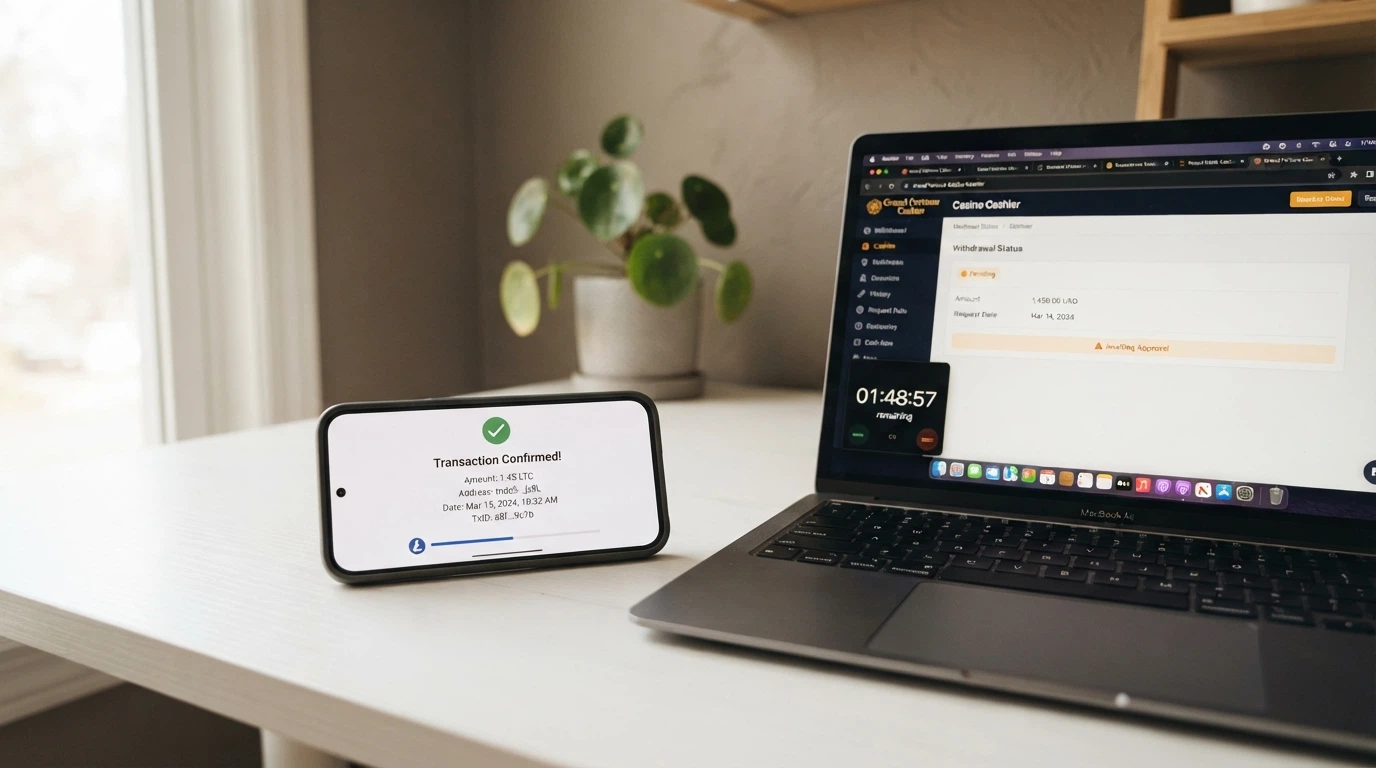
Crypto deposits are banned for licensed wagering in Australia under amendments to the Interactive Gambling Act covered earlier. An LTC deposit at a casino cashier is, by that fact alone, an offshore transaction. The Australian consumer-protection framework does not follow the funds. The dispute pathways that a licensed wagering provider is required to maintain — internal review, external dispute resolution through an approved scheme — do not exist at an offshore operator. The harm-minimisation tools that a licensed wagering provider must offer — binding deposit limits, BetStop-recognised self-exclusion, mandatory activity statements — are not required offshore.
How LTC Deposits Work at Offshore Casinos
A Litecoin deposit at an offshore casino works in three steps. The player opens the cashier, selects Litecoin, and the casino generates a deposit address. The player sends LTC from a personal wallet to that address. The casino credits the player’s balance once the transaction reaches a defined number of network confirmations. The whole process is normally under ten minutes for LTC.
The empirical picture comes from Casipto’s January 2026 testing of 47 offshore platforms, which recorded 134 Litecoin transactions. The average deposit confirmation time across that test was 6.2 minutes. At BC.Game specifically, the average LTC deposit time was 4.8 minutes. The minimum deposit amounts vary by operator; €20 is the confirmed minimum at Lucky Block, and most offshore casinos in this bracket set a similar floor. The fee paid to the Litecoin network is the player’s to absorb — Casipto measured the average at A$0.08 — which is small enough that minimum deposits do not lose a meaningful share to network costs.
The friction is the on-chain confirmation requirement. Most offshore casinos credit after two or three confirmations, which is fast enough that the player is rarely waiting. Where deposits do stall, it is usually because the casino’s automated crediting has flagged the transaction for manual review, which triggers at large amounts, at first deposits from a new wallet, or at random AML checks.
Withdrawal Speed: What the Numbers Actually Show
Withdrawal speed is the test that actually matters, because deposits are under the player’s control and withdrawals are under the casino’s. Casipto’s January 2026 test set reported an average withdrawal processing time of 11.7 minutes across 134 Litecoin transactions. At BC.Game, the average LTC withdrawal time was 8.3 minutes, and the largest test withdrawal — 12.4 LTC — was processed in 7 minutes 12 seconds.
Market summaries place Litecoin withdrawals for Australians at about 10 to 30 minutes after approval. The “after approval” qualifier matters. Casino-side approval is the variable that drives withdrawal time, not the Litecoin network itself. Once the casino approves the withdrawal, the LTC transaction settles in minutes; the wait is on the operator’s processing queue.
Where the system breaks down is on large withdrawals, on first withdrawals from an account, and on withdrawals where the casino triggers a KYC review. The 7-minute BC.Game withdrawal was a routine test transaction; a five-figure AUD withdrawal at the same operator may wait for document verification that the operator’s risk team has not yet staffed. The Lucky Block review notes that KYC may be requested on larger withdrawals — a fact that sits next to the no-withdrawal-limits claim and explains why both can be true at once.
No-KYC Claims vs the Reality: When ID Checks Actually Happen
“No-KYC” is one of the more misleading phrases in offshore casino marketing. Lucky Block’s AU review describes KYC-free signup, which is accurate for the signup step — a player can register an email address and deposit without providing identification. The same review notes that KYC may be requested on larger withdrawals, which is where the marketing language breaks down.
The reality is that offshore casinos operate under anti-money-laundering obligations even when they are not licensed in Australia. The thresholds vary, but the typical triggers are: withdrawals above a stated amount (often in the A$2,000 to A$10,000 band), first withdrawals from a new account, withdrawals to a wallet address different from the deposit address, and bonus claims where the operator wants to confirm the player’s identity before paying out. When triggered, the KYC check asks for government-issued identification, proof of address, and sometimes source-of-funds documentation. The check can take 24 to 72 hours, and the withdrawal does not release until it clears.
For an Australian player, the practical implication is that no-KYC marketing applies to the deposit and the early play. It does not apply to the moment the player tries to walk away with a meaningful win. The offshore casino can request documents at any time, and the player has no Australian regulator to complain to if the casino withholds the payout while the review runs.
Anonymity and Privacy: What Litecoin Actually Delivers
Litecoin is pseudonymous, not anonymous. Every LTC transaction sits on a public ledger, permanently, and the deposit address a player uses is associated with that player at the casino. The casino sees and records the deposit; the casino sees and records the withdrawal; the on-chain trail is visible to anyone who has the address. Blockchain analytics firms sell deanonymisation as a service, and a casino’s compliance team can use them.
What Litecoin delivers is privacy from a player’s own bank. A bank transfer to a casino carries the player’s name on the transaction. An LTC deposit carries the wallet address and a pseudonymous identifier. For a player who values keeping gambling transactions off a bank statement — a legitimate privacy preference — LTC delivers. For a player who believes the casino cannot identify them, LTC does not deliver that.
Provably fair is a separate concept. Some offshore crypto casinos publish provably fair verification for individual game rounds, allowing a player to confirm that the result was not manipulated after the bet. That is a real integrity check, but it is a check on the game’s randomness, not on the casino’s behaviour with deposits and withdrawals. A provably fair casino can still refuse a withdrawal, change its terms, or close an account.
What You Can Play at a Litecoin Casino (and What You Can’t)
The game library at an offshore Litecoin casino follows a familiar offshore shape. Pokies and online slots dominate the catalogue. Table games — blackjack, roulette, baccarat, poker variants — fill out a smaller section. Live dealer tables, streamed from studios, sit alongside RNG table games. Specialty games, crash games, and instant-win titles round out the offering. The mix is heavier on pokies than an AU-facing casino lobby would be, because the offshore market follows a global rather than Australian weighting.
Provider specifics for each of the ten operators were not confirmed from current snippets. The general expectation at this bracket of offshore casino is a Pragmatic Play, Play’n GO, NetEnt, Microgaming and Evolution Gaming roster, with Hacksaw Gaming and Nolimit City added at the higher end. The exact roster at each operator is something an Australian player confirms at the game lobby.
Online Pokies and Slots: The Games Australians Actually Play
Pokies are the most-played category at AU-facing offshore casinos, and the titles below are the ones with confirmed return-to-player data from current research. The table summarises RTP and volatility for six commonly-listed titles at offshore Litecoin casinos.
| Game Title | RTP | Volatility |
|---|---|---|
| Gates of Olympus | 96.50% | High |
| Sweet Bonanza | 96.51% | High |
| Book of Dead | 96.21% | High |
| Starburst | 96.09% | Low |
| Wanted Dead or a Wild | 96.38% | Very high |
| Wild Wild Riches Returns | 96.00% | — |
The first thing the spread shows is that the cluster sits in a narrow RTP band. Gates of Olympus at 96.50%, Sweet Bonanza at 96.51%, Book of Dead at 96.21%, Starburst at 96.09% — the titles most often named as favourites at AU-facing offshore casinos all return between 96% and 96.5%. The differences between them are smaller than the marketing language suggests. Wild Wild Riches Returns is listed at 96% RTP with a 10,000× max win multiplier, which signals a high-variance title with a long tail rather than a tight base game.
The second thing the spread shows is the volatility split. Starburst is the outlier — low volatility, frequent small wins, a flat session experience. The rest are high or very high volatility, which means long losing runs punctuated by larger hits. Wanted Dead or a Wild, at very high volatility, is the title Lucky Block ties its 50 free spins to. The match between the spin allocation and the game’s volatility profile is deliberate: very high volatility gives the free spins a real upside, even if the hit rate is low.
For an Australian player choosing between these titles, the RTP column is less informative than it looks. A 96.50% pokie and a 96.09% pokie both return roughly 4% to the house over the long run; the volatility decides whether the player experiences that 4% as a slow drain or as a sequence of small wins interrupted by a few large hits. Starburst is the title for a player who wants a flat session; Gates of Olympus is the title for a player who is willing to ride variance for a larger payout ceiling.
Table Games: Blackjack, Roulette and What Else Is on Offer
Table games sit behind the pokies at offshore Litecoin casinos in volume but matter to a player who prefers skill-based play. The headline figure for blackjack at this bracket is from CoinCasino’s live blackjack VIP, cited at 99.29% RTP with basic strategy. That figure is close to the theoretical maximum for a standard blackjack game — a 3:2 payout on blackjack, dealer stands on soft 17, late surrender, and basic strategy played perfectly pushes the RTP into the high 99s. The same conditions are common across offshore live dealer tables, though the exact rules at each operator vary.
Roulette is split between American (double-zero) and European (single-zero) wheels. European roulette returns 97.3% on most bet types; American roulette returns 94.7% because of the extra zero. A player who cares about the difference plays European; an offshore casino that offers both usually defaults to European for the live dealer section. Baccarat, craps, and casino poker variants round out the table-game offering, with RTPs in the 95% to 99% range depending on the bet type.
Table games at offshore casinos almost always contribute less to wagering requirements than pokies — typically 10% or excluded entirely. A player who plans to clear a deposit bonus on table games will find the effective wagering requirement several times the headline figure. The pokies-heavy weighting schedule is the operator’s incentive structure: a bonus balance is designed to be played on pokies, where the house edge is higher and the bonus clears faster against the player’s stake.
Live Dealer Tables with Litecoin: What to Expect
Live dealer tables at offshore Litecoin casinos stream from studios operated by Evolution, Pragmatic Play Live, and a handful of smaller providers. The experience is closer to a land-based casino than an RNG table game: a human dealer, real cards or a real wheel, real-time chat, and a betting interface that locks in once the round closes. Bet limits cover the same spread as a land-based table — small-stakes tables for casual play, VIP tables for larger bankrolls.
The live blackjack VIP figure cited above — 99.29% RTP with basic strategy — sits in this category. The same conditions that produce that RTP apply across most Evolution-powered live blackjack tables at offshore casinos: 8 decks, dealer stands on soft 17, doubling after split allowed, late surrender available. A player who plays basic strategy gets the same RTP regardless of operator, because the game rules are the dominant variable.
What varies between operators is the table inventory, the bet limits, and the studio. A casino with a deep Evolution integration carries more live dealer variants — blackjack, roulette, baccarat, game shows, dice games — than one with a smaller provider set. The bet limits at VIP tables often start at A$5 to A$10 per hand and can run into the thousands. Live dealer games typically contribute 10% to wagering requirements at offshore casinos, which makes them a poor choice for clearing a bonus.
Mobile Play: Apps vs Browser at Litecoin Casinos
Mobile play at offshore Litecoin casinos runs through the device browser rather than a dedicated app. The App Store and Google Play restrictions on real-money gambling apps make app distribution impractical for offshore operators, so the typical pattern is a mobile-optimised website that scales to the screen size and accepts touch input. The cashier, the game lobby and the live dealer section all run in the browser; LTC deposits and withdrawals work the same way they do on desktop.
The trade-off is that a browser-based casino does not get the native-app polish — push notifications, biometric login, a home-screen icon — that an app would offer. What it gets instead is a single codebase that runs on any device, which is operationally simpler for an offshore operator and means the player is rarely waiting for an app update. A punter who values the browser experience over the app experience will find offshore Litecoin casinos competitive on mobile; a punter who wants a dedicated app will not find one at this bracket.
What It’s Actually Like to Play at a Litecoin Casino in 2026
The test data and the community reports point in the same direction. LTC deposits and withdrawals at offshore casinos are fast, cheap and reliable within the casino’s processing queue; the variability is in the casino’s queue, not the Litecoin network. The Australian player experience in 2026 is shaped by that combination.

What Hands-On Testing Reveals About LTC Casino Reliability
Casipto’s January 2026 test set ran 134 Litecoin transactions across 47 offshore platforms. The aggregate numbers are 6.2 minutes average deposit confirmation and 11.7 minutes average withdrawal processing. The BC.Game-specific test reported 4.8 minutes average deposit and 8.3 minutes average withdrawal, with the largest test withdrawal — 12.4 LTC — processed in 7 minutes 12 seconds.
The pattern across that data is that Litecoin transactions are reliable. Deposits confirm; withdrawals process. The variability is in the long tail, not the median: a small number of transactions take materially longer than the average, and those outliers are typically the ones where the casino has flagged the withdrawal for additional review. A player who deposits a small amount and withdraws a small amount after a short session is firmly inside the fast average. A player who deposits a small amount and tries to withdraw a large one is outside the average and inside the KYC-and-review path.
The Australian Player’s Experience: Community Feedback and Common Themes
The community feedback on AU-facing offshore Litecoin casinos clusters around a few recurring themes. Fast payout audits commonly place Litecoin withdrawals at about 10 to 30 minutes after approval for Australians. Market summaries state that Litecoin and USDT (TRC-20) usually settle in under 10 minutes at no-KYC crypto casinos, while Bitcoin can take 30 to 60 minutes. The player experience matches those summaries when the withdrawal stays under the operator’s review threshold.
The recurring complaints cluster around three points. First, KYC triggers on larger withdrawals, which players who expected “no-KYC” experience as a contradiction. Second, the offshore casino’s domain is not stable — ACMA blocking requests push operators to new domains, and players who bookmarked a URL find it does not resolve a few months later. Third, the dispute pathway at an offshore casino is internal to the casino: there is no Australian regulator to escalate to, no approved external dispute resolution scheme, and no ombudsman. A player whose withdrawal stalls has the casino’s support team as the only point of contact.
The contrast with AU-licensed wagering is the gap the rest of this page describes. A licensed Australian wagering provider carries a dispute resolution pathway through the relevant state or territory regulator, BetStop coverage, mandatory deposit limits and activity statements. An offshore Litecoin casino carries none of those. The fast payout and the cheap deposit are real. The missing protection is real too.
How We Selected and Evaluated These Litecoin Casinos
The selection criterion for this page is straightforward. The evaluation lens is Australian.
The legal status of each operator is verified against the ACMA register of licensed interactive gambling providers. None of the ten operators in this ranking appears on that register, because no offshore operator offering online casino games to Australians can appear on it — the Interactive Gambling Act 2001 prohibits the supply. The confirmation that an operator is offshore is therefore by exclusion: not on the ACMA register, offering casino games to Australians, accepting Litecoin at the cashier.
The payment and bonus data comes from current AU-facing review material and from hands-on testing where available. Casipto’s January 2026 test set is the source for the LTC deposit and withdrawal timings, the fee comparison, and the BC.Game-specific data. ACMA is the source for the legal and enforcement figures. The ICLG 2026 report is the source for the express crypto prohibition under the IGA amendments. Where an operator-specific figure was not confirmed in current snippets, the absence is stated in the write-up rather than filled with a generic estimate.
The exclusion criteria are equally straightforward. AU-licensed wagering operators — bet365, Ladbrokes, Neds and similar — are excluded from the ranking because they are licensed for wagering, not for online casino, and they do not accept Litecoin. Operators that do not accept Australians are excluded. Operators with no Litecoin support are excluded. The result is the ten-operator set reviewed above.
Should You Play at an Offshore Litecoin Casino? What the Evidence Says
The facts point in two directions. The Litecoin payment rail is fast and cheap — the figures are in the payment section above — and the game libraries are broad, with pokies, table games and live dealer across all ten operators. The bonus offers are aggressive by the standards of any licensed market. For a player who has decided that offshore play is acceptable and is choosing between brands on payment speed and game roster, the data supports offshore Litecoin casinos as a functional product.

Against that, the legal and protection picture is unambiguous. Online casinos are prohibited in Australia under the Interactive Gambling Act 2001 — the prohibition, the penalties, and the enforcement record are covered above. Cryptocurrency for online wagering is prohibited under the same regime, which is why an LTC deposit at a casino cashier is by definition an offshore transaction. The Australian consumer-protection framework — BetStop binding force, dispute pathways, mandatory deposit limits — does not follow the player offshore. The protection gap is also covered above.
The conclusion the evidence supports is the one the ACMA register already implies. If an Australian player is going to wager online, the licensed Australian wagering market is the only option that carries Australian consumer protection. The offshore Litecoin casino market offers a faster and cheaper product, with broader game choice and more aggressive bonuses, but no Australian regulatory backstop. A player who has excluded themselves through BetStop can still deposit at an offshore casino. A player who wins a large amount at an offshore casino and triggers a KYC review has no Australian regulator to escalate to. A player who lands at a problem-gambling prevalence figure and needs help can use the National Gambling Helpline at 1800 858 858 or Gambling Help Online regardless of which casino they played at — but the offshore casino is not required to offer the deposit-limit, activity-statement, and self-exclusion-binding infrastructure that the licensed Australian market provides.
The facts are not on the side of offshore play for an Australian player who values the protection layer the country has built. They are on the side of offshore play for an Australian player who has weighed that protection gap and decided the speed and game choice are worth it. The page does not make that decision for the reader. It puts the legal position, the payment performance, the bonus mechanics and the protection gap on the table and lets the reader weigh them.
Frequently Asked Questions
Are Litecoin casinos provably fair and safe to use?
Provably fair verification covers specific game rounds at some offshore crypto casinos. That confirms a game’s randomness, not whether the casino pays out withdrawals or honours its terms. None of the operators here appear on ACMA’s register of licensed interactive gambling providers, which is the check an Australian player has.
Does BetStop cover offshore Litecoin casinos in Australia?
No. BetStop, the National Self-Exclusion Register, applies to Australian-licensed wagering services only. ACMA is explicit that it does not bind offshore online casinos. As at 31 July 2026 the register had 67,480 registrations and 41,290 active exclusions — none of which extend to the offshore Litecoin market.
Can Australians claim no-deposit bonuses at Litecoin casinos?
None of the ten featured operators in this ranking carries a confirmed no-deposit bonus. No-deposit offers exist at some offshore crypto casinos outside this set, typically with 50× to 100× wagering and tight cashout caps. The featured set’s offers are all deposit-gated.
Do Litecoin casinos in Australia require KYC or identity verification?
KYC requirements vary by operator. Lucky Block’s review describes KYC-free signup with KYC possible on larger withdrawals. Most offshore casinos verify identity at first withdrawal, above a stated threshold, or at bonus claims. The 24-to-72 hour review is common once triggered.
Which casino games and providers are available at Litecoin casinos in Australia?
The standard offshore Litecoin library is pokie-heavy, with a smaller table-game section and a live dealer section streamed by Evolution and Pragmatic Play Live. Common providers include Pragmatic Play, Play’n GO, NetEnt and Microgaming. Live blackjack VIP is cited at 99.29% RTP with basic strategy.
Free-Play and Demo Mode: Can You Try Before You Deposit?
Demo mode is widely available at offshore Litecoin casinos on pokies, and the typical pattern is the same as at licensed casinos: a player can launch a pokie in demo mode without logging in, play with a virtual balance, and judge the game’s volatility, hit frequency and bonus features before risking real money. Table games and live dealer tables usually do not offer demo mode; the operational cost of streaming a live table for a non-paying viewer is high enough that operators restrict it.
What demo mode does and does not show is worth being clear about. Demo mode shows what a slot looks like, how often it hits, what the bonus features trigger, and roughly how a session will feel. It does not show the real-money experience of having a deposit balance with a wagering requirement attached, and it does not show what happens when a withdrawal request triggers a KYC review. A player who uses demo mode to evaluate games is using it well; a player who assumes demo mode reflects the real-money experience is making a category error.