
A $2 Casino Deposit in Australia: What the Marketing Headline Hides in 2026
Walk into any affiliate list ranking “the best $2 minimum deposit casinos in Australia” and the number stares back at you. Two dollars. A coffee. Less, even, than the surcharge on a contactless tap. The promise is clear: real-money casino play, starting at the price of a scratchie. The reality on the other side of the deposit button is messier, and a lot of it has nothing to do with the operator and everything to do with where the player sits when they tap confirm.
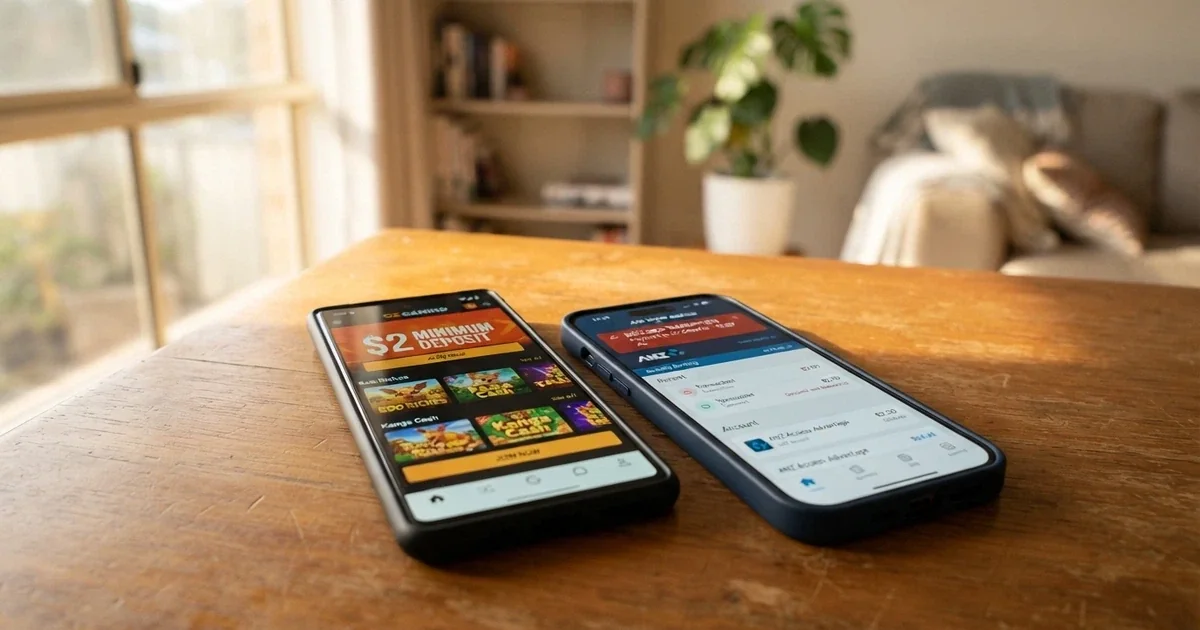
This page works through what that $2 figure actually buys an Australian player in 2026 — which payment rails honour it, which offshore brands accept it, how long the bankroll lasts on the pokies, and what consumer protections disappear the moment you cross from a licensed Australian wagering operator onto an offshore casino site.
Current as of 3 November 2026. Verified against the ACMA’s public register of blocked services and the licensing claims on each operator’s own terms page.
Table of Contents
- Why a $2 Casino Deposit in Australia Isn’t What It Looks Like
- The Payment Rails That Actually Let You Deposit $2
- The Offshore Casinos Australian Players Can Join — Ranked by Minimum Deposit
- What a $2 Bankroll Actually Buys You on the Pokies
- $2 Deposit Mobile Casinos in Australia
- New $2 Deposit Casinos — and Why the Welcome Bonus Rarely Applies
- The Legal Reality: Every $2 Casino Is Offshore
- Staying in Control When the Deposit Floor Is This Low
- How We Reviewed $2 Minimum Deposit Casinos in Australia
- Your $2 Deposit at an Offshore Casino: What You Should Actually Do
- Frequently Asked Questions
Why a $2 Casino Deposit in Australia Isn’t What It Looks Like
The $2 deposit headline is real, in the sense that the money will move. It is misleading in nearly every other respect. There is no Australian-licensed online casino to deposit it into, the deposit rail that lets you clear $2 is almost never a credit or debit card, and the welcome bonus that the banner advertises will not trigger at this deposit size. The number functions less as a price and more as a hook — a way of getting a player through the registration page and onto a platform where the real minimums quietly reset themselves.
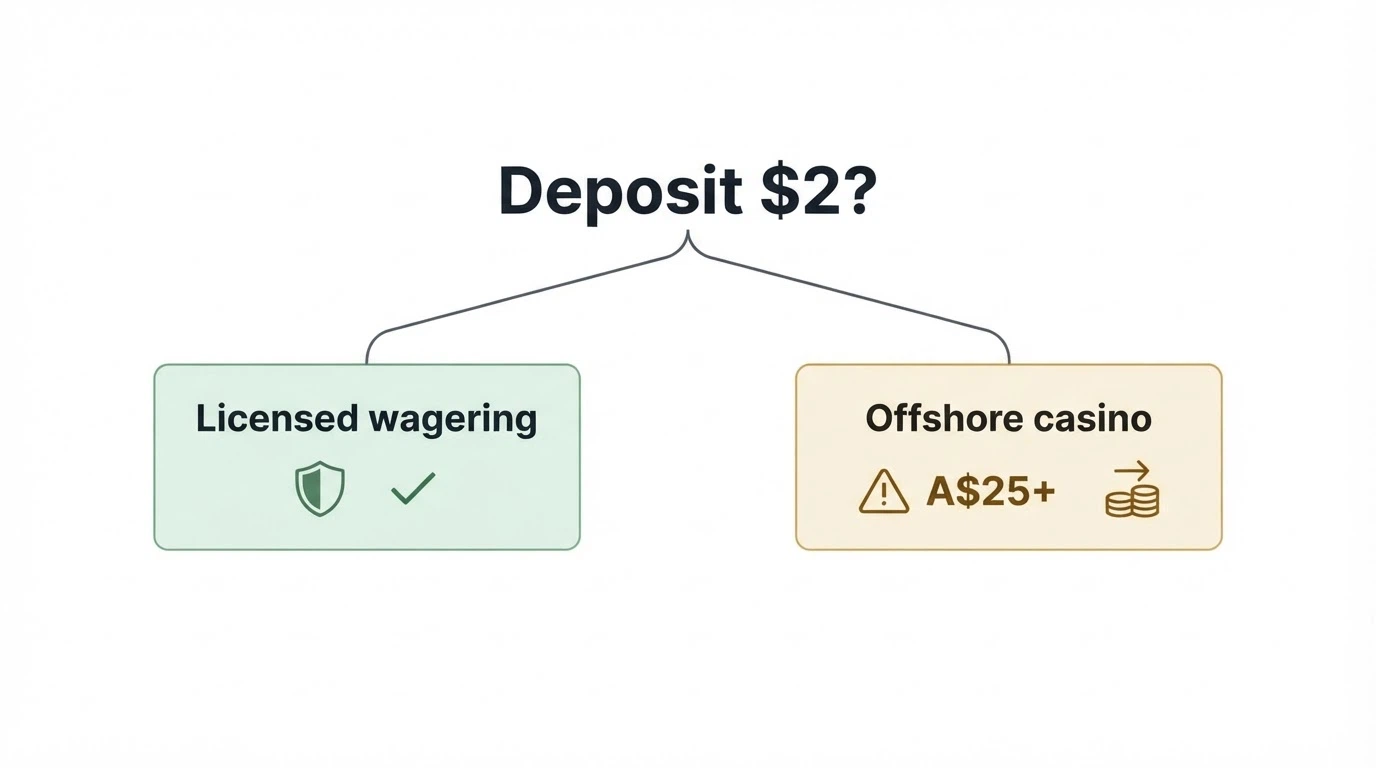
What the marketing number covers is the entry threshold. What it does not cover is everything that happens after the entry.
The “$2 deposit” label: what it promises vs what it delivers
The $2 number on an affiliate page usually means “at least one payment method will accept a two-dollar transfer.” It does not mean every method will. The genuine floor of A$0.10 sits at one end of the market — that is what a Bitcoin micro-deposit works out to at current exchange rates at Stake. Slightly higher up, around A$1, sit the USDT and other stablecoin minimums at the kind of crypto-native casinos Australian players can reach. The fiat floor, by contrast, sits much further up the ladder: A$10 is the practical minimum a Neosurf voucher can deliver, and most AU-facing offshore operators will not let a PayID or POLi transfer through for less than A$10 either.
The implication is simple. A genuine $2 AUD deposit, made through a payment rail denominated in Australian dollars, is not the norm. It is the exception, and it happens only at a small set of operators that explicitly route PayID — which POLi functionally replaced until its closure in September 2023 — and Bitcoin to a sub-A$10 minimum. The headline figure that the marketing runs on is real, but it is real for a narrow band of methods at a handful of brands — not the universal baseline the comparison tables imply.
Real-money play vs demo mode at the $2 entry point
A two-dollar deposit that clears the cashier does buy real-money eligibility. The account is live, the pokies are unlocked, and a winning spin pays into a withdrawable balance. What it does not buy is much session. At the A$0.10 minimum spin that most Pragmatic Play and NetEnt titles accept, A$2 funds roughly 20 spins on the floor. Push the stake up to A$0.20 — the minimum on Gates of Olympus and Sweet Bonanza — and you are funding ten spins. Even at a generous 96% return-to-player, the expected loss per spin at A$0.10 is about A$0.004, so the bankroll is not mathematically extinguished quickly. It is variance that extinguishes it. A long cold streak at the start of a session is what kills a $2 bankroll, not the house edge grinding it down spin by spin.
The other option is to skip real-money play entirely and use the demo mode that virtually every offshore operator makes available without registration. Demo balance is unlimited. It does not pay out. The choice between real money and demo at the $2 entry is, in practice, a choice between an actual stake and a practice round.
“Australian” $2 casinos — what the geo label really means
No Australian online casino licence exists. The Interactive Gambling Act 2001 makes it an offence to provide online casino games to a person physically in Australia, and no Australian regulator issues a licence for the product. Every brand that styles itself “Australian” — accepting AUD accounts, surfacing A$-denominated bonuses, using local imagery and slang — is doing so from offshore. The label is a marketing cue, not a regulatory one.
FairGO is the clearest example: an AU-themed brand, AUD accounts, Australian payment rails, but Curaçao-licensed and physically based elsewhere. The same pattern holds across most of the offshore $2-deposit market. What changes between brands is the prominence of the Australian styling, not the underlying legal status of the product they are offering.
The Payment Rails That Actually Let You Deposit $2
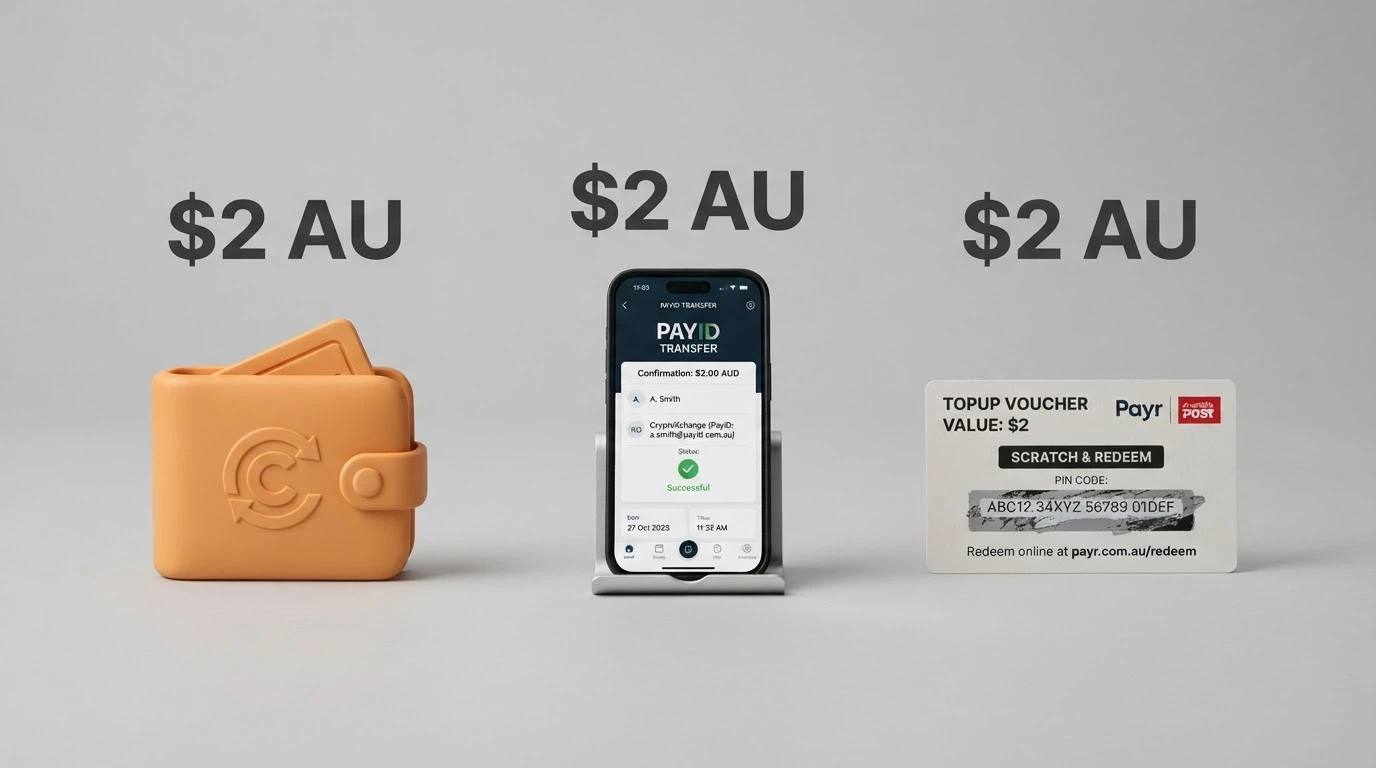
A genuine $2 deposit, cleared in AUD, is only as available as the payment rail that carries it. Five methods dominate the AU-facing offshore market, and they do not behave the same way at the two-dollar level.
| Payment method | Min deposit | Deposit speed | Withdrawal speed | Withdrawal supported |
|---|---|---|---|---|
| Bitcoin / crypto | ~A$0.10 | 1–30 minutes | Under 1 hour | Yes |
| PayID / Osko | A$10 | Instant | 1–5 business days (bank transfer) | No |
| Neosurf voucher | A$10 | Instant | N/A (one-way) | No |
| POLi | Discontinued | — | — | — |
| Visa / Mastercard debit | Varies (often A$10+) | Instant | 1–5 business days | Yes (at some operators) |
Only one of these five rails reliably clears a genuine two-dollar AUD transfer, and it is not the one most Australian players reach for first.
Crypto deposits: the only rail that goes below $2
Crypto is the only payment method where the genuine deposit floor sits below A$2. Bitcoin deposits at Stake clear from approximately A$0.10-equivalent at current rates; other coins sit in a similar band. Settlements take anywhere from one minute to half an hour, depending on the coin and the network. The exchange-rate risk is the trade-off. The AUD value of the deposit can move between the time the player sends it and the time it credits, and it can move again before the player cashes out. For a $2 transfer the absolute exposure is small — a few cents either way — but the principle is real: crypto deposits and crypto withdrawals are not the same AUD figure at the moment they reach the cashier.
The other side of crypto is the withdrawal speed. Where bank transfers take days, Bitcoin and most other cryptocurrencies clear in under an hour at tested sites. For a player funding a small balance and hoping to cash it out before the minimum withdrawal floor locks it in, that speed is the difference between getting the money out and having it sit trapped.
PayID and Osko: instant, Australian, but rarely $2
PayID is the most convenient AU-native deposit rail: instant settlement, no fees, and direct from an Australian bank account. For Australian players it is the method that feels least like gambling through an offshore intermediary. It is also almost never a $2 rail. Minimums at most operators start at A$10, sometimes A$20. POLi — the rail that used to fill this gap — was shut down in September 2023, with PayID and Osko functionally replacing it at a higher minimum.
The withdrawal side is where PayID disappoints. Deposits settle instantly through PayID; withdrawals do not. Cash-out reverts to bank transfer, taking one to five business days. That asymmetry matters at the $2 level because the bank transfer is the rail the player ends up on when they try to retrieve their balance, and the timing is the difference between seeing the money this week and seeing it next week.
Neosurf and prepaid vouchers: the fiat workaround
Neosurf fills the slot PayID leaves at the bottom of the market. It is a prepaid voucher — buy a voucher for a fixed AUD amount, enter the code at the cashier, and the deposit clears. The minimum at most operators is A$10, which is higher than the $2 headline but lower than most card minimums, and it works without a bank account or a crypto wallet.
The catch is that Neosurf is one-way. You cannot withdraw to a Neosurf voucher. Cash-out is forced to bank, card or crypto, and the same withdrawal-floor rules apply. The voucher solves the deposit problem and leaves the withdrawal problem exactly where it was.
The withdrawal trap: depositing $2, cashing out $50
The minimum withdrawal floor at most offshore casinos sits between A$20 and A$50, sometimes higher. That is the gap the marketing does not mention. A player who deposits A$2, wins A$15, and tries to cash out will find the request rejected — the balance is real, but the floor prevents it from leaving the platform. The only fix is to keep playing until the balance clears the threshold, which means feeding more money in or grinding the existing balance through more spins.
PayID offers no fix. Crypto does, partially: a low minimum withdrawal and a sub-one-hour clearing time mean a crypto-funded player can usually cash out before the balance drops back below the floor. Bank transfer does not: a one-to-five-business-day wait, combined with the floor itself, means a small balance can sit on the platform for the entire withdrawal window without ever being playable.
The withdrawal trap is the single most concrete cost of the low-deposit pitch at an offshore casino. The deposit is two dollars. The cashout is twenty-five, fifty, sometimes a hundred. Between those two numbers the bankroll is, in practice, captive.
The Offshore Casinos Australian Players Can Join — Ranked by Minimum Deposit
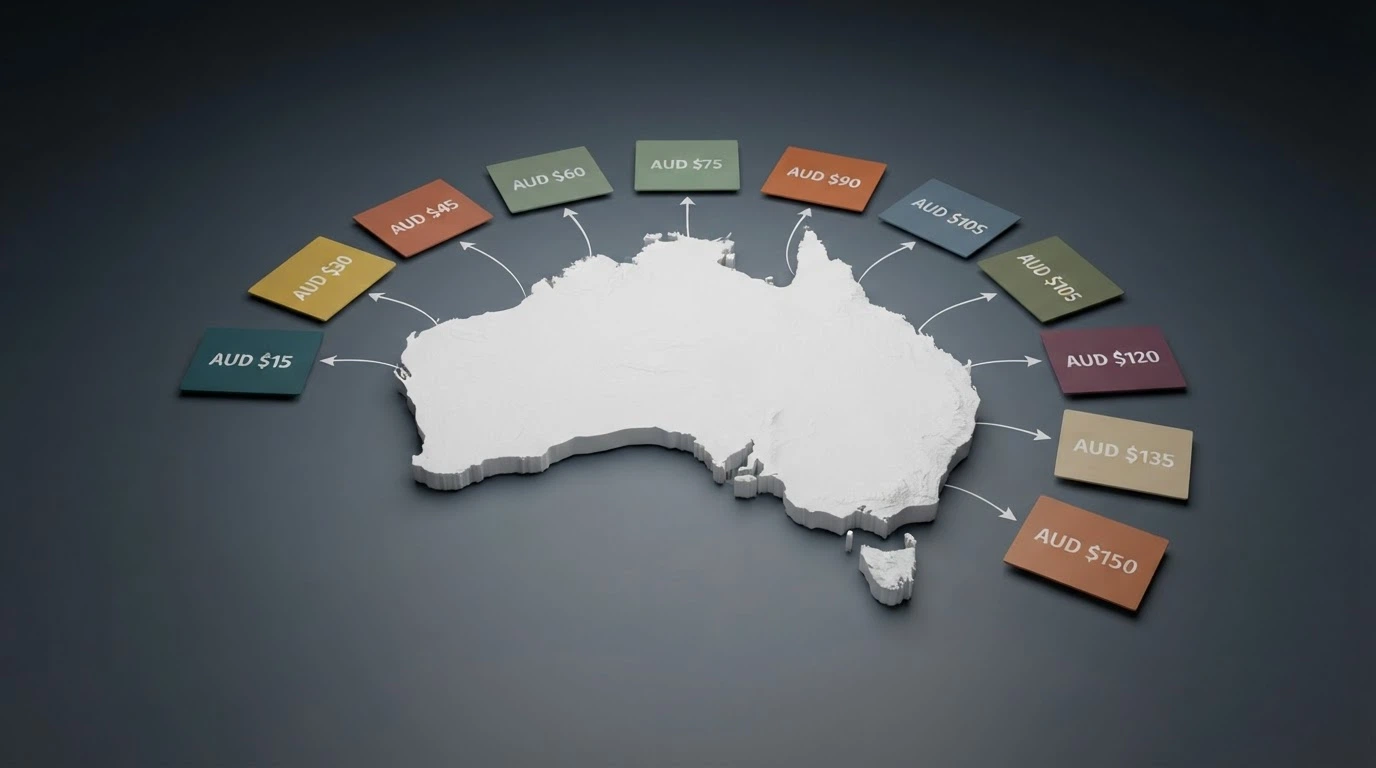
The table below ranks ten offshore brands that accept Australian players, ordered by how close each gets to a genuine two-dollar deposit. Every operator in this ranking is licensed outside Australia — the comparison is about how close each gets to the $2 floor, not about who is safest.
| Operator | Licensing jurisdiction |
|---|---|
| Stake | Curaçao |
| Rocket Play | Curaçao |
| FairGO | Curaçao |
| Skycrown | Curaçao |
| Royal Reels | Curaçao |
| WinSpirit | Curaçao |
| Bizzo Casino | Curaçao |
| Rainbet | Curaçao |
| Scream Casino | Curaçao |
| Rocket Casino | Curaçao |
The Australian licence column is empty for every row on purpose. None of these operators holds one.
Rocket Play — A$2–A$10 minimum, method-dependent
Rocket Play sits at the narrow end of the deposit range, with a stated minimum that floats between A$2 and A$10 depending on the payment method chosen. The game range is broad for the AU-facing offshore market — Pragmatic Play, NetEnt, Hacksaw and Play’n GO all appear in the lobby, which means the major titles that Australian players search for by name are present. Gates of Olympus, Sweet Bonanza and Big Bass Bonanza all show minimum bets in the A$0.10–A$0.20 range, so a A$2 deposit translates to somewhere between ten and twenty spins on those titles.
The deposit floor moves with the payment rail. A PayID deposit at Rocket Play is most likely an A$10 floor; a crypto deposit may sit lower. The brand does not collapse both into a single advertised number, and players who choose the wrong method at the cashier will see the actual minimum rise above the headline. The gap between “A$2 minimum” and “A$2 minimum via Bitcoin, A$10 via everything else” is the kind of detail that matters at this deposit size.
Skycrown — Curaçao-licensed, AU deposit terms unconfirmed this run
Skycrown is a Curaçao-licensed operator reaching Australian players. Its presence in the AU-facing $2-deposit conversation is established through affiliate coverage rather than directly verified licensing data this run. Before depositing, a player should check the current minimum deposit on Skycrown’s own cashier page, confirm which payment methods honour it, and read the bonus terms for the method they actually plan to use — minimum deposit, wagering multiplier, max bet while the bonus is active, and expiry. The information is on the operator’s terms page; the affiliate comparison is a starting point, not a substitute.
Royal Reels — Curaçao-licensed, deposit floor unconfirmed
Royal Reels sits in the same AU-facing offshore space as the rest of this ranking. Specific deposit and bonus terms were not confirmed this run, so the practical guidance is the same as for any operator where the published minimum and the cashier reality might differ. A player who wants to use Royal Reels at the $2 level should verify the current minimum on the deposit page, check that the payment method they intend to use is included in that minimum, and read the wagering terms in full before triggering any bonus. The default assumption — that an offshore brand’s headline minimum is the floor for every method — is the one that costs players the most at this deposit size.
Stake — ~A$0.10 BTC, the lowest genuine deposit in the market
Stake undercuts every other brand in this ranking on deposit floor. The minimum Bitcoin deposit at Stake clears from approximately A$0.10 at current exchange rates, which is the lowest genuine real-money deposit anywhere in the AU-facing offshore market. For a player whose primary question is “can I deposit less than a dollar”, Stake is the operator that answers yes — but only through crypto. Stake is a crypto-only operator. There are no AUD fiat rails, no PayID, no Neosurf. The A$0.10 floor exists because the floor is denominated in BTC, not AUD.
The trade-off follows from that. AUD value of any deposit moves between send and credit, and again between request and cashout. A $0.10 BTC deposit today is not a $0.10 BTC deposit an hour from now. The withdrawal side is faster than any fiat rail — sub-one-hour Bitcoin clearance — but the player is exposed to the exchange rate for the entire round trip.
WinSpirit — Curaçao-licensed, specifics unconfirmed
WinSpirit is a Curaçao-licensed operator with a presence in the AU-facing offshore market. Like several other operators on this list, the specifics — current minimum deposit, payment methods that honour it, bonus terms, game provider mix — were not confirmed this run. The verdict is qualitative. Before depositing at WinSpirit, a player should check the cashier page directly for the current minimum, identify which payment methods actually clear at that minimum, and read the bonus terms in full. The offshore status of the brand is not a reason to skip those checks; it is a reason to make them.
FairGO — AU-themed offshore brand, Curaçao-licensed
FairGO is the operator most explicitly styled for the Australian market. AUD accounts, Australian payment rails, an AU-themed brand identity — the marketing cues are all in place. None of that changes the underlying regulatory position. FairGO is Curaçao-licensed, not Australian-licensed, and the product it offers is the same product every other offshore casino on this list offers: online casino games to Australian players, unlicensed in Australia.
The gap between the Australian styling and the offshore regulation is the entire story of the AU-facing $2-deposit market. FairGO is the most legible example of it because the styling is the most prominent, but the pattern repeats across every brand on this list.
Bizzo Casino — Curaçao-licensed, specifics unconfirmed
Bizzo Casino is a Curaçao-licensed brand in the AU-facing offshore space. Specific deposit terms and bonus structure were not confirmed this run. The same practical guidance applies: check the current minimum on the cashier page, identify the payment methods that honour it, and read the bonus terms before triggering any offer. The absence of confirmed specifics is not a reason to skip those checks — it is a reason to do them more carefully.
Rainbet — Curaçao-licensed, specifics unconfirmed
Rainbet is a Curaçao-licensed brand reaching Australian players. Like the other operators in this section whose specifics were not confirmed, the practical advice is to verify directly: current minimum deposit, payment methods that clear at that minimum, and bonus terms in full before claiming any offer. The offshore status of the brand is the baseline. The specifics are what a player confirms before clicking deposit.
Scream Casino — Curaçao-licensed, specifics unconfirmed
Scream Casino sits in the same AU-facing offshore space as the rest of this ranking. The Curaçao jurisdiction and the absence of an Australian licence are the established baseline. Specific deposit and bonus terms were not confirmed this run, so the qualitative guidance is the same as for any other brand on this list where the headline minimum and the cashier reality can diverge: check the current minimum directly, identify which payment methods honour it, and read the bonus terms before triggering any offer.
Rocket Casino — Curaçao-licensed, specifics unconfirmed
Rocket Casino rounds out the ranking. Curaçao-licensed, AU-facing, no Australian licence. The same qualitative framework applies: confirm the current minimum on the deposit page, check which payment methods clear at that minimum, and read the bonus terms — wagering multiplier, max bet while active, expiry — before claiming any offer. The pattern across this ranking is consistent. The specifics that matter at the $2 level are the ones a player verifies at the cashier, not the ones an affiliate table summarises.
What a $2 Bankroll Actually Buys You on the Pokies
Two dollars buys a session on the pokies, not a long one. The mathematics of how long depends on two numbers: the return-to-player percentage and the volatility. RTP determines how much the game returns across an enormous number of spins; volatility determines how unevenly those returns arrive. At a $2 bankroll the player is dealing in a small enough sample that volatility matters more than RTP.
| Title | RTP | Provider | Volatility | Min bet |
|---|---|---|---|---|
| Blood Suckers | ~98% | NetEnt | Low | — |
| 1429 Uncharted Seas | 98.5% | Thunderkick | Low-medium | — |
| Starburst | 96.09% | NetEnt | Low | A$0.10 |
| Gates of Olympus | 96.50% | Pragmatic Play | Very high | A$0.20 |
| Sweet Bonanza | 96.48% | Pragmatic Play | High | A$0.20 |
| Big Bass Bonanza | 96.71% | Pragmatic Play | High | A$0.10 |
The RTP column on this table clusters in the 96–98% band. The volatility column is where the titles diverge.
Low-volatility pokies: the best titles for stretching a $2 deposit
Low-volatility pokies pay small amounts often. A $2 bankroll on a low-volatility title lasts longer than on a high-volatility one not because the RTP is necessarily higher — it often is, but the difference is small — but because the bankroll is not exposed to the long cold streaks that high-volatility games deliver as a matter of routine. A spin that returns less than the stake is the rule on a low-volatility game; a session-ending run of them is rare.
Blood Suckers, at roughly 98% RTP and low volatility, is the cleanest example. 1429 Uncharted Seas, at 98.5% RTP and low-to-medium volatility, runs a close second. Starburst, with 96.09% RTP and a A$0.10 minimum bet, sits slightly behind on the return but is widely available across AU-facing offshore brands and accepts the smallest stake the table allows. For a player whose primary goal is to maximise session length on a $2 bankroll, the choice is between these low-volatility titles and a higher-volatility game at higher risk of an early exit.
High-volatility pokies at $2: the long-shot appeal
High-volatility pokies pay rarely and pay big when they do. Gates of Olympus, with a 96.50% RTP, very high volatility and a 5,000x maximum, is the clearest example on the AU-facing market. Sweet Bonanza sits at 96.48% RTP with a 21,100x potential — the headline figure on the title — and a A$0.20 minimum bet. Big Bass Bonanza, at 96.71% RTP, high variance and a A$0.10 minimum, offers the most accessible entry into the high-volatility category.
The trade-off is sharp. A $2 bankroll at A$0.20 minimum funds ten spins on Gates of Olympus or Sweet Bonanza. Variance at very high volatility means the realistic outcome on ten spins is a quick loss, with a small chance of a session-defining hit. The 21,100x potential on Sweet Bonanza is not a number the $2 bankroll will reach in practice; it is a number the title is built around, and it is what the marketing leans on.
The real session: how long $2 lasts on Australian-facing pokies
At a 96% RTP pokie with A$0.10 minimum spins, the expected loss per spin is A$0.004. On pure expected value, A$2 funds 500 spins. On variance, it funds 20 to 80. The gap between the theoretical spin count and the practical one is the entire lesson of low-bankroll pokies play. RTP is an average across millions of spins; a $2 bankroll is a sample of dozens. The two do not meet.
What a session at this deposit size actually feels like is a fast-moving balance, frequent small returns on low-volatility titles, and long quiet stretches on high-volatility ones. The expected loss is small — under ten cents across a typical $2 session on a 96% RTP title at A$0.10 minimum. The felt experience is that the money goes quickly, because the player is running through spins faster than the average RTP predicts.
$2 Deposit Mobile Casinos in Australia
Mobile browser play works at every operator on this ranking. No app download is required to spin at minimum stakes on iOS or Android — the offshore casino market runs on instant-play browser access, and the $2 deposit flow goes through the mobile browser the same way it goes through the desktop site. PayID deposits settle from the banking app in seconds; a crypto deposit clears from a mobile wallet without leaving the browser session. The friction at the $2 level is not the interface but the payment rail. PayID has no withdrawal support and falls back to bank transfer; crypto offers the fastest round trip but exposes the player to exchange-rate movement on a small balance.

For a player funding a $2 session from a phone, the practical question is which payment rail they have ready. A player with a crypto wallet and a tolerance for exchange-rate risk has the cleanest experience. A player relying on PayID has the fastest deposit but the slowest withdrawal. A player with a Neosurf voucher has a clean deposit and no withdrawal path on the voucher itself.
New $2 Deposit Casinos — and Why the Welcome Bonus Rarely Applies
The freshest names in the AU-facing low-deposit space cycle through the affiliate lists regularly. The Pokies.net — an AU-focused brand with a A$2 minimum for PayID and Bitcoin — is one of the more prominent recent additions. Newness is not the same as suitability. The welcome offer that gets a new player through the door almost never applies at the $2 deposit level.
What a $2 first deposit actually unlocks vs what the banner promises
Most welcome bonuses at AU-facing offshore casinos trigger at an A$10 minimum, many at A$20 or A$25. A $2 deposit falls below every threshold on that range and almost never qualifies. The banner that advertises a 200% match bonus typically applies to a deposit ten times larger than the entry point. At $2, the matched amount is $4 in bonus funds — and 30x to 40x wagering on $4 produces a turnover requirement between A$120 and A$160, against a bankroll that was A$2 to start.
The bonus terms at the $2 level are functionally useless even when the bonus does trigger. A 200% match on a $2 deposit yields $4 of bonus funds. Clearing $4 against a 30x wagering requirement means turning over A$120 at minimum, with an A$5 max-bet cap while the bonus is active — a single over-cap spin voids the bonus. The promotion that the banner sells and the offer that lands at the cashier are different products.
The Legal Reality: Every $2 Casino Is Offshore
The Interactive Gambling Act 2001 makes it an offence to provide online casino games, online pokies and in-play sports betting to a person physically in Australia. No Australian licence exists for the product. The IGA was strengthened in 2017, and the ACMA — the federal regulator — has been enforcing it ever since. Since its first blocking request in November 2019, the ACMA has had 1,788 illegal gambling and affiliate websites blocked by Australian ISPs as of August 2026. Over 230 illegal gambling services have withdrawn from the Australian market since the ACMA started enforcing new illegal online gambling rules in 2017.
The individual player is not prosecuted. The IGA targets the provider, not the person in Australia. That asymmetry is the reason offshore casinos continue to accept Australian players without any Australian player being arrested for using them. The legal risk sits on the operator side. The consumer risk sits on the player side.
What you give up playing offshore: BetStop, consumer protection and dispute rights
An Australian-licensed wagering customer has a set of protections that an offshore casino player surrenders entirely.
BetStop — the National Self-Exclusion Register — binds every Australian-licensed online and phone wagering service. One registration excludes a person from every licensed brand simultaneously. As at 31 July 2026, BetStop had 67,480 registrations, with 41,290 exclusions still active. None of those exclusions reach an offshore casino. A self-excluded Australian can register with BetStop and still deposit at an offshore brand the next day.
Consumer protection under Australian law is the second piece. A licensed wagering customer with a refused withdrawal or a voided bonus has recourse through Australian consumer law and through the state or territory regulator that issued the licence. An offshore casino customer has none. Dispute resolution depends on the operator’s own terms and the Curaçao regulator that issued the offshore licence — neither of which is answerable to an Australian player.
DNS-level site blocking is the third. The ACMA has directed Australian ISPs to block 1,788 illegal gambling sites since 2019. When a site the player has a balance on is blocked, the balance can become inaccessible through any Australian ISP. There is no Australian recourse for retrieving it. The block is enforced on the Australian side; the operator’s terms page on the other side is unchanged.
AUSTRAC oversight — the fourth — does not apply to offshore casinos in the same way it applies to Australian-licensed wagering operators. Anti-money-laundering reporting obligations are weaker offshore. The audit trail on a small balance at an offshore brand is thinner than the audit trail on the same balance at an Australian-licensed bookmaker.
The 2026 reform and what changes on 1 January 2027
The Interactive Gambling Amendment (Gambling Reform) Bill 2026 passed Parliament on 19 August 2026. The measures commence on 1 January 2027.
The advertising restrictions are the most visible change. No more than three wagering advertisements per hour between 6:00 am and 8:30 pm. No wagering advertising from fifteen minutes before a live sporting event until five minutes after it ends. Athletes, celebrities and influencers are barred from promoting wagering products. Ads inside sports venues and on player uniforms are banned. Online wagering ads can only target logged-in, age-confirmed users who have not opted out.
The payment-provider blocking powers are the most consequential for offshore access. From 1 January 2027, banks and payment providers gain express authority to block transactions to illegal gambling operators. Credit cards, credit-related products and digital currency — crypto — are already banned as payment for online wagering under the Interactive Gambling Amendment (Credit and Other Measures) Act 2023, with penalties of up to A$247,500 for non-compliance. That ban has been in force since 11 June 2024. The 2027 commencement extends the same blocking logic to banks themselves.
Inducement marketing is restricted from 2027 as well. Direct marketing of gambling inducements is prohibited for fourteen days after a customer signs up, for three months after deregistration from BetStop, and indefinitely for customers identified as at risk.
The 2026 reform does not legalise online casino. It tightens the existing prohibition. Offshore casinos reaching Australian players remain illegal to provide, and the enforcement tools get sharper.
Staying in Control When the Deposit Floor Is This Low
The lowest-deposit casinos carry a specific responsible-gambling risk that the rest of the market does not: the frictionless top-up. A A$2 deposit that takes ten seconds to clear is a deposit that a player in a difficult moment can make ten times in an hour. The friction that higher minimums create is, in a perverse sense, a form of pause.
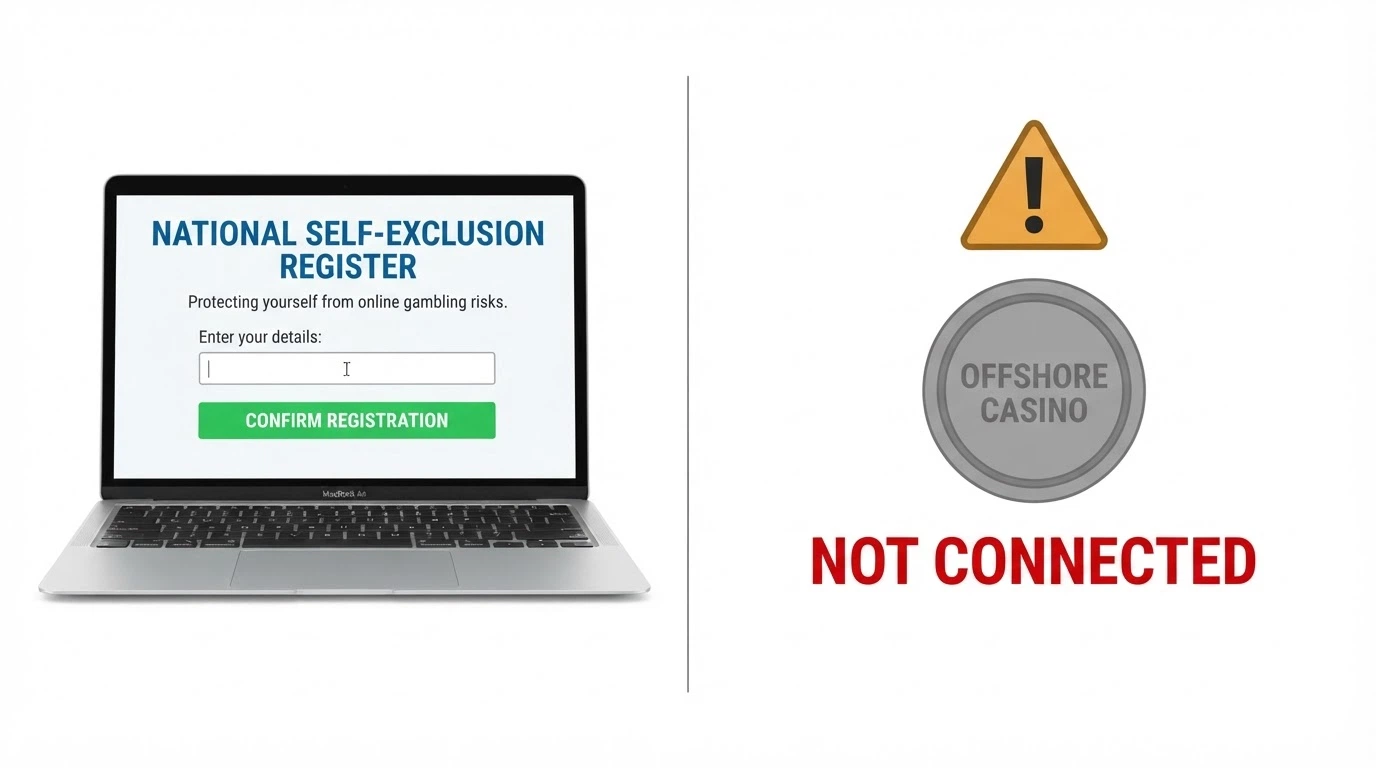
The licensed Australian alternative is BetStop. One registration, one exclusion, every Australian-licensed wagering service blocked simultaneously. The minimum exclusion period is three months; lifetime exclusion is an option. As at 31 July 2026, 78% of registrants were under 40, and 38% chose lifetime exclusion. The register is the single most effective self-exclusion tool available to an Australian who wants to stop.
BetStop does not cover offshore casinos. An Australian who has registered with BetStop can still deposit at an offshore brand. The offshore route is, on this dimension, the most exposed: no register-level exclusion, no operator-level exclusion that survives a brand switch, no consumer-law recourse for a player who wants the exclusion enforced.
The harm data is real. About 2.1% of Australian adults — roughly 430,000 people — experience problem gambling. The Australian Institute of Health and Welfare put high-risk gambling at 1.8% in 2022. These are not abstract figures. They are the population the responsible-gambling tools are designed for, and they are the population the offshore route leaves most exposed.
Where to get help: Australian gambling support services
The National Gambling Helpline is 1800 858 858 — free, confidential, staffed 24 hours a day, seven days a week. Gambling Help Online, at gamblinghelponline.org.au, offers online chat and email support with counsellors available around the clock. State-level services — Gambler’s Help in Victoria, GambleAware in New South Wales, Gambling Harm Support in South Australia, Gambling Help in Queensland — all route through the national helpline and offer the same 24/7 access. Self-help tools, activity statements and budget calculators are available through the same channels.
The support services are independent of any casino operator and exist to help players who want help. Reaching out to them is a decision that can be made at any time, before or after a deposit, and the contact itself is confidential.
How We Reviewed $2 Minimum Deposit Casinos in Australia
The operators in this ranking were checked against the ACMA’s public register of blocked services and against each operator’s own published terms page. Where licensing claims could not be verified this run, that absence is noted in the operator write-up rather than papered over. Where specific deposit minimums, bonus terms or payment-method availability could not be confirmed from snippets this run, the write-up addresses those points qualitatively and points the player at the cashier page where the figures live.
The evaluation criteria that ordered this ranking are the deposit threshold, the licensing jurisdiction, the game range and provider quality, and the payment-method support that actually clears at the headline minimum. The IGA prohibition is the baseline context: every operator on this list is offshore, every product they offer is unlicensed in Australia, and the consumer protections that come with an Australian licence are absent at every brand on the page.
The ranking is not a recommendation. The page describes operators; it does not direct a player to one. The verdict at the end of each operator write-up is about which reader the operator suits — by budget, by payment-rail preference, by tolerance for the offshore risk — not about which brand is best.
Your $2 Deposit at an Offshore Casino: What You Should Actually Do
A two-dollar deposit at an offshore casino buys a short session on low-stakes pokies, funded through a payment rail that usually means crypto or PayID, with no Australian consumer protection behind the balance. The session will last between twenty and eighty spins depending on the volatility of the chosen title. The welcome bonus will almost certainly not trigger. The withdrawal floor will almost certainly exceed the deposit. If the site is blocked by the ACMA while the balance is on it, there is no Australian recourse to retrieve it.
That is the honest version. The marketing version is “$2 deposit — start playing now.”
The licensed Australian alternative is wagering — sports and racing — through an NTRWC-licensed operator. Sportsbet, bet365, Ladbrokes and around fifty other brands hold Australian wagering licences. They are connected to BetStop. Their deposits are protected by Australian consumer law. Their bonus terms are governed by Australian regulators. They do not offer online casino games, and the deposit floor at most is well above $2. But the protections are real, the self-exclusion is enforced, and a refused withdrawal has a path to resolution.
The question “can I deposit $2 at an online casino in Australia” has a factual answer: yes, at an offshore brand, through crypto or PayID, with no Australian licence behind it. The question worth asking instead is “what am I giving up when I do.” The answer to that question is the same at every brand on this list: BetStop coverage, consumer protection, dispute resolution, and the regulatory recourse that makes a refused withdrawal contestable. The two-dollar price of entry is not the cost. The cost is what the entry surrenders.
For a player who wants to gamble online from Australia, the choice is between the offshore casino product — prohibited, unlicensed, cheap to enter, unprotected at the cashier — and the licensed wagering product — permitted, regulated, more expensive to enter, fully protected at every step. The $2 deposit is the headline that the offshore market sells. The decision underneath is about which regulatory regime a player wants their money sitting under.
Frequently Asked Questions
What is the minimum withdrawal amount at $2 deposit casinos, and can I cash out a $2 balance?
Minimum withdrawals at most AU-facing offshore casinos sit between A$20 and A$50, sometimes higher. A $2 balance sits below that floor and cannot be cashed out directly. To clear the floor a player needs to grow the balance through play, or fund additional deposits to bring the total above the minimum. Crypto withdrawals are the partial exception: low minimums and sub-one-hour clearing mean a crypto-funded player can usually cash out before the balance drops back below the floor.
Are $2 deposit casinos connected to BetStop (the National Self-Exclusion Register)?
No. BetStop binds Australian-licensed wagering services only. Offshore casinos reaching Australian players are not connected to the register, and a self-excluded Australian can still deposit at an offshore brand. BetStop is the strongest self-exclusion tool available to an Australian gambler, and its non-coverage of offshore casinos is the most concrete harm of the offshore route.
Why do most Australian-facing casinos set their actual minimum deposit at A$10, not $2?
Payment rail minimums drive the floor. PayID, POLi and most card processors have processing minimums that make a $2 deposit unworkable. Neosurf sits at A$10. Crypto is the only rail that clears below A$2, and crypto is the only rail at which a genuine $2 deposit reliably works. The $2 figure on the affiliate list is real, but it is real for a narrow band of methods — not the universal baseline.
What protections do I lose by playing at an offshore casino instead of a licensed Australian operator?
Australian-licensed wagering customers have BetStop coverage, Australian consumer-law recourse for refused withdrawals, AUSTRAC-mandated anti-money-laundering oversight, and a state or territory regulator that can enforce a dispute outcome. Offshore casino customers have none of these. A blocked site can leave a balance inaccessible through any Australian ISP, and there is no Australian path to retrieve it.
Has the 2026 Interactive Gambling reform changed anything for online casino players?
The Interactive Gambling Amendment (Gambling Reform) Bill 2026 passed on 19 August 2026 and its measures commence on 1 January 2027. The reform tightens the existing prohibition rather than relaxing it. Advertising is capped, payment-provider blocking powers take effect, and inducement marketing is restricted. Online casino games remain prohibited. Offshore casinos reaching Australian players remain illegal to provide.
Can I get a welcome bonus if I only deposit $2?
Almost never. Most welcome bonuses at AU-facing offshore casinos trigger at an A$10 minimum, many at A$20 or A$25. A $2 deposit falls below every threshold. Where a bonus does trigger at the $2 level, the matched amount is small — a 200% match yields $4 in bonus funds — and the wagering requirement of 30x to 40x produces a turnover target the original $2 deposit cannot realistically clear.