
Best Fast Payout Online Casino Australia: The Offshore Reality in 2026
Data current as of 11 November 2026 and verified against the ACMA register, the Interactive Gambling Act 2001 and its amendments, and the Interactive Gambling Amendment (Gambling Reform) Bill 2026 as published by the Australian Parliament.

Table of Contents
- “Fast Payout” Is a Promise, Not a Guarantee
- The Top 10 Casino Sites Australians Actually Visit in 2026
- Which Payment Method Gets Your Money Out Fastest
- Crypto Withdrawals Are Instant — but at What Cost?
- Why Your 2026 Fast-Payout Bonus Is Smaller Than It Looks
- Which Pokies Let You Cash Out Fastest in 2026
- Real-Money Play Unlocks the Fastest Withdrawals
- Every Fast-Payout Casino Australians Use Is Offshore — Here’s Why
- What Happens When Fast Payouts Turn Into Fast Losses
- How We Picked the Fastest-Paying Casinos for Australians
- Should You Chase a Fast Payout at an Offshore Casino?
- Frequently Asked Questions
“Fast Payout” Is a Promise, Not a Guarantee
Every offshore casino that takes Australian money advertises fast payouts. The promise is doing a lot of work in that sentence, and the work is what this page pulls apart. A reader who signs up expecting “instant” because a badge says so is the reader most likely to learn, days later, that “instant” was the operator’s word for “we’ll look at it soon”.
The fact behind the marketing is that the speed of a payout is the product of three separate decisions. First, the operator’s own processing window — how long its finance team takes to release the funds, often called the pending or review period. Second, the payment method’s transfer time — the technical speed at which a cleared amount reaches a bank account or wallet. Third, the verification status of the player’s account — which on a first withdrawal almost always means a Know Your Customer check that can sit between the request and the money for days.
A casino can have an excellent second factor and a miserable first, or vice versa. The badge on its homepage does not tell the reader which.
What “Fast Payout” Actually Means at an Offshore Casino
The industry uses “fast” loosely. There is no agreed definition, and operators use the word for several different things. The three tiers that cover almost every claim are instant, same-day, and 1–3 business days. Each tier conceals a different bottleneck.
The instant tier, when it is genuine, almost always means cryptocurrency. A request approved by the operator can hit a wallet in minutes once the blockchain confirms the transaction. Fiat currencies do not move that fast. The same-day tier covers most e-wallets and PayID or Osko transfers, where the operator releases funds in hours and the rail itself moves the money in minutes. The 1–3 business day tier is where most card and bank-transfer withdrawals sit, and where “fast” tends to mean a casino that releases within a working day rather than waiting until the end of the week.
A pending period sits in front of all three tiers. It is the operator’s internal hold between the player’s request and the moment the finance team actually pushes the funds. It is rarely advertised. Some operators offer zero hours pending time on e-wallets; others default to 24–72 hours. The reader who sees a “24-hour withdrawal” claim is being told only how long the rail takes, not how long the operator holds the money first.
The Gap Between the Casino’s Promise and Your Bank Balance
A casino’s “fast payout” claim is one half of a two-step transaction. The first step belongs to the operator and is internal. The second step belongs to the payment rail and is technical. Most players do not realise these are two clocks until their first withdrawal sits in pending for a day and a half, then moves in seconds once approved.
KYC verification is the other thing the marketing rarely mentions. The first withdrawal at any reputable offshore casino triggers an identity check — a driver’s licence, a recent utility bill, sometimes a selfie holding the document. The casino is legally required to do this under the anti-money-laundering rules of whatever jurisdiction issued its licence, and the check is the single most common reason a first withdrawal takes longer than any advertised speed. A player who has not prepared for KYC before requesting will lose at least a day to it.
There are stalling tactics an operator can deploy on top of that. A reverse-withdrawal button — a feature that lets a player cancel a withdrawal request while it sits in pending — is a well-known friction point. A manual review period on every withdrawal, regardless of size, is another. Neither is necessarily dishonest, but both add hours a player did not budget for.
The practical test a reader can run before committing real money is small and cheap. Deposit the minimum, request a withdrawal of roughly the same amount, and see how long the operator takes end to end. The casino’s real speed is the number that comes out of that experiment, not the badge on its homepage.
How to Spot an Online Casino That Will Actually Pay You Quickly
There is no Australian register of fast-payout operators to consult, because online casino is prohibited in Australia under the Interactive Gambling Act 2001 — there is no licence for it anywhere in the country, and every casino serving Australians is therefore offshore and outside any Australian accountability framework. Reading an offshore casino’s speed claim from the outside is therefore a matter of looking for tells rather than asking a regulator.
The first tell is the terms page. If the operator commits to a written processing window — “e-wallet withdrawals processed within 12 hours” — and that wording is in the user agreement rather than a marketing banner, it is the strongest speed signal available. The second is the payment method list. E-wallets and PayID are universally faster at offshore sites than bank transfers or cards. If a casino’s withdrawal page offers only cards and wire, the speed ceiling is structural, not operational. The third is the reputation on independent player forums, which need to be read with scepticism but do indicate patterns of slow-pay complaints. The fourth, and the most concrete red flag, is the presence of a reverse-withdrawal button. It is offered by a majority of offshore operators. The legitimate reason it exists is that the operator wants to give players a chance to cancel an impulsive withdrawal. The illegitimate effect is that it lengthens the operator’s effective processing window, because a withdrawal that has been cancelled does not count as a missed payout deadline.
The reader who can find only marketing claims and no terms-page commitment should treat the casino’s promise as a hypothesis to be tested, not a feature to be relied on.
New Fast-Payout Casinos — Higher Risk, Same Promise
A new offshore casino with a slick fast-payout landing page is the most common shape of disappointment in this market. The brand may pay quickly for its first thousand customers. It may also disappear before the two-thousandth withdrawal request, and the ACMA has already taken 1,564 illegal gambling and affiliate websites off Australian internet service providers since November 2019, with more than 225 illegal services withdrawing from the Australian market since 2017.
The figure to keep in mind is that a new offshore casino’s track record is a marketing asset, not a measurable history. There is no Australian regulator to backstop a withdrawal that goes missing. There is no ombudsman to escalate to. The only party with an interest in the operator’s continued existence is the operator, and the only leverage the player has is the size of the balance still on the site.
The cautious approach is straightforward. Keep balances small at any new operator, withdraw winnings promptly and in modest amounts rather than letting a balance compound, and treat any bonus offer at a brand with no track record as a smaller commitment than the headline figure suggests. Speed is easier to claim than to deliver, and the brand with the most to prove is the brand with the least history.
The Top 10 Casino Sites Australians Actually Visit in 2026
Every operator on this page is offshore, unlicensed in Australia, and outside the reach of any Australian consumer-protection body. The ranking below is not a “best of” list in the licensed-operator sense, because no licensed online casino exists in Australia. It is a list of the offshore casino brands Australians actually use, ordered by measured Australian traffic share in the BLASK BRANDS data set used for this review.

| Operator | AU Licence Status | AU Market Share |
|---|---|---|
| Rocket Play | Offshore — unlicensed in AU | 9.4% |
| Skycrown | Offshore — unlicensed in AU | 8.55% |
| Royal Reels | Offshore — unlicensed in AU | 2.51% |
| WinSpirit | Offshore — unlicensed in AU | 1.55% |
| Stake | Offshore — unlicensed in AU | 1.28% |
| Rainbet | Offshore — unlicensed in AU | 1.28% |
| Scream Casino | Offshore — unlicensed in AU | 0.99% |
| FairGO | Offshore — unlicensed in AU | 0.8% |
| Bizzo Casino | Offshore — unlicensed in AU | 0.57% |
| Rocket Casino | Offshore — unlicensed in AU | 0.57% |
The market share column tells the reader where Australian attention is going; it does not certify speed, fairness, or the existence of a working withdrawal. All ten are presented below in that ranked order, with the honest status each one carries.
Rocket Play
Rocket Play holds the largest measured Australian audience of any offshore casino in this set, at 9.4% market share. That figure is meaningful in a fragmented market — it means nearly one in eleven Australian visitors to an offshore casino is on Rocket Play at any given moment — but it says nothing about the operator’s withdrawal speed or bonus terms, neither of which was confirmed in independent checks for this review.
What can be said about Rocket Play from the outside is the shape of its offering. The brand carries a conventional offshore casino product line: real-money pokies, table games, and a sportsbook. Bonus structures at this kind of operator typically run on deposit-gated welcome packages with wagering multipliers in the 35x–50x range and game-weighting rules that reduce slot contribution. None of those specifics were independently verified for Rocket Play, and readers should treat any headline bonus figure on its site as the starting point of a terms-page read rather than a number to bank on.
For an Australian player choosing between the ten brands below, Rocket Play’s market position is the only honest reason to put it at the top of the list. The deeper checks — payout speed, KYC friction, withdrawal caps — are still the player’s job.
Skycrown
Skycrown sits second on measured Australian traffic at 8.55%, a few fractions behind Rocket Play and well clear of the third-place brand. The two top positions combined account for nearly 18% of Australian casino traffic, which makes the Rocket Play–Skycrown pair the dominant pair of offshore brands Australians reach for.
Skycrown’s product mix is again the conventional offshore offering, and again the same caveats apply. Bonus terms, wagering requirements, and withdrawal processing windows were not independently confirmed for this review, and the reader who goes to Skycrown expecting to know its real speed from a third-party source will not find one. The market-share ranking is the only thing this page is in a position to assert.
Skycrown essentially mirrors Rocket Play’s traffic levels, confirming it as a major offshore player. However, this is not an endorsement; the same necessary player verification for payout speed, KYC and bonus terms applies here just as strictly as with any other offshore operator.
Royal Reels
There is a sharp gap between the top two and the rest of the list. Royal Reels, at 2.51% Australian market share, holds a position well below Skycrown but still ahead of every other brand in the featured set outside the top pair. That gap is worth noticing — the market is more concentrated at the top than the long list of operators suggests.
Royal Reels carries the same offshore status as the rest of the set and the same lack of confirmed bonus or payout data. The relevant point for a reader weighing it against the two leaders is that traffic share is not the same as product quality, and an operator with a quarter of one of the leaders’ reach may simply be marketing harder in Australia or running on a more aggressive affiliate programme.
A reader who wants a less-trafficked brand — sometimes a deliberate choice, since smaller operators may offer more personal support or less crowded tables — can find Royal Reels here. The honest comparison is that the brand is real, the market data confirms its audience, and nothing else in this review is independently confirmed.
WinSpirit
WinSpirit holds 1.55% of Australian traffic, the fourth-largest offshore casino audience in the featured set and a clear step below Royal Reels. The product offering is the conventional offshore mix and, again, the same caveats apply to bonus terms and withdrawal specifics.
A brand at this traffic level is not so small that it disappears, nor so large that the player is part of a mass-market operation. It is the kind of mid-tier offshore operator a player ends up at by following a bonus offer rather than by picking the largest available brand. That is worth noting because the marketing surfaces the player meets are not the same surfaces a top-of-market operator is competing on.
The verdict is simple: WinSpirit is a real offshore brand with a measurable Australian audience and an absence of independently confirmed terms data, and a player choosing it over the leaders above should be choosing it for a stated reason — game mix, current bonus, payment-method fit — and not for the assumption that smaller is automatically better.
Stake
Stake sits at 1.28% Australian market share and is the operator in this set most clearly associated with cryptocurrency. That positioning is the central fact about it for an Australian player, because credit cards and crypto have been banned as payment methods for online wagering in Australia since 11 June 2024 under the Interactive Gambling Amendment (Credit and Other Measures) Act 2023, and a casino asking for either is operating outside the Australian rules. Stake is, by its own design, such an operator.
That is not a verdict on its fairness. It is a verdict on what the brand is: an offshore crypto casino with a measurable Australian audience, run from outside Australia under its own licensing rather than under Australian consumer law. The Australian player who joins Stake is, by definition, playing outside the regulatory system.
The honest comparison for a reader is that Stake’s crypto-first setup gives it structural speed advantages for withdrawals — no bank rail, no chargeback risk, near-instant settlement once approved — and structural disadvantages for recourse: no Australian complaint body, no chargeback, no BetStop coverage. Whether that trade is worth making is the reader’s call.
Rainbet
Rainbet holds 1.28% of Australian traffic, tied with Stake and just behind WinSpirit. The position in the ranking is, on the evidence available, the same kind of positional reading: a real offshore brand with a measurable Australian audience and an absence of independently verified bonus or payout data.
Rainbet’s product mix is the conventional offshore casino offering, and it shares with the rest of the set the structural offshore status: no Australian licence, no Australian consumer protection, no Australian complaint pathway. It does not have Stake’s distinctive crypto-first positioning, which makes its value proposition harder to read from the outside.
The honest read is that Rainbet is one of two operators tied at 1.28% Australian traffic, and a player comparing them is looking at differences in product mix and current promotion rather than differences in fundamental status.
Scream Casino
Scream Casino sits at 0.99% Australian market share, just below 1% and the seventh-largest offshore casino brand in this set. The brand carries the conventional offshore product offering and the same lack of independently confirmed bonus or payout terms as the rest of the set.
At this traffic level, the marketing surface is closer to a niche operator than to a top-of-market brand. A player reaching Scream Casino is more likely to have followed a specific bonus or affiliate link than to have compared operators across the market. That is not a complaint; it is a description of how smaller offshore brands acquire their share.
The verdict is positional: Scream Casino is a real, smaller offshore brand with a real Australian audience, and a player choosing it is choosing it for reasons specific to that brand — current bonus, game mix, design — rather than for any market-leading attribute this page can confirm.
FairGO
FairGO holds 0.8% Australian market share and is the operator in the set most overtly marketed to Australian players. The brand name, the visual style, and the dollar sign on its homepage are all Australian-facing signals. None of those signals are regulatory. FairGO is offshore and unlicensed in Australia, and an Australia-facing name on an offshore casino is marketing, not registration.
This is the cleanest illustration of the gap between marketing and regulation on the page. A player who sees the name FairGO and assumes it is an Australian-licensed brand has mistaken the marketing for the legal status. The two are separate things, and the Interactive Gambling Act prohibition on providing online casino games to Australians applies regardless of how the brand presents itself.
A reader who likes Australian-facing design and an Australian dollar balance can find that here. A reader who needs the protection of an Australian-licensed operator cannot, because no such product exists.
Bizzo Casino
Bizzo Casino holds 0.57% Australian market share, tied with Rocket Casino at the bottom of the featured set. The position is small but real, and the product mix is again the conventional offshore casino offering with the same lack of independently verified bonus or payout data.
A brand at this traffic level is operating on niche visibility rather than mass reach. The reader who finds Bizzo has likely followed a bonus offer or a specific affiliate link, and the choice to play there is a choice the reader is making for their own reason rather than a choice the market is pushing them toward.
The honest comparison is the same as it is for any brand at this position: real offshore brand, real Australian audience, no Australian regulatory backstop, and a player choosing it should be choosing it on specifics — current promotion, game selection, payment-method fit — rather than on market position.
Rocket Casino
Rocket Casino holds 0.57% Australian market share, tied with Bizzo Casino and the smallest operator in the featured set. The brand shares its first word with Rocket Play but is a separate operator, and the tie at the bottom of the list is the only useful market-position point this page can make.
For a reader choosing between the two 0.57% brands, the decision is not a market-position question. It is a game-mix, payment-method, and current-bonus question, and the same independent verification the reader would run on any of the ten applies here as much as it does at the top.
The honest verdict is that Rocket Casino is the smallest operator in this set by measured Australian traffic and a real offshore brand with no independently confirmed bonus or payout terms — and the ranking reflects reach, not quality, at this position in the table.
Which Payment Method Gets Your Money Out Fastest
The payment method a player chooses is the single biggest determinant of withdrawal speed at any offshore casino, bigger than the operator itself once a few real-world variables are held constant. A slow operator with PayID will still beat a fast operator with a bank wire on most days, because the rail’s technical speed sets a floor the operator cannot pull up from below.
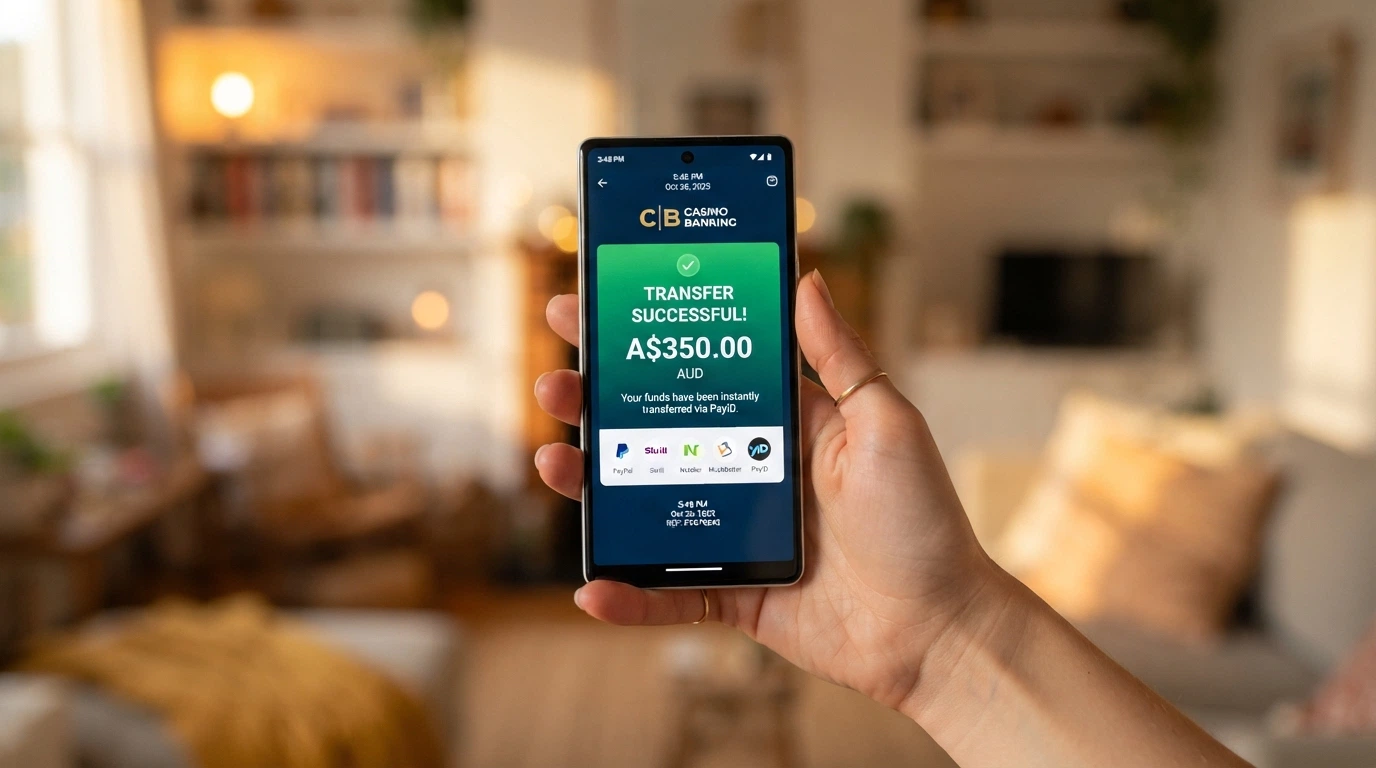
The legal framework shapes what is available. Since 11 June 2024, credit cards and crypto have been banned as payment methods for licensed online wagering in Australia, and an Australian who is asked for either by a gambling site is being served by an operator outside Australian rules. The four methods in the table below are the ones a player at an offshore casino will actually encounter.
| Method | AU Legal Status (Licensed Wagering) | Typical Speed at Offshore Casinos | Availability for Australians |
|---|---|---|---|
| PayID / Osko | Permitted | Minutes to hours after operator approval | Widely available |
| E-wallets (Skrill, Neteller, ecoPayz) | Permitted | Hours to a day after operator approval | Widely available at offshore sites |
| Debit card | Permitted | 1–3 business days | Widely available |
| Bank transfer | Permitted | 2–5 business days | Available |
| Cryptocurrency (BTC, ETH, LTC) | Banned since 11 June 2024 | Often minutes after operator approval and blockchain confirmation | Available only at offshore operators |
| Credit card | Banned since 11 June 2024 | N/A — deposit not accepted at licensed operators | Not available at AU-licensed operators |
The single column the reader should weigh most heavily is the third. Operator approval is the variable the player cannot choose; rail speed is largely fixed. A player who picks PayID or an e-wallet is buying the fastest rail on offer, while a player who picks bank transfer is paying for the slowest.
E-Wallets and PayID — the Fastest Route to Your Cash
PayID and Osko are the Australian real-time bank transfer system. A PayID payout moves money from the operator’s bank to the player’s bank in seconds once the transfer is released, which is why e-wallets and PayID consistently deliver the fastest fiat withdrawals at offshore casinos. The end-to-end time is the operator’s processing window plus seconds, and the operator’s processing window is the only delay in the chain.
The offshore e-wallet options are Skrill, Neteller, ecoPayz, and a few smaller providers. Each sits between the operator’s bank and the player’s bank, and each allows near-instant withdrawals to the e-wallet account, with subsequent transfer to an Australian bank account typically taking a day or less. E-wallets also bypass some of the KYC friction a direct bank transfer hits, because the operator’s verification has already happened when the e-wallet account was opened.
The reason these methods are the fastest is structural. PayID was designed for real-time transfers. E-wallets were designed for instant movement between accounts. Neither was designed for gambling, but both happen to fit the use case well. The reader who can use them at the casino of their choice is buying speed that bank transfers cannot match.
Processing Time vs Withdrawal Time — Why Your “Instant” Payout Isn’t
The phrase “instant withdrawal” on a casino homepage refers to the second half of the transaction only — the rail speed after the operator has approved the request. The first half, the operator’s processing window, is what most players miss. An “instant” PayID payout that sits in pending for two days is not instant; it is a two-day wait followed by a thirty-second transfer.
The two clocks combine into the total withdrawal time. A reader who cares about how long a withdrawal really takes needs to add them. The operator’s processing window is the variable one; the rail’s transfer time is mostly fixed at its published speed. A slow operator’s PayID will arrive in seconds once it moves; a fast operator’s bank transfer will still take days. The total time is the operator’s window plus the rail’s time, and the operator’s window is the larger of the two in almost every case.
The practical implication is that the choice of method matters less than the choice of operator, except in the extreme cases. A player at a slow operator with PayID will wait longer than a player at a fast operator with a bank wire, but only marginally so. A player who picks method first and operator second is optimising the smaller of two clocks.
Crypto Withdrawals Are Instant — but at What Cost?
Crypto withdrawals at an offshore casino clear faster than any fiat method. Once the operator approves the request, the transaction is broadcast to a blockchain, confirmed in minutes for most major coins, and the funds arrive in the player’s wallet. There is no bank to clear the transaction, no correspondent banking fees to eat into the amount, and no 24-hour wait for “business hours”. Speed is the genuine advantage crypto delivers here, and it is a real one.
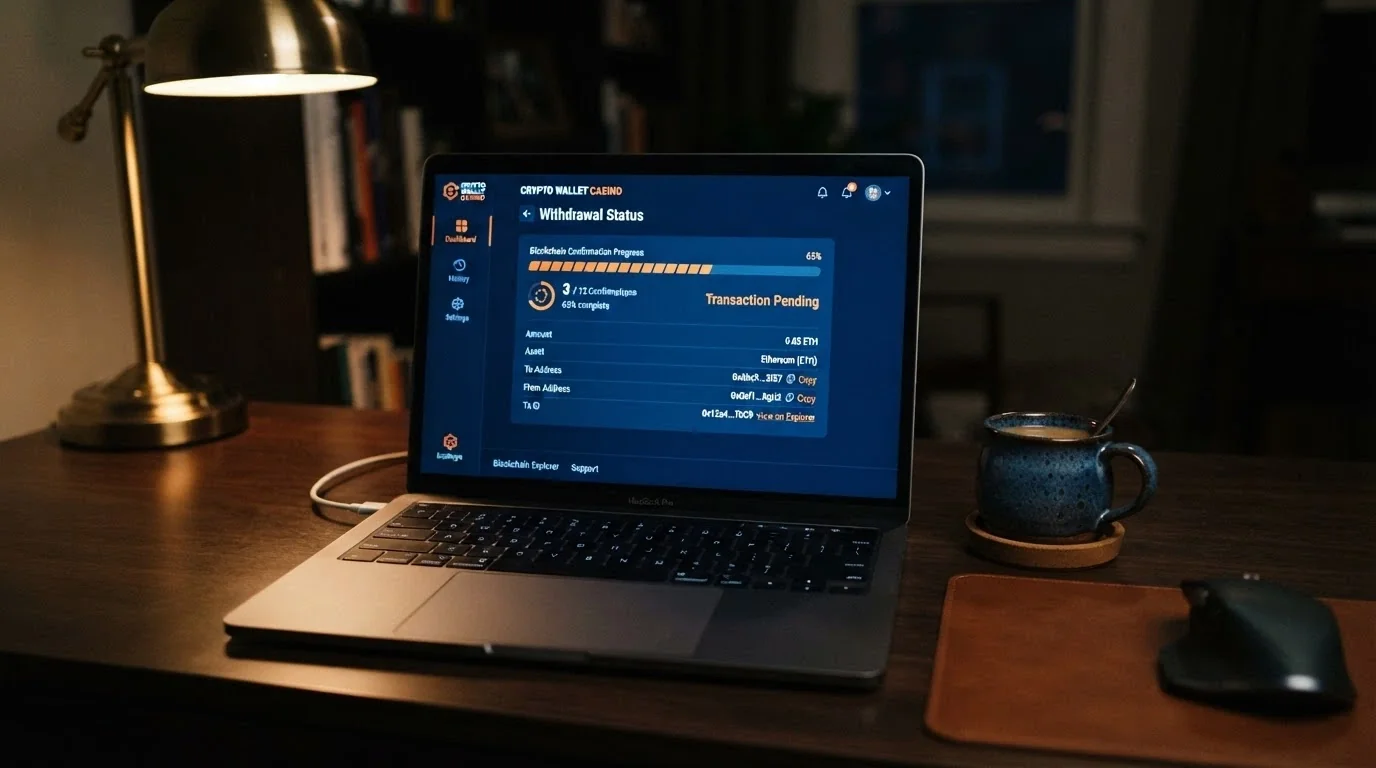
The cost of that speed is structural rather than transactional. Since 11 June 2024, crypto has been banned as a payment method for licensed online wagering in Australia, and a casino asking for crypto is operating outside the Australian rules. An Australian-facing operator using that rail is by definition offshore. Operators that fail to enforce the credit/crypto payment ban face penalties of up to A$247,500 under the Interactive Gambling Amendment (Credit and Other Measures) Act 2023 — that figure is the licensed side’s exposure; the offshore side operates under its own enforcement regime, which is to say, its own.
A player who withdraws in crypto at an offshore casino is making a clean trade. They get speed and forgo protections that are not negotiable at the fiat level. Whether the trade is the right one depends on what the player values, and the next two subsections are about what specifically changes hands.
Bitcoin and Altcoins — the Speed Argument
The mechanics of a crypto withdrawal are simpler than they sound. The casino’s treasury wallet signs a transaction to the player’s wallet address. The transaction is broadcast to the relevant blockchain, sits in the mempool, and is included in a block once miners or validators confirm it. From the player’s perspective, the balance appears in their wallet in anywhere from a few minutes to an hour, depending on the coin and the network’s current load.
Bitcoin transactions are the slowest of the major coins because block times run around ten minutes and most operators wait for several confirmations. Ethereum is faster at around twelve seconds per block, though gas fees can spike. Litecoin, Bitcoin Cash, and similar are designed for faster settlement and confirm quickly. Stablecoins on fast networks — USDC on Solana, for instance — confirm in seconds and avoid the volatility a player would otherwise carry between request and receipt.
The volatility risk is the mechanism that makes “instant” misleading. A player who requests a Bitcoin withdrawal at the equivalent of A$1,000 may receive the Bitcoin and watch it move 5% before they convert to Australian dollars. That is not the operator’s fault. It is the trade the player made by choosing a volatile asset as the settlement currency. Stablecoins remove it, at the cost of one extra conversion step.
What You Trade Away for Crypto Anonymity
The protections a player takes for granted at a licensed Australian service disappear at an offshore casino, and the disappearance is total at the crypto withdrawal step. There is no Australian chargeback mechanism on a confirmed blockchain transaction — once the funds have moved, they cannot be recalled by the player’s bank or by any Australian body. There is no dispute pathway through the ACMA, because the ACMA cannot recover money from an offshore operator under any circumstance. There is no BetStop coverage — the National Self-Exclusion Register binds Australian-licensed wagering services only, and an offshore casino is not connected to it. And the offshore operator can be blocked by ACMA direction at any time, with the player’s balance still sitting on the site.
The crypto step adds one more trade. The exchange rate between the crypto the player received and the Australian dollar they need to spend is the player’s problem, not the operator’s. A small spread at the conversion stage eats into the payout, and there is no consumer-protection body to escalate to if the conversion goes wrong.
A reader choosing crypto for speed is making a clean-eyed trade if they understand all four points. A reader choosing crypto because they assume the protections still apply has misunderstood the situation.
Why Your 2026 Fast-Payout Bonus Is Smaller Than It Looks
A “fast payout” badge and a welcome bonus are two separate marketing surfaces, and the bonus is the one that hides the most arithmetic. A bonus that pays out the same day the player wins it still has to be cleared before it becomes the player’s money, and clearing is where the value erodes.

The three mechanics that erode bonus value are wagering requirements, game-weighting rules, and maximum-cashout caps. None of them are advertised on the badge that says “instant withdrawal”. They sit in the terms page, where they do the work.
A wagering requirement is the multiple of the bonus the player must wager before the bonus and any associated winnings become withdrawable. A 40x wagering requirement on a A$100 bonus means A$4,000 of wagers before the bonus clears. Game weighting rules reduce the contribution of some games — most often table games — to that turnover requirement. A maximum-cashout cap puts a ceiling on what the player can withdraw from a bonus win, regardless of how much they actually won. The three together can turn a headline A$1,000 bonus into something closer to a few hundred in withdrawable value.
The reason this matters on a “fast payout” page is that a fast payout does not speed up bonus clearance. The withdrawal at the end is fast; the playthrough to get there is slow, and the player has been wagering the operator’s money the whole time. A player who joins for the speed and stays for the bonus is the player the marketing is built for.
Which Pokies Let You Cash Out Fastest in 2026
The choice of pokie does not change the rail speed, but it does change the friction a withdrawal is likely to hit. Some pokies are more likely to delay a payout than others, and a player who is optimising for a fast cashout should know which ones carry the heavier verification load.

The single biggest friction point is a progressive jackpot. A win on a progressive triggers a network-level verification — the operator has to confirm the prize pool, sometimes contact the game provider, and confirm the win before releasing the funds. That verification can add days to a withdrawal, regardless of the operator’s general speed. A non-jackpot pokie carries none of that delay.
Volatility is the second friction factor, though less directly. A high-volatility pokie produces fewer but larger wins, which can attract a manual review from the operator’s anti-fraud team on larger withdrawals. A low-to-medium volatility pokie produces steadier balances that look more like normal play. Bonus-buy mechanics, where a player can purchase a feature round directly, are often excluded from wagering contribution at offshore casinos — a player using bonus funds on a bonus-buy pokie may find that none of the wagering counts toward clearing the bonus.
The popular AU-facing pokie families — Big Bass, Buffalo, Lightning Link, and the like — are the ones most players reach for, and they sit across the spectrum of volatility and feature mechanics. A player who wants to know whether a specific title is bonus-buy, jackpot-linked, or restricted under a current bonus needs to check the operator’s game-info panel before playing. None of those specifics were independently confirmed for the operators on this page, and the player should verify them directly.
The Pokies With the Fewest Payout Friction Points
The pokies most likely to clear a withdrawal cleanly are non-jackpot, non-bonus-buy titles with low to medium volatility and full wagering contribution. They produce steady balances that look like normal play, do not trigger the additional verification a progressive jackpot requires, and contribute 100% toward wagering when the player is clearing a bonus. A pokie from a major provider — and there are several whose games appear across most offshore AU-facing casinos — is more likely to fit that profile than an obscure title from a small studio, simply because the major providers’ games are designed to clear the operator’s internal review without raising flags.
A player optimising for fast withdrawals should play the games that look most like normal play to the operator’s finance team, and avoid the games that trigger the operator’s manual review. That is a description of the mechanics rather than a recommendation of a specific title.
Real-Money Play Unlocks the Fastest Withdrawals
A demo or fun-mode player generates no withdrawable balance, by definition, and a player who has not made a real-money deposit cannot request a real-money withdrawal. The verification threshold the offshore casino sets is the deposit itself — KYC is triggered when the first real-money withdrawal is requested, not when the account is opened, and the casino’s verification stack will require documents regardless of how long the player has held an account.
The minimum withdrawal amount at an offshore casino typically sits in the A$20–A$50 range, though the exact figure varies and was not confirmed per operator for this review. A player who deposits A$10 and wins A$15 will find the balance technically withdrawable but the request rejected for falling below the minimum, with the funds returned to the playable balance. A player who wants to test the operator’s real speed should deposit enough to clear the minimum and request the minimum immediately.
A real-money fast-payout casino is one that offers e-wallet or PayID withdrawals, processes requests in under 24 hours, has a published minimum withdrawal, and runs a verification flow the player can complete before requesting the first withdrawal. Every offshore casino on this page offers real-money play. Whether each offers the rest is what the player’s own test withdrawal is for.
Every Fast-Payout Casino Australians Use Is Offshore — Here’s Why
The legal reality behind this page is the first thing the reader should know. Online casino is prohibited in Australia under the Interactive Gambling Act 2001 (IGA), and there is no licence for online casino anywhere in the country — not federally, not in any state or territory. Every casino on this page is an offshore operator offering an unlicensed product to Australian players, and the ACMA has had 1,564 illegal gambling and affiliate websites blocked by Australian ISPs since November 2019, with more than 225 illegal services having withdrawn from the Australian market since 2017.

The Interactive Gambling Amendment Act 2017 strengthened the IGA, closed loopholes used by offshore operators, and gave the ACMA its enforcement and site-blocking powers. The Interactive Gambling Amendment (Gambling Reform) Bill 2026 passed Parliament on 19 August 2026, with measures commencing 1 January 2027 — including express authority for banks and payment providers to block transactions to illegal gambling operators, a tightening of the advertising framework, and inducement-marketing restrictions.
The individual player is not prosecuted under the IGA. The Act targets the provider, not the person in Australia. That legal shield does not translate into consumer protection, and the sections below describe what the player forgoes by playing offshore.
The Interactive Gambling Act and Why No Local Casino Licence Exists
The Interactive Gambling Act 2001 prohibits the provision of online casino games, online pokies (slots), and in-play sports betting to a person in Australia. Wagering on races and sports placed before the event begins is licensed — major online bookmakers (Sportsbet, bet365, Ladbrokes, and about fifty others) hold licences issued by the Northern Territory Racing and Wagering Commission (NTRWC), administered through Licensing NT, with licences running up to 20 years. Online casino is not licensed anywhere in Australia because the IGA prohibits its provision.
The minimum age for all commercial gambling in Australia is 18, and the prohibition applies regardless of the player’s age. A player who is over 18 and at an offshore casino is still at an offshore casino — the age threshold is part of the licensed framework, and the offshore framework is not the licensed framework.
A page that promises “the best licensed online casinos in Australia” is describing something that does not exist. The honest reference point is the offshore operator serving Australians without an Australian licence, and the consequences of that arrangement sit in the sections that follow.
What the ACMA Can (and Cannot) Do About Offshore Operators
The Australian Communications and Media Authority (ACMA) is the federal regulator that enforces the online prohibition. Its tools include formal warnings, civil penalty proceedings, referrals for enforcement, and directions to ISPs to block illegal sites. It is good at removing Australian access to offshore sites — the 1,564 blocked-sites figure is the headline metric on that side of the regulator’s work. It cannot help a player who has been refused a withdrawal by an offshore operator, because the ACMA’s enforcement powers stop at the Australian border.
That is the asymmetry the player most needs to understand. The ACMA can take the site offline. It cannot recover the player’s money. It cannot force the offshore operator to pay. It cannot mediate a dispute. It cannot help with a complaint, because there is no Australian complaint body with jurisdiction over an offshore operator.
From 1 January 2027, the 2026 reform gives banks and payment providers express authority to block transactions to illegal gambling operators. That measure narrows the routes into the offshore market for Australian players, but it does not give anyone a way to recover funds already on an offshore site. The block sits at the transaction layer; the recovery question is not addressed by it.
What Australian Players Forgo When They Play Offshore
The protections that vanish the moment a player deposits at an offshore casino are the ones the licensed system is built around. There is no Australian consumer-protection body with jurisdiction over the operator. There is no BetStop coverage — the National Self-Exclusion Register binds Australian-licensed services only, and an offshore operator is not connected to it. There is no formal complaint resolution pathway, and the operator’s own dispute process is the only one available. There is no recourse if the operator refuses a withdrawal, delays one indefinitely, or closes the account. And the operator’s site can be blocked at any time by ACMA direction to ISPs, with the player’s balance still on it.
The gap between BetStop and the offshore operator is the most concrete harm. A player who self-excludes through BetStop is excluded from every Australian-licensed wagering service in a single step. A player who self-excludes and then plays at an offshore casino is not excluded from that offshore casino, because the offshore operator has no obligation to honour the BetStop registration. The offshore route is, in that sense, an open lane around the self-exclusion system.
The responsible-gambling infrastructure described in the next section is available to every Australian regardless of where they play. It does not replace the protections the offshore route does not provide, and the reader should treat the two as separate things.
What Happens When Fast Payouts Turn Into Fast Losses
The National Gambling Helpline is 1800 858 858 — free, confidential, staffed 24 hours a day, 7 days a week, with online chat and counselling available through Gambling Help Online at gamblinghelponline.org.au. The service reaches every Australian, no matter where they gamble, and it is the single most important number on this page.

The scale of the problem is worth naming in plain figures. About 2.1% of Australian adults — roughly 430,000 people — experience problem gambling, and the Australian Institute of Health and Welfare put high-risk gambling at 1.8% in 2022. The numbers are not abstract; they are the population the helpline was built to serve, and they are large enough that any reader who finds a personal stake in them is statistically unsurprising.
The practical self-help tools — deposit limits, time-outs, self-ban at the operator level — work regardless of where the player gambles, and a player who is worried about their own play can deploy them at an offshore casino even though BetStop does not reach that site. They are weaker than BetStop because the player has to set them up at every operator separately, but they are real tools and they are worth setting.
BetStop Won’t Save You Here — Self-Exclusion and Offshore Casinos
BetStop — the National Self-Exclusion Register — has been live since August 2023. As at 31 July 2026, the register had 67,480 registrations in three years of operation, of which 41,290 exclusions were still active. 78% of registrants were under 40, and 38% chose lifetime exclusion. The register works by excluding a person from every Australian-licensed online and phone wagering service in a single registration.
The register does not cover offshore casinos. An offshore operator is not connected to the register, and a player who has self-excluded through BetStop and then opens an account at an offshore casino will not be stopped by that registration. The operator has no obligation to honour the BetStop exclusion, and the ACMA cannot enforce that obligation offshore.
The practical alternative is to self-ban directly with each offshore operator the player has used. That is a weaker arrangement — it requires the player to remember every site, complete a self-exclusion request at each, and trust that each operator will honour the request — but it is the only one available outside the licensed system. The player who is committed to self-exclusion needs to know that the offshore route does not benefit from BetStop, and that the steps they take inside it are their own.
Where to Get Help When Gambling Takes More Than It Gives
The free support services available to every Australian do not require the player to be gambling at a licensed operator to use them.
The National Gambling Helpline — 1800 858 858 — is the first number to call. It is free, confidential, available 24/7, and routes callers to state-based counselling services and Gambling Help Online. Online chat and email counselling are available through gamblinghelponline.org.au.
Gambling Help Online runs a self-assessment tool that takes a few minutes and returns a reading on whether the player’s gambling is in a low, moderate or high risk band. The tool is not a diagnosis, but it is a real signal that the player can use to decide whether to talk to a counsellor.
State-based counselling services are reachable through the same helpline and through state-funded problem-gambling programmes. The service is confidential and free, and a player who is reading this page and recognising their own play in it is exactly the person the service was built for.
How We Picked the Fastest-Paying Casinos for Australians
The ranking on this page is built on three layers of evidence. The first is the Interactive Gambling Act 2001 and its amendments, which establish that no licensed online casino exists in Australia and that every operator serving Australian players is offshore. The second is the ACMA register and its enforcement record — the 1,564 blocked sites and the 225+ withdrawn services — which describes the regulatory environment in which the operators operate. The third is the BLASK BRANDS Australian market-share data, which identifies the offshore casino brands with measurable Australian traffic and provides the ranking on which the page is built.
The ranking criterion is measured Australian traffic share as an indicator of real-world use by Australian players. It is not a certification of speed, fairness, or payout reliability, and the page is explicit about that distinction. Bonus terms, wagering multipliers, withdrawal processing times, and game-provider lists were not independently verified for any of the ten operators in this run, and the page describes the operators qualitatively where independent verification is absent.
The page does not rank operators on criteria that were not measured. It does not claim a “fastest payout” winner because the underlying per-operator payout speeds were not independently confirmed. It presents the brands Australians actually use, in the order their measured Australian traffic places them, and leaves the speed comparison to the reader’s own test withdrawal.
Should You Chase a Fast Payout at an Offshore Casino?
The honest summary is short. A fast payout is a real thing at an offshore casino, and a player who picks the right operator and the right payment method can have money in their account within hours. The marketing is not lying when it says fast. It is also not telling the reader the full story.
The full story is that the speed comes with a clean set of forgone protections. No Australian consumer protection. No BetStop coverage. No ACMA recovery if the operator refuses a withdrawal. A site that can be blocked with the player’s balance still on it. A payment method — credit card or crypto — whose very availability signals the operator is outside Australian rules. These are not small things. They are the trade.
The reader who can stomach the trade and who treats the offshore operator as a short-term relationship rather than a long-term home is the reader for whom a fast payout at an offshore casino is worth chasing. The reader who cannot is the reader who should be looking at what Australia does license — wagering only, but wagering with the protections the offshore route does not offer — and accepting the slower payout that comes with the licensed framework.
There is no third option. No licensed online casino exists. The choice is between offshore speed without protection, and licensed wagering with protection and no casino games. The reader decides which side of that trade matters more.
Frequently Asked Questions
How long do withdrawals take at Australian online casinos?
Withdrawal times vary by method and operator: e-wallets and PayID typically arrive within hours of operator approval, bank transfers one to five business days, crypto minutes after blockchain confirmation. The first withdrawal triggers a KYC check that adds a day. No Australian body can compel an offshore operator to pay.
Is it legal to play at online casinos in Australia?
Playing is not the offence — the Interactive Gambling Act 2001 targets the provider, not the player. However, providing online casino games to Australians is prohibited, and no licence exists anywhere in the country. Every casino on this page is offshore and outside Australian law. The 2026 reform, commencing 1 January 2027, gives banks express authority to block transactions to illegal operators.
Do fast payout casinos offer no deposit bonuses?
No-deposit bonuses exist in the offshore market generally, but for the ten operators reviewed here no verified no-deposit terms were confirmed. Players should verify current offers on the operator’s site and read the wagering requirement, maximum-cashout cap and game restrictions before claiming — these are typically heavier on no-deposit offers.
What happens if an offshore casino refuses to pay out my winnings?
No Australian consumer-protection body has jurisdiction over an offshore casino, and the ACMA cannot recover funds. The only dispute process is the operator’s own. A small test withdrawal before committing a larger balance is the practical safeguard. Players can report the operator to the ACMA, which can block the site but cannot force a payout.
Are my winnings from online casinos taxable in Australia?
Gambling winnings are not assessable income under section 6-5 of the ITAA 1997, and losses are not deductible under section 8-1 — unless the person is carrying on a business of betting. The wagering tax sits with operators, not players. Offshore casinos do not pay Australian operator-level wagering taxes.
No-Deposit Bonuses at Fast-Payout Casinos — Do They Exist?
A no-deposit bonus is a small credit offered to a new player without requiring a deposit. They exist in the offshore casino market in general. For the ten operators on this page, no no-deposit bonus terms were confirmed in the independent checks behind this review, and the honest position is that a player who wants one should verify the offer directly on the operator’s site rather than assume it is current.
The reason to flag this rather than describe it generically is that no-deposit bonuses are the segment of the bonus market with the heaviest conditions attached. Wagering requirements on no-deposit bonuses typically run higher than on deposit bonuses, often in the 50x–100x range. Maximum cashout caps are common, sometimes as low as the bonus amount itself. Game restrictions are tighter, and the games that count toward wagering may be a small subset of the operator’s library.
A no-deposit offer with a fast payout is real, and a player who understands the terms can clear it profitably. A player who does not read the wagering and cap conditions is the player the offer is built to attract.