
Fast-Paying Online Casinos for Australian Players — A 2026 Withdrawal Guide
Current as of 11 November 2026, verified against the ACMA register and the Interactive Gambling Act 2001.
Every online casino accepting Australian players runs from offshore. None of them hold an Australian licence — none can, because the Interactive Gambling Act 2001 prohibits online casino games, online pokies and in-play sports betting outright. There is no licence for these products anywhere in the country, not federally and not in any state or territory. That single fact changes what “easy withdrawal” means in this market, and it is the starting point for everything that follows on this page. The ranking below ranks real payout speed, withdrawal limits and the friction between marketing claim and bank-account reality across ten offshore brands an Australian player can actually sign up to today. Every one of them is offshore and not Australian-licensed.
Table of Contents
- Why your 2026 payout speed depends on where your casino is licensed
- The real cost of “instant” withdrawals at Australian-facing casinos
- Which Australian-facing casino pays fastest? 10 compared
- The pokies that pay: RTP, volatility and why it matters for your cashout
- The offshore reality: what Australian law actually says about online casino
- Playing safe when the safety net does not reach offshore
- How we picked and ranked the fastest-paying casinos for Australian players
- Your money, your call: what you actually trade for a fast withdrawal
- Frequently asked questions
Why your 2026 payout speed depends on where your casino is licensed
The legal floor underneath every offshore casino matters more than its welcome bonus. The Interactive Gambling Act 2001 prohibits the product, and the absence of any Australian-licensed online casino means that “safe” cannot mean “licensed in Australia” the way it can for a sports bookmaker. Sportsbet, bet365 and Ladbrokes are Northern Territory-licensed and ACMA-supervised for racing and pre-event sport — a different product, regulated in a different framework. Online casino is not licensed and not supervised in that way, which leaves the player without the consumer-protection body that catches the casino that refuses to pay. ACMA’s role is enforcement against the provider, not fund recovery for the player.
Channelisation, the share of Australian gambling spend that stays inside the licensed system, has slipped from 74% in 2021 to 64% by 2025 — a ten-point drift in four years. Australians lose an estimated AU$3.9 billion a year to illegal offshore sites according to the H2 Gambling Capital 2025 report commissioned by Responsible Wagering Australia. That is the size of the market this page is written about: offshore brands, offshore regulators, and an Australian player whose protection comes from the operator’s house rules rather than from a regulator they can complain to.
The ranking below was built from operator terms pages, independent casino reviews, ACMA enforcement data and the Australian legislation that defines who can play where. Withdrawal speed was weighted first, then withdrawal limits, then the spread of payment rails offered for cashouts rather than just deposits, and finally the visibility of a public licence number on the operator’s terms page. A brand that posts a Curaçao or Anjouan licence number on its terms page was scored ahead of one that does not — the latter leaves the player no way to verify who is on the other side of the withdrawal.
What “easy withdrawal” actually means in 2026
Easy withdrawal, in a market where every casino is offshore and no Australian consumer-protection body has jurisdiction over cashouts, means three things at once. It means the operator releases your money in a timeframe you can plan around. It means the payment rail it pays out on is one you can actually reach — not a deposit-only method labelled as a withdrawal option. And it means the limits the operator imposes do not turn a fast-paying casino into a slow-paying one for any amount a player realistically wins.
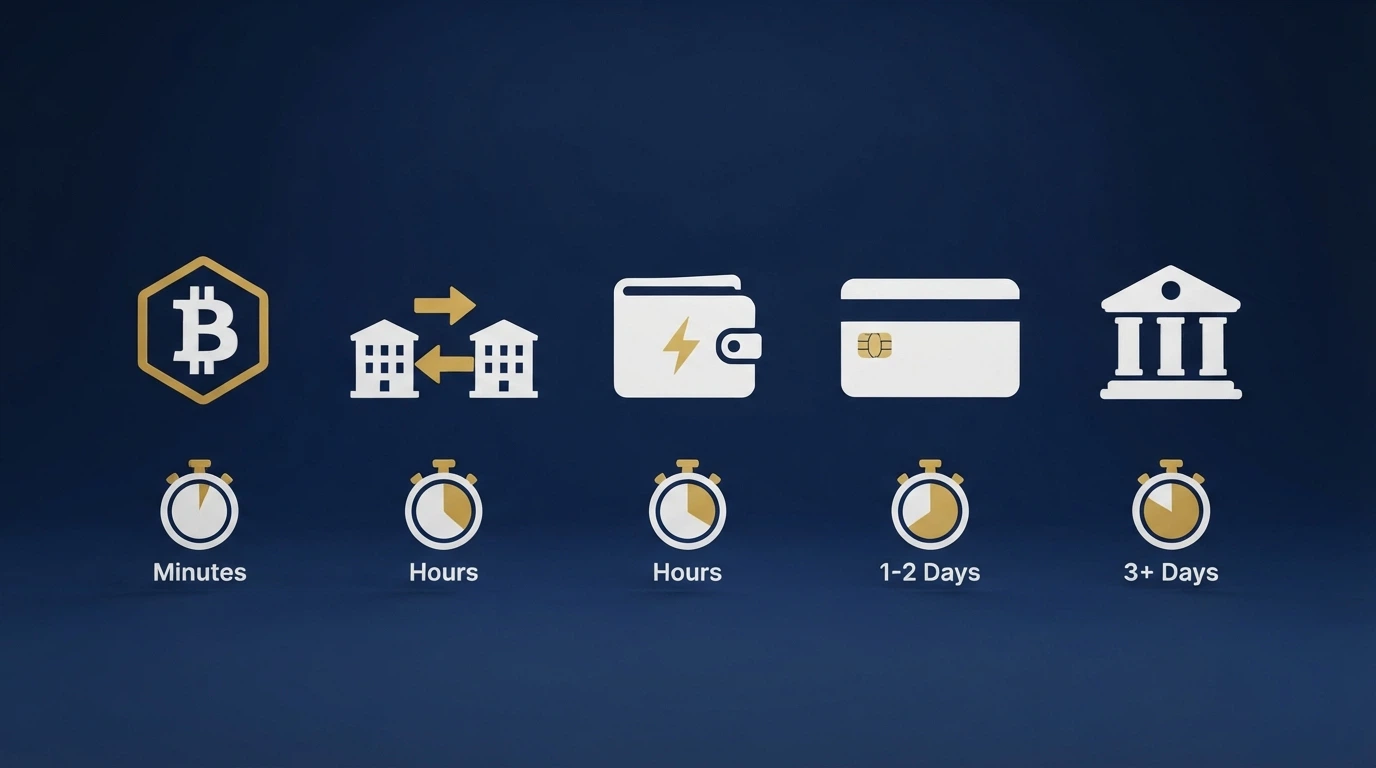
Crypto at offshore casinos typically settles in 10–60 minutes once approved, with USDT on the TRC20 network and Solana both clearing in under 5 minutes. PayID through the NPP is the fastest fiat option, settling under 60 minutes once the casino approves it. E-wallets clear in 1–6 hours, debit cards in 1–3 business days and bank transfers in 3–7 business days. Those numbers frame the speed side of the equation.
The reliability side is harder. The #1 cause of delayed payouts at every legitimate operator is incomplete KYC verification, not the casino’s processing speed and not the payment rail. The player who has uploaded ID and proof of address at sign-up is the player who actually gets the 10-minute crypto cashout. The player who has not is the one whose first withdrawal takes a week while the documents go through. That asymmetry is why “easy withdrawal” depends less on the brand a player picks and more on what the player does before they pick it.
The real cost of “instant” withdrawals at Australian-facing casinos
The fastest-paying casinos in this market are not the same as the easiest-paying ones, and the gap between them is the gap between the marketing claim and what the player actually experiences. A casino that advertises “10-minute withdrawals” is usually telling the truth about the processing side — what it controls. The five other bottlenecks are not in the operator’s control at all: the payment rail the player chooses, the KYC status of the account, the deposit/withdrawal rail mismatch, the withdrawal limits per day/week/month, and the wagering requirements on any active bonus.
Incomplete KYC is the single biggest cause of delayed payouts at every legitimate operator, and the asymmetry is brutal. A player who completes verification at sign-up walks through the same first withdrawal as any returning customer. A player who uploads documents only at cashout adds the verification window — sometimes 24–72 hours — on top of the operator’s processing time. That is the difference between a 10-minute withdrawal and a four-day wait for the same brand, the same rail and the same amount.
PayID’s promise is real on the deposit side: instant, fee-free, available 24/7. On the withdrawal side, the rail is receive-only. CommBank states it plainly: “A PayID can only be used to pay money into your account, never take money out.” When a casino markets “PayID withdrawals”, it usually means the withdrawal is paid by bank transfer to the underlying account, which routes via BECS at 1–3 business days. The PayID badge becomes a deposit feature with a bank-transfer payout.
Payment methods ranked by withdrawal speed
| Payment Method | Typical Withdrawal Speed | Notes (AU-specific) |
|---|---|---|
| Crypto (USDT TRC20, Solana) | Under 5 min | Fastest route; banned for licensed AU wagering since 11 June 2024; standard at offshore casinos |
| Crypto (Ethereum, Litecoin) | 5–30 min | Settles faster than BTC during network congestion |
| Crypto (Bitcoin) | 30–60+ min | Speed depends on mempool congestion; can stretch to hours at peak |
| PayID (NPP/Osko, fiat) | Under 60 min once approved | Receive-only rail — “PayID withdrawal” often routes via BECS at 1–3 business days |
| E-wallets (Skrill, Neteller) | 1–6 hours | Verification often lighter than at first cashout |
| Card (Visa, Mastercard debit) | 1–3 business days | Credit cards banned for AU wagering since 11 June 2024 |
| Bank transfer / wire | 3–7 business days | Slowest fiat option; bank processing is the bottleneck |
The crypto tier is the only one in the table where the speed advantage is structural rather than advertised. POLi, the once-familiar AU instant-deposit method, was decommissioned on 30 September 2023 and is no longer available at any Australian-facing casino. The closest replacement on the deposit side is PayID; on the withdrawal side, the closest replacement is whatever crypto rail the casino supports.
The KYC bottleneck: why your first withdrawal always takes longest
Every legitimate operator — every brand listed below — runs account verification before the first cashout. The ask is the same at every offshore casino: a government photo ID, a proof of address dated within the last three months, and sometimes a payment-method verification (a screenshot of the e-wallet, or a photo of the card with the middle digits masked). The processing window at a fast operator is 24 hours; at a slow one, three to five business days.
The reason verification exists is anti-fraud and anti-money-laundering compliance. The reason it delays first withdrawals is that most players do not upload the documents until they want to cash out. Operators can verify in 24 hours. Operators cannot verify before the player sends them anything. The bottleneck is on the player side, not the operator side.
A player who completes KYC at sign-up (uploading ID, proof of address and the payment-method check) clears the bottleneck before it forms. The first withdrawal is then processed on the operator’s schedule: 10 minutes at BitStarz, under 24 hours at Rocket Play, up to 5 days at Royal Reels. A player who waits until the first cashout sits in pending status adds the verification window on top of the operator’s, and ends up waiting a week for the same withdrawal.
PayID casino withdrawals: the promise and the fine print
PayID runs on Australia’s New Payments Platform and settles transfers between Australian banks in real time. That is what makes it the fastest fiat deposit method in the country. The complication is that PayID is a receiving rail, not a sending one: a PayID identifies an account to receive money, but the rail does not initiate outbound transfers. CommBank states this explicitly — a PayID can only be used to pay money into your account, never take money out.
When an offshore casino markets “PayID withdrawals”, what is usually happening is one of two things. The first is that the casino credits the player’s PayID-linked bank account via the NPP, and the funds clear in under 60 minutes once approved, the version that matches the marketing. The second is that the casino falls back to a bank transfer (BECS) to the same account, and the funds arrive in 1–3 business days, the version that matches the underlying rail. A player can tell which one they have by asking the operator directly which payment system the withdrawal uses; “PayID withdrawal” without a clarifying answer is a flag to ask before depositing.
The other half of the PayID story is the deposit/withdrawal asymmetry. A player can deposit via PayID in seconds. The same player, on the same casino, may then withdraw via bank transfer in days. That asymmetry is not a quirk of the casino — it is how the rail works — but it is a quirk of the marketing, which tends to brand the deposit speed and stay quiet about the payout rail.
Deposit bonuses and fast payouts: the wagering trap
A fast payout is only fast if the balance is actually withdrawable. A welcome bonus that carries a 40× wagering requirement ties the bonus balance to turnover the player must complete before any of it cashes out, and the gap between “big welcome package” and “money you can withdraw” is the gap the marketing never closes.
Take SkyCrown’s four-tier welcome of up to A$8,000 plus 400 free spins at 40× wagering on both the bonus money and the free-spin winnings. The required turnover on the headline figure alone is A$8,000 × 40 = A$320,000 in placed bets before any of the bonus becomes withdrawable. At a typical online pokie RTP of 96.50% (the Pragmatic Play flagship benchmark), the expected loss across that turnover is A$320,000 × 0.035 = A$11,200. That is the statistical cost of clearing the welcome package before a single spin is taken, and it is the figure that arrives on top of whatever the player deposits, not instead of it.
The expected loss is an average across many spins at the stated RTP, not a guaranteed outcome for any individual session. A player can run better than the math, or worse, on a single run. Across the volume of turnover required to clear a 40× bonus, the math is the math: the house keeps roughly 3.5 cents of every dollar wagered. Royal Reels’ smaller 100% up to AU$500 at 30× wagering is the same arithmetic at a smaller scale (AU$500 × 30 = AU$15,000 turnover; the same 3.5% house edge returns an expected loss near AU$525). Goldenbet’s A$100 no-wagering cash bonus has no turnover requirement at all, which is why the same A$100 is worth A$100 at cashout — a feature no other brand on this list matches.
How to pick a genuinely fast-payout casino: a checklist
Five checks separate marketing claims from real withdrawal performance, and they are the same checks at every offshore brand on this page.
- Read the withdrawal limits before depositing. Fair Go’s AU$2,500 per-transaction ceiling, on top of a AU$100 minimum, means a single big win splits across multiple requests and multiple processing windows. SkyCrown’s A$5,000 daily, A$10,000 weekly and A$15,000 monthly caps work the same way. Limits turn a “fast” casino slow when the win crosses a threshold.
- Verify which payment rails are offered for withdrawals, not just deposits. Royal Reels accepts cards and crypto for deposits but pays out via bank transfer only, a 1–5 business day window for a brand whose deposit side feels instant.
- Confirm KYC requirements at sign-up, not at cashout. Upload ID, proof of address and the payment-method check before the first deposit. Verification adds 24–72 hours when done at withdrawal; it disappears when done in advance.
- Look for independent withdrawal-speed tests, not operator claims. PokiesAustralia clocked Goldenbet’s PayID withdrawal at 28 minutes, a third-party measurement rather than the operator’s marketing copy. That is the kind of number worth trusting.
- Check the licence, and check the licence number. A public licence number on the operator’s terms page (Royal Reels publishes Curaçao GCB No. 365/JAZ; Rainbet publishes Anjouan licence ALSI-152406029-FI2) means the operator is identifiable to a regulator. A licence badge without a number is marketing, not regulation.
Which Australian-facing casino pays fastest? 10 compared
The table below ranks the ten operators against the same five checks: licence transparency, welcome bonus and wagering, withdrawal speed, minimum withdrawal, maximum withdrawal and game count. Every brand is offshore and not Australian-licensed. The table does not say any one of them is “safe” — it says what each one offers, how it pays and what it costs the player.

| Casino | Licence | Welcome Bonus | Wagering | Withdrawal Speed | Min Withdrawal | Max Withdrawal | Game Count |
|---|---|---|---|---|---|---|---|
| BitStarz | Curaçao eGaming | — | — | Crypto averaging 10 min | A$10 (crypto) | Unlimited | 6,000+ |
| SkyCrown | Curaçao | Up to A$8,000 + 400 FS | 40× | 10 min avg (bank up to 3 days) | A$30 | A$5,000/day, A$10,000/wk, A$15,000/mo | 7,200+ |
| Rocket Play | Curaçao (Dama N.V.) | 100% up to AU$200 + 50 FS | up to 40× | E-wallet/crypto under 24 hrs | AU$10–20 | AU$5,000–15,000/wk (tiered) | 3,000+ |
| Fair Go | Curaçao eGaming (Deckmedia) | Five-tier A$1,000 package | — | Crypto 15–45 min, bank 1–5 days | AU$100 | AU$2,500/txn, AU$5,000/wk crypto, AU$2,500/wk bank, AU$10,000/mo | 280 (RTG only) |
| Royal Reels | Curaçao GCB No. 365/JAZ | 100% up to AU$500 | 30× | Up to 5 days | AU$50 | AU$9,000 | — |
| WinSpirit | Curaçao | Deposit match + FS | — | E-wallet/crypto 1–24 hrs, card/bank 3–5 days | — | — | — |
| Bizzo Casino | Curaçao (TechSolutions Group N.V.) | Up to A$7,250 + 175 FS | 40× | Neteller 0–24 hrs, PayID supported | — | Restrictive ceilings | 8,000+ |
| Rainbet | Anjouan Gaming ALSI-152406029-FI2 | — | 40× on some | 5–15 min processing | US$15 equivalent | — | — |
| Stake | Curaçao | — | — | — | — | — | — |
| Goldenbet | Curaçao | A$100 no-wagering cash | 0× | PayID 28 min (tested), crypto under 4 hrs | AU$20 | — | 1,800+ |
Em dashes in the table mark figures the operator has not published or that this round of research could not confirm; the operator write-ups below handle each gap on its own terms. Stake is the obvious case, a brand with 1.28% Australian market share and almost no published AU-specific withdrawal data, and the section on Stake below covers the brand’s industry reputation for fast crypto payouts without inventing the specific figures that were not confirmed.
BitStarz: crypto-native speed with no withdrawal ceiling
BitStarz is the speed benchmark on this list. Crypto withdrawals average 10 minutes, the game library runs past 6,000 titles, and the operator accepts AUD plus more than 500 cryptocurrencies. There is no published withdrawal limit on the high-roller side, and the minimum withdrawal sits at A$10 on crypto. The licence is Curaçao eGaming, offshore and not Australian-licensed, like every other brand on this page.
The trade-off is that the speed advantage is entirely on the crypto side. AUD payouts via bank transfer or card run on the same rail as every other casino in this market: 1–3 business days for cards, 3–7 business days for bank transfer. The operator’s 10-minute claim is for crypto, not fiat. A player whose bank balance is the priority, and whose crypto wallet is not in the loop, is paying the fiat tax.
BitStarz is the speed benchmark in this market: 10-minute crypto averages, no withdrawal ceiling, 6,000+ games and a Curaçao licence number on the terms page. The fiat rail is the price of entry.
SkyCrown: the biggest library with the tightest limits
SkyCrown’s pitch is the four-tier welcome of up to A$8,000 plus 400 free spins, the 7,200+ game library that makes it one of the largest available to Australian players, and an advertised 10-minute average processing time on withdrawals. The reality underneath is tighter than the pitch suggests: 40× wagering on both the bonus money and the free-spin winnings, and withdrawal caps of A$5,000 per day, A$10,000 per week and A$15,000 per month. The minimum withdrawal is A$30.
The 40× wagering is the larger figure to internalise. At the headline A$8,000 bonus, the required turnover is A$320,000, and the expected loss across that volume, at the 96.50% RTP benchmark, is roughly A$11,200. A player who treats the welcome as a free bet underwrites that loss; a player who treats it as real money underwrites a different one.
SkyCrown’s headline A$8,000 bonus carries a real cost of roughly A$11,200 in expected loss across the A$320,000 turnover required to clear it. The 7,200+ games and the 10-minute processing claim are real; the cap structure and the 40× wall are the price.
Rocket Play: modest bonus, steady speed
Rocket Play runs on Dama N.V. under a Curaçao licence, with a 100% match up to AU$200 and 50 free spins at up to 40× wagering. The game library sits at 3,000+ titles and the withdrawal speed is e-wallet and crypto under 24 hours. The minimum withdrawal is AU$10–20 depending on the method, and weekly maximums run AU$5,000–15,000 tiered by verification level.
What Rocket Play lacks in headline size — the AU$200 welcome is a tenth of SkyCrown’s headline figure — it makes up for in reliability. Dama N.V. operates multiple brands across this market, the verification-tiered limits reward a player who has uploaded documents in full, and the under-24-hour crypto window is consistent with the operator’s own terms rather than aspirational.
Rocket Play is the smaller, steadier option on this list: a AU$200 welcome that clears faster than SkyCrown’s headline, an under-24-hour payout, and a verification-tiered ceiling that rewards the player who uploads documents in full.
Fair Go: AU-themed, RTG-only and slow on fiat
Fair Go is the most Australian-branded casino in the ranking, green-and-gold themed, RTG-only with 280 games, and operated by Deckmedia under a Curaçao eGaming licence. The minimum withdrawal is AU$100 with a per-transaction ceiling of AU$2,500, which is the highest minimum on this list and the most restrictive per-txn cap. Crypto withdrawals during business hours arrive in 15–45 minutes; bank transfers take 1–5 business days. Weekly limits are AU$5,000 on Bitcoin and eZeeWallet, AU$2,500 on bank transfer, with a AU$10,000 monthly ceiling.
The game library is the trade-off. 280 RTG titles is a small library by 2026 standards, and a player looking for the studio spread that Bizzo or SkyCrown offers will not find it here. The AU$100 minimum also prices out small-balance withdrawals, since a player who wants to move AU$50 cannot.
Fair Go’s 280 RTG titles and AU$100 minimum narrow the audience to a player who values the AU theme over library size. The 15–45 minute crypto window during business hours is the speed; the 1–5 business day bank transfer is the rest of the picture.
Royal Reels: licensed and slow
Royal Reels publishes a Curaçao Gaming Control Board licence number (No. 365/JAZ) on its terms page, a transparency step most of this market does not take. The welcome bonus is 100% up to AU$500 at 30× wagering on a AU$30 minimum deposit. The minimum withdrawal is AU$50, the maximum AU$9,000, and cashout times run up to 5 days.
The 5-day ceiling is the headline number to internalise. Where BitStarz and Goldenbet advertise minutes and Rocket Play runs under 24 hours, Royal Reels measures its cashout window in business days. The operator’s own terms confirm that bank transfer is the withdrawal route, with cards and crypto accepted on the deposit side only. A player depositing in USDT and expecting to withdraw in USDT is paying in the wrong rail.
Royal Reels is the brand that publishes its licence number (Curaçao GCB No. 365/JAZ) and then takes up to 5 days to pay out. The transparency and the speed are not the same number.
WinSpirit: BPAY deposits and a mixed-speed cashout
WinSpirit is one of the few offshore casinos accepting Australian players that offers BPAY for deposits, a local-rail feature the rest of this market has not adopted. The welcome package combines a deposit match and free spins (the operator’s terms page does not publish the exact figure this round), and the withdrawal speed splits sharply: e-wallet and crypto at 1–24 hours, card and bank transfer at 3–5 days.
The split is the thing to plan around. A player who deposits via BPAY and withdraws via Skrill or crypto can hit the fast lane; a player who deposits via BPAY and withdraws via bank transfer is in the slow lane for the same balance. The split is not a quirk of WinSpirit — it is how the rails work — but it is a quirk of the marketing, which tends to brand the deposit side and stay quiet about the payout side.
WinSpirit’s split personality is the read: BPAY in, Skrill or crypto out at 1–24 hours, card or bank at 3–5 days. The deposit rail is local; the withdrawal rail is whatever the player picks.
Bizzo Casino: 8,000+ games and a 40× wagering wall
Bizzo runs the largest game library on this list, 8,000+ titles from 70+ studios, under TechSolutions Group N.V.’s Curaçao licence (launched 2021). The welcome package is up to A$7,250 plus 175 free spins over four deposits at 40× wagering with an A$8 max bet, and Casino Guru rates the operator’s Safety Index at 8.4. PayID is supported for both deposits and withdrawals, and Neteller cashouts land within 0–24 hours.
The 40× wagering on a A$7,250 headline package is the same arithmetic as SkyCrown’s A$8,000 package — at the headline, A$7,250 × 40 = A$290,000 in turnover, with a statistical expected loss near A$10,150 at the 96.50% RTP benchmark. The A$8 max bet is the additional constraint: it caps the size of any single spin while the wagering is being cleared, and players who ignore it void the bonus.
Bizzo’s 8,000+ games and Casino Guru Safety Index of 8.4 make it the breadth-and-payid option; the 40× wagering on a A$7,250 headline is the price of admission.
Rainbet: Anjouan-licensed with sub-15-minute processing
Rainbet is the only Anjouan-licensed operator on this list, operating under licence ALSI-152406029-FI2 through RBGAMING N.V., valid through 13 June 2027. The operator publishes the licence number and expiry on its terms page, the same transparency step Royal Reels takes, against a different regulator. The minimum withdrawal is US$15 equivalent, and the team’s processing window runs 5–15 minutes for most requests; crypto settlement can stretch to 45 minutes during congestion. Welcome bonus terms were not confirmed this round; some promotional terms carry 40× wagering.
The Anjouan licence is the trade-off. Curaçao is the default in this market; Anjouan is a smaller regulator with a thinner complaint pathway. Rainbet counters with provably fair “Rainbet Originals” and a crypto-native product. The 5–15 minute processing window is faster than most Curaçao brands on the same rails.
Rainbet’s 5–15 minute processing window is the fastest published figure in this ranking, and the Anjouan licence is the trade-off. Provably fair originals are the bonus.
Stake: the brand Australians already know — with almost no published withdrawal data
Stake is the most-recognised offshore crypto casino brand among Australian players, with 1.28% Australian market share and a Curaçao licence. The brand’s industry reputation is for fast crypto payouts. The detailed withdrawal specifics — processing time, minimum and maximum amounts, bonus terms — were not confirmed in this round of research, and the operator’s published terms page does not carry an Australian-facing cashout window.
The honest read is that Stake is the brand-name option for a player who already knows it. The crypto reputation is real and the licence is verifiable. The published data is thinner than every other operator on this list, and a player who wants the table-row comparisons the rest of the page offers will not find them here.
Stake is the recognition-first option for an Australian player who already knows the name. The crypto reputation is real; the data gap is the trade-off.
Goldenbet: the no-wagering outlier with a 28-minute PayID test
Goldenbet is the anti-pattern on this list. The welcome is a A$100 cash gift with zero wagering, the only operator in the ranking where the bonus balance is the cash balance at withdrawal. PayID withdrawals have been independently clocked at 28 minutes by PokiesAustralia. Crypto clears in under 4 hours. The minimum withdrawal is AU$20. The licence is Curaçao.
The no-wagering structure is the headline. A A$100 bonus at 40× wagering across A$4,000 in turnover carries roughly A$140 of expected loss at the 96.50% RTP benchmark; Goldenbet’s A$100 carries zero, because there is no turnover requirement. The same A$100 is worth A$100 at cashout, a feature no other brand on this list matches.
Goldenbet’s A$100 with zero wagering is worth A$100 at cashout, the only operator on this list where the bonus balance is the cash balance. The 28-minute PayID test is the second fact that earns the spot.
The pokies that pay: RTP, volatility and why it matters for your cashout
RTP — return to player — is the share of wagered money a pokie returns to players over a very large number of spins. It is not a guarantee of any individual session, but it is the closest thing a player has to an odds benchmark when comparing games. A pokie at 99% RTP returns $99 for every $100 wagered, on average, across millions of spins; a pokie at 94% RTP returns $94. The 5-point gap is the difference between an online pokie at a major studio and a pub pokie in New South Wales, where the regulated minimum is 85%.
Volatility sits beside RTP and is the figure most reviews skip. A low-volatility pokie pays out smaller wins more often; a high-volatility pokie pays out larger wins less often, with longer dry stretches in between. For a player clearing a wagering requirement, low volatility tends to mean a steadier balance and a longer play time per A$100 wagered. For a player hunting a single big win, high volatility is the model. The two figures are independent: Mega Joker at 99% RTP is low volatility, while Bonanza Megaways at 96.70% RTP is high. The math does not rank them; the player’s goal does.
The land-based comparison is where the online edge shows up. New South Wales pubs and clubs are regulated at a minimum 85% RTP, Victoria at 87%. Online pokies from Pragmatic Play, NetEnt, Big Time Gaming and Microgaming sit between 94% and 97% on average, a 7-to-12-point gap that adds up to roughly A$7–A$12 more returned per A$100 wagered. That is the structural reason online pokies are where Australian-facing offshore casinos concentrate their game libraries.
Online pokies with the best RTP for Australian players
| Title | Provider | RTP | Volatility | Max Win |
|---|---|---|---|---|
| Mega Joker | NetEnt | 99.00% | Low | 2,000× bet |
| Blood Suckers | NetEnt | 98.00% | Low | 900× bet |
The two titles above carry the highest published RTPs in the Australian-facing offshore market, and both are low volatility, steady payout patterns rather than large-jackpot hunts. Beyond these two, the table below covers the studio-level benchmarks for the four providers that supply most of the featured operators’ libraries. Per-title RTPs and volatility data outside the two listed above were not confirmed this round; sticking with the provider-average is the safer read.

Provider RTP benchmarks: why the studio matters
Four studios supply the bulk of Australian-facing pokies across the operators on this page. Pragmatic Play’s library averages 96.50% RTP, with a medium-to-high volatility profile and Sweet Bonanza as the flagship. NetEnt sits at 96.10%, spanning low-to-high volatility with Starburst at the low end. Big Time Gaming runs 96.70% on average at high volatility, anchored by Bonanza Megaways. Microgaming rounds out at 96.20%, low-to-medium volatility, with Thunderstruck II as the headline. The spread across those four studios is 96.10% to 96.70%, a 0.6-point band that, at scale, is roughly A$0.60 per A$100 wagered.
The 96.50% figure is the benchmark used in the wagering calculation earlier in the page. It is the median of the four studios and the figure the Pragmatic Play flagship library delivers in practice. A player clearing a 40× bonus on a Pragmatic Play pokie at 96.50% RTP loses roughly 3.5 cents of every dollar wagered to the house edge; the same volume on a 94% pokie loses 6 cents. Across A$320,000 of turnover, the difference is A$8,000 in expected loss, the spread between two studios on the same wagering wall.
The offshore reality: what Australian law actually says about online casino
Online casino is prohibited in Australia. The Interactive Gambling Act 2001 makes it an offence to provide online casino games, online pokies or in-play sports betting to a person physically in Australia, and there is no Australian licence for the product, not federally and not in any state or territory. The 2017 amendment closed the loopholes offshore operators had used and gave the Australian Communications and Media Authority its enforcement and blocking powers. ACMA’s first blocking request went out in November 2019; since then, the regulator has blocked 1,774 illegal gambling and affiliate websites, and more than 230 illegal services have withdrawn from the Australian market since enforcement strengthened in 2017.
The enforcement record in 2026 is active. Between January and March 2026, ACMA received 422 enquiries and complaints, opened 25 formal investigations covering 60 gambling websites and identified at least one IGA breach in 23 cases. The pattern is the same one ACMA has reported every quarter for the last several years: complaints in, investigations out, sites blocked or withdrawn.
The individual player is not the target. The IGA prohibits the provider, not the person gambling. What that means in practice is that no Australian is going to be prosecuted for spinning a pokie at a Curaçao-licensed casino, but no Australian is going to be made whole by an Australian regulator if that casino refuses their withdrawal, either. ACMA’s role is to block access and pursue providers, not to recover funds. That asymmetry is the single most important fact about playing at an offshore casino, and it is the fact the rest of the legal section is built around.
The Interactive Gambling Act: what it prohibits and what it does not
The IGA prohibits the supply of online casino games, online pokies and in-play sports betting to a person in Australia. It does not prohibit racing wagering or pre-event sports betting placed through a licensed operator, and it does not prohibit the player. What the player gets in return for the prohibition is the licensed Australian wagering market, which sits under state and territory licensing (primarily Northern Territory Racing and Wagering Commission licences, the de facto national licensor for the country’s largest online bookmakers) and is supervised by ACMA for online compliance.

What the player does not get, at an offshore casino, is the consumer protection that comes with that licensing. ACMA cannot recover a player’s money from an offshore operator; no Australian complaints body has jurisdiction over a Curaçao or Anjouan licensee; the site can be DNS-blocked at any time, potentially with a player balance still on it. The legal status of the player is fine. The legal status of the player’s money is not.
BetStop will not protect you at an offshore casino
BetStop, the National Self-Exclusion Register, launched on 21 August 2023. By 30 June 2026, the register had recorded 65,430 registrations, with 40,160 exclusions still active and 25,155 people choosing lifetime exclusion. The register binds every Australian-licensed wagering service: one registration excludes a person from every licensed online and phone bookmaker in the country, with exclusion periods from three months to lifetime.
BetStop does not reach offshore casinos. A Curaçao or Anjouan licensee is not connected to the register, and a self-excluded person can keep depositing at every brand on this page. The structural tell is in the offshore product itself: BetStop exists because the licensed product can enforce a single registration; the offshore product cannot, because no single regulator oversees the brands a player might use. For a player who has registered for BetStop and is looking at offshore casinos as a workaround, the offshore route is open. For a player who has not, the offshore route is also open, and that is the harm point of the offshore market.
The 2026 gambling reform: what changes from 1 January 2027
The Interactive Gambling Amendment (Gambling Reform) Bill 2026 passed Parliament on 19 August 2026, and its measures commence on 1 January 2027. The bill adds federal advertising restrictions: a cap of three wagering ads per hour between 6:00 am and 8:30 pm, a live-sport blackout from 15 minutes before until 5 minutes after each event, a ban on broadcasting sporting odds outright, and a bar on athletes, celebrities and influencers from promoting wagering. It bans direct marketing of inducements for 14 days after a customer signs up, for three months after a person deregisters from BetStop, and indefinitely for customers flagged as at risk of gambling-related harm. And it gives banks and payment providers express authority to block transactions to illegal gambling operators.
The Bills Digest for the reform frames the wagering-advertising measures’ objective plainly: to break the connection between wagering and sport, minimise exposure of children and other vulnerable people to wagering advertising, and reduce its saturation across the internet, radio and television. The bank-blocking authority is the change that touches offshore casinos most directly, since a transaction to a Curaçao or Anjouan licensee is, by definition, a transaction to an illegal operator, and a bank with the authority to block can do so at its discretion. The reform does not legalise offshore casinos; it does not create an Australian online casino licence; it does not recover anyone’s existing balance at an offshore site. It tightens the rails the offshore market runs on, and it does so on a 1 January 2027 starting line.
What happens when an offshore casino refuses your withdrawal
When an offshore casino refuses a withdrawal, voids a win or closes an account, the practical options narrow quickly and the dead ends arrive early.
- The ACMA cannot recover your money. The regulator’s role is to enforce the IGA against providers, issuing blocking requests, pursuing civil penalty proceedings, referring operators for further action. Fund recovery is not within its scope.
- No Australian consumer-protection body has jurisdiction. State and territory fair-trading bodies and the Australian Financial Complaints Authority do not cover gambling disputes with offshore operators.
- The site can be DNS-blocked with your balance still on it. ACMA’s blocking authority does not transfer balances or warn account holders in advance.
- The Curaçao and Anjouan regulators operate complaint processes that vary in responsiveness, with the practical reality that outcomes are slow, partial and dependent on the operator continuing to hold a licence with the regulator in question.
The remaining route is the operator’s own complaints process, which is where most disputes start and most disputes end. A player who has kept records (KYC documents, withdrawal confirmations, support transcripts) has a stronger position at this stage than a player who has not. None of this changes the fact that the offshore route is structurally outside any Australian consumer-protection framework, and a player who values that framework is a player who should not be on this page.
Playing safe when the safety net does not reach offshore
The licensed Australian wagering market has a layered safety net, including BetStop for self-exclusion, activity statements from operators, deposit limits mandated by licence conditions and ACMA supervision. None of it reaches the offshore casinos on this page. What does reach them is operator-level deposit limits and time-outs, which the better-run brands publish and enforce, plus the harm-prevalence backdrop: roughly 2.1% of Australian adults (about 430,000 people) experience problem gambling, and the Australian Institute of Health and Welfare put high-risk gambling at 1.8% in 2022.
The harm-minimisation angle most reviews skip is that offshore casinos are where the licensed safety net ends, not where a new one begins. A player who has registered for BetStop and finds the offshore route open is at the gap the register does not cover. Comparing licensed versus offshore options reveals two products with very different protection profiles, and no welcome bonus compensates for that structural gap.
Where to get help: the numbers that work right now
The National Gambling Helpline is 1800 858 858, free, confidential and staffed 24 hours a day, seven days a week. Gambling Help Online offers 24/7 chat and email counselling. Both services work regardless of where a person plays: licensed bookmaker, TAB, offshore casino or anywhere in between. They do not require a BetStop registration, do not share information with operators and do not appear on a player’s wagering history.
BetStop registration, as the section on BetStop above notes, is the right step for a player whose play is limited to Australian-licensed wagering services (racing, sport, lottery). One registration excludes that person from every licensed online and phone bookmaker in the country. It does not exclude them from any offshore casino. For those who want comprehensive protection, relying on BetStop alone is insufficient; a separate, strict discipline is required for offshore activities because no regulatory register bridges that divide.
Fast withdrawals, fast deposits: the harm-minimisation angle most reviews skip
The crypto rail that clears a withdrawal in 5 minutes clears a deposit in the same 5 minutes. The speed symmetry is the part of the offshore product the marketing never explains: the same rails that make a fast payout possible also make a fast loss possible, with no cooling-off period, no operator-mandated deposit delay and no BetStop registration to catch the impulse. Crypto deposits are banned for licensed Australian wagering since 11 June 2024 for exactly this reason, and the structural tell is that crypto speed is a risk vector, not just a convenience.
Deposit limits are the guardrail that works at offshore casinos. Most of the brands on this page publish per-transaction, daily, weekly and monthly limits a player can set from the account dashboard, and the better ones enforce them on the deposit side as well as the withdrawal side. A player who sets a weekly deposit limit before the first deposit (and not after the first impulse) keeps the speed symmetry from running in one direction only.
How we picked and ranked the fastest-paying casinos for Australian players
The ranking is built from five inputs, each weighted in order. The first is withdrawal speed as published in operator terms and corroborated by independent casino reviews; the second is withdrawal limits (per-transaction, daily, weekly and monthly); the third is the spread of payment rails offered for cashouts rather than just deposits; the fourth is the visibility of a public licence number on the operator’s terms page; the fifth is independent third-party speed tests where available. Every operator listed was checked against its published withdrawal terms and against at least one independent review site.
The sources used were operator terms pages, independent casino review sites, ACMA enforcement data and the Australian legislation that defines who can play where. The operators not on this list were excluded either because their published withdrawal terms were not specific enough to rank (no public processing time, no public limits) or because their terms page was inaccessible to research this round. The limitation is the one that runs through the entire page: every operator on this list is offshore and not Australian-licensed, and the ranking cannot compare any of them against an Australian-licensed alternative, because no such alternative exists.
A note on what the ranking does not include: bonus value beyond the welcome package, ongoing promotions, VIP or loyalty terms, jackpot size, or game-specific payout speed. Each of these is a meaningful factor for a player picking an individual casino, and each is also a factor that varies by country, currency, time and account history in ways the page cannot reflect. The five inputs above are the inputs the page can stand behind.
Your money, your call: what you actually trade for a fast withdrawal
A fast payout feels like a win, and at the operator level it is one: 10 minutes at BitStarz, 28 minutes by independent test at Goldenbet, under 24 hours at Rocket Play. The price of that speed is the stack of trade-offs the player, not the casino, carries. The offshore licence means no Australian consumer protection if the operator refuses the withdrawal. The crypto speed that makes the deposit fast also makes the next deposit fast. The big welcome bonus at SkyCrown or Bizzo ties up A$290,000–A$320,000 in turnover at a 3.5% house edge. The A$5,000/day cap at SkyCrown turns a fast casino slow for any win above it. The incomplete KYC at sign-up turns a 10-minute cashout into a four-day wait for the same amount.

The decision the page leaves the reader with is which trade-off they can live with. The player who wants the speed and accepts the offshore route has the ranking above. The player who wants the speed and the protection has the licensed Australian wagering market, and not online casino, because no Australian-licensed online casino exists. The player who is somewhere in between has the rest of the section above this one, including the helpline number that works regardless of the choice.
The one thing every player should do before depositing at any brand on this page is the same. Complete KYC at sign-up, not at cashout. Set a deposit limit before the first deposit, not after the first impulse. Save the helpline number (1800 858 858) somewhere the player will find it at 2 am on a Tuesday, not just when they need it now. The speed of the withdrawal is a feature; the conditions underneath it are the cost.
Frequently asked questions
Are online casinos legal in Australia and can I get in trouble for playing?
No Australian licence for online casino exists — the Interactive Gambling Act 2001 prohibits online casino games, online pokies and in-play sports betting. The player is not prosecuted; the Act targets providers, not individuals. ACMA cannot recover a player’s money if an offshore operator refuses a withdrawal.
What is the minimum withdrawal amount at Australian-friendly online casinos?
Minimums vary by brand and method. BitStarz sits at A$10 on crypto, SkyCrown A$30, Rocket Play AU$10–20, Fair Go AU$100, Royal Reels AU$50, Rainbet US$15 equivalent, and Goldenbet AU$20. Crypto minimums run lower than fiat because processing costs differ, and a player moving a small balance should check the brand’s published minimum before depositing.
Can I withdraw casino winnings to my Australian bank account in AUD?
Yes, in AUD at brands that accept Australian dollars. Bank transfers take 3–7 business days, debit cards 1–3 business days. PayID deposits settle instantly, but the rail is receive-only and withdrawals often fall back to BECS at 1–3 business days. Faster AUD payouts go via e-wallet like Skrill or Neteller, or PayID where supported both ways.
What happens if an offshore casino refuses my withdrawal — can I complain to the ACMA?
The ACMA cannot recover a player’s funds; its role is enforcement against providers, not dispute resolution for individuals. The operator’s own complaints process is the first step; the Curaçao or Anjouan regulator is the second, with realistic expectations about timing and outcomes. No Australian consumer-protection body has jurisdiction over offshore casino disputes.
Are casino winnings taxable in Australia?
No — betting and gambling winnings are not assessable income under section 6-5 of the ITAA 1997, and losses are not deductible under section 8-1, unless the person is carrying on a business of betting or gambling. No Australian case has held an ordinary punter’s winnings assessable. A casual player keeps the full amount.
Live dealer tables: do they slow down your withdrawal?
The withdrawal speed at a live dealer table is the same as at a pokie, since the rail that pays out does not change based on what game the player was playing. The catch is on the bonus side. Most offshore casinos apply a reduced contribution rate to live dealer games against wagering requirements, often 5–10% of the pokies rate, which means a player clearing a 40× bonus on live blackjack is moving the wagering needle far slower than a player clearing the same bonus on pokies. The rail is fast; the bonus is not.
The other half of the live-dealer question is library coverage. SkyCrown runs 7,200+ titles including live dealer; Bizzo runs 8,000+ from 70+ studios, with the live lobby included. Fair Go’s 280 RTG titles do not include live dealer at the same depth. A player who wants the live-dealer experience alongside the cashout speed should weight the library side of the table accordingly.