
Where Australian Players Actually Find the Best Paying Online Pokies in 2026
The pokie that returns 99 cents for every dollar wagered looks like a gift until you read the small print, the licence footer, and the pending-period clock. “Best paying” is a phrase that gets stapled to every high-RTP title in an affiliate table, yet what the casino is actually running on its servers is not always the version the studio marketed. Verified against 11 November 2026 against the ACMA register of blocked services and the licensed-wagering framework in force.

Table of Contents
- What “best paying” actually means for online pokies in 2026
- The highest-RTP pokies available to Australian players right now
- Offshore casinos where Australians play the highest-RTP pokies in 2026
- How fast your pokies winnings actually reach your bank account
- Playing pokies for real money: what changes when the spin costs cash
- What Australian players give up when they play offshore
- The law every Australian pokies player needs to understand in 2026
- Responsible gambling: the numbers every pokies player should see
- How we ranked the best-paying online pokies for Australian players
- What to play — and what to check before you spin
- Frequently asked questions
What “best paying” actually means for online pokies in 2026
The phrase carries two meanings and the marketing copy never picks. One is return to player — the long-run percentage of wagers a pokie returns to all players across millions of spins. The other is the jackpot, the headline max-win figure, the number that makes a slot look life-changing in a thumbnail. They pull in opposite directions, and treating them as the same thing is how a player ends up spinning low-volatility Blood Suckers expecting San Quentin xNumbers payouts.
A 97% RTP pokie has a house edge of 3%. That puts a pokie in the same neighbourhood as a single-zero roulette wheel and well ahead of most table games. The Australian online average sits in the 95–96% range, which means the typical offshore pokie keeps between four and five cents of every dollar. Anything sitting at 97% or above is doing better than the field. Lightning Roulette, the live-dealer favourite, has a house edge of 2.70% — the same territory a 97%+ RTP pokie occupies, and the comparison is instructive: a high-RTP pokie is not a wild outlier, it is closer to a fair bet than the marketing lets on.
The cost of a bonus tells the rest of the story. Take a typical offshore welcome: a 100% match up to AU$1,000 with a 40x wagering requirement, the kind of headline that does most of the recruiting on its own. The bonus alone produces AU$40,000 in required turnover before anything can be withdrawn. Apply the average online pokie house edge of around 4.5% (RTP 95.5%) and the expected loss on that turnover is roughly AU$1,800 — forty thousand multiplied by 0.045. That is the bonus’s real cost, before the spin ever starts. A player who clears the wagering and walks away even has, on average, paid that figure for the privilege. The marketing never writes this number down.
RTP: the one number that tells you how much a pokie gives back
RTP is a statistical average over millions of spins. It is not a prediction of what a session returns, what a bonus pays, or what the next fifty pulls will give you. It is the percentage of all money wagered on the title that, across the entire player base across the entire lifespan of the game, finds its way back as winnings. The rest is the house edge, and the house edge never sleeps.
That is also why a 1% gap matters more than it sounds. A 99% pokie returns $99 per $100 wagered over the long run; a 96% pokie returns $96. Over ten thousand $1 spins, that is a $300 difference for the same entertainment. Over a million, the gap is $30,000. The size of the wager scales the number, but the percentage gap compounds regardless of the player at the machine. The average online pokie in Australia returns 95–96%, which means a 97%+ title is already 1–2 percentage points ahead of the field. The 99% titles sit 3 points ahead. The maths compounds. Players who notice the gap keep it; players who don’t pay the difference to the house.
The single most important caveat about RTP is the one most pages leave out: the number printed on the affiliate review is the studio’s marketing default. The version a given AU-facing casino runs can be lower. Studios ship the same title in several selectable RTP configurations and the operator picks one. Book of Dead’s marketed default is 96.21%; casinos can run it at 94.25%. The casino chooses, the player rarely knows, and the comparison table on this page refers to the version with the highest published RTP — the best case the title can offer. Reading the in-game information screen before the first spin is the only way to confirm what is actually loaded.
Why Australian players shop for pokies in a market that does not license them
Australia does not licence online casino. The Interactive Gambling Act 2001 makes it an offence to provide a prohibited interactive gambling service — online pokies, online casino, in-play sports betting — to a person physically in Australia. The prohibition targets the operator, not the punter. What it means in practice is that every casino in any ranking of “best online pokies Australia” is an offshore operator holding a Curaçao licence or something comparable. None holds an Australian licence, because none can.
That is why the search for high-RTP pokies keeps landing AU players on Curaçao-licensed sites. The Australian domestic market has online sports and race wagering licensed at state and territory level — the Northern Territory is the de facto national licensor — and licensed lotteries and keno. There is no licensed online pokie anywhere in the country. The high-RTP games players want are built by studios whose entire business model is offshore-facing. Pragmatic Play, NetEnt, Play’n GO, Big Time Gaming, Nolimit City, Thunderkick — none of them operate inside the Australian framework, because the framework does not let them.
That is also the reason the rest of this page carries a recurring caveat. BetStop, the National Self-Exclusion Register, does not bind offshore casinos. The ACMA’s enforcement powers run against operators offering prohibited services to Australians; once a player deposits offshore, that player sits outside every Australian consumer protection that the licensed wagering customer takes for granted. The IGA protects the Australian market structure. It does not, and is not designed to, protect the individual player once the player has chosen the offshore route.
The highest-RTP pokies available to Australian players right now
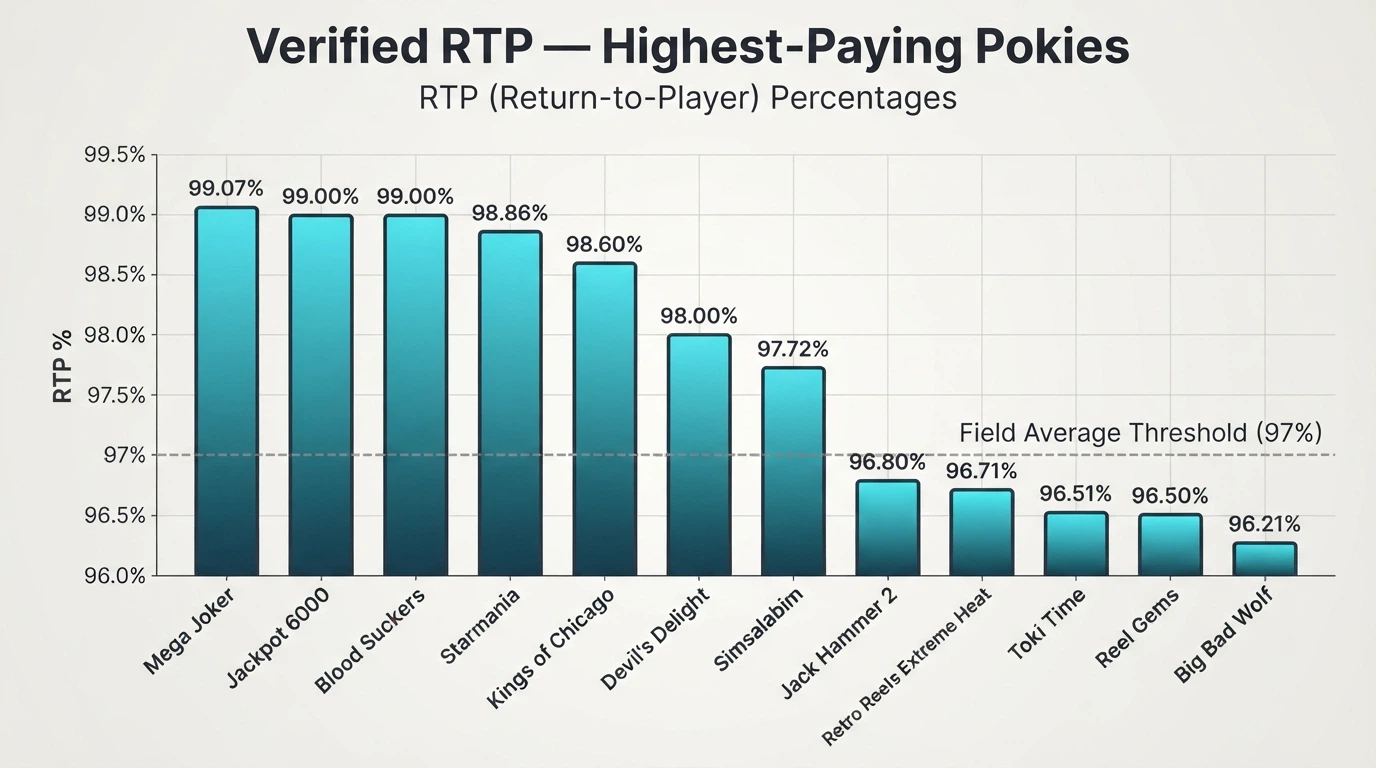
The cluster below is the top of the verified Australian-accessible market in 2026. Each figure is the title’s highest published RTP — the version a player would ideally be playing — and the column on volatility tells you what kind of ride that RTP pays for. A 99% RTP at low volatility looks very different from a 99% RTP at extreme volatility; the table is the starting point, not the verdict.
Every pokie in the top tier — ranked by verified RTP
| Pokie | Provider | RTP | Volatility | Max Win |
|---|---|---|---|---|
| Ugga Bugga | Playtech | 99.07% | Low | 1,000x |
| Mega Joker (Supermeter mode) | NetEnt | 99.00% | Medium | 2,000x |
| Book of 99 | Relax Gaming | 99.00% | Medium | 12,075x |
| Jackpot 6000 (Supermeter mode) | NetEnt | 98.86% | Medium-High | 6,000x |
| 1429 Uncharted Seas | Thunderkick | 98.60% | Low | 670x |
| Blood Suckers | NetEnt | 98.00% | Low | 900x |
| White Rabbit Megaways | Big Time Gaming | 97.72% | High | 13,029x |
| Dead or Alive 2 | NetEnt | 96.80% | Very High | 111,111x |
| Big Bass Bonanza | Pragmatic Play | 96.71% | Medium-High | 2,100x |
| Sweet Bonanza | Pragmatic Play | ~96.51% | High | 21,100x |
| Gates of Olympus | Pragmatic Play | 96.50% | Extreme | 5,000x |
| Book of Dead | Play’n GO | 96.21% | High | 5,000x |
That list is, by definition, the ceiling. Most of the Australian offshore market runs pokies in the 94–96% band. Anything published at 97%+ is doing better than the field, and the table above is what “best paying” actually means in title-level terms. San Quentin xWays by Nolimit City, listed separately because its RTP sits below this cluster but its theoretical max win of 150,000x is the highest on the market, is the natural counter-example — a pokie the table excludes because its RTP does not earn the seat, but a pokie a player chasing the ceiling payout has heard of.
Why a 99% RTP pokie is rarer than the affiliate lists claim
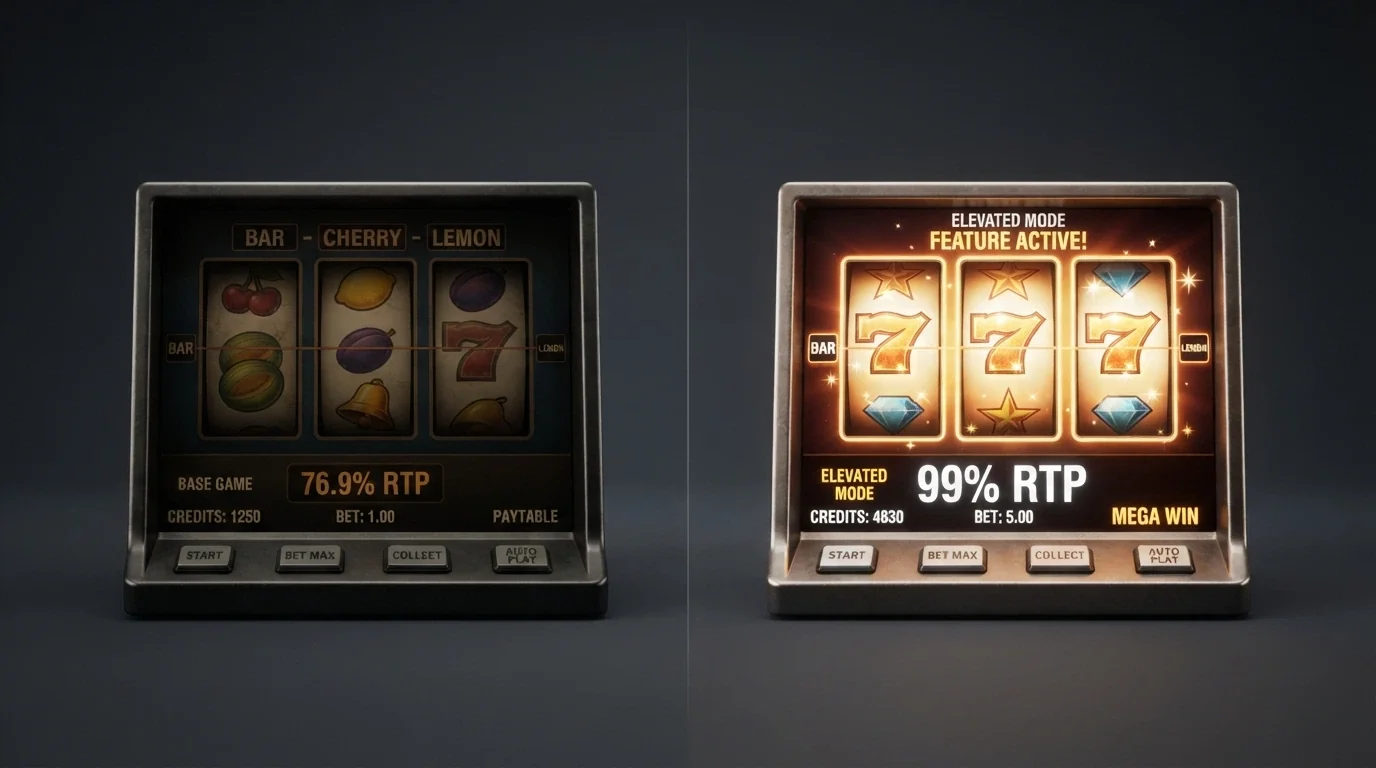
The top three numbers on that table all carry a footnote. Mega Joker’s 99.00% figure applies only in Supermeter mode at maximum bet. Base play returns somewhere between 76.9% and 85.1% — the rest of the percentage is locked behind a specific mode of play and a specific stake. A player who loads Mega Joker and spins at default settings is not playing the 99% pokie they read about. They are playing the 76.9% one, and the house edge is closer to a quarter of every dollar than the marketing whisper suggests.
Jackpot 6000 has the same condition in a different shape. The 98.86% figure requires the player to enter the Supermeter and bet the maximum of 10 coins per spin. Below that, the pokie sits well below the listed figure. Ugga Bugga is the cleanest of the three — 99.07% with low volatility and a 1,000x max win, no mode-switching required — but it is also a Playtech title that is harder to find at offshore casinos than the standard Pragmatic and NetEnt fare, because Playtech’s distribution deals are not as generous with the small operators.
The pattern is the headline. The percentage on the review is the best-case configuration. The number on the screen is whatever the casino has loaded. For three of the four titles in the 98%+ band, that gap is large enough to change the maths of whether the pokie is actually doing what the table says. Read the in-game information panel before the first spin. The version is printed there.
RTP vs volatility: chasing the payout without the wipeout
The highest-RTP pokies tend to be low-volatility, modest-max-win titles. Blood Suckers returns 98.00% with a 900x max win. 1429 Uncharted Seas returns 98.60% with a 670x max win. Both are slow, repetitive, and rarely produce a screenshot. They pay their high RTP by giving back small amounts on most spins and reserving the big payouts for almost nothing — that is what low volatility means.
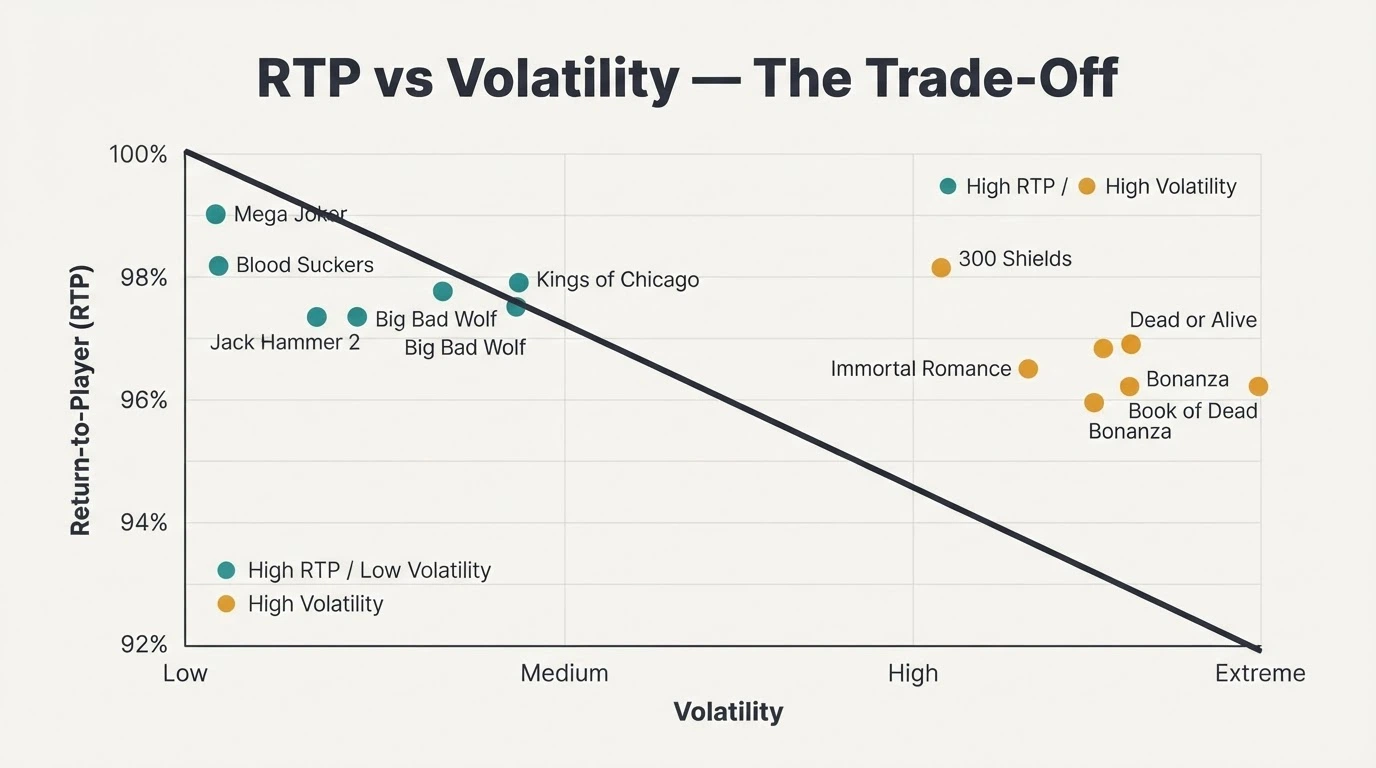
The big max wins live elsewhere. Dead or Alive 2 sits at 96.80% RTP with a max win of 111,111x — the full-board sticky wilds in Train Heist mode can theoretically produce a six-figure multiplier on a single spin. San Quentin xWays takes it further, with a 150,000x ceiling that is the highest of any widely available AU-market pokie. Both of those titles are very high to extreme volatility, which is to say the majority of spins return almost nothing and a tiny minority pay out a life-changing amount. The RTP averages out to its published figure across millions of spins, but the player experience is a long run of nothing punctuated by something rare.
The trade-off is mechanical. A game that pays out 50,000x on rare occasions needs to take more from the majority of spins to balance the RTP. High max wins inherently create high volatility. A player who wants a long session on a small bankroll is better served by Blood Suckers or 1429 Uncharted Seas. A player chasing the kind of payout that makes the affiliate thumbnail is looking at Dead or Alive 2 or San Quentin xWays — and accepting that the vast majority of their spins will feel like the casino is taking the money and not giving much back. Neither player is wrong. They are playing different games, and the RTP column on the table above does not tell them which one they are picking.
The same pokie, three different RTPs — and what it costs you
Studios ship configurable RTP, and the casino picks which version to run. Book of Dead ships in three flavours: 96.21% as the default, 94.25% as a reduced variant, and 92% on a smaller number of operators. Starburst ships at 96.09% as the default, with variants around 94.05% and 92.01%. Mega Moolah base game sits around 88.12%, far below the rest of the field, because the progressive jackpot portion of the wager funds the seven-figure payouts that make Mega Moolah famous. The player sees the same title, the same logo, the same reels. The percentage underneath is different.
Gates of Olympus is the practical example. The marketed RTP is 96.5%, but a number of operators run 95.51% or 94.5% versions. The difference between 96.5% and 94.5% is two cents per dollar wagered. On a session of 5,000 $1 spins, that is $100 the player did not realise they were handing over. Book of Dead reduced to 92% is worse: the player is sitting at an 8% house edge rather than the 3.79% the marketing copy implies, and the gap compounds across every spin they take.
The check is simple. Open the pokie, look for the information or paytable button, scroll to the rules or game details section, and read the RTP line. It is printed there by regulation in most jurisdictions. If the number matches the marketed default, the player is in the best version the casino offers. If it is lower, the player knows what they are playing and can adjust their session budget accordingly. The player who skips this step is the one paying the difference. Nobody else is.
Which providers build the highest-paying pokies — by the numbers
Aggregating RTP across a studio’s full catalogue gives a sense of where to look. NetEnt sits at the top of the verifiable averages, with an arithmetic mean of 96.39% across 392 qualifying games — the largest sample of any studio in the data. Big Time Gaming follows at 96.25%, Push Gaming at 96.15%. All three are above the Australian online pokie average. All three also ship at least one title above the 97% line, and the catalogue average is dragged upward by those titles rather than by anything exceptional across the rest of the library.
NetEnt’s catalogue average is shaped by games like Blood Suckers (98.00%) and Mega Joker (99.00% in Supermeter), and by a long tail of mid-96% titles that sit just above the field. Big Time Gaming’s average leans on White Rabbit Megaways (97.72%) and other Megaways titles; Push Gaming’s average is spread across a portfolio of high-volatility titles with RTPs that cluster around 96%. None of the three has a catalogue of 99% games. The 97%+ titles are the exception, not the rule, and the averages above reflect that.
The provider mix matters at the lobby level. BGaming runs the RTPs at RocketPlay and Rocket Casino in this ranking, with the catalogues leaning toward mid-96% titles like Aztec Magic Deluxe. Pragmatic Play’s pokies — Sweet Bonanza, Big Bass Bonanza, Gates of Olympus — cluster around 96.5% in their highest-RTP configuration, which is competitive but not exceptional. For a player targeting the 97%+ tier specifically, NetEnt is the first stop, BTG and Push Gaming the next, and Pragmatic Play the broadest mid-tier option.
Offshore casinos where Australians play the highest-RTP pokies in 2026
Every operator in this ranking is offshore. None holds an Australian licence because none can; the Interactive Gambling Act 2001 prohibits the provision of online casino and online pokies to Australians, and no state or territory issues the licences that would legalise the product. What follows is a comparison of the offshore operators that reach Australian players with real traffic, ranked by relevance to the pokies topic, not by market share. The table below sets out the bonus headlines the operators use to recruit; the per-operator write-ups underneath work through what those terms actually mean in cash.

| Operator | Welcome Bonus (AU$) | Wagering | Free Spins |
|---|---|---|---|
| RocketPlay | 100% up to AU$1,000 | 40x (bonus + FS) | 100 |
| Skycrown | 100% up to AU$500 + AU$500 (tier 2) | 20x (FS winnings) | 200 |
| Royal Reels | — | — | — |
| WinSpirit | 100% up to A$1,300 | 40x (no-deposit FS) | 100 + up to 40 no-deposit |
| Stake | — | — | — |
| Rainbet | 250% up to ₹199,800 | 40x | 60 |
| Scream Casino | — | — | — |
| FairGO | — | — | — |
| Bizzo Casino | — | — | — |
| Rocket Casino | 100% up to AU$500 | 45x (bonus + FS) | 50 + 20 no-deposit |
The em-dash cells are operators where bonus terms, wagering or licence detail were not verified this run, and the write-ups underneath explain what is and is not confirmed. None of these operators is licensed in Australia. None can be. That is the single fact the rest of the page repeatedly returns to, because it shapes what the rest of the page can offer the reader.
RocketPlay: 100% up to AU$1,000 with a tight AU$7.50 max-bet rule
RocketPlay’s first-deposit welcome is a 100% match up to AU$1,000 plus 100 free spins, released in batches of 20 a day over five days. Minimum deposit AU$30. Wagering on the deposit bonus is 40x, and the same 40x applies to free spin winnings. Free spin winnings also carry a maximum cashout cap of AU$5,000. The second-deposit bonus is a 200% match up to AU$1,000 with the same 40x wagering and a higher AU$75 minimum.
The number that matters is AU$7.50. RocketPlay caps the maximum bet during any active bonus period at AU$7.50, and exceeding that can result in bonus cancellation. For a pokie player targeting high-RTP titles and grinding through wagering, that cap is the difference between a sensible bonus and an unusable one. AU$7.50 per spin is workable on most titles — Mega Joker, Blood Suckers, 1429 Uncharted Seas all accept that stake — but the player who wants to run Jackpot 6000 in Supermeter mode at 10 coins per spin cannot do so under this bonus. The bonus terms and the highest-RTP configuration are not always compatible.
RocketPlay runs BGaming and other providers in its lobby; the games catalogue reaches the standard Pragmatic Play and NetEnt titles through integration partners. The bonus is generous by Australian-offshore standards. The bet cap is the caveat. For a pokie player on a modest bankroll who plans to spin mid-volatility titles at AU$1–AU$5 a spin, the bonus works. For a high-stakes grinder, it does not.
Skycrown: 200 free spins and a split-tier AU$1,000 match
Skycrown splits the welcome across two deposits: a 100% match up to AU$500 on the first deposit, with the remaining AU$500 attached to the second deposit at higher wagering terms. Total headline: AU$1,000 plus 200 free spins. Free spin winnings carry 20x wagering, well below the 40x standard at competitors. The bonus must be cleared within seven days of activation.
The seven-day window is the figure that decides whether Skycrown’s offer is worth chasing. Two hundred free spins at 20x wagering is genuinely favourable against the field — most offshore competitors sit at 40x on free spin winnings. A player who can clear AU$10,000 of bonus turnover in a week, on the games Skycrown’s terms permit, will extract more value from Skycrown’s free spins than from almost any other bonus in this ranking. The trade-off is the time pressure. Players with limited play time during the week find the bonus expires before the wagering is complete.
The second-deposit match at higher wagering is the part of the offer most players skip. The free spins are the centre of gravity, and Skycrown’s lobby populates the bonus spins on popular slots rather than niche titles, which keeps the wagering realistic on standard mid-96% pokies. Skycrown is the top choice for a player who can clear the wagering in a focused week of play, capitalising on the 20x conversion rate that beats the market’s standard 40x requirement.
Royal Reels: a known name with terms research could not pin down this run
Royal Reels appears regularly in Australian-facing search results for offshore pokies. What could not be confirmed in the verification round is the licence, the welcome bonus terms, the wagering multiple, the free-spin allocation, and the validity period. The brand name has visibility; the underlying terms did not surface for confirmation. Treat the absence of a confirmed figure as a reason to read the small print before depositing.
The checks worth running are the same for any operator whose terms did not arrive cleanly. Look at the licence footer — it should name a regulator (Curaçao is the most common for this kind of operator) and provide a registration number that resolves on the regulator’s public register. Read the bonus terms page directly, paying attention to wagering multiple, max-bet cap during bonus, free spin game restrictions and max cashout from free spin winnings. Open one of the high-RTP titles in the lobby before depositing and check the in-game RTP line against the figure the marketing uses. If any of those checks return a gap, the deposit is the player’s call to make — but the gap is now visible.
The brand has reach; the brand’s terms need verifying. That is what the absence of confirmed figures means here.
WinSpirit: the only operator in this set with a deposit-free spins route
WinSpirit’s headline welcome is a 100% match up to A$1,300 plus 100 free spins across the first two deposits, with a A$30 minimum. The bonus comes in batches of 20 free spins over five days. The standout is the secondary path: up to 40 no-deposit free spins available via app download and review action, with 40x wagering on winnings, a 40-day validity window, and an A$50 maximum win per batch. The free spins run on Lady Wolf Moon and Pearl Diver, both BGaming titles.
The no-deposit path is what makes WinSpirit the only operator in this set with a zero-cost entry point. Forty free spins with a 40x wagering requirement and an A$50 cap per batch is modest by any absolute measure, but it is also money the player did not risk. A player who downloads the app, leaves a review, and clears the wagering on the named BGaming titles walks away with whatever the cap allows, and never made a deposit to do it. The cap is the ceiling: A$50 per batch, not per session, and not as a pooled total.
The deposit bonus is competitive at A$1,300 across two deposits, though the terms beyond the headline were not confirmed in detail this run. WinSpirit is the primary option for a player who wants to test a lobby without making a deposit, provided they are willing to navigate the app download and review mechanics to earn the no-deposit batch.
Stake: crypto-native operator with a Curaçao licence and no confirmed welcome bonus
Stake holds a Curaçao licence and reaches Australian players; the licence date was not confirmed this run. What Stake does not appear to do is recruit with a matched-deposit welcome bonus. The operator’s draw is game variety, instant crypto payouts, and a sports and casino product built around digital-currency rails rather than fiat deposit matching.
For a pokie player specifically, that positioning cuts both ways. Stake’s strengths are game range and withdrawal speed: the lobby carries thousands of titles across the major studios, and crypto withdrawals can clear in minutes rather than hours. The absence of a matched-deposit bonus means there is no wagering requirement to clear on a welcome package, and no max-bet cap to plan around. The player deposits, plays, withdraws. The bonus maths does not enter the picture.
The verification step that matters here is the same as elsewhere: open one of the high-RTP titles in the Stake lobby and confirm the in-game RTP against the published figure. Stake suits the crypto-comfortable player who values payout speed over bonus value and is willing to skip the matched-deposit structure altogether.
Rainbet: an INR-denominated welcome that AU players need to convert
Rainbet’s welcome offer is a 250% match up to ₹199,800 plus 60 free spins, with 40x wagering on the bonus. The denomination is Indian rupees; the minimum deposit is approximately ₹2,855, equivalent to around AU$50 at recent exchange rates. The AUD terms were not confirmed in detail, and the conversion is the part of the offer most players will misread on first inspection.
A 250% match reads as enormous against the field, where 100% is standard. The arithmetic underneath is more modest: ₹199,800 at current exchange rates is roughly AU$3,600, and a deposit of around AU$150–AU$200 will collect most of the headline percentage. The player who reads “250%” and assumes a AU$3,600 ceiling is over-counting. The free spins are 60, again a respectable count but on titles whose identity was not confirmed this run.
Conversion costs come in twice. The deposit converts from AUD to INR at the payment processor’s rate, and the withdrawal converts back. Players who deposit and withdraw in the same currency do not see this cost. Players who move between AUD and INR on each transaction pay the processor spread twice. The bonus value has to clear that spread to come out ahead. Rainbet suits the player who already holds INR or accepts the conversion cost as part of the offer.
Scream Casino: AU-facing site with terms not confirmed this run
Scream Casino surfaces in Australian-facing search results and accepts AU players. What was not confirmed in the verification round is the licence, the welcome bonus, the wagering multiple, the free-spin allocation, and the validity period. The brand is visible; the underlying terms did not surface for confirmation. The same verification checklist applies.
Licence footer first, with the registration number checked against the named regulator’s public register. Bonus terms read directly, with attention to the wagering multiple, max-bet cap during bonus, free-spin game restrictions and the max cashout on free-spin winnings. In-game RTP checked against the published figure on one of the high-RTP titles. If any of those checks return a gap, the gap is the player’s information, and the deposit decision is theirs.
FairGO: a brand pitched at Australians with terms not confirmed this run
FairGO brands itself for Australian players, and the marketing is tailored accordingly. Bonus terms, wagering, and licence detail were not confirmed in the verification round. A brand that markets itself at Australians is not the same thing as a brand licensed in Australia. The IGA does not licence online pokies, and the brand’s local-facing copy does not change the offshore status of the operator.
The verification checklist is the same: licence footer, bonus terms page, in-game RTP confirmation. FairGO suits a player who responds to the AU-targeted branding and is willing to verify the underlying terms themselves before depositing.
Bizzo Casino: a known AU-facing name with terms not confirmed this run
Bizzo reaches Australian players and surfaces in AU-facing search rankings. Bonus terms, wagering, and licence detail were not confirmed this run. The brand has recognition; the verification did not return clean figures on the points the rest of this ranking captures. The same checks apply: licence footer, terms page, in-game RTP.
Bizzo’s market presence is real; the operator is on enough AU-facing lists that the verification work should be straightforward for a player who wants to chase the offer. Treat the absence of confirmed terms as a reason to run the checklist, not as a reason to skip the operator.
Rocket Casino: 50 deposit-match spins plus 20 no-deposit spins on sign-up
Rocket Casino runs a welcome of 100% up to AU$500 plus 50 free spins on Aztec Magic Deluxe, a BGaming title, with a AU$30 minimum deposit and 45x wagering on bonus and free spin winnings. The additional 20 no-deposit free spins on registration are the route that lets a player test the lobby without committing a deposit. Both sets of free spins run on the same BGaming title.
The 45x wagering is the highest in this ranking, and the AU$500 ceiling is the lowest deposit-match ceiling among the operators with confirmed terms. Rocket Casino’s offer is smaller and stricter than RocketPlay’s, Skycrown’s or WinSpirit’s. The trade-off is the no-deposit entry: a player who registers an account collects 20 free spins without funding anything, and 45x on a BGaming title means the wagering requirement is real but the spin count is small enough to clear.
Rocket Casino suits the player who wants a no-deposit test run before committing, accepts the higher wagering, and plans to play BGaming titles specifically. The smaller ceiling is the cost of the entry point.
How fast your pokies winnings actually reach your bank account
“Fast payout” is the second-most-common headline in offshore casino marketing, after “best paying”. Both phrases mean roughly the same thing in practice: a number the casino picked to recruit rather than a number the casino can be audited against. The actual payout timeline at an offshore casino is the sum of three layers, and the slowest layer sets the speed. None of the three is regulated by an Australian authority, because the product is not licensed here.
Payout speed by method: what AU players actually use in 2026
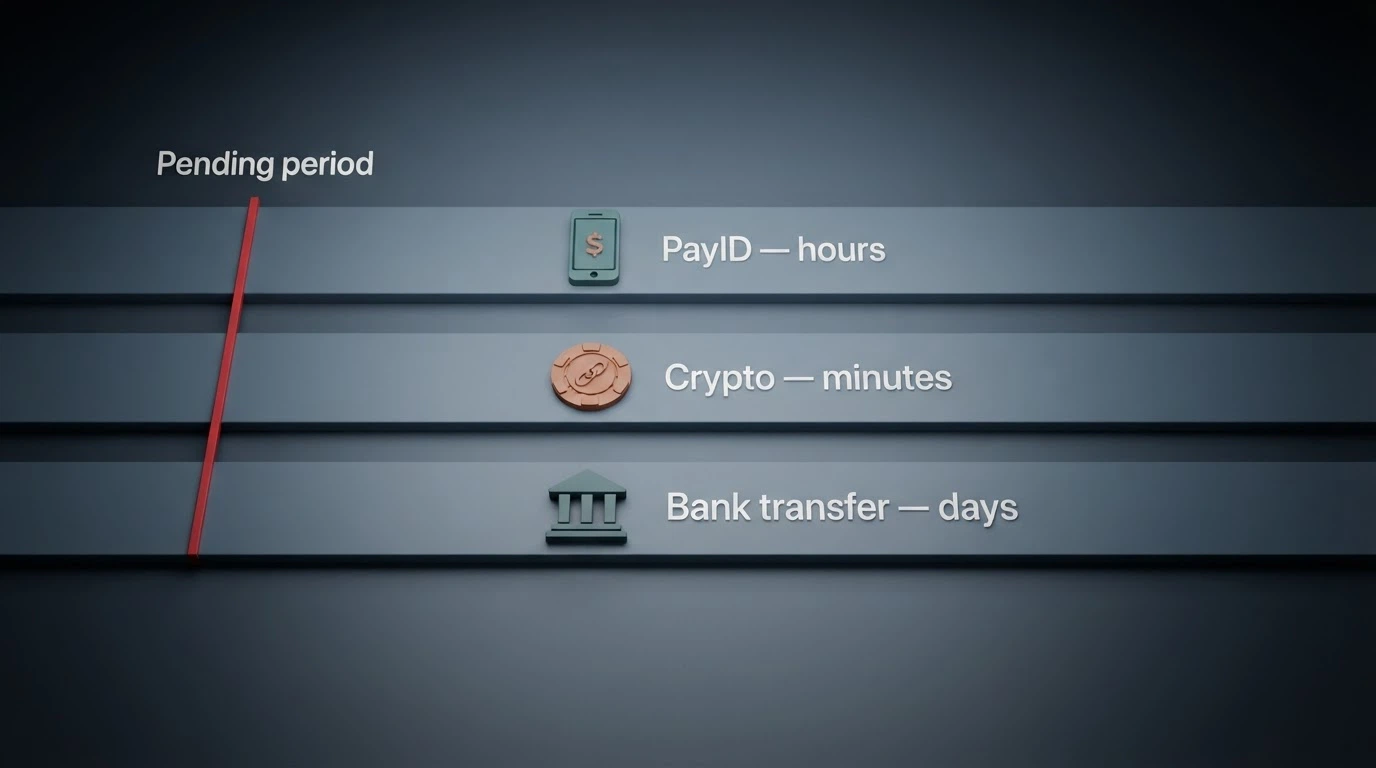
The fastest AUD route at offshore casinos in 2026 is PayID or Osko. Both move through the New Payments Platform and clear within minutes once the casino releases the funds. The second route is crypto — Bitcoin, Ethereum, USDT and the major stablecoins settle in minutes on the chain, with no banking hours to wait for. The slowest is the bank transfer, which still clears in one to three business days but carries the highest minimums and the strictest verification.
POLi was decommissioned in September 2023 and is no longer a deposit route. The 2026 deposit toolkit for Australian players is PayID, debit card, bank transfer and crypto. Cards run through the standard merchant rails; PayID runs through the NPP; bank transfer runs through direct credit. Crypto is the only method that operates outside the Australian banking hours, which is why it remains the route players choose for time-sensitive withdrawals despite the volatility and the conversion step.
The method the casino supports is the first half of the question. Whether the casino actually releases the funds on the timeline it advertises is the second. Offshore casinos are not bound by any Australian maximum withdrawal time. The pending period, the internal review window between “approved” and “sent”, sits entirely inside the operator’s discretion.
Why “instant withdrawal” claims collapse under a 72-hour pending period
The instant-withdrawal headline assumes the casino’s internal review is instant. It is not. Most offshore operators run a pending period — an internal window during which a withdrawal request sits in review before the casino actually pushes the funds. The pending period is where the “instant” claim dies. Pending periods of 24 to 72 hours are common in this market, and longer windows are not unknown. The marketing says instant; the pending period says otherwise; the player experiences the gap.
The pending period is also the gap that no Australian regulator can close. The licensed wagering market has no uniform maximum withdrawal time either, but it has the Australian consumer law framework and a regulator behind the operator. The offshore casino has neither. A player whose withdrawal sits in pending for a week has no Australian regulator to contact, no BetStop-style register to lean on, and no chargeback right through the Australian consumer framework once crypto or a non-Australian processor handled the deposit.
The realistic expectation is: pending period first, then the method’s own clearing time. PayID on top of a 24-hour pending is roughly a day end-to-end. Crypto on top of a 48-hour pending is roughly two days. Bank transfer on top of a 72-hour pending is the better part of a week. The player who plans around the pending period rather than the marketing claim is the player who plans correctly.
Playing pokies for real money: what changes when the spin costs cash
The RTP is the same in demo and real-money mode. The volatility is the same. The hit frequency is the same. The maths does not know whose money is on the line. What changes is the person at the keyboard. Real money adds three things that demo play does not have: a budget ceiling that the player has to set and enforce, the temptation to chase a loss that the game itself never suggests, and the consequence of a session running longer than planned. The game does not change. The stakes the player is playing for do.
Minimum deposits at the operators with confirmed figures cluster around AU$30. RocketPlay, WinSpirit and Rocket Casino all sit there. Rainbet’s minimum is approximately AU$50 at recent exchange rates. A player who plans to deposit once and play through a single welcome bonus needs to set a session budget before the deposit, not after. The session budget is the only number on the page the player sets for themselves; the wagering multiple, the RTP, the house edge — those are set by the casino and the studio. The budget is the one lever the player controls.
Demo play is the right way to learn a new pokie’s mechanics, volatility feel and bonus-round frequency. Real-money play is the right way to test the same pokie against a budget. Mixing the two — switching between demo and real on the same title — is how a player loses track of which session is the budgeted one. Keep them separate. Demo for learning. Real for the budgeted session. Never both at once.
The deposit methods that work for Australian players at offshore casinos
The Australian deposit toolkit at offshore casinos in 2026 is PayID, debit card, bank transfer and crypto. POLi was decommissioned on 30 September 2023 and is no longer a route. PayID and Osko are the dominant instant-transfer methods for AUD funding; both clear through the New Payments Platform and reach the casino account within minutes. Debit cards work through the standard merchant rails and are accepted by most offshore operators, subject to the casino’s own processing rules. Bank transfers are slower but familiar and work for players who want to keep the entire deposit trail inside the Australian banking system.
Crypto is the route that operates outside the Australian banking hours. Bitcoin, Ethereum and the major stablecoins settle on the chain, and withdrawals back to a personal wallet can clear in minutes. The 11 June 2024 ban on credit cards and crypto for online wagering applies to licensed Australian wagering operators. It does not bind offshore casinos in the same way: an offshore casino accepting AU players may still process both card and crypto deposits, because the offshore operator is outside the IGA’s enforcement perimeter. The player choosing crypto at an offshore casino is choosing speed and round-the-clock access; the player choosing PayID is choosing the AUD-native rail; neither is wrong.
What Australian players give up when they play offshore
The list of protections an Australian player forfeits the moment the deposit clears at an offshore casino is concrete. Each item on it is something the licensed wagering customer takes for granted. None of them applies offshore.
- No BetStop coverage. The National Self-Exclusion Register binds Australian-licensed wagering services only. An offshore casino is not connected, and a registered self-excluded person remains free to deposit and play.
- No Australian consumer-law chargeback path. Disputes with offshore operators sit outside the Australian Competition and Consumer Commission’s reach. The Australian Financial Complaints Authority does not cover offshore gambling disputes.
- No ACMA complaints recourse. The ACMA’s blocking and enforcement powers run against operators offering prohibited services to Australians; the authority is not a dispute-resolution body for individual players.
- No guaranteed payout. An offshore operator can refuse a withdrawal, void winnings, or close an account with a balance on it. The player has no Australian regulator to escalate to.
- No site stability. Since November 2019 the ACMA has had 1,564 illegal gambling and affiliate websites blocked by Australian ISPs, and more than 225 illegal services have withdrawn from the Australian market. An offshore site can become unreachable with a player balance still on it.
AU-dollar pokies: the currency-conversion cost most players miss
Most offshore casinos operate in USD, EUR or crypto rather than AUD. A player depositing in AUD at a USD-denominated casino pays the conversion twice: once on the way in, at the payment processor’s rate, and once on the way out, at the same processor’s rate on the return. The spread between the processor’s rate and the mid-market rate is the hidden cost. It is small per transaction — typically 1–3% — but it is paid on every deposit and every withdrawal.
The total cost depends on how often the player converts. A player who deposits once, plays through a welcome bonus, and withdraws once pays conversion twice and loses a few per cent of the total volume to spread. A player who deposits and withdraws in smaller batches — topping up, cashing out partial balances, switching between games — pays conversion more often and loses more to spread.
Crypto sits in a different category. The conversion cost is between AUD and the crypto, not between AUD and USD, and the cost depends on the exchange used, the coin chosen, and the network fees on the day. USDT on a low-fee network tends to be cheaper than BTC at peak network congestion; stablecoins remove the volatility risk between deposit and withdrawal. A player who uses crypto for both legs pays the conversion once in each direction, but the spread on stablecoin conversions is typically tighter than on fiat cards.
The cost is small in percentage terms and significant in total. A player who runs ten deposits and ten withdrawals a year at a 2% spread on a AU$200 average transaction has paid roughly AU$80 to the processor. That AU$80 is the budget that did not make it to the pokies.
The law every Australian pokies player needs to understand in 2026
The Interactive Gambling Act 2001 makes it an offence to provide a prohibited interactive gambling service to a person in Australia. The offence targets the operator, not the punter. What it means for the player is that every online pokie site an Australian can deposit at is operating outside the Australian framework — there is no licensed online casino in the country, not federally and not in any state or territory. The framework that exists is for wagering (sports and race betting, pre-event), lotteries, and keno. Online pokies are prohibited; online sportsbooks are licensed at state and territory level.

No licence, no regulator: why online pokies are banned in Australia
Australia chose prohibition over licensing for online casino. The Interactive Gambling Act 2001 prohibits the provision of online pokies, online casino games and in-play sports betting to anyone physically in Australia. The Australian Communications and Media Authority enforces the prohibition: it investigates complaints, issues formal warnings, refers operators for civil penalty proceedings, and directs Australian ISPs to block illegal services.
The licensing that does exist runs through the states and territories. The Northern Territory Racing and Wagering Commission, administered by Licensing NT, is the de facto national licensor for online and phone wagering. NT-licensed bookmakers take bets on sports and racing; they do not, and cannot, offer online casino or online pokies. The state and territory regulators do the same for land-based: Crown in Melbourne, The Star in Sydney, and the casino operators in Queensland, South Australia, Tasmania and the ACT are state-licensed for their physical floors. None of them extends that licence to an online casino product.
What that means for the offshore pokies market is structural. Every AU-facing offshore casino is a prohibited-service provider under the IGA, and every player depositing at one is using a product the Australian framework was designed to keep out. The prohibition has not produced a licensed market because the prohibition’s purpose was not to create one. It was to prevent the harms that the licensed wagering framework — with BetStop, deposit limits, activity statements, intervention protocols — was built to address.
The 2026 gambling reforms: what changes on 1 January 2027
The Interactive Gambling Amendment (Gambling Reform) Bill 2026 passed Parliament on 19 August 2026 and commences on 1 January 2027. The reform package is the most significant change to Australian online gambling law in over a decade, and the parts that touch offshore pokies are the parts the rest of this page has to track.
Bank blocking authority. From 1 January 2027, banks and payment providers gain express authority to block transactions to illegal gambling operators. The blocking power sits with the financial institutions; the ACMA maintains the list. An offshore casino that the ACMA has referred for blocking becomes a transaction the player’s bank declines. PayID, debit card and bank transfer become the rails on which the block lands. Crypto is harder to block because it operates outside the banking system; the reform does not change that. What it changes is the experience of paying with AUD: it becomes the experience of having the deposit declined.
Advertising restrictions. A phased ban over three years: Phase 1 prohibits wagering advertising during news and current affairs programming; Phase 2 bans ads during live sporting coverage and inside sports venues; Phase 3 expands to broader broadcasting and online. No more than three wagering ads per hour between 6:00 am and 8:30 pm; no wagering advertising from 15 minutes before a live sporting event until 5 minutes after it ends; radio ads barred during school drop-off and pick-up times; broadcasting sporting odds banned outright; online wagering ads only to logged-in, over-18 users with opt-out. Athletes, celebrities and influencers are barred from promoting wagering.
Inducement cooling-off. Direct marketing of inducements is prohibited for 14 days after sign-up, for three months after BetStop deregistration, and indefinitely for at-risk customers. The “inducement” definition covers free bets, bonus offers, and the matched-deposit structures offshore casinos use to recruit AU players. The rule applies to licensed Australian operators; offshore operators are not bound by it, but the banks’ blocking power and the advertising restrictions change the recruitment environment that the offshore market depends on.
AdStop opt-out register. A new register, separate from BetStop, that lets Australians opt out of wagering advertising across digital platforms. The register is opt-out rather than opt-in by default, and licensed operators are required to suppress advertising to registered users. Offshore operators are not bound by the register, but the platforms that carry the advertising — broadcasters, social media, search — are.
The payment bans already in force: credit cards and crypto
Credit cards, credit-related products and digital currency (crypto) are banned as payment for online wagering in Australia since 11 June 2024 under the Interactive Gambling Amendment (Credit and Other Measures) Act 2023. The ban applies to licensed Australian wagering operators. Operators that fail to enforce face penalties of up to A$247,500 per breach. The ban does not bind offshore casinos in the same way; an offshore operator accepting AU players may still process both card and crypto deposits, because the offshore operator is outside the IGA’s enforcement perimeter. The ban applies where the licensed operator touches the AUD banking system.
What that means for an AU player at an offshore casino is: card deposits and crypto deposits may still clear at the offshore site, even though the same transactions would be declined at a licensed Australian operator. The licensed side has the regulatory hook; the offshore side does not. The 1 January 2027 bank blocking authority closes part of this gap on the AUD side by giving banks express authority to decline transactions to ACMA-referred operators. The bank blocking change is the one that reaches offshore pokies players directly. The credit card and crypto ban does not, because the offshore operator sits outside the framework that enforces it.
Responsible gambling: the numbers every pokies player should see
The harm data is the part of the page that most affiliate reviews skip. The numbers are uncomfortable. They are also the part of this subject a player should see before deciding how to play.
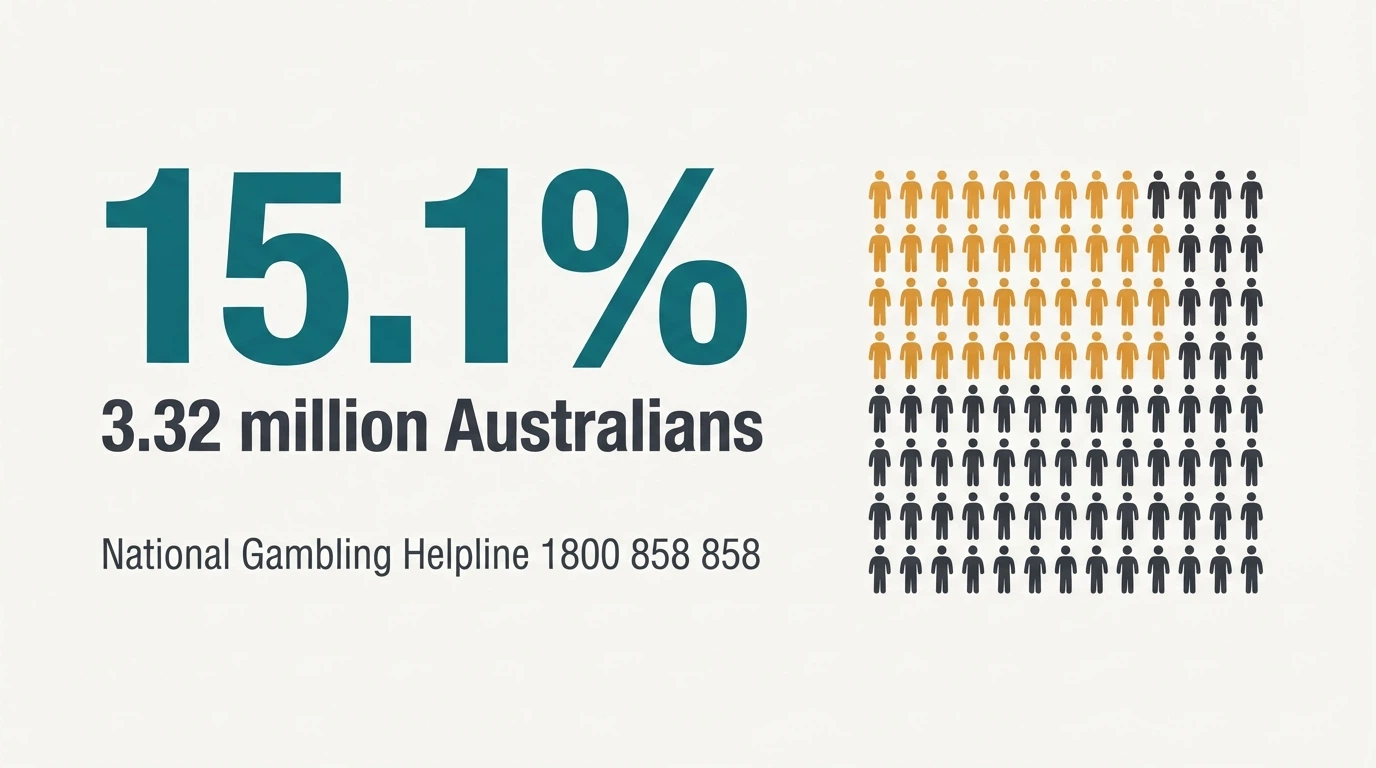
15.1% of Australian adults — an estimated 3.32 million people — are experiencing some level of gambling harm as of March 2026. 13.0% (2.857 million) from their own gambling; 5.4% (1.177 million) from someone else’s. The modelled national estimate runs higher: approximately 3.29 million Australians affected annually, with over 400,000 Years Lived with Disability attributable to gambling harm. Risky gambling increased from 13.7% in 2024 to 19.4% in 2025 — almost doubling since the COVID-19 lockdowns. About 2.1% of adults (roughly 430,000 people) experience problem gambling.
State-by-state, the participation spread runs from Queensland at 70.2% through Western Australia at 69.6% and South Australia at 67.9%, to New South Wales at 63.9%, Victoria at 60%, and Tasmania at 59.9%. Aboriginal and Torres Strait Islander Australians are at risk of gambling harm at 27.1%, against 14.6% for non-Indigenous Australians. The disparity is the largest single gap in the harm data, and the one most often left out of the affiliate review.
BetStop, self-exclusion and the offshore casino’s blind spot
BetStop — the National Self-Exclusion Register — launched on 21 August 2023. By 31 March 2026, 59,830 people had registered. 37,247 had active exclusions. 78% of registrants were under 40; 38% chose lifetime exclusion. The 26 February 2026 statutory review published the participation data and the awareness gap: only one in three wagerers (33.5%) know BetStop exists, and only around one in four Australian adults (26.5%) are aware of the register.
The number that sits underneath the awareness figure is the gap the register was built to close. An estimated five million Australians wager regularly, and around 400,000 are high-risk. Of those, almost 60,000 have registered with BetStop. The ratio is the reason the awareness figure matters: a harm-reduction register that two-thirds of the wagering population does not know about is a register reaching a fraction of the people it was designed for.
BetStop binds only Australian-licensed wagering services. An offshore casino is not licensed here, is not connected to the register, and will keep accepting a self-excluded person’s money. That is the single most important limitation of BetStop for the offshore pokies player, and the one a self-excluded Australian needs to know: registering with BetStop does not stop the offshore account. It stops the licensed wagering accounts. The offshore side has to be handled separately, by closing accounts directly with the operators, and the offshore operators do not always cooperate.
Where to get help: the services that actually work for Australian players
- National Gambling Helpline — 1800 858 858. Free, confidential, staffed 24/7. The first call most people make.
- Gambling Help Online — gamblinghelponline.org.au. Online chat and counselling, with self-help tools and information for affected others as well as the gambler.
- BetStop — National Self-Exclusion Register. Effective for licensed wagering accounts; ineffective for offshore casino accounts. Register at the official portal.
These services are free and confidential, and they exist regardless of where the gambling happened. Offshore play does not put the help line out of reach; the help line has no jurisdiction to ask.
How we ranked the best-paying online pokies for Australian players
The RTP data on this page comes from cross-referenced figures across PayoutVerdict, SlotArk, AusSlots, Australia Casino Review, Aureal Money Pokies, SlotSims and SlotRandomizer. The RTP column in the table is the title’s highest published figure — the version of the game the studio markets — not the version every casino runs. Variable-RTP configurations are flagged in the prose where they apply (Book of Dead, Starburst, Mega Moolah, Gates of Olympus), and the verification step is the in-game information screen, which any player can read before the first spin.
The operator selection is AU-facing offshore casinos with real traffic, checked against the ACMA’s blocking data. The list is what an Australian punter searching for “best online pokies” actually finds, not a curated whitelist. None of the operators holds an Australian licence, and the ranking order is relevance to the pokies topic (game selection, RTP availability, bonus terms), not market share.
The harm data is from Roy Morgan (March 2026), ANU POLIS (2025), the Australian Gambling Research Centre at AIFS (2025), the AIHW (2022), and the Journal of Gambling Studies (2026). The legal framework is the Interactive Gambling Act 2001 and its amendments, sourced from the regulation skill and AustLII. The BetStop statistics are from the ACMA’s quarterly reporting through Q3 FY 2025–2026 and the February 2026 statutory review by the Department of Infrastructure, Transport, Regional Development, Communications, Sport and the Arts. No operator was weighted above another by invented criteria. The ranking reflects what the data says, not what the marketing wants.
The figures this page cannot verify are stated as such. Where research returned no confirmed value — bonus terms, wagering multiples, free-spin allocations, licence details — the write-up says so rather than inventing a number.
What to play — and what to check before you spin
The starting point is the RTP table in the section on the highest-RTP pokies. Target 97% or above where it is available. Anything above the 95–96% Australian online average is doing better than the field, and the cluster at the top of the table — Ugga Bugga, Mega Joker, Book of 99, Jackpot 6000, 1429 Uncharted Seas, Blood Suckers — is the ceiling. Below 97% is competitive, not best paying.
Match the volatility to the bankroll. Low-volatility, high-RTP titles like Blood Suckers and 1429 Uncharted Seas suit players with a small bankroll who want long sessions. High-volatility, lower-RTP titles like Dead or Alive 2 and San Quentin xWays suit players with a bankroll that can absorb the dry spells in pursuit of the ceiling payout. Neither approach is wrong; they are different games with different RTP profiles.
Check the version before the first spin. Open the pokie, read the information panel, confirm the RTP line matches the figure on the review. If the casino is running a reduced-RTP configuration, the gap is on the screen before the player wagers a cent. The check takes thirty seconds.
Run the offshore checklist before depositing. Licence footer with a registration number that resolves on the regulator’s public register. Bonus terms read directly. Max-bet cap during bonus noted. Free-spin game restrictions and max cashout confirmed. If any check returns a gap, the gap is the player’s information, and the deposit decision is theirs.
The legal context does not change with the operator chosen. The Interactive Gambling Act 2001 prohibits online pokies in Australia; the 2026 reform package tightens enforcement from 1 January 2027; every AU-facing offshore casino in any ranking is operating outside the Australian framework. The right pokie for a particular player depends on that player’s bankroll, session length, and tolerance for volatility. The right operator depends on the verification work the player is willing to do. Neither decision is one this page can make for the reader.
Frequently asked questions
What is the highest paying pokie in Australia in 2026?
The highest verified RTP on the Australian-accessible market in 2026 is Ugga Bugga at 99.07%, with Mega Joker at 99.00% in Supermeter mode and Book of 99 at 99.00% close behind. All three carry caveats: Ugga Bugga is a Playtech title that is harder to find at smaller offshore casinos, Mega Joker’s 99% figure requires Supermeter play at maximum bet (base play returns 76.9–85.1%), and Book of 99 needs the expanding-symbol bonus round to deliver the headline payouts. None of the three is what the casino may actually be running.
How do I check the RTP of a pokie before I play?
Open the pokie, look for the information or paytable button, scroll to the rules or game details section, and read the RTP line. It is printed there by regulation in most jurisdictions. If the figure matches the published default — 96.21% for Book of Dead, 96.5% for Gates of Olympus, 96.51% for Sweet Bonanza — the casino is running the best version available. If the figure is lower, the operator has deployed a reduced-RTP configuration, and the gap is yours to know about before the first spin.
What is the difference between RTP and volatility in pokies?
RTP is the long-run percentage of wagers a pokie returns to all players — a statistical average over millions of spins. Volatility is the shape of the distribution around that average: a low-volatility pokie pays out small amounts often, a high-volatility pokie pays out large amounts rarely. A 98% RTP at low volatility (Blood Suckers) gives a long, even ride with a 900x ceiling. A 96.8% RTP at very high volatility (Dead or Alive 2) gives a long stretch of almost nothing and a 111,111x ceiling on the rare spin that lands. The RTP column does not tell a player which game they are picking.
Can I use PayID or crypto to deposit at offshore pokies sites?
Yes. PayID and Osko are the dominant instant AUD deposit routes at offshore casinos in 2026, and they clear through the New Payments Platform within minutes. Crypto (Bitcoin, Ethereum, USDT and major stablecoins) is the alternative that operates outside banking hours, with withdrawals settling in minutes on the chain. The 11 June 2024 ban on credit cards and crypto for online wagering applies to Australian-licensed operators; offshore casinos are not bound by the same enforcement perimeter, and both methods may still clear at an AU-facing offshore site.
How does BetStop self-exclusion work for online pokies players?
BetStop is the National Self-Exclusion Register, live since 21 August 2023. A single registration excludes a person from every Australian-licensed online and phone wagering service. The minimum exclusion period is three months, and lifetime exclusion is available. The limitation is structural: BetStop binds only Australian-licensed wagering services. Offshore casinos are not connected to the register, and a self-excluded person remains free to deposit and play at an offshore operator. Registering with BetStop stops the licensed accounts; the offshore accounts have to be closed directly with the operators.
Are pokies winnings taxable in Australia?
No, not for recreational players. Betting and gambling winnings are not assessable income under section 6-5 of the ITAA 1997, and losses are not deductible under section 8-1. The exception is a person carrying on a business of betting or gambling — professional punter status, which the ATO applies case by case. The vast majority of recreational pokies players have no Australian tax obligation on winnings, and no Australian tax deduction available on losses. Operators pay point-of-consumption tax where the customer is; that is the operator’s liability, not the player’s.