
Fast Withdrawal Casinos in Australia in 2026 — What’s Real, What’s Marketing, and What It Costs
Every casino that takes a bet from an Australian is operating against the law. The Interactive Gambling Act 2001 has made online casino, online pokies and in-play wagering a prohibited interactive gambling service since well before the first crypto wallet was hooked to a payment page. There is no Australian licence for any of them — not federally, not in any state or territory. So when this page ranks ten fast-withdrawal casinos for Australian players, it is ranking ten offshore operators offering a product that cannot legally be supplied to someone sitting in Sydney or Perth or Brisbane.
This is the framing the rest of the search results skip. Australian players use these casinos anyway. They want their money out fast. The speed comparison matters, and it is the only comparison a page can honestly make, because every other consumer protection an Australian punter expects at home does not exist at these sites. There is no BetStop coverage on offshore books, no ACMA complaint recovery, and from 1 January 2027 banks will gain the express authority to block transactions to illegal gambling operators. Knowing that, the question becomes narrower and more useful: which offshore casino pays out quickest, on what terms, and where does the marketing outrun the maths?
Verified against the ACMA register, the Anjouan Gaming Authority licence register, and the published terms pages of each operator as at 22 November 2026.
Table of Contents
- Why Your 2026 Fast-Withdrawal Casino Payout Isn’t Actually Instant
- Crypto Casinos Clear Faster — but the Anonymity Has a Catch
- Your Phone Won’t Slow Down Your Cashout — Online and Mobile Withdrawals in 2026
- A No-Deposit Bonus at a Fast-Withdrawal Casino Sounds Perfect — Until the Wagering Hits
- Live Dealer or Pokies — Which Game Type Gets Your Money Out Faster?
- New Fast-Withdrawal Casinos in 2026 — Fresh Brand, Same Offshore Reality
- The 10 Fastest Withdrawal Casinos Australians Actually Use in 2026
- Every Fast-Withdrawal Casino Australians Use Is Offshore — Here’s What the Law Says
- Playing Offshore Doesn’t Mean Playing Without a Safety Net
- How We Evaluated These Fast-Withdrawal Casinos
- What You Should Actually Do About Fast Withdrawals — Your Three-Move Shortcut
- Frequently Asked Questions About Fast-Withdrawal Casinos in Australia
Why Your 2026 Fast-Withdrawal Casino Payout Isn’t Actually Instant
The marketing word on this corner of the market is “instant”. Every operator in this guide uses it somewhere — on a homepage banner, in a payment-methods table, in a footnote to a withdrawal-cap clause. None of them mean it. The fastest payout a real punter sees at a real Australian-facing casino runs through two stages that sit on top of each other, and a payout that survives both stages still has to land in a bank account or a wallet before it becomes money the punter controls. The “instant” survives only as long as both stages stay short, and the casino controls one of them entirely.
What “Fast Withdrawal” Actually Means at an Australian Online Casino
The industry benchmark for a fast withdrawal is under twenty-four hours, with the best sites pushing crypto and PayID payouts through in under one hour. That is the working definition published in 2026 affiliate coverage and it is the ceiling the rest of this page judges by. Four speed tiers structure the market: Instant (under one hour, via crypto or PayID after approval), Same-day (under twenty-four hours, via e-wallets), Fast (one to three business days, via cards), and Standard (three to five business days, via bank transfer). Most of the operators in this guide cluster in the first two tiers; the bank-transfer tier is what punters land on when they choose the deposit method they already had in their wallet before they ever opened an account.
“Fast” in this market, then, is a promise of same-day processing rather than a guarantee of same-hour settlement. The casino’s own pending window, a reviewer or compliance team approving the withdrawal, sits on top of whatever the network can deliver. That is where most of the actual delay lives, and it is the part of the cashout the punter has no visibility into.
PayID, Cards and Crypto — How Your Deposit Method Shapes the Cashout
The route your money takes in is most often the route it takes out, and that choice sets the speed floor before the casino has had a look. PayID is the fastest Australian-native rail because it settles through the New Payments Platform and reaches the recipient’s account in under sixty seconds once the casino approves the withdrawal. Card deposits create a card-withdrawal bottleneck — the same Visa or Mastercard that funded the account in real time typically takes one to three business days to release funds back, with operator fees that can reach four per cent. Crypto is the speed ceiling at the offshore end: USDT on Tron settles in one to three minutes with network fees under A$2, and it is the only rail that does not depend on the Australian banking window at all.
One rail that has gone the other way is POLi. POLi shut down on 30 September 2023 after BPay withdrew support for the service, and any operator still listing POLi in its banking page is running outdated payment documentation. Punters who see POLi on a checkout page in 2026 should treat it as a hygiene signal, not a speed signal — the operator has not updated its payment page in roughly two and a half years.
The other rail worth naming in this context is credit. Credit cards, credit-related products and digital currencies are banned as payment methods for licensed Australian wagering services since 11 June 2024, with penalties for the operator up to A$247,500. Crypto deposits on these offshore sites are not just a speed choice; they are a confirmation that the site sits outside the Australian regulatory perimeter entirely.
From Under an Hour to Five Business Days — the Real Withdrawal Speed Tiers
A ranked breakdown looks like this. Crypto on Tron, specifically USDT TRC-20, is the practical speed champion: confirmations settle in one to three minutes with fees that round to roughly A$2. PayID is the AU-native equivalent and clears in under sixty seconds once the casino has approved the withdrawal — but the casino’s approval is the wildcard. In Q2 2026 testing across major AU-facing casinos, the fastest PayID payout cleared in under ten minutes and the slowest took just over eleven hours. E-wallets land in the same-day tier and usually clear within twenty-four hours. Cards take one to three business days, with operator fees that can hit four per cent. Bank transfers through the legacy BECS clearing system take one to three business days at best and three to five at worst, with fees that can reach five per cent.
The single most useful thing a punter can take from this is the separation between the network’s speed and the casino’s speed. The network is mostly fixed: USDT on Tron is always going to be a few minutes, and BECS is always going to be at least a business day. The casino’s processing time is variable: it can be ten minutes in the morning and twenty-three hours on a Saturday night, and the only lever a punter holds is the choice of method. Picking USDT TRC-20 means picking the rail where the casino’s processing is the entire delay, not the smaller half of it.
Payout Caps, Pending Windows and the Bottlenecks No One Mentions
The casino-side delays hide in three places: the pending window, the KYC check, and the withdrawal cap. The pending window is the period between hitting the withdraw button and the casino’s payments team authorising the transfer. At SkyCrown the pending time averages ten minutes and can stretch to twenty-four hours; at most of the operators in this guide it sits somewhere in that range. KYC is the verification step that holds up the first withdrawal on almost every offshore site — SkyCrown is explicit that KYC is mandatory before the first cashout, and the same is true in practice at most of its peers, even where the marketing copy dodges the point. The withdrawal cap is the ceiling on what the casino will release in a single week or month, and at the offshore end those ceilings are tighter than punters expect: SkyCrown caps at A$7,500 per week and A$45,000 per month, Royal Reels at A$10,000 per week at standard tier, Fair Go at A$5,000 per week on bonus winnings. PayID itself imposes a separate floor and ceiling: minimums of A$10 to A$30 across major operators, daily maximums of A$2,000 to A$10,000.
The bottlenecks that hit a cashout regardless of method, then, are not the network. They are the operator’s own gates. A punter who picks a fast method, hits the withdraw button, then waits twenty-three hours because the operator’s compliance team works weekdays only has just had a fast network wasted on a slow casino.
Crypto Casinos Clear Faster — but the Anonymity Has a Catch
Crypto is the rail where the marketing is closest to true, which is also the rail that confirms the site is operating outside Australian rules. The deposits and the withdrawals both clear faster than anything else a punter can pick, and the anonymity is real in the way that no name-on-a-card payment is. The cost is the regulatory perimeter: an Australian punter using USDT to deposit at an offshore casino has self-selected into the unregulated end of the market, with no Australian consumer protection, no BetStop connection, and no ACMA recourse if the operator decides to hold funds.
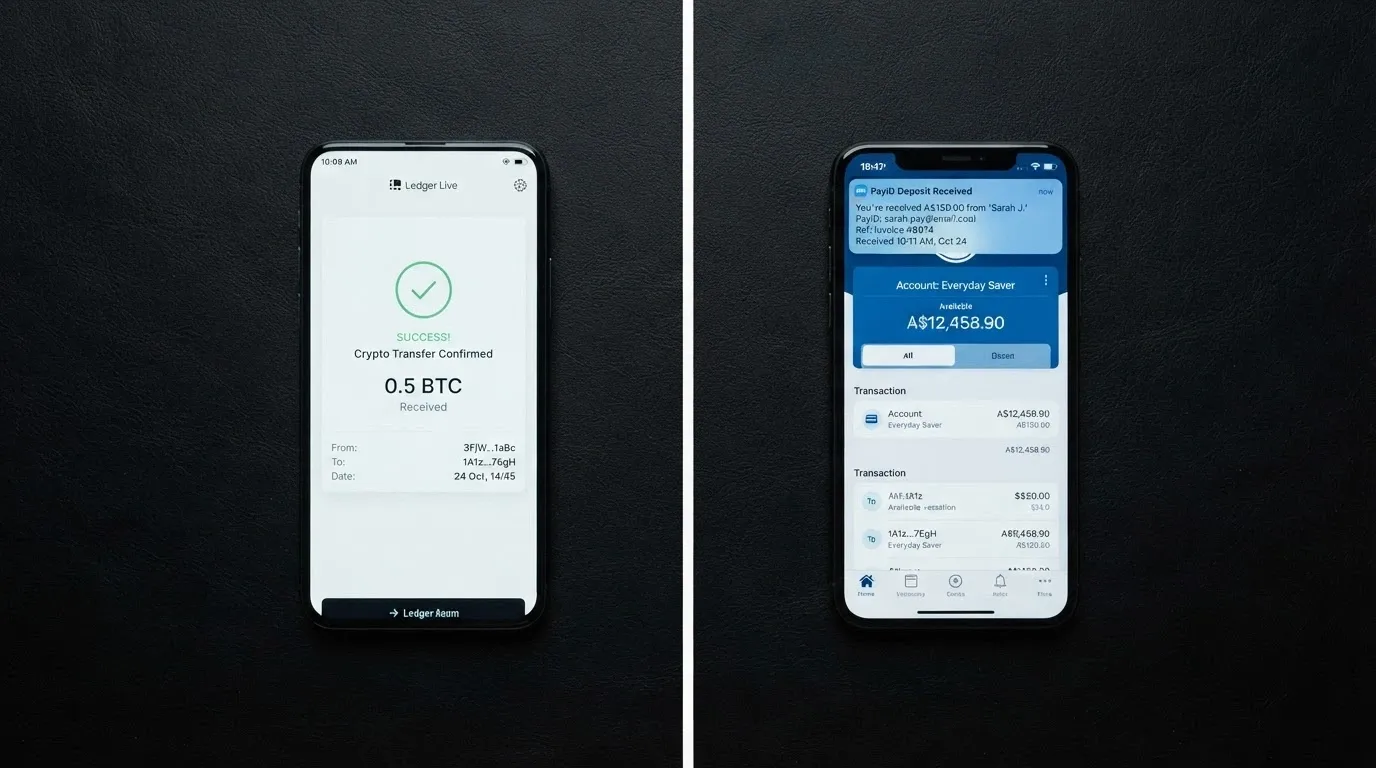
Bitcoin, Ether and USDT — Not All Crypto Withdrawals Are Equal
The coin the punter picks changes the clock. USDT on Tron (TRC-20) is the practical speed champion: one to three minutes for confirmation, network fees under A$2, and a confirmation profile that does not degrade under load. Bitcoin is the volatility and congestion case — the Bitcoin base layer is functional for settlement but its fee market can spike during busy windows, and the on-chain finality is slower than Tron by an order of magnitude. Ether sits in the middle on speed but has the most variable fee component of the three; gas prices have moved enough in past cycles to make an A$100 withdrawal cost A$30 in fees on a busy day.
The operator-specific processing time is what most punters actually feel. BitStarz processes crypto withdrawals in twelve to thirty minutes, Stake in one to two hours, Wild Fortune in three to four hours. Fair Go’s crypto pipeline is fifteen to forty-five minutes during business hours and two to four hours on weekends. None of these are the one-to-three-minute on-chain confirmation time, because the operator’s own approval step is the delay a punter is actually waiting through.
The Anonymity Trade-Off — What You Gain and What You Risk
Crypto casinos promise privacy. The promise is partly true: there is no card network logging the deposit, no bank statement line item, no name-on-the-transaction in the way a BSB-numbered transfer leaves. What the promise glosses over is what anonymity costs a punter when something goes wrong. A casino that asks for nothing also owes nothing under Australian consumer law, because Australian consumer law does not reach it. BetStop does not reach it. ACMA does not recover balances — the regulator can block the site, fine the operator and refer it for criminal enforcement, but it cannot put money back into a punter’s account. There are now 1,564 illegal gambling and affiliate websites blocked by Australian ISPs since November 2019, and the punter who held a balance on a blocked site took the loss.
The cleanest way to think about the trade-off: a casino that skips KYC is a casino that is also unreachable by any Australian complaint pathway. The punter gets privacy on the way in and zero recourse on the way out.
Your Phone Won’t Slow Down Your Cashout — Online and Mobile Withdrawals in 2026
The withdrawal process is identical across devices because it runs through the same back-end payment system. A punter requesting a PayID cashout on an iPhone triggers the same approval workflow as a punter requesting one on a desktop browser, and the network settlement does not care which screen the request came from. The mobile experience is a UX question, not a speed question.
A No-Deposit Bonus at a Fast-Withdrawal Casino Sounds Perfect — Until the Wagering Hits
The offer that needs no deposit is the offer that takes the longest to turn into withdrawable cash. AU-facing offshore casinos use the no-deposit bonus as a top-of-funnel draw, and the wagering requirements on those bonuses are set high enough that most players clear only a fraction of the bonus before the validity window closes. Royal Reels’ A$10 no-deposit bonus triggers after phone verification and carries an average wagering multiple of 31x across the site’s bonuses. Across the offshore market, no-deposit bonus wagering typically runs 40x to 60x, with maximum cashout caps of A$50 to A$200 for cash chips and A$20 to A$100 for free-spin winnings.

Wagering Requirements Are the Real Speed Bump
The turnover multiple — not the pending period — is what keeps bonus money locked for days or weeks. SkyCrown’s A$8,000 plus 400-free-spin welcome package is the largest figure on this page and it carries 40x wagering on both the bonus money and the free-spin winnings. RocketPlay’s 100% match up to A$200 plus 50 free spins is a more modest offer at 30x wagering on the bonus. Fair Go’s five-tier welcome package runs 100% up to A$200 on each of the first five deposits, totalling up to A$1,000, with 30x wagering on pokies — the fairest wagering terms on this page. Bizzo Casino’s 150% match up to A$750 carries 35x wagering. Rocket Casino tightened its terms as of September 2026 to 50x wagering on all deposits over A$100, with a A$5 max bet limit while the wagering is clearing.
The wagering is also where the max-bet-while-wagering rule trips players up. Most operators cap the bet size during the wagering period — SkyCrown, Royal Reels, Rocket Casino and most of the others impose some version of this — and a single spin above the cap can void the bonus and the winnings. The headline figure shrinks after the maths, and the maths include the wagering, the max-bet cap and the validity window together.
The A$8,000 SkyCrown welcome package at 40x wagering requires A$320,000 in turnover before any of it can be withdrawn. At A$1 a spin with five seconds between spins, clearing that turnover takes 320,000 spins — about 444 hours of continuous play, or roughly two months at eight hours a day. This is the time-to-clear figure the bonus’ “fast payout” tagline has to sit alongside. A punter who clears the bonus in two months of weekend sessions and then hits a withdrawal-cap of A$7,500 a week is looking at another six weeks before the full balance clears. The fast-payout casino, in other words, is fast on the rail and slow on the bonus.
Live Dealer or Pokies — Which Game Type Gets Your Money Out Faster?
The game genre does not change the cashout clock. The cashier does not differentiate between a Pragmatic Play live-dealer blackjack hand and a RealTime Gaming pokie spin. What does change is the path to a withdrawable balance. Live casino sessions tend to run at higher table stakes with fewer but larger withdrawals — a punter who plays A$50 a hand at a live blackjack table is looking at fewer transactions per session and a longer time between wins than a punter grinding A$0.20 spins on a pokie. Pokies generate more, smaller transactions per session and a shorter time between cashout attempts.
Live-versus-RNG, then, is a session-behaviour question, not a cashout-speed question. The processing time is identical because the payment rail is identical.
New Fast-Withdrawal Casinos in 2026 — Fresh Brand, Same Offshore Reality
A new casino promising fast payouts still operates under the same prohibition, and it has no track record to check. New operators have no payout history, no compliance pattern to verify, and no third-party tested times. The marketing claim of “instant withdrawal” on a brand launched this quarter is unprovable in the absence of audits or independent testing, and the offshore-status consequences — no ACMA recourse, no BetStop coverage, balance at risk if the site is blocked — apply the same way they apply to every other operator on this page.
The sensible test for a newly launched casino is the same as the test for any operator on this list: the licence, the payment methods, the KYC requirement, the withdrawal cap. The audited numbers come later, if they come at all.
The 10 Fastest Withdrawal Casinos Australians Actually Use in 2026
The ranking that follows ranks offshore casinos on tested payout performance, with the honest framing no other page provides. The fastest operator on this list is the operator whose processing time is shortest on top of the fastest rail, not the operator whose homepage makes the loudest speed claim. The bonus terms come second because a “fast withdrawal” casino with a 40x wagering trap is fast only on the rail.

| Casino | Licence Status | Welcome Bonus | Wagering | Fastest Payout Speed | Weekly Withdrawal Limit |
|---|---|---|---|---|---|
| Rocket Play | Offshore — no Australian licence | 100% match up to A$200 + 50 free spins | 30x | Under 3 hours (e-wallets) | EUR/USD 5,000 |
| SkyCrown | Offshore — no Australian licence | Up to A$8,000 + 400 free spins (4-tier) | 40x | 10 min pending, up to 24 hours | A$7,500 |
| Royal Reels | Offshore — no Australian licence | A$10 no-deposit bonus after phone verification | 31x avg | PayID tested 4 hr 12 min | A$10,000 |
| WinSpirit | Offshore — no Australian licence | — | — | A$10 minimum, no fees | — |
| Stake | Offshore — no Australian licence | — | — | Crypto 1–2 hours tested | — |
| Rainbet | Offshore — Anjouan licence ALSI-152406029-FI2 | — | — | Crypto typically minutes to hours | No maximum |
| FairGO | Offshore — no Australian licence | 100% up to A$200 × 5 deposits (total up to A$1,000) | 30x on pokies | Crypto 15–45 min business hours | A$5,000 (bonus winnings) |
| Scream Casino | Offshore — no Australian licence | — | — | — | — |
| Bizzo Casino | Offshore — no Australian licence | 150% up to A$750 | 35x | E-wallets under 1 hour | A$10,000 |
| Rocket Casino | Offshore — no Australian licence | — | 50x on deposits over A$100 | USDT TRC-20 tested ~6 hours | — |
Every operator on this list is offshore. The Interactive Gambling Act 2001 makes it an offence to provide an online casino to a person in Australia, and there is no Australian licence for any of these products. Rainbet carries a verifiable Anjouan licence, ALSI-152406029-FI2, issued on 14 June 2024 and checked against the Anjouan Gaming Authority register on 18 July 2026. None of the other nine operators carries a verifiable Australian licence because no such licence exists. Where the table shows an em dash, the operator’s specific figure — bonus amount, wagering multiple, payout speed, weekly cap — was not confirmable from public sources at review time.
Rocket Play
Rocket Play is the PayID-friendly all-rounder with the most manageable wagering hurdle on this page. The 100% match up to A$200 plus 50 free spins carries 30x wagering on the bonus amount, lower than SkyCrown’s 40x and Rocket Casino’s 50x, and the e-wallet payout clears in under three hours for tested transactions. The operator supports 34 payment methods including PayID and a crypto suite (BTC, ETH, LTC, DOGE, USDT), accepts Australian dollars from a minimum deposit of A$25, and caps withdrawals at EUR/USD 5,000 per week or EUR/USD 15,000 per month. The wagering is the reason to look at Rocket Play first: a bonus a punter can actually clear in a reasonable session budget, on a rail that does not ask for two months of weekend play.
SkyCrown
SkyCrown is the biggest welcome package on the list — and the wagering that comes with it. Up to A$8,000 plus 400 free spins across four deposits, with 40x wagering on both the bonus money and the free-spin winnings. The pending time averages ten minutes and stretches to twenty-four hours, with KYC mandatory before the first withdrawal. The withdrawal cap is A$7,500 per week or A$45,000 per month, USDT equivalent for the crypto side. The casino carries 40-plus game providers and roughly 5,400 pokies. The honest verdict is that SkyCrown’s welcome figure is the largest on the page, and its time-to-clear is the longest; the casino is worth considering for a high-roll session budget, not for a punter who wants to bank a bonus in a calendar month.
Royal Reels
Royal Reels is the A$10 no-deposit entry point with a tested 4-hour PayID cashout. The A$10 no-deposit bonus triggers after phone verification and the site’s bonuses carry an average wagering multiple of 31x. The PayID cashout tested at 4 hours 12 minutes on a weekday, well within the same-day tier and meaningfully faster than bank transfer. The weekly withdrawal cap is A$10,000 at the standard tier, A$20 minimum on PayID and A$10 on Neosurf, and the crypto route clears in under an hour. Royal Reels suits punters looking for a low-stakes entry point backed by tested, sub-five-hour PayID speeds and manageable wagering requirements.
WinSpirit
WinSpirit is the low-minimum option: A$10 withdrawals with no operator fees, PayID and crypto supported, Visa accepted. The trade-off is thin confirmed terms. The welcome bonus and wagering multiple were not verifiable at review time, and that absence is itself a signal at this end of the market. WinSpirit is the operator to consider for a small-balance cashout trial rather than a bonus-driven session; the rail is solid, the bonus side is not documented well enough to judge.
Stake
Stake is the crypto-native powerhouse. Fast blockchain payouts — tested between one and two hours for crypto withdrawals — and no PayID support at the cashier, because the product is built around crypto-native play rather than bonus acquisition. Stake does not advertise a welcome bonus in the same shape the other operators on this list do; the value proposition is the game catalogue and the crypto rail, not a matched-deposit headline. Stake is the right choice for a punter already operating in USDT or BTC who wants the speed ceiling, not the entry bonus.
Rainbet
Rainbet is the only operator on this list with a verifiable licence — from Anjouan, not Australia — and no maximum withdrawal cap. The Anjouan Gaming Authority licence (ALSI-152406029-FI2, B2C, issued 14 June 2024, expiring 13 June 2027) was checked against the official register on 18 July 2026. The casino is crypto-focused with PayID mentioned in some third-party reviews, the minimum deposit is A$15, and the game catalogue runs to 6,818 titles. The welcome bonus was not displayed for Australian players at review time. The verdict is structural rather than promotional: Rainbet is the operator with a paper trail, no withdrawal ceiling, and the same offshore reality as the rest of the list.
FairGO
FairGO is the RTG specialist with the fairest wagering terms on this page. The five-tier welcome package runs 100% up to A$200 on each of the first five deposits, totalling up to A$1,000 in bonus cash, with 30x wagering on pokies. Crypto withdrawals clear in fifteen to forty-five minutes during business hours and two to four hours on weekends. The weekly cap on bonus winnings is A$5,000 and the minimum withdrawal is A$100. The game library is RealTime Gaming — 280-plus titles, with more than 800 pokies in the broader catalogue. FairGO stands out for punters prioritizing transparent, achievable wagering terms over the inflated headline bonuses common elsewhere.
Scream Casino
Scream Casino is the least-documented operator in the set. Payout speed, bonus terms and licence details were not available at review time, and a lack of verifiable payout data is itself a signal when ranking by withdrawal speed. The marketing claim of fast withdrawals has nothing to anchor it; the audited times, the bonus terms and the licence register entry are absent. Scream Casino is the operator a punter ranks last on this list for the reason a punter would rank any operator last: unverified speed claims at an offshore site are not the same as tested payout times.
Bizzo Casino
Bizzo Casino is the e-wallet speed bet. The 150% match up to A$750 carries 35x wagering, the e-wallet cashout clears in under one hour, and the weekly withdrawal limit sits at A$10,000. The game library is 1,500-plus pokies from Pragmatic Play and Hacksaw Gaming, and the minimum withdrawal is A$20. Bizzo is the strategic choice for e-wallet users seeking a balanced bonus and reliable sub-hour cashouts.
Rocket Casino
Rocket Casino is the operator whose terms tightened in September 2026. The wagering is now 50x on all deposits over A$100, with a A$5 maximum bet while the wagering is clearing. The USDT TRC-20 cashout tested at approximately six hours — slower than Fair Go’s fifteen to forty-five minutes, but still inside the same-day tier. The minimum withdrawal is A$30. The welcome bonus was not confirmable at review time. Rocket Casino is the operator whose rail is still respectable but whose terms have moved against the punter in the last quarter, and a punter claiming a deposit over A$100 needs to know that the 50x wagering is what they are signing up to.
Every Fast-Withdrawal Casino Australians Use Is Offshore — Here’s What the Law Says
The Interactive Gambling Act 2001 prohibits the supply of online casino games, online pokies and in-play sports betting to a person in Australia. There is no licence to provide these services anywhere in the country. The 2017 amendments gave the Australian Communications and Media Authority the enforcement teeth that have produced 1,564 blocked sites since November 2019 and more than 225 services withdrawn from the Australian market since the law was strengthened. The 2026 reform passed Parliament on 19 August 2026 and its measures commence on 1 January 2027, including the authority for banks and payment providers to block transactions to illegal operators.

The Interactive Gambling Act 2001 — What It Bans and What It Doesn’t
The Interactive Gambling Act 2001 prohibits online casino games, online pokies and in-play sports betting. Permitted and licensable services are wagering on races and sporting events placed before the event begins, lotteries and keno, through operators licensed by an Australian state or territory. Licensing for online bookmakers concentrates in the Northern Territory through the Northern Territory Racing and Wagering Commission and Licensing NT, the de facto national wagering licensor. Land-based casinos exist and are state-licensed — Crown, The Star and the like — but those licences do not extend to an online casino product.
The 2017 amendments to the IGA closed the loopholes that had let offshore operators reach Australian customers through locally licensed front-ends, and gave ACMA the formal power to direct ISPs to block illegal sites. The 2026 reform expands the regime further: it prohibits foreign-matched lotteries and online keno, narrows the trade-promotion exclusion that had allowed some inducements to slip through, and introduces the AdStop register as a national wagering advertising opt-out. None of this legalises online casino. The product is prohibited, the prohibition is enforced, and the 2027 measures add banking-level enforcement on top.
ACMA Blocks, Fines and Site Takedowns — What They Mean for Your Balance
ACMA can direct Australian ISPs to block illegal gambling and affiliate websites. The regulator has had 1,564 such sites blocked since November 2019, as at March 2026. More than 225 illegal services have withdrawn from the Australian market since 2017 rather than face enforcement. ACMA can issue formal warnings, pursue civil penalty proceedings and refer operators for criminal enforcement. What ACMA cannot do is recover a punter’s balance. The regulator’s powers run against the operator, not against the funds a punter has deposited.
The 2027 measure that changes the dynamic is the banking-level authority. From 1 January 2027, banks and payment providers gain the express power to block transactions to illegal gambling operators. A punter using PayID or BPAY or a debit card to fund an offshore casino may find the transaction declined at the bank level rather than at the cashier level. Crypto transactions sit outside this regime, which is one reason the offshore crypto rails remain in use even as the fiat rails tighten.
Licensed vs Offshore — the Protections Australian Players Lose
A licensed Australian wagering service must provide a set of consumer protections that an offshore casino does not. BetStop — the National Self-Exclusion Register — covers every Australian-licensed wagering service and zero of the casinos on this page; 59,830 people had registered as of Q3 FY 2025–2026, with 37,247 active exclusions at 31 March 2026, and none of those exclusions bind an offshore operator. Australian consumer law recourse is unavailable against an offshore operator because the operator sits outside Australian jurisdiction. The credit card and crypto payment ban — in force since 11 June 2024, with operator penalties up to A$247,500 — applies to Australian-licensed wagering only; the offshore casinos that accept credit cards and crypto are not subject to it.
The cleanest way to think about the gap is that the licensed-Australian system is a closed loop with consumer protection at every step — dispute resolution, responsible-gambling tools, payment-method regulation, advertising rules — and the offshore system is an open loop with none of those steps. The product is illegal at the supply side, the punter is not prosecuted at the demand side, and the only thing protecting the punter’s balance is the operator’s own commercial interest in paying out.
Playing Offshore Doesn’t Mean Playing Without a Safety Net
The tools and services Australian players can still access, even when the casino itself sits outside the regulatory perimeter, are real and worth naming. The closed loop is broken; the harm-reduction infrastructure around the punter is not.
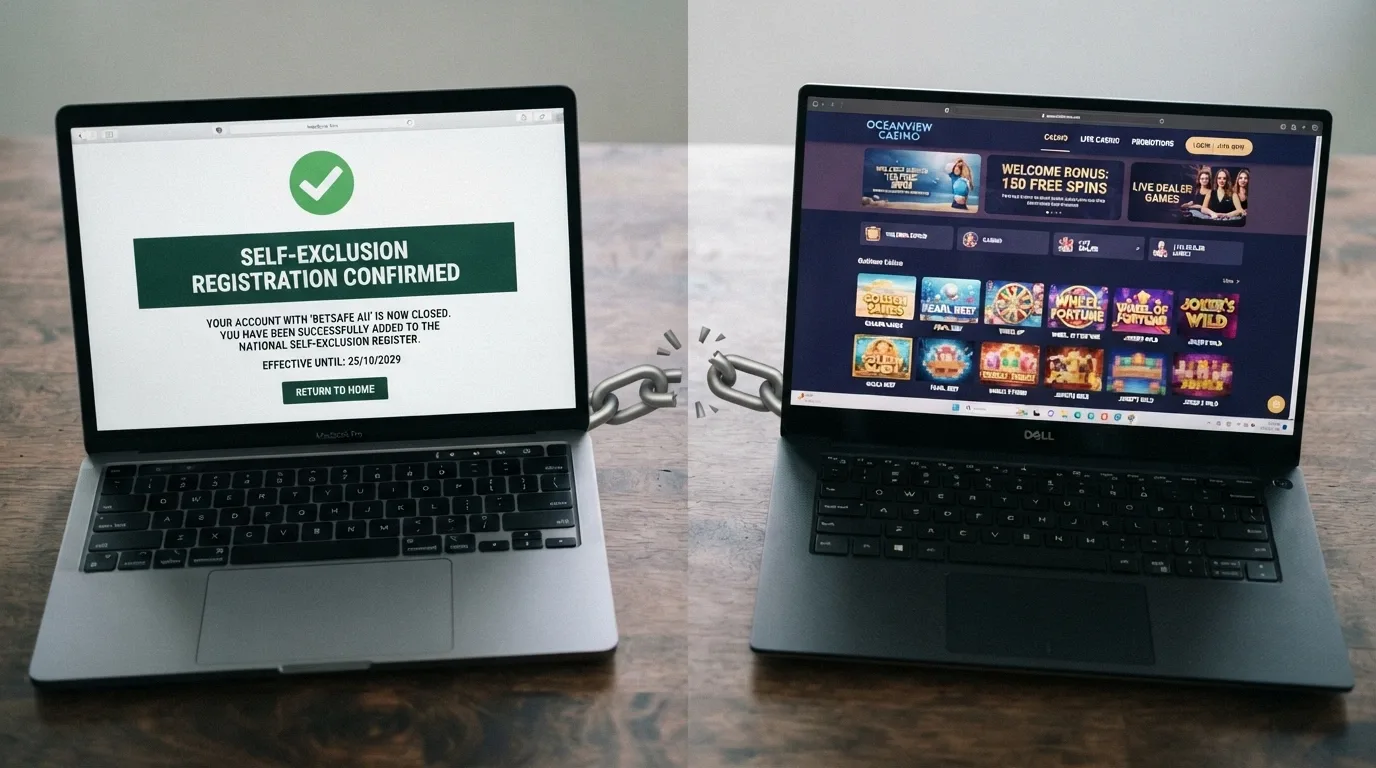
BetStop Won’t Reach These Sites — Your Actual Safety Options
BetStop is the National Self-Exclusion Register, live since August 2023, administered by ACMA. One registration excludes a person from every Australian-licensed online and phone wagering service. The minimum exclusion period is three months; the maximum is lifetime. The register covers Australian-licensed wagering operators and does not reach the offshore casinos on this page. A punter who has self-excluded through BetStop has done the right thing for the licensed end of the market and nothing at all for the offshore end.
The tools that do reach the offshore end are operator-level: deposit limits set at the cashier, take-a-break periods configured through the responsible-gambling page of the individual casino, activity statements that show session history. These tools are real and most operators on this page implement them, but they are tools the punter has to activate and monitor themselves. They are not the closed-loop protection BetStop provides on the licensed side.
The two harm-reduction services that work regardless of where a punter plays are the National Gambling Helpline (1800 858 858, free, confidential, 24 hours a day, 7 days a week) and Gambling Help Online at gamblinghelponline.org.au, which provides 24/7 online chat with counsellors and self-help tools. The helpline is the same number across the country and is the right first call for any punter who feels their play has moved past what they intended. As of March 2026, 15.1 per cent of Australian adults — an estimated 3.32 million people — experience some level of gambling harm from their own or others’ gambling behaviours, and risky gambling among Australian adults increased from 13.7 per cent in 2024 to 19.4 per cent in January 2025, almost doubling since the COVID-19 lockdowns. The modelled national estimate puts roughly 3.29 million Australians aged 5 and over affected annually, including 1.97 million adults with at-risk or problem gambling. The numbers are large because the harm is real and is not contained by the offshore-or-licensed boundary.
How We Evaluated These Fast-Withdrawal Casinos
The rankings on this page are based on four inputs in this order: tested payout speed, withdrawal limits, bonus-term fairness, and payment-method range. Tested payout speed came from affiliate testing published across Payoutverdict.com, Pokiesaustralia.com, Gamblinginsider.com, Casinoaudit.net, tech-insider.org, australiangamblers.com, playcasino.com, flaxenbd.com, casipto.com, Watchmynumbers.com and clearcasinos.com. Where two sources disagreed on a tested speed, the range is what this page reports. Where a source claimed a speed without a tested figure behind it, the claim has been treated as marketing and the operator has been moved down the ranking.
The licence check ran the Anjouan Gaming Authority register for Rainbet (ALSI-152406029-FI2, issued 14 June 2024, verified 18 July 2026). For the rest of the operators, the licence check is the negative finding: no entry on any register that authorises online casino supply to Australian residents, because no such register exists. The ACMA register of blocked services was checked against the operator names on the ranking, and the IGA 2001 prohibition is the baseline honesty check that no competitor page performs.
What this evaluation is not is a recommendation that any operator on this list is legal, safe, or endorsed for play. The honest scope is that these are offshore casinos ranked on payout performance, with the offshore reality named in every operator write-up. The ranking is useful for the question it answers — which operator pays out fastest on what terms — and it is silent on the question it cannot answer, because no offshore answer exists, which is whether the balance will still be there tomorrow.
What You Should Actually Do About Fast Withdrawals — Your Three-Move Shortcut
Pick your method before your casino. The fastest rails — USDT TRC-20 and PayID — set the speed floor that no operator on this page can undercut. USDT TRC-20 settles in one to three minutes on chain with fees under A$2; PayID clears in under sixty seconds once the casino has approved the withdrawal; everything else is slower, with cards at one to three business days and bank transfers at three to five. The operator comparison only matters once the rail is chosen.
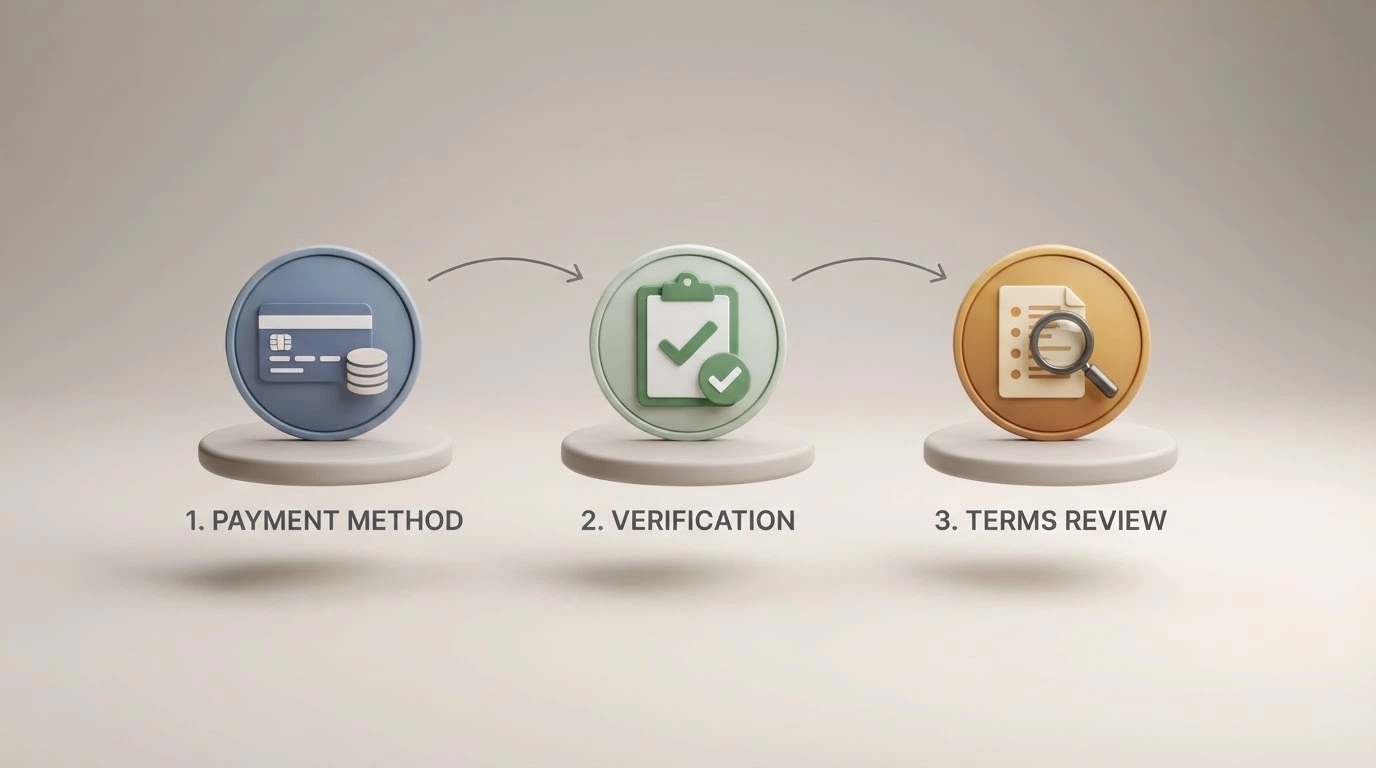
Complete KYC before you play, not after you win. SkyCrown is explicit that KYC is mandatory before the first withdrawal; the same is true in practice across the rest of the operators on this list, even where the marketing dodges the point. A punter who pre-subplies ID, proof of address and a selfie at signup moves the verification step into the wagering window. The punter who waits watches the pending window stretch from ten minutes to twenty-four hours while compliance asks for a utility bill.
Read the wagering before the headline bonus figure. A$8,000 at 40x wagering is roughly A$320,000 in turnover before any of it can be withdrawn. A$200 at 30x is A$6,000. A$100 at 50x is A$5,000. The welcome figure is the marketing word; the turnover is the cost. The bonus terms also include the max-bet-while-wagering rule and the validity window, both of which can void a bonus on a single spin above the cap.
Then accept the part that does not move. Every operator on this page is offshore, and none of them is reachable through BetStop, ACMA complaint recovery or Australian consumer law. From 1 January 2027 banks will be able to block transactions to illegal operators, which tightens the fiat rails further without changing the crypto rails. The tools a punter does have are the deposit limits at the cashier, the activity statement, the National Gambling Helpline at 1800 858 858 and Gambling Help Online at gamblinghelponline.org.au. The fast-withdrawal decision is a decision about which rail, which verification timing and which bonus terms — and a decision to play at an offshore site at all, with the understanding that the protection a punter expects at home does not travel.
Frequently Asked Questions About Fast-Withdrawal Casinos in Australia
What is the fastest withdrawal method at Australian online casinos?
USDT on the Tron network (TRC-20) is the fastest, with on-chain confirmation in one to three minutes and network fees under A$2. PayID is the fastest Australian-native rail, settling in under sixty seconds once the casino approves the withdrawal, though the casino’s processing time can stretch the total to several hours. E-wallets clear within twenty-four hours; cards take one to three business days; bank transfers take three to five.
Are fast withdrawal casinos in Australia legal and licensed?
Online casino is prohibited under the Interactive Gambling Act 2001, and there is no Australian licence for online casino, online pokies or in-play betting. Every fast-withdrawal casino that accepts Australian players is an offshore operator offering a prohibited product. Rainbet holds an Anjouan licence (ALSI-152406029-FI2) verified on the official register; no operator on this list holds an Australian casino licence because no such licence exists.
What causes delays when withdrawing from an online casino in Australia?
The casino’s pending window, the KYC check at first withdrawal, and the withdrawal cap. Pending time at SkyCrown averages ten minutes and stretches to twenty-four hours; KYC is mandatory at the first withdrawal at most operators; weekly caps sit between A$5,000 and A$10,000 at the operators that publish them. The payment method sets the speed floor once the casino has approved the transfer.
Can I withdraw no-deposit bonus winnings instantly at an Australian casino?
No. No-deposit bonus wagering typically runs 40x to 60x across the offshore market, with maximum cashout caps of A$50 to A$200 for cash chips and A$20 to A$100 for free-spin winnings. Royal Reels’ A$10 no-deposit bonus carries an average 31x wagering across its bonuses. Even after the wagering is cleared, the withdrawal is still subject to the casino’s pending window and the operator’s withdrawal cap.
What is the difference between “instant payout” and “fast payout” at online casinos?
Instant is a marketing term implying a withdrawal that completes in minutes; in practice it means the casino’s processing time sits on top of the rail’s settlement time. Fast is the working industry definition of under twenty-four hours, with the best sites pushing crypto and PayID into the under-one-hour tier. Neither term means the withdrawal is automatic from button-press to bank balance, because KYC at first withdrawal and the operator’s pending window apply to both.
Do fast withdrawal casinos in Australia charge fees for cashing out?
It depends on the method. PayID through an Australian bank is typically free at the network level. Crypto on Tron (USDT TRC-20) costs under A$2 per transaction in network fees. Cards can carry operator fees of up to four per cent, and bank transfers can carry fees of up to five per cent. WinSpirit publishes no fees on a A$10 minimum withdrawal. Other operators absorb fees at some tiers and pass them through at others, so the published terms are what to check before requesting a withdrawal.
No-Verification Withdrawals — Are They Real at AU Casinos?
“Fast withdrawal casino no verification” is a search-term magnet in this market, and the honest answer is: not at the operators worth playing at. Most legitimate offshore casinos trigger KYC at the first withdrawal or above a threshold, and that is the trade-off — verification costs time, but skipping it means handing your deposits and your winnings to a counterparty that asks for nothing in return for nothing. The “no verification” pitch is most often a marketing word that quietly moves to KYC at withdrawal anyway, or it is a genuine red flag for an unlicensed operator with no compunction about holding funds.
The privacy-versus-speed trade-off is the more useful framing. A punter who pre-subplies KYC documents on signup — ID, proof of address, a selfie — gets the verification out of the way while the wagering is happening. By the time the bonus is cleared and the withdrawal is requested, the casino’s compliance team has nothing to do and the cashout moves. The punter who waits is the one who watches the pending window stretch from ten minutes to twenty-four hours while a compliance team asks for a utility bill.
Crypto vs PayID — Which One Lands in Your Wallet First?
Network-to-network, the answer is USDT TRC-20 by a small margin — one to three minutes for on-chain confirmation against under sixty seconds for PayID once the casino has approved the withdrawal. The margin disappears once the casino’s own processing time sits on top. The fastest PayID cashout in Q2 2026 testing cleared in under ten minutes from button-press to bank balance; the slowest took just over eleven hours. Crypto operator times cluster in a wider range: BitStarz at twelve to thirty minutes, Stake at one to two hours, Wild Fortune at three to four hours. The takeaway is not that crypto beats PayID — it is that the casino’s processing time dominates both rails, and the difference between one to three minutes and under sixty seconds is irrelevant once a payments team decides to wait eighteen hours.
Fees tilt the comparison the other way. USDT TRC-20 charges under A$2 per transaction at current network rates; PayID through an Australian bank is free at the network level, with operator fees typically absorbed by the casino. Withdrawal limits tilt it back again: PayID daily caps at A$2,000 to A$10,000 across the major operators, while crypto limits depend on the operator’s own ceiling and the on-chain confirmation depth.
Online Pokies With Fast Payouts — Does the Game Affect the Cashout?
The pokie a punter plays has zero bearing on withdrawal speed. RTP and volatility shape session outcome — how long a bankroll lasts, how often a feature triggers, how big a win lands — but the cashier does not see the difference between a Pragmatic Play pokie, a Hacksaw Gaming pokie and a RealTime Gaming pokie. What does shape the path to a withdrawable balance is the wagering requirement the bonus carries and the minimum withdrawal threshold the casino sets. Fair Go’s minimum withdrawal is A$100; Rocket Casino’s is A$30; WinSpirit’s is A$10. A punter who has won A$80 at Fair Go has not yet reached the threshold to withdraw, regardless of how the cashout rails perform.
Game speed, in other words, is a session-length variable. Cashout speed is a payment-rail variable. They never meet.