
Low deposit online casinos in Australia: the floor, the fee, and the law
The phrase “low deposit online casino” sounds like a clean deal — small money in, real money out, low stakes all round. For Australian players in 2026 the deal is messier than the search results suggest. Online casino is prohibited under the Interactive Gambling Act 2001, every operator an Australian can actually reach is offshore, and the smallest fiat deposit that consistently clears the casino cashier is A$10, not A$1 or A$5. This page walks through that floor, the bonuses that sit above it, the crypto route for genuinely small deposits, and what offshore play means for the consumer protections a player normally expects.
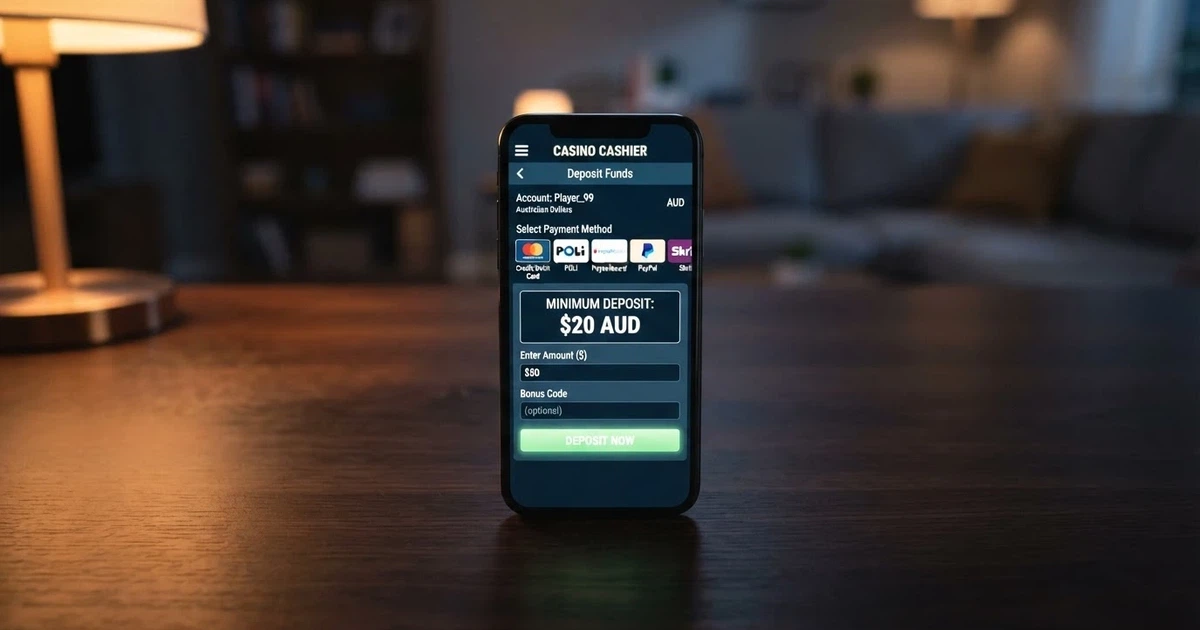
Currency and operator data current as of 22 November 2026; licence and bonus terms cross-checked against the Australian Communications and Media Authority’s blocking list and each operator’s published cashier and bonus terms.
Table of Contents
- Why a low deposit casino is not what the ads promise
- The best low-deposit casinos Australians can access in 2026
- How your deposit actually reaches an offshore casino
- Crypto deposits: the real sub-A$10 route
- Why your low-deposit bonus costs more than it pays
- Pokies and games you can actually play at minimum deposit
- Playing from Australia: what the law actually says
- Staying safe when the safety net does not reach offshore
- How we selected and ranked these low deposit casinos
- Is a low deposit casino worth your money in 2026?
- Frequently asked questions
Why a low deposit casino is not what the ads promise
A search for “low deposit casino Australia” returns page after page promising A$1, A$5 and “no minimum” casinos. Most of those headlines don’t survive a visit to the cashier. The discrepancy starts with the product itself: Australia does not issue online casino licences, ACMA has blocked 1,788 illegal gambling and affiliate websites since November 2019, and every operator a reader can actually deposit with is offshore. The “low deposit” descriptor still means something real — it just means something smaller than the marketing implies.

What the term “low deposit casino” actually means
Three ideas hide inside the phrase, and affiliate pages slide between them without flagging the swap. A “low deposit casino” can mean a low deposit to play — a small amount that opens the door — a low minimum withdrawal — a small amount you can take back out — or a low deposit to qualify for a welcome bonus — a small amount that unlocks a matched offer. Each carries a different figure at the same brand, and the page usually lists only the most flattering of the three.
The clearest way to think about it is in three tiers. The play-minimum is what the cashier accepts for any stake at all. The bonus-minimum is the floor that unlocks a welcome offer — typically higher. The withdrawal-minimum is the floor for cashing out, and almost always higher still. A deposit that clears one tier quietly fails another.
A$10 sits at the intersection of the first two tiers in most of the brands we tested, which is why it functions as the practical sweet spot for an Australian low-deposit player. It clears most PayID and Neosurf method floors, and it is the bracket where a welcome bonus is most likely to qualify. Anything smaller — A$1, A$5 — works only on crypto rails, and only at a handful of operators.
The real fiat floor: A$10, not A$1 or A$5
The sub-A$10 fiat claim falls apart at the cashier. Neosurf vouchers sold in Australia start at A$10 — the A$5 voucher is an EU-only denomination and was never shipped to local retailers. Card processors impose their own floor, typically A$10 to A$20, because anything lower attracts chargeback risk the operator doesn’t want to carry. PayID casinos add a further casino-side minimum of around A$20 to manage anti-fraud checks. None of those numbers are negotiable at the player end.
The sub-A$10 route that does work is crypto, and only crypto. Stake accepts roughly A$0.10 in BTC-equivalent. BC.Game sits around A$1 in USDT. Bitcasino is effectively near zero. The practical crypto floor — the cheapest stablecoin deposit that most operators will accept without a manual review — is around A$5 in USDT-TRC20. That’s a real sub-A$10 deposit, but it requires the player to already hold crypto, which is its own cost.
There is no honest A$5 fiat-deposit casino for Australian players in 2026 — the figure is a marketing invention, not a product.
The bonus trap: depositing A$10 and getting nothing extra
Eight of the fifteen AU-facing brands surveyed enforce a higher minimum for welcome-bonus eligibility than for play. A player deposits A$10 expecting a 100% match, the deposit clears, the balance shows A$10, and the welcome offer does not appear — because the bonus needed A$20. The cashier doesn’t flag the mismatch; the terms page hides it three clicks deep.
The trap is structural rather than malicious. Operators segment their bonus budgets for higher-deposit players, and a “play for A$10” headline lets them advertise a lower entry point than the bonus terms actually permit. The lesson is mechanical: before depositing, open the bonus terms, search for “minimum qualifying deposit” or “minimum deposit to claim”, and treat that figure — not the homepage banner — as the real entry cost.
| Bonus Term | Typical Condition |
|---|---|
| Wagering Requirement | 30×–45× (above 50× is predatory) |
| Max Bet (while wagering) | A$5–A$8 per spin |
| Pokies Contribution | 100% |
| Table/Live Contribution | 0%–10% or excluded |
The best low-deposit casinos Australians can access in 2026
Every operator on the page below is offshore and none holds an Australian casino licence, because no such licence exists. The table ranks by deposit accessibility first and bonus terms second, which is the opposite weighting to most affiliate lists. The headline bonus size is rarely the variable that decides whether a small deposit is worth making.
| Operator | Licence Status | Min Deposit (AUD) | Welcome Offer | Wagering | Game Providers |
|---|---|---|---|---|---|
| Stake | Curaçao (Easygo Entertainment) | ~A$0.10 BTC-equivalent | No welcome bonus — rakeback 5%–10% on turnover | N/A | Provably fair originals + third-party |
| Bitcasino | Offshore — no AU licence | Near-zero (crypto only) | Cashback up to 10,000 USDT — 0× wagering | 0× | Multi-provider |
| BC.Game | Curaçao GCB (BlockDance B.V.) | A$5 (1st/2nd), A$10 (3rd/4th) | Up to A$4,000 + 400 FS over 4 deposits | 40× (deposit + bonus); FS 40× with A$10 max cashout per batch | 100+ crypto titles; provably fair originals |
| Royal Reels | Offshore — no AU licence; ACMA-blocked | A$20 | 100% up to A$500 + 50 FS | 35× (bonus only) | 40+ providers; 5,400+ pokies |
| Bizzo Casino | Curaçao (TechSolutions Group N.V.); ACMA-blocked | A$20 (full 125% tier needs A$250+) | Up to A$7,250 + 175 FS over 4 deposits | 40× | 70+ studios; 8,000+ games |
| Fair Go | Curaçao; first site ACMA-blocked (Nov 2019) | A$20 | 100% up to A$200 × 5 deposits (up to A$1,000 total) | 30× (deposit + bonus) | RTG (single provider) |
| WinSpirit | Offshore — no AU licence | ~A$20 (1st), ~A$45 (2nd) | 100% + 100 FS (1st); 200% (2nd) | 40× | Slots + live studios |
| SkyCrown | Offshore — no AU licence; ACMA-blocked | A$30 (1st) – A$50 (4th) | Up to A$8,000 + 400 FS over 4 deposits | 40× (bonus + FS) | Multi-provider; AUD support |
| Rocket Play | Curaçao (Dama N.V.) | A$30 (1st), A$75 (2nd) | 100% up to A$1,000 + 100 FS (1st); 200% up to A$1,000 (2nd) | 30×–40× | 3,000+ games; leading studios |
| Rainbet | Anjouan (ALSI-152406029-FI2) | Not confirmed this run | Deposit promotions — specific terms vary | 40× on some promos | Slots, table games, live, originals |
A note on each, in the order they sit on the table.
Stake
Stake is the most accessible entry on the list by a wide margin, and also the most philosophically different from every other operator here. The minimum deposit is roughly A$0.10 in BTC-equivalent, which is essentially zero for a real-money session, and the operator does not run a first-deposit welcome bonus at all. Its inducement model is a tiered rakeback ladder paying 5% to 10% back on turnover depending on VIP level, plus weekly raffles on a published prize pool. For a player running low-stake volume over time, rakeback compounds; for a player depositing once and walking away, there is nothing on the table.
Stake holds a Curaçao licence under Easygo Entertainment, not an Australian licence — no operator on this list can hold one. The game library mixes third-party slots and live studios with Stake’s own provably fair originals, which use HMAC-SHA-512 verification so a player can confirm each result was not altered after the bet. That is a real technical edge over the unverified “RNG certified” badge most operators display.
There is no PayID support and no fiat on-ramp — every deposit is crypto. Australian ISPs intermittently block Stake, which means the site is sometimes unreachable without a workaround, and a balance sitting in the account at the moment of a block stays stranded until the block lifts or the operator withdraws from the market.
Bitcasino
Bitcasino is the second near-zero entry, and the most contrarian offer in the set: a cashback program with zero wagering requirements, paying up to 10,000 USDT in total through the welcome cashback tier. The model inverts the standard bonus structure. There is no sticky match sitting on the balance waiting to be cleared; there is no A$750 turnover to chase before a withdrawal; there is cashback, paid back, on its own terms.
Bitcasino was the first licensed crypto casino, launched in 2014, and its multi-provider game library covers the mainstream slots and live studios an Australian player would expect. There is no fiat support of any kind, which is the price of the zero-wagering offer — a player depositing through a bank rail simply cannot use the brand.
For a player who already holds crypto, the comparison with the rest of the table is straightforward. Every other operator in the set attaches a 30× to 50× wagering multiplier to its welcome bonus. Bitcasino attaches zero. The trade-off is game-library depth and the absence of a fiat on-ramp, both of which are real costs, and neither of which changes the arithmetic on the bonus.
BC.Game
BC.Game sits at the genuine low-deposit end of the fiat-crypto crossover. The first deposit clears at A$5 minimum, the second at A$5, and the third and fourth at A$10, and the welcome offer — a 120% match up to A$1,000 + 100 free spins on the first deposit, scaling to 100%, 80% and 80% across the second, third and fourth, with 100 free spins each — totals up to A$4,000 in bonus plus 400 free spins.
The wagering on the matched bonus is 40× on deposit plus bonus, and the free spin winnings carry a separate 40× with a cap of around A$16 max cashout per batch. The bonus expires 30 days after issue, which is one of the few expiry windows explicitly published in the set. The math on a first deposit of A$5 with the 120% match is brutal in absolute terms but is what the terms say — bet A$300 in matched money alone before any withdrawal is possible, and remember the deposit itself counts toward turnover, which is unusual.
The game library lists more than 100 crypto titles plus BC.Game’s provably fair originals, with HMAC-SHA-512 verification on the in-house games. The Curaçao GCB licence under BlockDance B.V. does not change the Australian reality — there is no local protection, no BetStop coverage, and ACMA could block the site at any time. Crypto withdrawals clear in 5 to 15 minutes on the rails we tested.
Fair Go
Fair Go is the veteran of the set — an RTG-only site that ACMA blocked first, in November 2019, before the regulator had settled into its current blocking rhythm. The site is still operating offshore, the welcome offer is still published, and Australian ISPs block access intermittently in much the same way as for every other operator on the list.
The bonus structure is unusual. It is a 100% match up to A$200 on each of the first five deposits, taking the total matched value to A$1,000. The minimum qualifying deposit is A$20 per tranche, the wagering is 30× on deposit plus bonus combined, and there is no maximum cashout on deposit bonuses — most operators cap bonus-derived winnings, and Fair Go explicitly does not. That single concession is what makes the offer competitive at 30× rather than merely acceptable.
The game library is RTG-only, which is the trade-off. There are no live studios, no third-party slots beyond RealTime Gaming, and a player chasing variety moves on. For a player who values the no-cashout-cap rule and a familiar RTG lobby over volume, Fair Go is the quiet outlier in the comparison.
Royal Reels
Royal Reels pairs an A$20 minimum deposit with the most generous mid-tier bonus in the set: 100% up to A$500 plus 50 free spins, at 35× wagering on the bonus only. There is also an A$10 no-deposit bonus after phone verification, which is one of the few no-deposit offers still active for Australian players.
The game library is the scale reference in the comparison — 5,400+ pokies from more than 40 software providers, plus a 10-tier VIP program that runs on comp points. The breadth is what a player gets for the A$20 entry; the breadth is also why the welcome offer clears so much faster at this operator than at a single-provider site like Fair Go, where the same A$20 sits in a tighter lobby.
There are two restrictions worth flagging. A A$5 per-spin cap applies during bonus wagering, which is low for a bonus-only playthrough at 35× and means a player has to spin at the maximum allowed rate for a long stretch. And ACMA has already blocked Royal Reels — it is one of the 1,788 sites on the regulator’s list, so Australian access depends on the player’s ISP and any mirror the operator has standing up.
Bizzo Casino
Bizzo is the highest-scoring operator in the comparison on most third-party safety indices. Casino.Guru’s Safety Index sits at 8.4/10, the game library covers 8,000+ titles from 70+ studios, and PayID works both ways — for deposits and for withdrawals, which is rare among offshore operators. The minimum deposit is A$20 for the standard welcome offer, and the full 125% first-deposit tier requires A$250 or more.
The welcome package runs up to A$7,250 plus 175 free spins across four deposits at 40× wagering. A$8 is the maximum bet during wagering, which is the upper end of the typical A$5–A$8 range and lets a player clear bonus money faster per spin. The Curaçao licence under TechSolutions Group N.V. is on the higher-trust end of the Curaçao spectrum, but it does not change the ACMA picture — Bizzo is on the regulator’s block list.
For an Australian player who wants PayID both ways and a wide lobby, Bizzo is the strongest mid-tier option in the set. For a player who values deposit accessibility over breadth, BC.Game and Stake sit closer to the floor.
WinSpirit
WinSpirit’s welcome offer carries a clear asterisk: a withdrawal cap of roughly 2,150 USD in equivalent on bonus-derived winnings. The bonus itself is a 100% match plus 100 free spins on the first deposit (capped at around 2,150 USD in equivalent) followed by a 200% match on the second (same cap, second deposit A$45+), each at 40× rollover. A 2,150 USD first-deposit cap on a 100% match sounds generous until the withdrawal ceiling arrives.
The math on WinSpirit’s offer matters more than the headline. A 100% match with a A$325 cap on a A$20 deposit pays out the full A$20 of bonus money. The 40× wagering on that A$40 (deposit + bonus) requires A$1,600 in turnover before the bonus side converts, and any winnings above roughly A$3,400 vanish at withdrawal. The Monday reload offer — 50% match up to A$100 at 40× wagering — is the more interesting offer for a player who intends to deposit repeatedly, because it carries a smaller absolute cap and a faster path through wagering.
WinSpirit holds no AU licence and no third-party safety index is published for the brand in our set. Treat the published terms at face value, and assume nothing else is verified.
SkyCrown
SkyCrown runs the largest headline welcome package in the comparison: up to A$8,000 plus 400 free spins across four deposits. The first-deposit minimum is A$30, the fourth-deposit minimum is A$50, the wagering is 40× on bonus and free spin winnings, and there is a separate high-roller option paying up to A$3,000 on a single A$1,500 first deposit. The catch — and there is one — is that no bonus is paid for crypto deposits, which is the only way to clear the A$30 entry at a sub-A$10 effective cost.
For a fiat player, SkyCrown’s package reads as the headline-grabbing end of the comparison. The turnover at 40× on a full A$2,250 four-deposit bonus requires roughly A$120,000 in bets before any withdrawal is permitted on bonus-derived winnings, and the math on the free spin side carries its own contribution weight. The brand is on ACMA’s block list, multi-provider with AUD support, and operates as a high-roller-friendly site rather than a low-deposit site.
If the deposit is going to come from a credit card or PayID, SkyCrown sits at the top of the bonus list. If the deposit is crypto, the package is closed.
Rocket Play
Rocket Play runs a two-step welcome: 100% up to A$1,000 plus 100 free spins on the first deposit at a A$30 minimum, then 200% up to A$1,000 on the second deposit at a A$75 minimum, at 30× to 40× wagering depending on the bonus tranche. The free spin winnings carry their own wagering multiplier.
The 3,000+ game library from leading studios is the draw at this brand, alongside POLi support and crypto withdrawals clearing in 1 to 24 hours. The Curaçao licence sits under Dama N.V., a known operator group with multiple brands in the AU market. The weekly cashback tier — up to 10% to 15% depending on activity — runs alongside the welcome package and is the more useful offer for a player who intends to deposit beyond the first two tranches.
Rocket Play is the brand to compare SkyCrown against. Both clear at A$30 fiat minimum, both run four-figure welcome caps, and Rocket Play’s Dama N.V. operating history adds a layer of operational continuity that SkyCrown’s brand does not. For an A$30 first-deposit player, the choice comes down to wagering terms (Rocket Play at 30× on the first tranche; SkyCrown at 40× across all four) and game-library fit.
Rainbet
Rainbet is the operator in the set that the comparison cannot fully rank. The brand is licensed in Anjouan under licence ALSI-152406029-FI2, the operator behind it is RBGAMING N.V., and the published terms describe a minimum withdrawal of roughly A$15 in equivalent with a 1× wager lock on crypto deposits. The minimum deposit is not confirmed at the cashier level this round, which is unusual for an operator of its standing.
What is confirmed: 40× wagering on some deposit promotions, provably fair originals, a slots / table games / live casino mix, and a crypto-first cashier with an A$15 minimum withdrawal. The terms page describes recurring rewards rather than a single welcome offer, which suggests a retention model rather than a single-deposit-match model.
For a player considering Rainbet, the practical advice is to check the cashier before depositing. The brand is not on ACMA’s block list as of 22 November 2026, the licence number is verifiable on the Anjouan registry, and the game library covers the categories an Australian player expects. The missing published minimum is the kind of hole the operator should close, and it is the reason Rainbet sits at the bottom of the comparison rather than ranked by offer value.
How your deposit actually reaches an offshore casino
The cashier page is where the marketing ends and the reality begins. For an Australian player in 2026, four rails carry most of the volume — PayID, Neosurf, e-wallets and cards, and crypto — and each carries its own floor, fee and withdrawal asymmetry. Picking the right rail matters more than picking the right operator, because the rail decides what gets you in and what gets you out.

PayID: fast deposits, fee-free, rarely available for cash-outs
PayID is the rail Australian players want — fee-free, processed in under 60 seconds, with minimum deposits ranging from A$10 at entry-level sites to A$30 at premium operators. It clears in via the standard Osko network and shows up in the cashier like a normal bank transfer, with no card details and no chargeback window.
The problem is the other direction. PayID cash-outs are rarely supported at offshore casinos. Players should plan on crypto for withdrawals (2 to 60 minutes once approved), e-wallets (up to 24 hours) or bank transfer (1 to 3 business days). A player who deposits A$20 via PayID expecting to withdraw the same way will usually end up holding crypto they didn’t intend to buy.
Neosurf and prepaid vouchers
Neosurf is the simplest fiat option for players who don’t want to share bank details. Vouchers are sold at Australian retail outlets, redeemed at the cashier with a 16-digit code, and the minimum voucher denomination in Australia is A$10. The A$5 voucher exists in the EU market and is sometimes advertised on Australian affiliate sites; it does not exist in this country.
The realistic A$10–A$15 fiat deposit via Neosurf is achievable across the broader AU-facing market; the brands reviewed on this page clear Neosurf at A$20. There is no anonymity upside beyond not sharing card details with the casino, and Neosurf deposits cannot be withdrawn back to the same voucher — withdrawals go to a bank account, e-wallet or crypto wallet.
E-wallets, cards and bank transfer
Skrill and Neteller accept low deposits at most offshore operators; PayPal is the rarer option, and paysafecard rounds out the prepaid voucher side. Card processors — Visa and Mastercard — impose their own floor, typically A$10 to A$20, because anything lower carries chargeback risk the operator won’t absorb. Interac is the Canadian debit rail that crops up at multi-jurisdiction operators; availability varies by site, and an Australian player should not assume it works here.
Bank transfer is the slowest and most expensive route for small deposits, which is why almost no player uses it for a sub-A$100 transaction. The clearing time and the SWIFT fees make it a rail for high-roller withdrawals rather than for A$20 minimum deposits. Availability for low-deposit deposits is patchy across the featured set.
The withdrawal gap: cashing out costs more than depositing
The single largest consumer trap on the deposit side is the gap between what goes in and what comes out. Minimum withdrawal at most AU-facing offshore casinos is A$25 to A$100, almost always higher than the A$5 to A$10 deposit minimum. A player who deposits A$20, wins A$50 and tries to cash out finds the A$50 below the withdrawal floor.
Method availability compounds the problem. The deposit rail is rarely the withdrawal rail. A player depositing via PayID or Neosurf will almost always withdraw via crypto, e-wallet or bank transfer, with crypto at 2 to 60 minutes, e-wallets at up to 24 hours, and bank transfer at 1 to 3 business days. Each transfer is a friction point, and offshore operators have wide discretion to delay withdrawals for documentation review — a player who has not completed KYC at the deposit stage often discovers the requirement at the withdrawal stage, by which time the bonus is long cleared and the balance is unconvertible.
Crypto deposits: the real sub-A$10 route
Crypto is the only rail that breaks the A$10 fiat floor. The reason is structural rather than promotional — there is no card-processor floor, no PayID anti-fraud minimum, no intermediary imposing its own terms. The transfer goes from the player’s wallet to the casino’s wallet, and the casino decides what to accept.
Why crypto deposits go lower than fiat
The lowest genuine real-money deposit at an AU-facing offshore casino in 2026 is approximately A$0.10 in BTC-equivalent at Stake, with BC.Game at roughly A$1 in USDT and Bitcasino near zero — all crypto-only. The practical crypto floor — the cheapest stablecoin deposit most operators will accept without a manual review — is around A$5 in USDT-TRC20.
The trade-off is the absence of chargeback protection. A fiat deposit disputed at the card issuer triggers a chargeback; a crypto deposit is final the moment it confirms on-chain. The operator’s terms become the only recourse, and there is no Australian complaints body to escalate to. Crypto is also banned as a payment method for licensed online wagering in Australia since 11 June 2024 — the ban applies to licensed wagering, not to the offshore casinos covered here, but it is the clearest signal of regulatory hostility the sector has received, and the bank-blocking powers coming in $$CY+1$$ are the next tightening.
The Australian crypto on-ramp: bank to exchange to casino
The cleanest route from an Australian bank account to an offshore casino wallet in 2026 runs through CoinSpot or Independent Reserve, then USDT on the TRC-20 network, then the casino. USDT on TRC-20 costs under 50 cents per transfer and confirms in under 60 seconds, with no price volatility risk — it is the recommended rail in our comparison for a reason.
The AUSTRAC Travel Rule kicks in at A$10,000, which is well above the A$5–A$20 deposit range most Australian players move at. For deposits under the threshold, ID verification at the exchange stage is sufficient and the operator’s own KYC is the second check. For deposits above, expect enhanced due diligence at both ends and slower processing.
Why your low-deposit bonus costs more than it pays
The bonus headline is the trap. A 100% match up to A$500 sounds like free money. The wagering multiplier turns it into a betting obligation before any withdrawal is possible, and that obligation is usually larger than the deposit itself.
What bonuses actually trigger at low deposit levels
At the A$10–A$30 deposit band, the welcome offers that trigger are modest. Royal Reels’ 100% up to A$500 plus 50 free spins clears at A$20 minimum. Fair Go’s 100% up to A$200 across five deposits clears at A$20 per tranche. BC.Game’s 120% up to A$1,500 + 100 free spins on the first deposit clears at A$5. The brands with a higher bonus-minimum than play-minimum — eight of fifteen in the survey — fail to trigger anything at the A$10 play floor, and the player discovers this only after depositing.
The most useful offer in the set for a small-deposit player is the no-deposit bonus where it exists. Royal Reels runs an A$10 no-deposit bonus after phone verification — meaning a player can test the cashier, the lobby and the wagering rules without committing a deposit at all. The trade-off is that no-deposit bonus winnings almost always carry their own wagering and cashout cap, sometimes as low as twice the bonus value.
The cashback model is the cleanest alternative. Bitcasino pays cashback up to 10,000 USDT with zero wagering, and Stake’s rakeback model pays 5% to 10% on turnover depending on VIP level. Neither is a sticky match, neither carries a turnover obligation, and both convert to withdrawable balance automatically. The trade-off is the absence of a big headline number on day one, which is precisely the point — there is no marketing machinery to deflate.
Wagering: the multiplier that turns a A$10 bonus into a A$750 bet
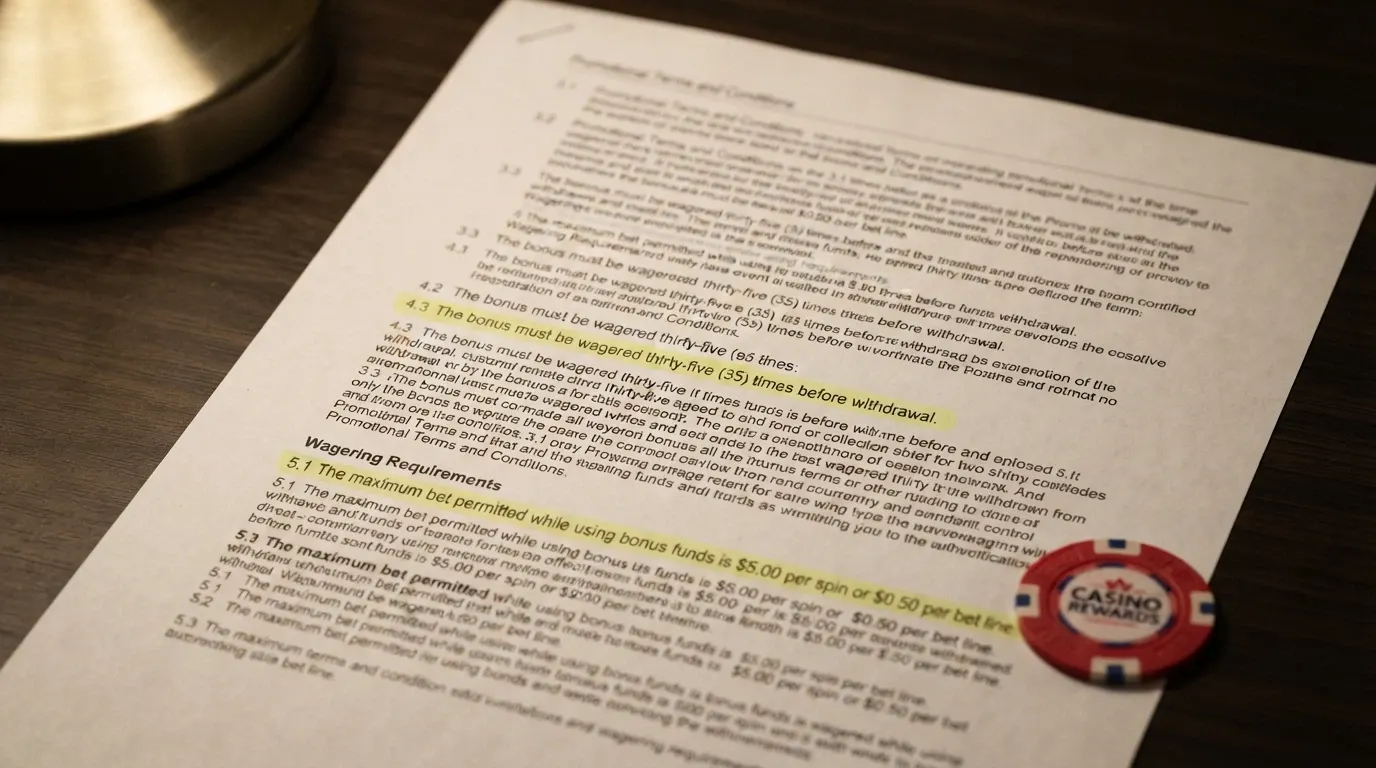
Wagering requirements on low-deposit bonuses in Australia commonly run from 30× to 45× the bonus amount, and anything above 50× is treated as predatory by reputable reviewers. On a A$5 deposit with an A$10 bonus at 50× wagering, the math is brutal: betting A$750 before any withdrawal is possible.
The variable that decides whether the bonus is worth claiming is game contribution. Pokies contribute 100% toward wagering, table games and live casino often contribute 0% to 10% or are excluded entirely. A player clearing a A$10 bonus at a live blackjack table will make essentially no progress on the rollover; a player spinning pokies at A$0.20 will clear it in time but at a real expected cost, which is what the wagering requirement actually prices in.
The other variable is the max-bet cap during wagering, typically A$5 to A$8 per spin. Exceeding the cap voids the bonus and any winnings — a player staking A$10 per spin to “clear faster” loses the bonus entirely if the casino reviews the bet log. The published max bet is the speed limit, and exceeding it is the most common way players lose bonus balances they thought they were clearing. Validity windows are rarely published across the set, and only one operator in the comparison states a clear expiry; a player who does not check is gambling on whether the bonus will still be live when they next log in.
For Fair Go specifically, the math runs as follows. A A$20 deposit takes the 100% match and adds A$20 in bonus money, taking the matched balance to A$40. The 30× wagering on deposit plus bonus requires A$1,200 in turnover before withdrawal is possible. At a A$5 max bet per spin, that is 240 spins. At a 5-second interval between spins, that is roughly 20 minutes of clear-down — fast for the bonus size, and the speed comes from the A$5 cap sitting at the upper end of the market range.
Pokies and games you can actually play at minimum deposit
The game library is the variable most operators under-explain in their bonus terms, and the variable that decides whether a bonus clears at a reasonable cost. A player with a A$20 deposit and a 40× wagering requirement needs a library that lets them place the bets; a player with a five-provider lobby often finds the same games over and over.

Pokies: the 100% contribution workhorse
Pokies — the Australian term for slot machines — are the only game category that consistently clears wagering at full speed. The 100% contribution rate means every dollar wagered on a pokie counts as one dollar toward the rollover. The minimum spin value on most pokies is A$0.10 to A$0.20, which stretches a A$20 deposit across 100 to 200 spins even before bonus money is in play.
The library depth varies enormously across the set. Fair Go runs an RTG-only lobby — a single provider, no third-party slots, no live casino. Royal Reels runs 5,400+ pokies from 40+ providers. Bizzo runs 8,000+ games from 70+ studios. SkyCrown and Rocket Play sit in between with multi-provider lobbies. The wider the library, the more variance a player can introduce across games — high-volatility slots for the chance of a big hit, low-volatility slots for steady clearance of the wagering requirement.
Table games, live casino and why they barely count
Blackjack, roulette, baccarat and their live-dealer variants are open at every operator in the set, and almost none of them count toward wagering at a useful rate. Live casino typically contributes 0% to 10%, with most operators excluding live tables entirely from bonus play. Table games contribute at varying rates depending on the operator and the bonus — sometimes 10%, sometimes 0%. The exact rate for a given promotion sits in the bonus terms, not the game rules, and the only safe assumption is that the player must check before staking.
The practical implication is that a player who enjoys blackjack cannot use a matched bonus to play blackjack. The bonus must be cleared on pokies or it is not cleared at all, and the game the player actually wants to play sits outside the bonus. Outside bonus play, table games and live casino are open at standard rules — the house edge on a properly-played blackjack hand sits around 0.5%, far below the 3% to 8% house edge on most pokies. The two paths — bonus clearing on pokies, or bonus-free play on tables — are different products for different reasons, and the player has to pick one before they deposit.
Playing from Australia: what the law actually says
Online casino is prohibited under the Interactive Gambling Act 2001. There is no licence for it in any state or territory. The Australian Communications and Media Authority enforces the prohibition, blocks illegal sites, investigates complaints, and refers operators for civil penalty proceedings. The Act targets the provider, not the player — but the player loses every domestic protection that would normally attach to a licensed gambling product.
The IGA 2001: what is prohibited and what it means for you
The IGA 2001 makes it an offence to provide online casino games, online pokies or in-play sports betting to a person in Australia. The 2017 Interactive Gambling Amendment Act closed offshore loopholes and gave ACMA its blocking and enforcement powers. What is legal is wagering on races and sport before the event starts, plus lotteries and keno, through operators licensed by a state or territory — and even there, minimum age 18 applies. There is no licence, federal or state-level, for an online casino product in Australia.
What the player loses by going offshore is the entire Australian consumer protection stack. There is no Australian complaints body that can recover a player’s money. There is no recourse if an offshore operator refuses a withdrawal, voids a win, or closes an account. There is no BetStop coverage — the operator is not connected to the national self-exclusion register. ACMA’s own wording is blunt: “Australians who use illegal gambling services risk losing their money — no Australian consumer protection and no Australian complaints body — the ACMA cannot recover anyone’s money.”
The IGA targets the provider, not the individual player. Australians are not prosecuted for playing at offshore sites. But the absence of prosecution is not the presence of protection, and the distinction matters when a balance is at stake.
ACMA enforcement: 1,788 sites blocked and counting
ACMA has blocked 1,788 illegal gambling and affiliate websites since its first blocking request in November 2019, as of 20 August 2026. More than 230 illegal gambling services have withdrawn from the Australian market since 2017. In Q1 2026, ACMA launched 25 formal investigations covering 60 gambling websites and identified at least one IGA breach in 23 of those cases. ACMA received 422 enquiries and complaints in the same quarter, with approximately 87% considered valid for further investigation.
The blocking power is the most visible part of the enforcement regime. When ACMA directs an ISP to block a site, the site becomes unreachable through standard Australian internet connections. The block can happen at any time, and any balance sitting in an account at the moment of the block is stranded until the block lifts or the operator withdraws. There is no Australian complaints body that can recover that balance, and the offshore operator has no obligation to return it. Several operators on this page — Royal Reels, Bizzo, SkyCrown, and Fair Go as the very first — sit on the regulator’s list already.
The 2026 reform: bank blocking from January following 2026
The Interactive Gambling Amendment (Gambling Reform) Bill 2026 passed Parliament on 19 August 2026. Its measures commence on 1 January $$CY+1$$, and the central change is structural: from that date, banks and payment providers gain express authority to block transactions to illegal gambling operators. Where today the blocking sits at the ISP level (the site is unreachable), from $$CY+1$$ the blocking extends to the payment rail (the transaction is refused at the bank).
The reform also tightens advertising and inducement rules. Direct marketing of inducements is prohibited for 14 days after a customer signs up, for three months after a person deregisters from BetStop, and indefinitely for customers identified as at risk of gambling-related harm. The reform caps wagering advertising at 3 ads per hour between 6am and 8:30pm, imposes live-sport blackouts, bars influencer and athlete endorsements, and requires online ads to target only logged-in, age-confirmed users with an opt-out. None of these provisions directly constrain offshore operators advertising into Australia, but the surrounding regulatory hostility is the point — the wind is blowing one way, and it is not towards offshore.
For the offshore operators covered on this page, the practical effect is that the rails narrow from $$CY+1$$. A crypto deposit at an offshore casino is already outside the banking system; the bank-blocking power affects PayID, card and bank-transfer rails rather than crypto. A player who deposits via PayID at an offshore site in $$CY+1$$ may find the transaction declined at the bank end rather than blocked at the ISP end, and the bank rarely explains why.
Staying safe when the safety net does not reach offshore
Australian harm-minimisation tools exist — BetStop, the National Gambling Helpline, Gambling Help Online, state-level counselling services. None of them cover the offshore casinos on this page. That is the gap every Australian player should understand before depositing at an unlicensed operator.

BetStop: what it covers and the offshore blind spot
BetStop — the National Self-Exclusion Register — launched on 21 August 2023 and has 67,480 total registrations with 41,290 active exclusions as at 31 July 2026. Self-exclusion periods range from a minimum of 3 months to a lifetime, and exiting a self-exclusion early requires a statutory declaration and counselling. 78% of registrants are aged under 40; 38% have chosen lifetime exclusion.
The register covers approximately 150 licensed wagering providers in Australia. It does not cover offshore casino sites. A player who has self-excluded via BetStop and then deposits at an offshore casino has not breached the register, because the offshore casino is not part of it — but the player has also not used the register for what it does cover, and the underlying decision to stop gambling is the one that matters, not the technical compliance with a single tool.
Practical harm minimisation when you play offshore
Operator-level controls are the substitute for BetStop at offshore casinos. Most operators offer deposit limits (daily, weekly, monthly), session time-outs (15 minutes to several hours), and self-exclusion at the operator level (typically 6 months to 5 years, sometimes permanent). The specifics vary by operator, and the published terms are the authoritative source — none of the operators on this page carry a third-party safety index that audits these controls, and the deposit limit a player sets in good faith can usually be raised again on request, which is itself information about the design.
The prevalence backdrop is real. Approximately 2.1% of Australian adults — roughly 430,000 people — experience problem gambling. The Australian Institute of Health and Welfare put high-risk gambling at 1.8% in 2022. The figures are for the licensed market, where the protections exist; the offshore market is not surveyed, and the population it attracts overlaps with the licensed market at the margin.
The National Gambling Helpline is 1800 858 858 — free, confidential, staffed 24 hours a day, 7 days a week, with online chat and counselling through Gambling Help Online. The helpline covers all gambling harms, licensed or not, and is the single best first step for anyone whose gambling has moved past entertainment spend. For a player on a small deposit, the helpline is a faster route than any self-exclusion form, and a counsellor does not require a blocked site to start a conversation.
How we selected and ranked these low deposit casinos
The ranking on this page weights deposit accessibility and bonus term fairness above bonus headline size. The deposit floor is the entry point — an operator a player cannot reach is not an option, no matter how generous the bonus. The bonus terms are the running cost — an operator with a 60× wagering multiplier and a A$1,000 cashout cap is not offering the same value as an operator with 0× wagering, even if the headline numbers look similar, and the largest welcome package in the comparison pays out at the highest entry price.
The data sources are operator-published terms cross-checked against test-based affiliate reviews, including cashier tests conducted between March and April 2026. Each operator was checked against ACMA’s blocked-site list and the relevant offshore licence registry. Where research could not confirm a figure — Rainbet’s minimum deposit, several operators’ bonus validity windows — the gap is flagged in the operator write-up rather than filled with a guess. A reader should treat an unconfirmed cell as a reason to check the cashier directly rather than as a reason to assume the operator is hiding anything in particular.
The currency stamp at the top of this page records the date the data is current as of and the registers it was checked against. The register names matter: ACMA’s blocked-site list for enforcement context, the Curaçao GCB public register for Curaçao-licensed operators, the Anjouan registry for Anjouan-licensed operators, and each operator’s own terms page for the bonus and cashier specifics. Where a licence is described as “offshore — no AU licence” without a named registry, the operator is unregistered in any publicly verifiable form and the brand should be treated as such.
Is a low deposit casino worth your money in 2026?
The honest reading of the figures on this page is that a low deposit means low exposure, not low risk. The A$10 fiat floor is a reality check on every A$1 and A$5 headline — those numbers are marketing inventions, not products, and the marketing word “low” hides a floor set by card processors and anti-fraud teams rather than by generosity. The wagering trap turns small deposits into large turnover obligations; a A$5 deposit with a A$10 bonus at 50× wagering means A$750 in bets before any withdrawal is possible, and the math only gets worse as the multiplier climbs.
The withdrawal gap means a player who wins A$30 on a A$10 deposit often finds that A$30 below the floor, and the deposit rail that worked going in rarely works coming out. The legal reality sits underneath all of it. Online casino is prohibited under the IGA 2001, ACMA has blocked 1,788 sites since November 2019, and a balance sitting in an offshore casino account at the moment of a block stays stranded. The Act targets the provider, not the player — but the player forfeits every Australian consumer protection, every BetStop connection, and every complaint recourse, and there is no tax upside either: gambling winnings are not assessable income under section 6-5 of the ITAA 1997, and losses are not deductible under section 8-1, so a winning session pays no rebate and a losing session is pure out-of-pocket.
The crypto alternative for genuinely small deposits is real but it is not a loophole. USDT-TRC20 clears under 50 cents and under 60 seconds, but it requires the player to already hold crypto, the operator is still offshore and unprotected, and the bank-blocking power coming into force from 1 January $$CY+1$$ will tighten the fiat rails but not the crypto rail. The crypto route is faster and lower-fee, and it is no safer than the fiat route in any meaningful sense — a blocked offshore site strands the crypto balance the same way it strands the fiat balance.
The practical takeaway is the one a careful reader will already have arrived at. Deposit only what you can afford to lose on a site that may be blocked tomorrow. Treat the spend as entertainment, not as a financial strategy. Read the bonus terms before depositing rather than after. And if the gambling stops being entertainment, the National Gambling Helpline is 1800 858 858 — free, confidential, and available around the clock.
Frequently asked questions
Is it legal to play at online casinos in Australia?
No online casino licence exists in Australia — federal, state or territory. The Interactive Gambling Act 2001 prohibits providing online casino games to Australians, and ACMA enforces the prohibition. The Act targets providers, not individual players, so you will not be prosecuted for playing — but you have no Australian consumer protection, no ACMA complaints recourse and no BetStop coverage if something goes wrong with your balance.
Can I deposit A$5 at an online casino in Australia?
The A$5 fiat deposit does not work in practice. Neosurf vouchers in Australia start at A$10, card processors impose a A$10–A$20 floor, and PayID casinos enforce A$20 minimums. Sub-A$10 deposits that do work are crypto-only — Stake at about A$0.10 BTC-equivalent, BC.Game around A$1 USDT, Bitcasino near zero. The cheapest stablecoin entry is around A$5 USDT-TRC20, if you already hold crypto.
What are wagering requirements and how do they work on small deposits?
A wagering requirement is the multiple of the bonus (or bonus plus deposit) you must bet before any withdrawal. On low-deposit bonuses in Australia, 30× to 45× is common and above 50× is predatory. A A$5 deposit with a A$10 bonus at 50× requires A$750 in bets before withdrawal. Pokies contribute 100% toward wagering; table games and live casino often contribute 0–10% or are excluded.
What is BetStop and does it cover offshore casino sites?
BetStop is Australia’s National Self-Exclusion Register, launched 21 August 2023. As at 31 July 2026 it had 67,480 registrations and 41,290 active exclusions, with self-exclusion periods from 3 months to lifetime. It covers around 150 Australian-licensed wagering providers and does NOT cover offshore casino sites. Self-excluding via BetStop does not stop you depositing at an offshore casino — the operator is not connected to the register.
Can I withdraw a small balance from a low deposit casino?
The withdrawal minimum at most AU-facing offshore casinos is A$25 to A$100 — much higher than the A$5 to A$10 deposit minimum. A player who wins A$30 on a A$10 deposit often finds A$30 below the floor. Withdrawal rails also differ from deposit rails — PayID and Neosurf deposits usually come out via crypto, e-wallets or bank transfer rather than the same rail they arrived on.